‘Immediate Commodifiability’; Or, A Virtual Teach-In on Austerity in Education

As a public service, some of the best of recent (and older) diagnosis and critique, largely an extension of work already done over at Infinite ThØught:

It is fascinating, and very revealing, to see how Browne’s unreal confidence in the rationality of subjective consumer choice is matched by his lack of belief in reasoned argument and judgment. The sentence that immediately follows the vacuous one about students’ ‘wants’ reads: ‘We have looked carefully at the scope to distribute funding by some objective metric of quality; but there is no robust way to do this and we doubt whether the choices of a central funding body should be put before those of students.’ It is, first of all, striking that the only alternative envisaged to the random play of subjective consumer choice is an ‘objective metric of quality’, i.e. some purely quantitative indicator. And second, it is no less striking that instead of allowing that an informed judgment might be based on reasons, arguments and evidence, there are simply the ‘choices’ made by two groups, treated as though they are just two equivalent expressions of subjective preference. We can have the money for a national system of higher education distributed either in accordance with the tastes of 18-year-olds or in accordance with the tastes of a group of older people in London: there’s no other way to do it.

Stefan Collini, Browne’s Gamble

György Lukács used to say that the objective unity of the capitalist order was never so apparent as in a phase of crisis. Then, the relative autonomy of expansionary times, which were so often asserted as the reality of social relations, would be abruptly suspended. The power of discretion would flow back to the centre, to the strategic politics of the state and to those prepared to launch a fundamental challenge to it.

What is objectionable is the ascendency of quantification, the emergence of quantifiability as a qualifying condition of relevance and admissibility. A species of transcendental reductionism. We need look no further than the familiar, degraded world of academic research. Scientific and scholarly projects, we all know, do well in these times to internalise the definitions, the priorities and the timescales of the REF as a main condition of finding institutional support. Reputation – the regard of one’s peers and serious audiences – is a frothy measure of achievement if it cannot be captured in scores and tables…League tables generally do not only reduce particular and distinct activity to a single numerical scale. As numerical procedures, they offer perverse compensation by generating distinctions where none can credibly be thought to exist in reality. 10 or 15 institutions differ within the space of 1%. But the visual code of the table – equal spacing in the plane of the vertical – renders such trivia grave and lapidary, carves them in stone…These processes of quantification and financialisation are effecting a progressive abstraction of university functions, in which exchange value is the homogeneous substance of working life. Now the labour of perfecting and defending these processes calls for an equally abstract organisational stratum of leader-managers, in a classic process of bureaucratisation.

Francis Mulhern, Humanities and University Corporatism

Wendy Brown, Why Privatisation Is About More Than Who Pays

Continue reading

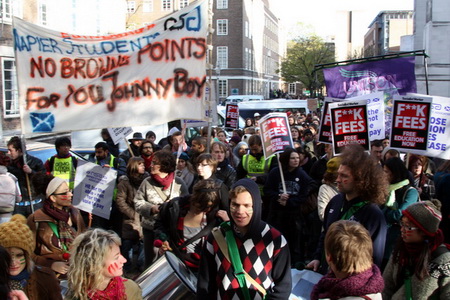
Zero-Level Protest, the Student Movement and the Spectacle of Politics

I agree with Joe.

The fall-out from Wednesday’s fees protest has congealed into some familiar oppositions. On the one side, we have disavowal. The violent minority, undermining the broad case against cuts, inarticulate in their regression to a juvenile acting-out. On the other side, affirmation. The real vandals are Clegg and Cameron, the insurgents were the epiphenomenal expression of legitimate mass anger, and broken glass is the not-that-unfortunate substratum of all great political movements.

These are not morally equivalent narratives. The case for the disavowers is built on a palpable desire to appeal to bureaucratic reasonableness, and to present the case in terms sympathetic to the cadences and tones of power, as if the problem was one of flawed communication. More ‘rational debate’ please! More damagingly, the internal disciplining necessary to any movement conceived of as a Party is already under way. Bad protester, good protester. Wayward foot-soldier, clear-sighted leader. There was a serious message, and the hijackers lost it.

This is nonsense. That the march was larger than expected would have made news, barely. But the aerial shots of Westminster, and the collections of amusing signs and fancy dress, would have concurred fully with the established parameters, the well-worn rituals, of polite English disagreement. There would have been patronising cod-support about how polite the young are these days and Mock-The-Week non-jokes about the difference between Parisian insurrectionists and London shufflers. In such symbolic space, and especially on The Right, the trope of the feckless student is impermeable to disproof. This is the mistake of those scrambling for respectability. No amount of denouncing The Crazed Vandals Of Millbank will make the cause of education palatable (although those heading up the NUS will ascend, like those before them, into the lower ranks of party politics).

Slavoj Žižek put the appropriate response nicely:

“You could have delivered the same message without violence”. Fuck them, of course you can deliver the message. But nobody would hear the message. This is what they like, that 100 people gather and write a message and then you don’t even get the bottom note [in the day’s paper]…You have to break some windows to get the message through.

This is true enough, but should already alert us to some dangers, and to the necessity of overcoming the choice between affirmation and disavowal. Continue reading

Ethics of Austerity 2: Interlude of Broken Glass

There’s always a surprising disconnect between experience and public reality when you attend an event that goes on to become an “event.” On such occasions, I find myself wondering how my experience can run so counter to the public narratives that emerge. Yesterday’s (10 Nov.) protest march in London is no different.

Here are some media images that reflect the protest I attended:

But the images that defined the “event” were slightly different. We’ve all seen them on the TV, in the papers, and on the web.

What I don’t want to do is engage in hand wringing over a protest hijacked by violent fringe elements, or tut at those smashing up the office building or gathered outside to watch. Instead, I want to do the opposite, I want to imagine myself as the one who failed, failed to fully grasp that it wasn’t just a sunny afternoon of political play acting. Continue reading

Protest against cuts: 20 Wednesday 2010

October 20: Protest Against the Cuts at Downing Street 6pm

From the Coalition of Resitance:

Stop the Con-Dem cuts! Build the Resistance! Can’t Pay, Won’t Pay!

Speakers include Tony Benn, Caroline Lucas MP, Rev Jesse Jackson, Jeremy Dear (NUJ), Dot Gibson (IHOOPS), Lee Jasper (BARAC), Zita Holbourne (BARAC) John McDonnell MP, Mark Serwotka (PCS), Jeremy Corbyn MP, Bob Crow (RMT), Aaron Porter (NUS)

Continue reading

Neoliberalism Strikes Back, or Is This Really a Crisis?

A post from Roberto Roccu.


Of course it is. Yet, Colin Hay hits the right note when he points out that if crises are conceived as moments of radical questioning and change of existing paradigms, then what we see today is not a crisis, but rather a “catastrophic equilibrium”. Indeed, now that the reverberations of the rhetoric of London’s G20 in April 2009 have faded, it appears that the measures adopted both on a national and on the global scale are concerned with shoring up the old growth model based on flexible accumulation, in the attempt to restore its economic profitability, regardless of its social unsustainability.

Rather than downplaying the magnitude of the economic problems we face, Hay’s aim is to show how in a period when all the material conditions for speaking in terms of a crisis are present, with all the potential implications for a radical reconfiguration of our economic policies and political economies, the ideational discourse is still dominated by the very paradigm that created such material conditions. This fits well with Hay’s account of the genesis of neoliberalism, which emerged as the solution to a discursively-boosted epochal crisis of Keynesianism in times where material conditions were far from being as severe as the ones we face today.

It would be easy to dismiss Hay for “being too academic”, particularly in a context where what he calls the pathologies of the neoliberal paradigm have infected all of the developed world with very real consequences for those individuals and groups that have lost their jobs and are experiencing a dramatic increase in their social insecurity. Still, identifying the distinction between existing material conditions and the missing narrative for linking those conditions and framing a coherent and credible political project is extremely fruitful. This is the hiatus where capitalist realism as an ideology and a practice has prospered. In this respect, the regained profitability of the capital accumulation regime has brought about two seemingly parallel yet interrelated trends, that are most visible in the developed country struck hardest by the crisis, the US.

On the one hand, the rise of the Tea Party movement. The mainstream press has set its focus on the populist, anti-intellectual and anti-establishment aspects of the phenomenon. Yet, their fundamentalist neoliberalism – best expressed in the call to “return to the principles of Austrian economics” – has largely gone unnoticed. On the other hand, the ever clearer and stronger political position taken by Murdoch’s media empire against the Obama administration and more generally against any kind of state intervention in the economy is equally relevant. The daily space granted to Glenn Beck on Fox appears to me as the most evident trait d’union between these two trends.

On this side of the Atlantic, dismissing these phenomena as something alien would be misleading and dangerous. And not only because Murdoch’s empire extends well within Europe, and he is even now launching an offensive on the British media. Most importantly from a social standpoint, is the other trend – the rise of populist, worryingly xenophobic yet economically conventional movements – which is manifesting itself with a surprising regularity, even in countries like Sweden, that our diehard clichés still like to characterise as “welfare paradises”.

The analysis of what is happening in the European space is rendered more complex by the presence of a further level of decision-making, located on a larger spatial scale than the state. Now, all of us have become accustomed to hear about the democratic deficit within the EU. One of its major consequences is that the struggle for influence does not follow institutionalised forms, and lobbying is by and large the name of the game. Within this context, the effective mobility and mobilisation of capital and of its allies on the EU scale (and beyond) confronts a mobility of labour that remains mostly on paper, as the bulk of the jobs that are neither highly skilled nor unskilled are still largely allocated on a national basis. As a consequence, it has proven incredibly hard to mobilise working forces beyond the national scale.

Even the rampant xenophobia – exemplified by the rise of parties such as the Northern League in Italy, the Freedom Party in the Netherlands, the Swedish Democrats in Sweden, and the list could go on to include at the least fifteen of the EU’s twenty-seven members – must be seen as a fragment that begs for relations with the whole. And in the Europe of the four freedoms of movement (people, goods, services, capital), where the mobilisation of capital is effectively globalised and the mobilisation of labour is still limited by national boundaries, it comes as no surprise that the genuine anger of the working class(es) is channelled towards an attack of the only one freedom that can credibly be limited by national authorities: the movement of people.

And yet, there would be plenty of material to start from in the direction of some Europe-wide coordination. From the Spanish general strike to the recent demonstrations in the Netherlands to industrial action on the London Underground to the French general strike of this Tuesday. Unfortunately, very little has been happening on the European scale. And as long as capital is more powerful to begin with and better organised on a larger scale whereas labour is weaker and sometimes divided also on the national scale, the prospects for resisting, reversing and subverting the current neoliberal offensive appear to be dire indeed.

The Nu-Bureaucratic Zombie Academy

Whither UK academia? Last month scientists blossomed with anger when Vince Cable, a man of advanced learning no less, wildly misrepresented the state of research excellence. Such a transparently false ’empirical’ case for cuts depends heavily on the trope of pointless, money-sucking academics [1], as if billions in state rescue packages had been precipitated by feckless spending on the Large Hadron Collider. Although social science and humanities is a sideshow [2], the claims are just as misleading for those of us working in politics, since 72% of the stuff we pump out is ‘world leading’ or ‘internationally recognised’.

The travesty of the RAE is what provides the commonsensical gloss for this redoubling of efforts to ‘magnitise’ investment, realise profit and ‘link to’ (read: subsidise) business. All of which conforms wonderfully to k-punk‘s diagnosis of capitalist realism, business ontology and nu-bureaucracy:

…the drive to assess the performance of workers and to measure forms of labour which, by their nature, are resistant to quantification, has inevitably required additional layers of management and bureaucracy. What we have is not a direct comparison of workers’ performance or output, but a comparison between the audited representation of that performance and output. Inevitably, a short-circuiting occurs, and work becomes geared towards the generation and massaging of representations rather than to the official goals of work itself. Continue reading