Looking Beyond Spring for the Season: Echoes of Time Before Tahrir Square

This is the fifth and last part in a series of posts from Siba Grovogui, Professor of International Relations and Political Theory at John Hopkins University. The first part is here; the second here; the third here; the fourth here. The series considers the character and dimensions of the tension between the African Union and ‘the West’ over interventions in Africa. As before, responsibility for visuals adheres solely to Pablo K.
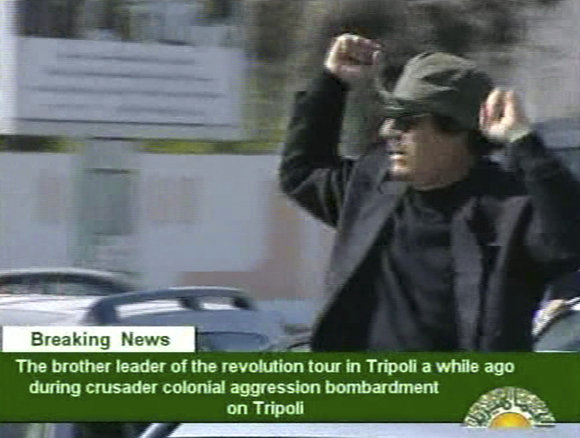

It would be disingenuous to relate events in North Africa and the Middle East (or MENA) today without reference to the media. Here too, there are many possible angles to examine. I will focus on the institutional support that the media provide in shaping consensus in support of foreign policy. In this regard, so-called mainstream Western media and networks (BBC, CNN, Fox, RFI and the like) have played a significant role in generating domestic support for the Libyan campaign. The media find themselves in the contradictory positions of both providing sustenance to foreign policy rationales and reporting on government actions. In this role the media either wittingly or unwittingly assumed the position of justifying contradictory Western foreign policy aims while trying to satisfy the needs of their audiences (especially domestic constituencies and home governments) for information from the front. Consistently, the media often generate sympathy for foreign actors or entities that either support Western interests or have affinities for Western values.

This role is not without a cost, especially when foreign policy actions, including wars, fail to attain their objectives. When the outcome of foreign policy proves disastrous, Western media also have an inexhaustible capacity to either ignore their prior support for the underlying causes or to reposition themselves as mere commentators on events over which they had no control or could not prevent. Increasingly, these tendencies have spread around the world as evidenced in the techniques and styles that have propelled the Qatari-based Al Jazeera into prominence as key contender in the emergent game of production, circulation, and consumption of foreign policy-concordant images for their affective and ideological effects.

So it is not surprising that the backdrop and background scenarios for most reporting on the 2011 revolts in MENA are dimensions of Orientalism, of which they are many. But the most constant is one of autocratic ‘barbarism’. In this regard, the discourses and media techniques for creating and supporting sympathetic figures are just as constant (or invariable) as Western states rationales for intervention. The media-hyped stories of Oriental despotism that preceded Operation Desert Storm, when the US expelled Iraq from Kuwait, have provided the template. During that event, for instance, media feted their viewers with stories of invading Iraqi hordes storming through hospital only to disconnect incubators and let helpless infants die a slow death. These and many stories of heroic bids by US soldiers to prevent such barbarism were later discredited but not the other horrific stories which convinced US citizens of the need to wage war on Saddam Hussein’s occupying army. In the Libyan case today, one of the earlier images of the aura of impunity created by Gaddafi was that of a Libyan female lawyer who was allegedly raped by Gaddafi’s forces. There was also a reported event of military takeover of a hospital.

Continue reading

Looking Beyond Spring for the Season: Democratic and Non-Democratic Cultures

This is the fourth part in a series of five posts from Siba Grovogui, Professor of International Relations and Political Theory at John Hopkins University. The first part is here; the second here; the third here. The series considers the character and dimensions of the tension between the African Union and ‘the West’ over interventions in Africa. As before, responsibility for visuals adheres solely to Pablo K.


It is not accurate to say that the African Union has been indifferent to the conflict in Libya. If there has been silence in Africa, it has to do with the extent to which the ‘maverick’ Colonel (Gaddafi) has angered some of his peers over the years by interfering in the affairs of such states as Nigeria, Liberia, Burkina Faso, Sierra Leone and others, with disastrous effects. Even when, as in Sudan and Uganda, officeholders have welcomed his entreaties, large segments of the populations have not appreciated them. Yet, regardless of their personal views of Gaddafi and their political differences with him, African elites and populations have yearned for a more positive, conciliatory, and participatory solution to outright regime change or the removal of Gaddafi preferred by the West. This variance, I surmise, comes from a positive understanding of postcoloniality that include forgiveness, solidarity, and democracy and justice, as exhibited in post-apartheid South Africa and post-conflict Liberia, Angola, Mozambique, and the like.

In opting for negotiated mediation and a new constitutional compact, therefore, the African Union (or AU) aimed to foster a different kind of politics in Libya – admittedly one that has escaped many of the states endorsing that position. As articulated by Jean Ping, the Secretary General of the AU, the Libyan crisis offered an opportunity “to enhance a self-nourishing relationship between authority, accountability and responsibility” in order to “reconstitute African politics from being a zero sum to a positive sum game” toward one “characterized by reciprocal behavior and legitimate relations between the governors and the governed.” Mr. Ping added two other dimensions to his vision. The first is an acknowledgement that events in Libya point to the fact that all Africans “yearn for liberty and equality’ and this yearning is “something more consequential than big and strong men.” The second is that Africa’s destiny should be shaped by Africans themselves based on an actualized “sense of common identity based, not on the narrow lenses of state, race or religion, but constructed on Africa’s belief in democracy, good governance and unity as the most viable option to mediate, reconcile and accommodate our individual and collective interests.”

Coming from a politician, these words may read like slogans. But the uniform refusal of the AU to endorse Western intervention tells another story. Continue reading

Looking Beyond Spring for the Season: Common and Uncommon Grounds

This is the second part in a series of five posts from Siba Grovogui, Professor of International Relations and Political Theory at John Hopkins University. The first part is here. The series will consider the character and dimensions of the tension between the African Union and ‘the West’ over interventions in Africa. Responsibility for visuals adheres solely to Pablo K.


As I indicated in my last post, the decision by the African Union (or AU) to not endorse the current military campaign in Libya has been mistaken by many observers and commentators alternatively as a sign of African leaders’ antipathy to political freedom and civil liberties; a reflexive hostility to former colonial powers, particularly France and Great Britain; a suspicion of the motives of the United States; and more. The related speculations have led to the equally mistaken conclusion that the African Union is out of step with the spirit of freedom sweeping across the Middle East and North Africa (or MENA). The absurdity of the claim is that the only entity that imposed any outline of solution agreeable to Gaddafi has been the African Union and this is that Gaddafi himself would not be part of any future leadership of the country. But the AU has insisted on an inclusive negotiated settlement. The purpose of this series of essays is not therefore to examine the meaning and implications of the absence of ‘Africa’ on the battlefield of Libya, but to point to the larger geopolitical implications of the intervention for international order, global democratic governance, and the promotion of democratic ideals and political pluralism in the region undergoing revolution and beyond.

To begin, it is not just ‘Africa’, ‘African indecision’, and ‘African non-Normativity’ that are at stake in the characterization of African actions or inactions. Much of what is construed as ‘lack’ or ‘absence’ in Africa is also intended to give sustenance to the idea of the indispensability of the West – composed on this occasion by France, Great Britain, the United States, and tangentially Canada – to the realization of the central ends of the MENA Spring. The myth of the centrality of the West to the imaginary of freedom everywhere is inscribed in the name given to the events under description. In the US at least, the Arab Spring evokes many other ‘Springs’ all located in the West (including the 1968 Prague Spring or the 1989 collapse of the Soviet Union and its satellite states). Likewise, ‘Jasmine’, the emblem of the Tunisian revolt has been advanced as evocative of the Ukrainian ‘Orange’ and other colour-coded European events. These allusions have justifications but they are seldom evoked comparatively to elucidate the originality and specificity of the MENA revolutions. In this latter regard, even the suggestion of an Arab Spring assumes that the majorities in the countries involved are Arab. This is not always the case in North Africa but Orientalism obliges!

The fact is that the ongoing revolutions in MENA are at once specific and universal in their own ways. Continue reading

The Politics of Austerity: Emergency Economics and Debtocracy

austerity |ôˈsteritē| noun – sternness or severity of manner or attitude

It was possible, therefore, to commit a sin without knowing that you committed it, without wanting to commit it, and without being able to avoid it. Sin was not necessarily something that you did: it might be something that happened to you.

– George Orwell, “Such, Such Were the Joys”

Why what have you thought of yourself?

Is it you then that thought yourself less?

Is it you that thought the President greater than you?

Or the rich better off than you? or the educated wiser than you?

 I do not affirm that what you see beyond is futile, I do not advise that you stop,

I do not say leadings you thought great are not great,

But I say that none lead to greater than these lead to.

– Walt Whitman, “A Song for Occupations,” Leaves of Grass

The Politics of Austerity – Part I

This is the first in a series of posts that look at the political implications of the ongoing global economic crisis. I begin by examining the way that crisis is being used to attack the very idea of democracy through an assertion of the political imperatives of “the market” and the violation, bending and re-writing of the law by capitalist elites. I conclude by laying out how understanding the economic crisis in political terms shapes our ability to respond to it.

In the second post I’ll look at the ethos of austerity, which justifies the pain inflicted on largely innocent people, while suggesting that an affirmative democratic response to the economic crisis must begin with its own ethos, which I suggest should be an ethos of care for the world – which can provide orientation and inspiration for political struggles seeking to address the deeper causes of our current crisis. In the third post, I turn to the structures of the economy and of politics that define the current crisis, looking at the banking crisis, the bailouts, the politics of recovery/austerity and also reflecting of the structural imperatives of capitalism that led us to crisis. This, then, leads to the question of how to respond to the politics of austerity, and of what alternative actions are available to us, which is where the fourth and final post will pick up – with an affirmation of a caring ethos that supports a radically democratic economic vision.

Emergency Economics

In a previous post I briefly highlighted Bonnie Honig’s work, Emergency Politics, to examine the way that the ethical case for austerity is made; most basically, the existence of a supreme emergency, in this case economic, justifies actions that would normally be considered unacceptable. Honig’s work looks at how the appeal to emergency is used to reassert the exceptional political power of the sovereign over and against the law, with a focus on the reassertion of sovereignty witnessed over the past ten years in response to the threat of terrorist attack in the US and Europe.

Rather than accepting the necessarily intractable conflict between the power of the sovereign and the power of the law, Honig attempts to deflate this paradox by turning her attention to the always ongoing contestation that defines democratic politics, a contest over both the content of the law and the institutional embodiment of sovereign power. She suggests, then, that attending to the ambiguities of the “people”, who are both the democratic sovereign and a diffuse multitude, as well as the political element in the law – as new laws come into being through political action – enables us to avoid thinking about emergencies as moments of exception in which the rule of law is lost to the play of political power, while also acknowledging the limits of established law in moments of profound crisis. By undermining the exceptional nature of crises and emergencies Honig alters the challenge we face when circumstances force us to make choices or carry out actions we know are harmful and wrong by asking what we (democratic publics and citizens) can do to survive an emergency with our integrity in tact.

What do we need to do to ensure our continuity as selves and/or our survival as a democracy with integrity? Our survival depends very much on how we handle ourselves in the aftermath of a wrong. We will not recover from some kinds of tragic conflict. But when faced with such situations, we must act and we must inhabit the aftermath of the situation in ways that promote our survival as a democracy.

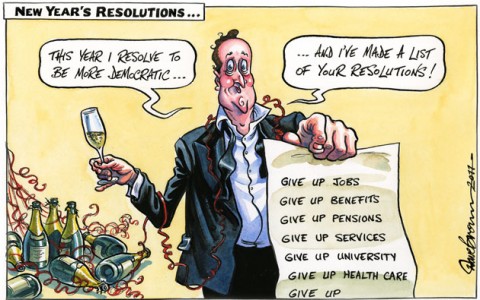
I continue to find this a useful way to understand our current economic crisis. Appeals to austerity depend upon the exceptional state created by crisis in order to justify the pain inflicted upon masses of people and the priority given to private interests (the markets, investors and bankers) over democratic publics. So, as democratically enacted laws must bow before the sovereign power threatened by exceptional attacks, so economic justice and democratic equality must bow before the commands of market forces, of economic inevitability, in this time of crisis.

The economic version of this argument is stronger still. While the space of political contestation that remains open when we accept the framing of emergency politics is limited, it does exist in the clashing of opposing sovereigns. The prospect of a substantive alternative to neoliberal economic ideology is dim, a light flickering weakly on antiquated appeals for a return to Keynesianism or watered down triangulations of the moderate-middle that sell off dreams of a just economy bit by bit – capitalist realism in action.

Honig awakens us to an important aspects of our current crisis: that “the market” is not in fact supremely sovereign, and the move to re-establish and further neoliberal policies and push through austerity measures requires an engagement in democratic politics – albeit one that undermines the notion of the public itself and seeks to use the power of the law to subvert democracy. Recognising the current crisis in these terms not only challenges us to consider how to survive our current troubles without giving up democratic virtues, it also reinvigorates and clarifies the political challenge we face. Emergency economics – with its assertion of debtocracy over democracy – is not an inevitable response to the crisis, it is a political one that we can, and should, fight against.

Continue reading

On Objecting to the New College of the Humanities; Or, Who Would Pay £18,000 a Year to Listen to this Outdated Victorian Rationalism When They Could Buy Themselves a Second-Hand Copy of John Stuart Mill?

Yes, this is more comment on the New College, a.k.a. Grayling Hall, a.k.a. Grayling’s Folly, a.k.a. North Oxford in Bedford Square (NOBS), a.k.a. The Ultimate Scab University.

It won’t have escaped your notice that there has been a flurry of disgust, disbelief, protest and rage at the announcement of the New College of the Humanities (an aside: ‘of the’ Humanities? Why not ‘for the’ Humanities?). There have also been a number of responses that pretty much add up to ‘meh’: to wit, there are some bad things, but also some good things about Grayling’s Folly. And then there has been some welcoming of this project, and its ‘chutzpah’. Since we are in a downward vortex of vanishing funding and academic status, why not expand where we can? And why damn the entrepreneurial? As Brian Leiter puts it:

NCH is just the natural continuation of the elimination of 75% of government funding for higher education and 800% increases in tuition in the space of a few years. If the Brits can’t even keep the Tories out of office, and if their party of the Left is now in bed with the Neoliberals, it’s really hard to see why one should think “petitioning” the government for more government funding for higher ed will produce any results. The battle to be won is at the polls, and NCH is just a symptom of the battle already lost.

All this makes me think it’s worth clarifying the case against, and the potential mitigating factors. Continue reading

Administrative Offences; Or, In Terrorem, University of Nottingham Branch (The Sequel)

Like Ryan Giggs, the University of Nottingham is by now learning something of the Streisand Effect, where attempting to hide information and silence critics inadvertently leads to much greater levels of discussion and critique than would otherwise have been the case. Recall that Dr Rod Thornton was suspended in early May for a paper he wrote for the BISA conference (an academic gathering for those working on all matters ‘international’, from foreign policy to anti-globalisation). But the story isn’t going away and now the paper itself is available at Scribd (or in pdf if you prefer). It’s 112 pages of description and analysis which, among other things, charges named senior staff at the University of Nottingham as implicated in breaches of law and good conduct.

Particularly of interest is the disclosure in the paper that much of the documentation drawn on to build Thornton’s case is already in the public domain, having been the subject of a series of Freedom of Information (FoI) requests in the years since the arrests. Much of the most damning material comes from a comparison of emails, reports and other documentation that has been released under FoI, or which is linked to written documents that Thornton says he possesses, and so which could be easily checked in a court of law. There is reference to meetings, but even here quotes are linked to transcripts. All of which rather puts into question Nottingham’s contention that defamation was a serious threat. Moreover, Thornton makes a good defence of naming names on other grounds – which is precisely that he is not seeking to bring the University into disrepute, but to single out those most responsible for a calumnious series of events.

It turns out, for example, that Thornton has been subjected to a series of investigations since 2008, apparently of increasing triviality. At one point he was charged with providing faulty reading lists on the grounds that he did not add his office hours to the front page and included too many essays on a module guide. The fallout for Hicham Yezza and Rizwaan Sabir has been somewhat more serious – in addition to continual stops-and-searches after the incident, both have been listed on Home Office documents enumerating ‘major Islamist plots’ against the UK.

But what of the trigger for the arrests in the first place? We might assume an innocent misunderstanding occurred, with regrettable consequences. But:

what were these three documents that had ‘no valid reason whatsoever…to exist’ [as the University Registrar described them to the police]; documents which were ‘utterly indefensible’ for Yezza (and, later, for Sabir) to have, and documents which count not be sent via the university’s computer system? Well, two were articles from the journals Foreign Affairs and the Middle East Policy Council Journal, while the other was a publicly available document downloaded from the United States Department of Justice (US DoJ) website.

It’s hard to say anything positive about anyone who thinks work published in Foreign Policy is illegal. Criminal in some slighlty different sense, perhaps, but not illegal. As Thornton dryly comments, you can buy it in airports. Sadly, it gets worse: Continue reading

What We (Should Have) Talked About at ISA: Poststructural and Postcolonial Thought

…(drumroll)… We are collectively joyous at being able to introduce a new contributor to The Disorder Of Things: Robbie Shilliam, currently at the Victoria University of Wellington and author of a slightly staggering array of critical texts (on the impact of German intellectuals on IR; the Black Atlantic in modernity; the Haitian Revolution; race and sovereignty; and the imperatives of decolonial thinking, among others). Cross-posted at Fanon/Deleuze.


At the recent ISA conference in Montreal, I participated in a lively, weighty and difficult roundtable on postcolonial and poststructural approaches to International Relations. Alina Sajed had supplied the panellists with a provocation by way of refuting Dipesh Chakrabarty’s famous injunction that Europe was the inadequate and indispensible to frame the epistemological constellations of “modernity”. Sajed challenged the panellists to debate whether Europe was in fact dispensable as well as inadequate. There was certainly a spectrum of opinions given and positions taken on the function, possibility and desirability of the relationship between poststructural and postcolonial approaches. As a form of reflection I would like to lay out some thoughts by way of clarifying for myself what the stakes at play are in this discussion and where it might productively lead.

For myself I do not read the Europe that Chakrabarty considers in terms of the historical expansion and exercise of material colonial power. I read it in terms of a fantasy that captures the imagination. At stake is a conception of the whys, hows and shoulds of people suffering, surviving, accommodating, avoiding, resisting and diverting the colonial relation and its many neo- and post- articulations. In this particular respect, I take Frantz Fanon’s position and agree with Sajed: “Europe” must be dispensed with. In any case, as Ashis Nandy has shown, the monopolisation of the meaning of Europe by a fascistic figure (rational, male, hyper-patriarchal, white, civilized, propertied) has required the re-scripting of the pasts of peoples in Europe and a concomitant distillation of the traditions of European thought themselves so as to accord to this fantasy figure. Europe is a fantasy through and through, but one that damages different peoples with different intensities. And those who look in a mirror and experience no significant cognitive dissonance when they proclaim “European” can still count themselves, to different degrees, as being a thoughtful protagonist in a contested human drama. For others, there is only the promise of living this drama vicariously through the thought of others. That is why “Europe” is dispensable, even though for some peoples Europe has never been indispensible; regardless, it must be dispensed with.

Let me explain a little more what I mean by all of this. Europe is first and foremost a sense of being that constructs its empathy and outreach in terms of a self whereby all who cannot intuitively be considered of European heritage are categorized into two entities. First, they might be the “other” – foils to the understanding of the self. Their emptied presence is to be filled as the verso to the internal constitution of the European self. If they are lucky, they are given a kind of non-speaking part in the drama. In fact, they usually are lucky. Much critical European thought – and certainly almost all of canonized European thought – speaks volumes about the ”other” but only so as to fill in the European “self” with greater clarity.

Second, they might be the “abject” – the entity that is impossible for the self to bear a relationship to, although even this impossibility will be instructive to the inquiring European self. Abjects, under the European gaze, are reduced to a primal fear out of which an intensity of feeling is engendered that wills the drama of human (European) civilization. Defined in excess to the other/abject, the internal life of the European self can substitute itself for humanity at large in all times and spaces, and develop itself as a richly contradictory being that overflows its meaning and significance.

I do not know whether other colonialisms predating and contemporaneous to the European project matched this audacity. And in a significant sense, it really does not – and should not – matter. After all, the lure of making comparison is the precise methodology through which the European self overflows to define all others by a lack. I do though want to hazard a particular claim at this point, which might or might not bear up to scrutiny: the prime “others” of European colonialism were the indigenous peoples of the Americas. And while we owe much to Kristeva’s work on the term, the prime “abjects” of European colonialism were the enslaved Africans bought over to the Americas.

Continue reading

The Qaddafi Controversy, Regurgitated

You might have thought that the realities of muscular interventionism in Libya had by now trumped the apologetics of constructive engagement. But Benjamin Barber has other ideas. His counter-attack to the nay-sayers deploys several connected themes, all of which appeal, once again, to the purported political realism of befriending Saif Gaddafi and the corresponding idealism and naivety of opposing such benevolent stewardship.

First, the attacks on the fortunate son have been “overwrought”, and have materially endangered the chances of peace by pissing him off. Second, Saif remains “a man divided, torn between years of work on behalf of genuine reform that at times put him at risk”, and thus still open to our charms. Third, he is even now working for civil society and democracy, pressuring his father to release journalists and in effect continuing the work of his foundation as a fifth column within the regime. Yes, Saif has been naughty (I’m not angry, I’m just disappointed), but his intentions are still at least partly good, and failure to achieve a better Libya through a rapprochement with him ultimately condemns we who would rather cling to the saddle of our high-horse than descend into the messy realities of progress.

The riposte is bold, and at least has the merit of maintaining the original analysis, no matter how much short-term developments may seem to degrade it. But the rationalisation, wrapped in what Anthony Barnett so aptly characterises as a ‘cult of sincerity’, falls somewhat short. The central meme, repeated by David Held, represents Saif Gaddafi as an enforcer-cum-reformer of near schizophrenic proportions. While it is (now) readily admitted that he is personally responsible for human wrongs, it also becomes necessary to insist on his internal, and magnificently cloaked, commitment to human rights. This may work for those who knew him personally and remain invested in his personal quirks and charms, but can hardly stand as a recommendation for his role as good faith mediator. As Barber himself argues (with a different intent and a suspect logic) if Saif is both revolution and reaction then he is also neither, and therefore a cipher for the projection of political fantasies.

These justifications repeat binaries of politics/morality and realism/idealism in dismissing critics (we were engaged in a calculated politics while you luxuriate in abstract ethics). Yet they also almost attempt, ham-fisted and inchoate, to escape them. After all, the defence is not that Saif is merely our bastard. Nor is it that he is a true rebel son, prepared to overthrow not only the personal dynamic of filial submission but also the political fatherhood of little green books, torture prisons and outré couture. He is said to be both, flickering and indistinct, as if this commends him. As if he can only change things because he is the natural heir of the old order. He moves between our worlds, you see. A Venn-diagrammed endorsement.

Continue reading

What We Talked About At ISA: Critique in Anti-Colonial Thought: Fanon and Cabral as Philosophers of Being, knowledge and ethics

I saw folk die of hunger in Cape Verde and I saw folk die from flogging in Guiné (with beatings, kicks, forced labour), you understand? This is the entire reason for my revolt.”.[1]


I sincerely believe that a subjective experience can be understood by others; and it would give me no pleasure to announce that the black problem is my problem and mine alone and that it is up to me to study it…Physically and affectively. I have not wished to be objective. Besides, that would be dishonest: It is not possible for me to be objective.”.[2]

For some time, I have been preoccupied by the connections between the ways in which we see, analyse and interpret the world, and the forms of political action to which this gives rise. In general, for critical social theory, the challenge is how to think about the world such as to understand and overcome structures of injustice or violence in it.  As a particular instance of this, the anti-colonial movement of the middle part of the twentieth century provides much food for thought, not least when so many point to patterns of colonialism and imperialism in world politics today.

In the paper I presented to the International Studies Association conference a few weeks ago, I offer a particular reading of Frantz Fanon and Amílcar Cabral as philosophers of being, knowledge and ethics.  Commonly, but not exclusively, these two figures are understood as having important things to say about revolt and resistance – Cabral is portrayed as the arch-pragmatist who emphasises the need for political unity and realistic objectives, whereas Fanon is frequently engaged for his affirmative treatment of violence in an anti-colonial context.  In this sense, they are largely approached as political thinkers and activists rather than philosophers per se.

Yet, their systems of thought stem from distinctive, and in important ways shared, philosophical commitments on the nature of being (ontology), ways of constructing knowledge (epistemology) and the ethical foundations of engagement (um, ethics). These foundations are strong, coherent and compelling points of departure and important in terms of understanding what kind of future order they envisaged.  What are these, and how do they support an anti-colonial political programme? What is the relevance of this intellectual legacy today? Continue reading

Libya and the Temptations of Geo-Political Reason

While Libya quakes, an assorted commentariat tussles over the legacy of the new military humanism and its possible revival. That such statements are now tempered with a caution absent for Kosovo and its successors mitigates matters somewhat, but not much. Despite the disavowal and dissimulation, the conclusions reached are much the same. Something must still be done. There is an obscenity about this rush to engage in geo-political reason, to pronounce on real and illusory national interests, to play soldier by speculating on where to move the battalions on the great chess board of high politics. In periods of less emergency, we might speak of a complex weaving of beliefs and interests, of competition between economic, military and political logics, or of international statecraft as a particular and peculiar kind of practice. But in the face of NFZ+, RPGs and UNSCRs, such vulgar and academic maneuvers appear to be surplus to requirements, for the cheer-leaders as much as for the poo-poo-ers.

But the advocates and the critics are closer now too. Both want the revolution to succeed. Both are wary or hostile to the rationales of power. Both see the possibility of a sub-optimal partition or stalemate. And both are engaging in some wishful thinking, whether by assuming that the authorisation of the UN or the absence of explicit lies will limit the reach of militarism or in simply asserting that the Revolution is on the verge of seizing the state without (faux) internationalism. Which isn’t to say that there aren’t some fairly compelling assessments available.

All of this opens up a space for further discursive refinements. We might do well to talk about the confusion between ad bellum and in bello concerns, or about the wisdom of replacing a concern with the consequences of intervention with a folk-psychological assessment of the true intentions of its instigators, as if the legacy of ‘muscular liberalism’ mattered more than the fate of those with some rather more pressing concerns.

But what of the sudden convergence around a statist geopolitics?  Continue reading