Fratriarchy, Homoeroticism and Military Culture

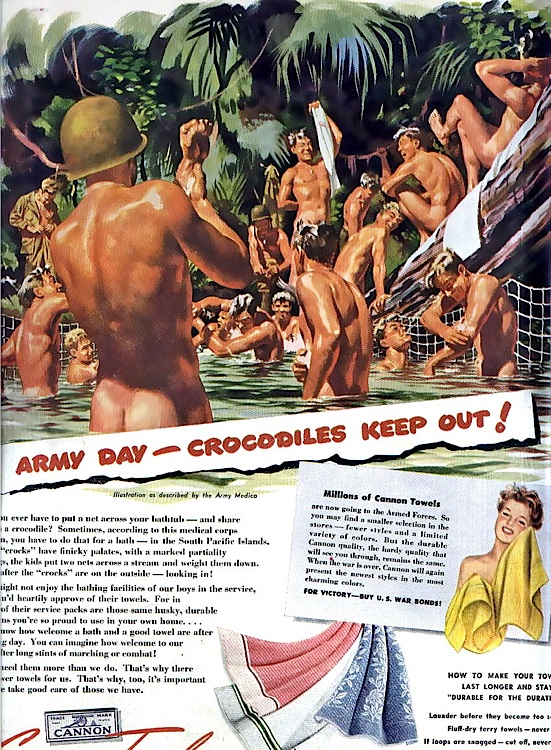
The ever-excellent Sociological Images offers up this 1940s advert, and others like it, as an example of how images previously taken to be innocent consumer bait for stereotypical homemakers now appear to us as dripping with homoeroticism. They may have added too that this half-ironic, half-nostalgic distance is what endears us to such images, which we then enjoy as vintage objects, for all that we know about the true historical context in which they were produced.

One common idea, which relates nicely to military bathing aesthetics (cannon towels? really?) is that many bonding behaviours in nominally heterosexual, male-dominated groups are in fact homosexual, but in a disavowed or repressed way. The scrum, the shared shower, the bunk-beds, the exclusion of women not only from the fields of play and war, but also from the various celebrations and carnivals that follow, all seem to indicate a desire for intimacy that cannot be named as such.

In the excellent Bring Me Men (which deserves its own dedicated review), Aaron Belkin identifies a more complex relation. In becoming military men, there is a need not only to disavow femininity, but also to become intimate with the ‘unmasculine’ and the ‘queer’. Rather than identifying a direct alignment of the masculine with the military, or seeing gender norms as accidental in their intersection with the military, there is instead a constitutive tension between the masculine and the unmasculine (or, we might say, between the strongly heteronormative and the homosexual). Basic training relies on a traumatic ambiguity, continually casting initiates as by turns masculine and unmasculine, so that no soldier can ever be sure that they were sufficiently on the ‘right side’ of the line. As one Marine put it: “The opposite of feminine? No. To me, what is masculine? I don’t know. [pause] And I’ve worked so hard at being it”. The continual ambiguity – what Belkin calls discipline as collapse – interacts with surveillance and punishment to produce the soldier-subject.

More brutally: Continue reading

Mapping the (In)Visibility of Gender in Politics and International Relations

Do elite institutions teach the global politics of gender and sexuality on any scale or in any depth? Emma Foster, Peter Kerr, Anthony Hopkins, Christopher Byrne and Linda Åhäll (all of Birmingham, at least when they did the research) have an Early View piece up at The British Journal of Politics and International Relations addressing just this question. Surveying the course content of the 16 top Politics and IR Departments in the UK (‘top’ meaning either in the top 10 in student satisfaction scores or in REF scores), they give some empirical confirmation of what many of us might have known anecdotally:

Our findings…show, in our view quite strikingly, that few political science and international relations departments offer extensive or in-depth coverage of gender and sexuality issues. As a result, many political science and international relations undergraduates merely experience a brief introduction to ‘feminism’ as their only encounter with key debates over gender inequalities and sexual identity.

Of 629 modules in IR and Politics identified across those Departments, only 9 existing full modules related to gender or sexuality (increasing to 12 if Aberystwyth’s ‘forthcoming’ courses are included). That’s 1.4%. Only an estimated 8.9% of all surveyed modules offer at least one week on feminism/gender as part of their wider sweep. The study also shows up some noteworthy cases where there is Departmental expertise but no teaching provision. Warwick and Oxford both have seven staff listing gender/feminism as a core research interest, but Warwick hosts only one gender-related module and Oxford none. Although the paper does not pursue this in great detail, the suggestion is that the relative paucity of courses is not a result of absent expertise, since the progress of feminist and gender studies has been sufficient that all Departments surveyed (with the exception of de Montfort) have staff members with a gender interest. Indeed, on the average of these 16 elite institutions, there are some 3.9 gender specialists in each one (although numbers are always, of course, shifting).

The overall picture, then, is of some progress (perhaps surprisingly limited) in getting gender (but not sexuality) included as the spectral “week on feminism”, presumably primarily in theoretical survey modules. But this vague and introductory inclusion is not supported by more concentrated work either theoretically (as in a module on different perspectives on gender) or empirically (as in an issue-by-issue survey of gender in global politics). Although Foster et al. do not map changes in Faculty composition, this appears to be happening at the same time as gender and feminist academics are increasing in strength within IR.

As is to be expected, this leaves a number of issues unaddressed. Continue reading

What We Talked About At ISA: Researching Sexuality in ‘Difficult’ Contexts

In September 2009, Ugandan Parliamentarian David Bahati introduced a draft ‘Anti Homosexuality Bill’ that proposed enhancing existing punishments for homosexual conduct in the Ugandan Penal Code, introducing new ‘related offences’ including ‘aiding and abetting’ homosexuality, ‘conspiracy to engage’ in homosexuality, the ‘promotion of homosexuality’, or ‘failure to disclose the offence’ of homosexuality to authorities within 24 hours, and mandating the death penalty for a select class of offences categorized as ‘aggravated homosexuality’. The bill remained bottled up in parliamentary committees for the duration of the 8th Parliament, thanks in large part to a sophisticated local campaign that sought to bring international pressure to bear on the government of President Yoweri Museveni, but has since been reintroduced in the current 9th Parliament and therefore remains a live concern. In August 2010, I travelled to Uganda to interview a range of actors associated with ongoing debates over sexuality in the country. Rather than commenting on the urgent and pressing substantive concerns at issue in these debates, at an ISA panel entitled ‘Researching sexuality in difficult contexts’, I chose to reflect on some of the methodological dilemmas I encountered in the field, for which my training in international relations had left me unprepared. Emboldened by recent ISA panels on storytelling and auto-ethnography (and utterly bored by what passes for mainstream IR), these reflections take the form of excerpts from my diary (italicized), interspersed with the more censorious, academic voice that I trotted out at ISA. (I make no apology for not writing about the more ‘serious’ issues at stake—on this occasion—because it occurs to me that where sexuality is concerned, the pursuit of fun can raise deadly serious questions, making distinctions between the trivial and the serious difficult to sustain.)

Uganda, August 2010: I am here to do interviews and I spend most of my day setting them up, preparing for them, travelling to or from them, or conducting them. The rest of the time I hang out, people watch, trying to piece together a picture of how life outside heteronormativity survives in a climate that seems—on the surface at least—as inhospitable as Uganda is supposed to be. On Friday, Al (name changed, and this account provided with permission) invited me to a strip-tease. This was going to be a straight strip-tease, but one that some of the gay men went to so that they could watch the straight men getting off on watching the women strip. It sounded convoluted, but unmissable. Plus, I’d never been to a straight strip-tease, so it seemed important to plug this gaping orifice in my sexual history. We entered a dimly lit hall and took seats at the back in a group near the bar. I think I was the only brown man there. There was also one white man in the whole place, in our group. He had evidently been to the place before, and because he came with the same motivations as Al, he had been traumatized on a previous occasion by the way the women flocked to him (money?). So Al was instructed to tell the emcee (a short guy dressed in a white track suit) to make sure that the women didn’t come to our corner. The real attraction, from the point of view of the gay guys, was that the women sometimes got the straight guys to get on stage and strip. Al told the emcee to do his best to encourage this possibility. Call it Straight Guy for the Queer Eye. I was impressed by the brazenness with which Al communicated all this to the emcee. As for the show, let’s just say it took the ‘tease’ out of strip-tease. The first woman (girl? all the performers looked like they were in their 30s, but they could have been younger and prematurely aged by their work) danced to some vaguely familiar Western pop number. She was followed by another woman with bigger hips. Somebody in the group, setting himself up as my informant, tells me that she is ‘a real African woman’. She danced to Shania Twain’s ‘From this Moment On’ (a song I played to my last (and final, I think) girlfriend on the first day I met her, after a year-long correspondence). Just when Shania reached the second verse, the woman dropped her panties. None of the performers took off their bras. ‘African men aren’t interested in breasts’, my self-appointed informant intones. The next half-hour is a blur of female anatomy. So here I am, in a country that people have been calling ‘conservative’ and that American evangelist Rick Warren has decided is ripe for transformation into the world’s first ‘purpose driven’ nation, looking at more naked women in ten minutes than I have seen in ten years, to the soundtrack of my failed romantic history.

Continue reading