What We Talked About At ISA: Technology and World Politics (Part I)

The presentation I gave at the International Studies Association (ISA) conference was on the broad topic of technology and world politics, with more specific reference to the use of crisis mapping software in humanitarian situations. One of the main contentions of this research is that the role of technology in world politics tends to get massively overlooked by the field of IR. This is a bit odd considering the important role of technology in issues of world politics – weapons systems, financial systems, communications systems, surveillance technologies, social media tools, etc., etc. In fact, it’s hard to point to a single standard IR issue that isn’t infected with technological aspects. Yet IR remains a science limited to a focus on disembodied individuals. Whether it be rationalists or constructivists, little mention needs to be made of the actual materiality of these actors and their contexts. Instead, international relations is taken to be comprised of these actors alone.

To get a sense of the materiality of the world, you have to turn to alternative fields – political psychology and its attention to our embodied nature; gender studies for focus on the body and its political roles; and in my particular case, science and technology studies (STS) for an understanding of technology’s unique form of agency. Growing out of sociology, STS became known originally for taking a specifically social approach to the study of science. That is to say, it began looking at how scientists operate in practice in order to create facts. In doing so, it created a lot of controversy – first, for its willingness to suspend the truth of scientific claims in order to look purely at how they gain legitimacy. Second, for its undermining of naïve visions of the scientific method (a naivety that plagues IR to this day). Finally – and for the purposes here, the most interesting controversy – was the agency it attributed to nonhuman objects. I won’t go into the nuances here (maybe another time), but the basic point here is that agency is not primarily about intentional action (a problematic claim about human agency anyways), but instead it is about action changing a structural context. [1] In this sense, it seems unproblematic to agree that technical objects do have agency – in other words, they can change structural contexts by being introduced into preexisting assemblages (a term which itself points to the mutual implication of technology and society).

Continue reading

The AHRC Writes Back (Kind Of)

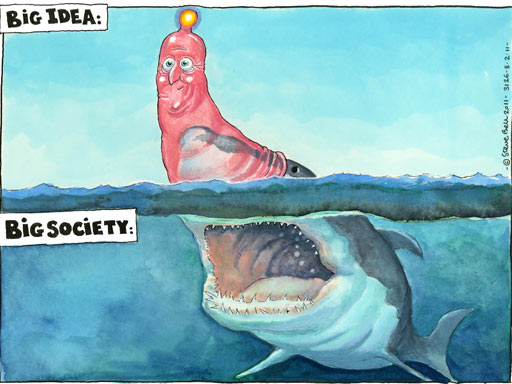
Today the Arts & Humanities Research Council responded to yesterday’s piece in The Observer claiming that the government had readjusted the rules (specifically The Haldane Principle) to increase their control over the direction of research in the UK within the state’s ‘national priorities’. Shorter version: the Tories didn’t pressure us, we’re completely independent and the funding to ‘The Big Society’ is coincedental.

Iain Pears is on the case. As he notes, it’s simply not convincing that the approved language suddenly appeared in the relevant documents unconnected with the political agenda of the governing party. The pressure may have been implicit, and the relationship might have been more informal and complicit than hierarchical, but the consequences for research are much the same.

But the AHRC not only wants to defend itself from these specific charges but also to maintain the legitimacy of the government setting overall priorities. Once again, the exact mechanics are expected to be taken on trust. Indeed, in 2009 a Commons Select Committee (Innovation,  Universities, Science and Skills, since you asked) addressed this exact point. While agreeing ‘in theory’ that the government had a role in setting overarching strategy, the relevant MPs (hardly a selection of Parliamentary rebels) put their collective figure on the aspects of policy that still concern us most:

Continue reading

Analytic Political Theory and the Science Question

Building on my post responding to Patrick Jackson’s The Conduct of Inquiry in International Relations, I wanted to highlight a book on methodologies in political theory that I’ve been working my way through.

In my post I suggested that “normative” theorists would object to Jackson’s characterization of their work as essentially the same as political activism or religious speculation – which I stand by.

I struggle to think of an approach to ethical theory whose adherents don’t aspire to be systematic, accountable, and oriented toward discovering or producing practical ethical knowledge. While the meaning of these terms and the methods by which one pursues these aims would obviously differ from those used in strictly empirical investigations, Jackson’s broad practical definition of science raises the possibility that those of us concerned to make ethical evaluations maybe be entitled to declare: “we are scientists!”

I came across a chapter by Daniel McDermott in Political Theory: Methods and Approaches (edited by David Leopold and Marc Stears) that illustrates my point extremely well. In the chapter, “Analytical Political Philosophy,” McDermott says the following:

Analytical political philosophy is a complement to social science. Whereas social scientists aim to determine the empirical facts about human behaviour and institutions, political philosophers aim to determine what ought to be done in light of that information… There are a number of different ways to characterize it, but probably the best is that analytical political philosophy is an approach to gaining knowledge that falls into the same broad category as science.

McDermott goes on to draw parallels between the natural and social sciences and analytical political philosophy, which he admits depends upon the reality of moral facts. He avoids the controversies surrounding this issue by distinguishing metaethics from political philosophy, drawing a further comparison between science.

This leads to a deeper, and more interesting, version of the objection to the political philosopher’s project: there simply are no moral facts, ever. The theories political philosophers develop really are theories about nothing, like those medieval theologians developed about the number of angels that could fit on the head of a pin. This is a genuine worry, but it is the kind of metaethical worry that is none of the political philosopher’s business. In philosophy, as in most intellectual endeavours, progress depends in part upon a successful division of labour. All of biology, for example, is ultimately physics, but that does not mean biologists should become physicists. Nor would they allow worries about the origins of the universe to distract them from their projects… My claim is that political philosophers should set aside worries about whether there are moral facts is controversial… Continue reading

Of Consensus and Controversy: The Matrix Reloaded

This is the fourth and final post in a series of responses to Patrick Thaddeus Jackson’s recent book The Conduct of Inquiry in International Relations. Paul began the discussion with comments on the problems of boundary setting, Joe followed up with an interrogation of the nature of Jackson’s pluralism, and Nick most recently gave an exposition of a missing methodological position in the typology.  We look forward to a reply from PTJ himself in the near future.


In this post, with the pleasure and pain of coming last in a hitherto excellent series, I want to tease out several issues that struck me in the reading of Jackson’s Conduct of Inquiry, which specifically relate to the success of the central typology, a possible alternative and the ‘science’ debate in this context.

I confess to having begun my reading of this work very sceptically – although not because of any doubt about the author or importance of the subject matter. Rather, like Joe, I doubted whether there would be much of interest for me as one whose work does not have too much invested in the ‘science’ claim as it stands in the mainstream IR debates. Whilst, along with my colleagues, and as I will discuss below, I remain unconvinced about the use of the term ‘science’ amongst other things, I found the book engrossing, stimulating, erudite and brilliantly argued.  The marketing people are free to recommend it particularly for graduate students, although my own view is that it contains very important intellectual challenges for the whole field at all levels. It is no small achievement that it reaches Jackson’s stated ambition to provide a platform for a much better philosophical conversation about inquiry than we have had thus far.

Perhaps controversially, however, I cannot pretend to have emerged from the book wholeheartedly sharing Jackson’s enthusiasm for the kind of pluralism in the field of IR that he aims to promote. I respect the sentiment and the generosity of spirit in which it is made, and I do recognise that it is essential for keeping important conversations on track, and that this is the best way forward for a less introspective discipline. Yet I feel myself torn, as perhaps critical pluralists are fated to be, between a desire to fight false dogmas and respect reasonable differences.  In some senses, it is Jackson’s own critical reading of different positions that subversively feeds this tension.

I. Of knowing and being: some questions

I was struck in the early set-up of the book by the distinction between scientific and philosophical ontologies upon which the central typology is built. Briefly, according to Jackson, scientific ontologies specify the catalogue of objects of investigation – states, individuals, classes etc. – whilst philosophical ontologies relate to the ‘hook-up’ between mind and world. Jackson presents this in a 2×2 matrix, with which I am sure readers are by now familiar:

Jackson’s key claim is that as researchers our methodologies flow logically from where we sit on these philosophical-ontological issues, and as such should not all be evaluated on neopositivist claims of how valid ‘science’ proceeds. Whilst I accept the broad point, what I want to pursue in more detail is whether this typology does in fact get to the heart of the core wagers that underpin each ontological position in the matrix. Continue reading

Inference and Scientific Progress in International Relations

This is the third in a series of posts by several of us at The Disorder Of Things on Patrick Thaddeus Jackson‘s The Conduct Of Inquiry in International Relations: Philosophy of Science and Its Implications for the Study of World Politics. Paul started things off with his post setting up Jackson’s methodology of politics in order to ask important questions about the politics of Jackson’s methodology. Joe continued with his post and a discussion of the relationship between the scientific and the normative, and their institutionalization within IR. Next week will see a final post, followed by a reply by Jackson himself.

Update (17 Feb): Meera’s post is now up.


Inference and Scientific Progress in International Relations

From a philosophy of science perspective, IR discussions on methodology and epistemology have always struck me as a bit bizarre. The outdated nature of most debates and the odd use of labels like ‘positivism’ have made IR philosophy of science too often seem like a muddled confusion, rather than an insightful debate. So it’s hard to overstate how fantastic it is to see a book like Patrick Thaddeus Jackson’s – precisely because it weaves skillfully through rigorous philosophy of science, and doesn’t remain bound by IR’s idiosyncratic frameworks of debate. I find myself highly sympathetic to a lot of what Jackson argues for in this book, and am a strong proponent of methodological pluralism. There are two major points I think Jackson’s book neglects though – one is more based upon my own philosophical position (an external critique), while the second is a problem more or less within Jackson’s position (an internal critique). In what follows I try to examine some missing elements of Jackson’s book, and suggest what might be an alternative approach. [1]

On Monism and Dualism

Jackson begins by setting out a 2×2 matrix of different fundamental philosophical orientations (‘wagers’). These are considered ideal types that help to clarify the vast field of philosophy of science. The first distinction is between mind-world dualism and mind-world monism. It is a distinction concerning the relationship between the researcher and his or her object. The second distinction is between what Jackson calls phenomenalism and transfactualism – or what might be also known as instrumentalism versus realism about scientific objects. The former sees empirical data as all that can be legitimately said to exist, whereas the latter argues we can deduce the existence of unobservable entities as well.

Phenomenalism Transfactualism
Dualism Neopositivism Critical Realism
Monism Analyticism Reflexivity

The 2×2 matrix: A scholar’s best friend.

As Jackson is clear about the ideal-type nature of this categorization, I don’t want to criticize that aspect. Rather, my point is that in his discussion of mind-world dualism and monism Jackson leaves aside one crucially important position (and the position undertaken by many in the so-called ‘speculative realist’ movement). [2] Whereas Jackson sets the empiricist, explanation-based, ‘scientific’ perspectives on the side of mind-world dualism, he sets the social constructivist, understanding-based perspectives on the side of mind-world monism. The former tries to bridge the gap between mind and world by creating accurate representations. The latter asserts that all of reality is intertwined with linguistic and conceptual baggage. (36) (This is precisely what Quentin Meillassoux will call the ‘correlationist’ position: the reduction of Being to the relation between mind and world. )

Continue reading

Freeing the Pluralist Imagination, or on the wisdom of escaping Weber’s “Iron Cage”

This is the second in a series of posts by several of us at The Disorder Of Things on Patrick Thaddeus Jackson‘s The Conduct Of Inquiry in International Relations: Philosophy of Science and Its Implications for the Study of World Politics. Paul started things off with his post setting up Jackson’s methodology of politics in order to ask important questions about the politics of Jackson’s methodology. The next few weeks will see further posts, followed by a reply by Jackson himself.

Update (3 Feb): Nick’s post is now up, to learn about material monism and the philosophical power of beards read it here.

Update (17 Feb): Meera’s post is now online, in which she threatens the stability of the matrix.


A broad definition of science, by design, does not provide us with any standards for good research, or indeed any specific advice for how to go about doing research, beyond the two basic admonitions to focus on factual knowledge of the world, and to separate this activity logically and conceptually from the promulgation of normative judgments and partisan-political stances. (25)

Patrick Jackson, The Conduct of Inquiry in International Relations

My comments on Jackson’s book need to be put in a personal context. I have no interest in claiming the title of “science” for my work or “scientist” for myself. Further, I do not consider my primary vocation the production of empirical knowledge. Instead, my work is “normative” and focused, most broadly, on how we think about the ethical dimension of world politics. Finally, I do not self-identify as a participant in the discipline of “International Relations,” nor as a “political scientist;” the tradition of scholarly work identified as “International Relations” is compromised by its statist foundations and the historically positivist pretensions that motivated the move to a science of politics are unsustainable in my estimation.

This raises an obvious question: why am I commenting on a book about the conduct of scientific inquiry in International Relations (IR)?

A Personal Anecdote

While at a conference in Ljubljana, Slovenia, I had an argument with my friend, Laust Schouenborg, about the nature of social science. Sitting in a Soviet-era housing block converted into a budget hotel, watching the sun go down behind the park, I was rhetorically ejected from academia.

Our argument began when Laust, after reading Chris Brown’s International Relations Theory: New Normative Approaches, suggested (contra Brown) that because there are no standards of what constitutes a “good” normative argument, the study of ethics had no place in IR, and that scholars concerned with making arguments about how politics should be, had no place in academia.[1] The modern university is a place for scientific study and those who were not practicing science should, he claimed, be relegated to the political and cultural spheres.

This line of reasoning shocked me, but it was only the culmination of a disciplining process I experienced in my first two years as a PhD student in the International Relations Department at the LSE. Even as many members of faculty supported my work, I was constantly asked why I was studying in an IR department and some “colleagues” suggested that my research was value-less as scientific work – whatever its virtues as polemic or sermon.[2]

These experiences have left me with two abiding intellectual concerns about the conduct of social inquiry. The first is to challenge the institutional privilege bestowed upon those conducting their inquiry as “science.” On this concern, Jackson and I share considerable ground, as his critique of exclusive definitions of scientific inquiry deflates dominant pretensions and advocates for a more inclusive study of world politics. And I must give credit where it is due: Jackson doesn’t suggest that my kind be thrown from the ivory tower – just given separate offices. The second concern is deeper and more contentious: to challenge the notion that the ethical questions that interest me can and should be separated from scientific inquiry into world politics. On this point Jackson and I share less ground, and for this reason the bulk of my comments will focus on how and why Jackson separates the “scientific” and the “normative” in his pluralist approach to IR.

Aside from satisfying very personal concerns, I offer this response to Jackson’s book because his generous orientation, stated most forcefully in the concluding chapter, invites engagement. Along with analyzing Jackson’s essentially Weberian account of a pluralist science of IR, and suggesting that a fuller account of social inquiry should bring together ethical and empirical inquiry, my most substantive critique is that the pluralism Jackson defends is partial and continues to discipline the study of world politics in an unsustainable way – a critique that, if correct, undermines a central aim of his project.

Continue reading

Demarcation Problems: ‘The Conduct Of Inquiry’ Between Politics & Methodology

This is the first in a series of posts by several of us at The Disorder Of Things on Patrick Thaddeus Jackson‘s The Conduct Of Inquiry in International Relations: Philosophy of Science and Its Implications for the Study of World Politics, released last year to considerable critical acclaim. The next few weeks will see further posts, followed by a reply by Jackson (or PTJ) himself. Taken together, we hope they go some way to meeting the challenge, to paraphrase PTJ himself, of emerging from splendid isolation to engage in some contentious conversations on inquiry.

UPDATE (24 Jan): Joe’s call to free the pluralist imagination is now up.

UPDATE (3 Feb): Nick’s speculative realist examination of inference, progress and materialist monism is now available.

UPDATE (17 Feb): Meera’s further untangling of ‘science’ and challenge to the stasis and status of reflexivism completes this round of responses.

UPDATE (14 March): PTJ has begun his reply.


Conclusion: neither science nor the methodology of research programmes provides arguments against anarchism. Neither Lakatos nor anybody else has shown that science is better than witchcraft and that science proceeds in a rational way. Taste, not argument, guides our choice of science; taste, not argument, makes us carry out certain moves within science (which does not mean that decisions on the basis of taste are not surrounded by and entirely covered by arguments, just as a tasty piece of meat may be surrounded and entirely covered by flies). There is no reason to be depressed by this result. Science, after all, is our creature, not our sovereign; ergo, it should be the slave of our whims, and not the tyrant of our wishes.

Paul Feyerabend, ‘Theses on Anarchism’ (1973), For & Against Method (with Imre Lakatos)

I: Conducts Of Inquiry

Paul Feyerabend’s Dada-ist approach to the philosophy of science was informed by a hostility to singular conceptions of the world, a rejection of rigid prescriptions for the correct character of knowledge and a healthy scepticism towards how people thought their forms of inquiry worked. Setting himself against method, he argued that ‘science’ has no common structure and that no general laws can explain its success or prescribe its methods. The growth of knowledge has not only historically been associated with a disrespect for prevailing methodological rules, it in fact requires such violation (whether deliberately or unwittingly).

Patrick Jackson’s The Conduct Of Inquiry attempts both to expand and to limit the knowledge practices counted as legible and legitimate in International Relations. Like Feyerabend (and Imre Lakatos and Thomas Kuhn and Karl Popper for that matter), Jackson evinces a healthy distrust of hard, fast or easy judgements about truth, reality and research procedure. And so he both avoids making the argument for a particular philosophical perspective with which to forge ‘better’ IR and eschews usual schemas that start with the putative ‘fundamentals’ of ontology and epistemology. Instead he offers a Weberian ideal-typification of methodologies (not methods), intended not as a menu of coherent and precise options but as a useful typology of functional categories (on which more in a moment).

The conception of methodology proffered is an expansive one, taken to designate ‘the logical structure and procedure of scientific inquiry’, but not the actual nature of reality and knowledge or the correct technique for a particular problem. Four commitments to philosophical ontology organise the options, generating four methodologies through their various combinations. The purpose is not somehow to test between them, but to reveal their assumptions and explain how they hang together as philosophical wagers. Hence the need to discuss the forms of faith and commitment that under-gird our styles of research.

So, in one sense, we could read PTJ as speaking with Feyerabend in demonstrating that “all methodologies, even the most obvious ones, have their limits…like an undercover agent who plays the game of Reason in order to undercut the authority of Reason (Truth, Honesty, Justice, and so on)“.

This intervention is much needed. Continue reading

Rape & Rape Prevention: A Cod-Evolutionary Perspective

Rape is an evolutionary adaptation. More than that, it now appears that anti-rape strategies are evolutionary too, which for women means increased strength at certain stages of the menstrual cycle, increased general distrust of men and hatred of black men in particular. Taking Darwin in vain, this is the argument put together by Jesse Bering at Slate.

We should probably start by getting our definitional house in order. In an admirable example of rigging the answer by misspecifiying the question Bering names rape as “the use of force, or threat of force, to achieve penile-vaginal penetration of a woman without her consent“. So men are biologically incapable of being raped, women incapable of raping, and the sexual-reproductive organs the only legible site for sexualised aggression (no anal here please!).

Hardly surprising, given this terminological firing gun, that rape emerges as a phenomena only comprehensible in procreational terms. This is a narrower agenda even than saying that it is somehow ‘evolutionary’, itself already less than saying it has something to do with ‘biology’ (the possibility of rape being about ‘sex’, socially understood, or ‘power’ stands at yet further removes).

The quality of proof offered doesn’t fare much better. Take the study on racist attitudes and menstrual cycles, results we’re at risk of ignoring with our rampant ‘political correctness’ (*yawn*). Turns out women from this sample (77 white undergraduates) scored higher on fear-of-rape metrics of black men when they were most vulnerable biologically to impregnation. Bering takes this as supporting an evolutionary adaptation against ‘out-groups’, although he concedes that ‘cultural transmission’ may play a role.

The study itself suggests something rather less conclusive. It found that implicit race bias (non-conscious stereotyped associations of the form ‘black-physical’) was much more strongly correlated with rising fertility than explicit bias. Its metrics for race bias were all clearly consistent with a sociological or interpretive account of race (which is to say that race is a social, not a biological category, and that its meaning is historically and politically determined, not the outcome of adaptive ancestral behaviour). The data is also somewhat partial, as its relation to some wider questions. There is no comment on the fact that, for example, race bias remains fairly pronounced even where there is no ‘conception risk’, nor any significant attempt to cite work on general levels of race bias in general populations as a comparator or to examine variation among degree of bias in the women studied and the possible sources for those differences.

Continue reading

On science and universal values

Sam Harris gives a Ted Talk consoling “people like us” with the good news that science will provide universal standards of right and wrong, good and evil. Thank you, Science! All those pesky relativist and fanatical religious type can now be put in their place.


Continue reading