Property as Futurism

The third post in our symposium on Brenna Bhandar’s Colonial Lives of Property is by Sara Salem. Sara is an Assistant Professor in Sociology at the London School of Economics. Sara’s research interests include political sociology, postcolonial studies, Marxist theory, feminist theory, and global histories of empire and imperialism. She is particularly interested in questions of traveling theory, postcolonial/anti-colonial nationalism, and feminist theory. She has recently published articles in journals such as Signs; Interventions: A Journal of Postcolonial Studies; Review of African Political Economy; and the European Journal of Women’s Studies, among others.


Brenna Bhandar’s ‘Colonial Lives of Property’ is an incisive and exciting book on questions of race, empire, property and the law. Drawing on multiple settler-colonial contexts—Palestine, Australia and Canada—and various time frames, Bhandar meticulously unpacks the loaded legal and social concept of ‘property’ to reveal its entanglements with histories of settler colonialism and race. Bhandar shows us that there cannot be a history of private property law that is not also at the same time a history of land appropriation in the colonies. The colonial drive to appropriate indigenous land—often in the process exterminating indigenous peoples—did not only have specific social, political and economic effects, but also produced legal understandings of land, property and citizenship. Bhandar notes, “Property law was a crucial mechanism for the colonial accumulation of capital, and by the late nineteenth century, had unfolded in conjunction with racial schemas that steadfastly held colonized subjects within their grip. Property laws and racial subjectivity developed in relation to one another, an articulation I capture with the concept of racial regimes of ownership,” (p. 2).

The book demonstrates that by unveiling these processes of appropriation and extermination, we come closer to understanding the categories we today so often work with, such as property and private ownership, and who belongs in the category of the ‘modern human’ and can thus access these. It shows us that the law was developed in and through colonialism, and that “there cannot be a history of private property law, as the subject of legal studies and political theory in early modern England that is not at the same time a history of land appropriation in Ireland, the Caribbean, North America, and beyond,” (pp. 3). This is a particularly important project because of the ways in which property is often associated with freedom. To purchase property means to secure freedom from various calamities, including economic insecurity. Private property has long served as the bulwark of modern liberalism, and one only has to think of the various institutions that were set up primarily to defend private property, among these the police forces.

Continue reading

Colonial Lives of Legality and Possibilities for Resistance?

The Disorder of Things is delighted to host a symposium on Brenna Bhandar’s new book, Colonial Lives of Property: Law, Land, and Racial Regimes of Ownership. First up is the symposium organiser, Alvina Hoffmann, a PhD student in IR at King’s College London. She is review article editor, social media officer and member of the editorial board of Millennium: Journal of International Studies. She is co-convenor of the research group Doing International Political Sociology. Her thesis investigates the annexation of Crimea, the Sami people’s struggle over land rights and the Internet users’ claims over digital spaces through the lens of rights claims practices which intersect in various institutional settings such as the UN.


Brenna Bhandar’s Colonial Lives of Property takes its readers on an analytical journey through various empirical and temporal contexts, excavating the racial assumptions underpinning the development of modern property law which animate contemporary settings of settler colonialism. In Bhandar’s own words, the book’s main focus lies “on the political ideologies, economic rationales, and colonial imaginaries that gave life to juridical forms of property and a concept of human subjectivity that are embedded in a racial order” (p. 22). The book is an impressive study which skilfully combines archival material, legal cases and fieldwork to showcase the various practices of appropriation of land and its rationalisation through property law regimes. It will appeal to scholars from various disciplines studying the development and contemporary manifestations of racial capitalism, Indigenous people’s dispossession and resistance struggles, and the history of property, territory and sovereignty more broadly. This interdisciplinary form of inquiry not only helps shed new light on questions surrounding the enduring forms of racial and economic inequalities, but also offers thoughtful reflections on new political imaginaries of property.

In this post, I want to draw out three points that Brenna Bhandar’s rich and thoughtful book raises. First, I will show how her historical analysis of processes of racialisation constituted political subjects in colonial settings. Then I will focus on practices of legality and consider ways in which her analysis can be applied in international law with regards to Indigenous peoples and their claims to land rights. The final part will consider Bhandar’s conclusive thoughts on alternative political imaginaries of property which draw on an array of scholars and resources which inspire critical theories and practices of such imaginaries.

Continue reading

States of Intersection: Beyond womenandchildren

The next commentary on Revisiting Gendered States: Feminist Imaginings of the State in International Relations (the full series is here).


Although it can no longer be claimed with any credibility that gender is at the fringes of International Relations as a discipline, consistently excellent and adequately nuanced analyses of the gendered nature of IR and its touchstone – the state – are still few and far between. In a field otherwise saturated by liberal feminism focused largely on the West (the US, the UK and Western Europe to be precise), Swati Parashar, J Ann Tickner and Jacqui True’s Revisiting Gendered States: Feminist Imaginings of the State in International Relations provides a refreshing change. Bookended by an incisive forward by Spike Peterson and a compelling, almost poetic afterward by Christine Sylvester are eleven ‘substantive’, and uniformly thought-provoking chapters. In less than 200 pages the contributions to Revisiting Gendered States manage to traverse the whole spectrum of issues sacralized by IR: state formation, borders and bordering practices, terrorism, security, identity and belonging.

The text reopens the discussion the seminal Gendering States: Feminist (Re)visions of International Relations Theory published in 1992 and edited by Spike Peterson, initiated. Gendered States has the same point of departure – an examination, and concomitant critique of the centrality of the masculine, patriarchal state in IR but it does so in a distinctly 21st century context. The state is no longer a blackhole or a rarefied rational actor, but rather a set of complex and often confused practices: an effect, symptom and perpetrator of globalisation, securitisation, and nationalism. The chapters are truly global in scope, drawing on case studies from Indonesia, Sri Lanka, India, the Middle East, Indonesia and Australia. The contributions are not merely empirically heterodox, they are also theoretically pluralist, drawing variously on queer theory, assemblage theory, affect theory and postcolonialism alongside more mainstream IR theory. Continue reading

Settler Colonial Sovereignty: Some implications of Jasbir Puar’s conception of the sovereign right to maim

The fourth contribution to our symposium on Jasbir Puar’s The Right to Maim comes from Darcy Leigh and Cynthia Weber. Dr Darcy Leigh currently teaches decolonial and queer legal perspectives, as well as interdisciplinary ‘widening access’ programming, at the University of Sussex Law School. She has previously been a Teaching Fellow and/or Research Assistant at the universities of Edinburgh, Ottawa and Alberta. Dr Leigh has also worked as a facilitator, researcher and/or consultant with decolonial higher education projects Dechinta Centre for Research and Learning and the Akitsiraq Law School, as well as in the equalities and policy sectors in School, as well as in the equalities and policy sectors in Scotland. Cynthia Weber is Professor of International Relations at the University of Sussex.  She has written extensively on sovereignty, intervention, and US foreign policy, as well as on feminist, gendered and sexualized understandings and organizations of international relations.


State sovereignty, as a central analytical category in the field of International Relations (IR), has been too often uncontested (Walker, 1993). In spite of a wave of critical sovereignty studies in the 1990s (Ashley, 1988; Bartelson, 1995; Weber, 1995; Biersteker and Weber, 1996; Walker, 1993), with few exceptions those debates largely skirted or ignored altogether how state claims to sovereignty are woven through and require specific relationship to race and sexuality (Doty, 1996; Peterson, 1999; Weber, 1999). Only very recently have IR scholars come to recognize the centrality of sexuality and race in sovereign state formation (Anievas, Manchanda & Shilliam, 2015; Agathangelou et al 2008; Inayatullah & Blaney, 2004; Leigh, 2017; Manchanda, 2015; Rao, 2012, 2014; Richter-Montpetit, 2007, 2015, 2016; Sabaratnam, 2017; Shilliam, 2015; Weber, 2016). More recently still, IR scholars are beginning to recognize the centrality not just of sexuality and race, but also of settler colonialism and disability (Beier, 2005, 2009; Crawford, 1994, 2007; Howell, 2011, 2018; Leigh, 2015; Shaw, 2008).

Jasbir Puar’s challenging and provocative new book, The Right to Maim, pushes these discussions further, demonstrating the inextricability of state sovereignty from settler colonialism as configured through racialized and sexualized relations of debility, capacity and disability. In so doing, Puar contests the function and meaning not only of sovereign statecraft, but also of settler colonialism.

In this short piece, we focus on the implications of Puar’s reworking of sovereignty and settler colonialism.

Continue reading

The right to maim: the interstitial existence between biopolitics and necropolitics

This is the third post in our symposium on Jasbir Puar’s The Right to Maim, by TDOT’s very own Nivi. Previous posts in the symposium can be found here.


I came to Jasbir Puar’s The Right to Maim: Debility| Capacity| Disability just as I was wrapping my head around Afro-pessimism, and specifically the claim by some of its proponents (see for instance this interview with Frank Wilderson) that any meaningful comparison (and by extension abiding solidarity) between Palestinians and black populations is – at its crux – misguided. This comes from the belief that the “regime of violence that subsumes Black bodies is different from the regime of violence that subsumes hyper-exploited colonial subalterns, exploited workers and other oppressed peoples.” I found this provocative, but also deeply unsettling: does the condition of ‘blackness’ preclude worthwhile parallels from being drawn with those suffering under a brutal settler colonial occupation with no respite in sight? Indeed, does the mass incarceration of black bodies in the US not face its equal in Gaza – the world’s largest open-air prison, as the common refrain is wont to remind us – or is ‘blackness’ antithetical to humanity whilst ‘indigeneity’ can still be, albeit conditionally, enfolded within humanity?

Continue reading

Spectrums of Debility and Resistance

The second post in our symposium on Jasbir Puar’s Right to Maim is by Isis Nusair, who is Associate Professor of Women’s and Gender Studies and International Studies at Denison University. She is the co-editor with Rhoda Kanaaneh of Displaced at Home: Ethnicity and Gender among Palestinians in Israel, and translator of Ramy Al-Asheq’s book of poetic prose Ever Since I Did Not Die. She is the writer and director with Laila Farah of Weaving the Maps: Tales of Survival and Resistance; a one-woman show based on research with Iraqi, Palestinian and Syrian refugee women.  Her upcoming book is titled Permanent Transients: Iraqi Women Refugees in Jordan and the USA. She is currently conducting research on the narratives of crossing of Syrian refugees into Germany. Isis previously served as a researcher at the Women’s Rights Division of Human Rights Watch and the Euro-Mediterranean Human Rights Network.

Jasbir Puar’s The Right to Maim: Debility, Capacity, Disability makes an important contribution to our thinking about the connection between debility, capacity and disability. The book challenges binary thinking and offers a continuum when thinking about dis/ability. Puar argues that “capacity, debility and disability exist in mutually reinforcing constellation and are often overlapping or coexistent, and that debilitation is a necessary component that both exposes and sutures the non-disabled/disabled binary” (Puar, xv).

Continue reading

Anarchy, Security, Hierarchy: Reading IR with Jasbir Puar

The first post in our symposium on Jasbir Puar’s The Right to Maim is by Sankaran Krishna who teaches politics at the University of Hawai`i at Manoa. His latest essay (“Manhunt Presidency: Obama, Race and the Third World”) will be published in the journal Third World Quarterly in 2019.


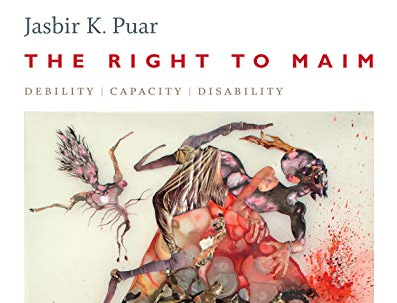
Jasbir Puar’s The Right to Maim: Debility, Capacity, Disability (Duke, 2017) sensitizes us to how binary categories organize our thinking and our disciplines –and often do so in ways that obscure important ethical issues. In this brief essay, I first adumbrate Puar’s thesis in her remarkable book and then take a critical look at the role that a certain binary – anarchy/security – plays in constructing the discipline of IR in specific ways, and end with some speculations on what the introduction of a third term, hierarchy, does to re-center issues of inequality, domination, racism and violence in the study of our world.

To peremptorily summarize Puar, she argues that the western discourse of disability rights is a quintessentially “white” political, economic, social, cultural and racial formation. Disability rights are fought for by and accrue primarily to affluent or middle-class citizens of western, developed societies even as these societies are themselves –through their military, economic, political, social and other interventions- responsible for much of human and planetary pain.

Continue reading

The Right to Maim: A Symposium

Alison Howell is Assistant Professor of Political Science at Rutgers University – Newark, where she is also affiliated to Women’s and Gender Studies, the Division of Global Affairs, and Global Urban Studies. Her research examines the global politics of science and technology, especially as it relates to the uses and abuses of medicine in war and (settler) colonialism. She is currently co-authoring a book with Melanie Richter-Montpetit, under contract with Oxford University Press, titled Race and Security Studies.


I’m delighted to provide an opening introduction to the Disorder of Things symposium on Jasbir Puar’s The Right to Maim.

Clearly, Puar’s vast body of work has already had a significant impact on International Relations. Recently published in a tenth anniversary edition, Terrorist Assemblages offered IR students and scholars a set of concepts including homonationalism, which continue to help us to develop deeper understandings of the queer politics of global racial violence and imperialism. The Right to Maim is no less bold in its interventions, yet again re-shaping our understandings of topics at the heart of much IR research, including war, security, (settler) colonialism and capitalism. It also offers altogether new avenues for research.

Continue reading

On Situatedness, Knowledges and Absences: A Response to the Symposium on Decolonising Intervention

The final post in our symposium on Decolonising Intervention. A massive thanks to Lee for organising and editing; errors in this final part are mine.  If tweeting, please use #DecolonisingIntervention. The earlier posts can be seen here: my introduction, Marta’s response, Lee’s response, Amy’s response and Megan’s response. The whole book is available for free Open Access download here.


My sincere thanks to all the contributors to this symposium for reading the book and responding with such thoughtfulness, seriousness and robustness. I respect them all enormously as scholars and have learned a great deal from their own work – a learning process which continues through this symposium as well. Moreover, the space for deep reading, critical feedback, intellectual argument and reflection is something that the structures of the neoliberal academy increasingly accumulate against; my pleasure and gratitude is deepened by the knowledge that the contributors have all actively managed to hold the door open in spite of this.

My response to their contributions will principally focus on the questions they raise and points of contestation. However, I was happy to see that the basic argument and conclusion of the book – that intervention is intimately structured by relations of colonial difference – is one with which they appear to agree and find compelling as an explanation for the continuation of failure. A primary hope of mine in writing this up was that one could not read this book and look at intervention in post-conflict or ‘fragile’ states, and its various ‘implementation problems’, without this understanding in mind. Having done this work, I find it now very difficult to read assessments of post-conflict state-building or development practice that continue to reproduce various forms of technocratic fantasy about how exactly it is that institutions, polities and economies are ‘built’ or ‘improved’.

Screen Shot 2018-06-23 at 17.40.35.png

This conclusion and the analysis supporting it has been reached through an engagement with the experiences and perspectives of intervention’s targets in Mozambique. Thus, the book is also concerned with how we study what we study in the field of International Relations – specifically how we cultivate what Niang deftly describes as the ‘value of uncanonical insights of subjects whose absence would otherwise give an incomplete account of the game of intervention’. The contributors had different reactions to this proposition and the way it was taken forward in the book, which I will look at below. Notwithstanding the challenges and complexities of this, I feel that if we are to practice a scholarship which is both more ‘scientific’ and more democratic, this kind of epistemic and methodological re-positioning of scholars vis-à-vis structures of power is absolutely critical. Continue reading

‘This House Believes Britain Should Be Ashamed of Churchill’

Below is a slightly expanded text of a ten-minute speech I gave at the Oxford Union for the proposition ‘This House Believes Britain Should Be Ashamed of Churchill’. The bits in square brackets are things I didn’t have time to say, or hadn’t thought of saying at the time, or reflections on what happened later. Shoulda coulda woulda: that’s what blogs are for. 

In April 2016, Boris Johnson (while still mayor of London) wrote a curious article for the Sun. The article was timed to coincide with a visit to the UK by President Obama, who was widely expected to appeal to the British people to vote to remain in the European Union in the upcoming referendum. As a leading spokesperson for the Leave campaign, Boris wanted to pre-empt Obama. He tried to do this by invoking Churchill in two ways. First, he drew attention to one of Obama’s first acts upon entering the Oval Office, when he returned a bust of Churchill to the British embassy in Washington. Speculating on why Obama might have done this, he suggested—with more than a hint of Trumpian Birtherism—that this might have been ‘a symbol of the part-Kenyan President’s ancestral dislike of the British empire—of which Churchill had been such a fervent defender.’ See, Obama’s grandfather had been arrested and tortured for his alleged participation in the Mau Mau insurgency in Kenya, which began during Churchill’s postwar premiership. Having tried to discredit Obama by reminding us of his dislike for Churchill and the British empire, Boris then invoked Churchill in a more positive vein as a symbol of the struggle against dictatorship in Europe who might similarly inspire the efforts of Leavers in their own struggle against the dictatorship of the European Union. In this strange little article and its intersecting oppositions—Boris v. Barack, Leave v. Remain, Churchill v. the empire—we have all the ingredients that might explain why this House, in 2018, is being asked to consider whether to express shame in a long dead British Prime Minister.

Continue reading