Primitive Accumulation; Or, A Virtual Read-In on the London Riots

The blogosphere has a million corners, countless nooks and several large echo-chambers, complete with their own centres of self-congratulatory gravity. All have been aflame over the last week, saturating events, riots and insurgencies with the weight of historical expectation, the political memory of past iteration and the awesome condescension of easy interpretation. Gaps persist: gender and the dynamics of formally opposed masculinities have escaped all but the most cursory attention. It is one paradox of all this profuse commentary that decrying the statements and manifestos of others is the most satisfying and patronising manifesto of all. At its worst, it engages in the fullest of narcissisms (let’s make this about us and the quality of our analysis) whilst proudly displaying its contempt for thought (now is not the time for theory!). And of course, the problems and challenges are real. Much more real than we can face, too real for the sordid postures of moralising (I denounce Satan and all his works!) and liable to stay as real once we paper over them and return to our default settings.

Oh, and I find myself in unsurprising agreement with Joe and Meera (although I think Ken Livingstone’s attempts to make the link to cuts and social marginalisation is more ham-fisted than shameful). Which is all by way of introduction. There are reams to be written on the way the punditocracy and assorted commentariat are deploying (and misapplying) categories of cause, the unstable and multiple uses made of ‘politics’, the questions of historical precedent and historical return, and on and on. Exhaustion at the war of position prevents any such post. Instead, a mix-tape of diagnosis and critique, with both the smooth joins and the subtle dissonances that implies. More useful than a 1,000 faux-fresh words.

—————–

These looters are doing what they’re supposed to; grabbing the goods they see in the shops and can’t buy in a recession. They loot the bling – the sports shoes, gold watches, mobile phones and plasma TVs; and you can recognize the very poor when you see a woman looting potatoes from a corner shop. These acquisitive looters are certainly copying the gold standard of a social contract eroded by and evaporating with the money. These are riots in the cause of consumer goods. Burning and robbing other people’s things is one thing, but soon enough, and with no social cause or justice worth the name, people too become indistinguishable from things: witness the widely-circulated photo of the woman leaping for her life from a burning building; such potential deaths still threaten to bring the house down on top of us. This whole distressing episode began with the police shooting dead a black man in north London they said was a gunman; no evidence he fired a shot, we’re told, but the man was already indistinguishable from his gun.

Gabriel Gbadamosi, ‘The Blazing Light In August’

Continue reading

Reading violence: what’s political about the London riots(?)

To reiterate somewhat, there is a politics to these riots. Panicking, political leaders and many others, have queued up to deny this, labelling it “pure violence,” “criminality, pure and simple“, or “mindless violence“. Over and over again, the distance between the rioters and the ‘community’ or ‘Londoners’ has been set up and reinforced. This is not without some public backing. After all, many Londoners are, rightly, angry, frightened, upset, frustrated, shocked and saddened by the sight of homes and businesses not just smashed but burning voraciously into the night whilst looters showed off their new gear. We were a world away, it seemed, from the specific, dignified, coherent demands for justice being made by Mark Duggan’s family and their supporters. Many asked themselves: what do they want? The answer seemed to be: trainers. What could be political about stealing from Foot Locker?

First things first. This post is not about constructing a narrative of social apologia via moral determinism – i.e. the idea that people couldn’t help themselves, or were bound to do it by their economic status etc. Between this and the ‘mindless violence’ line of argument, there are plenty of fools (sadly many, powerful, wealthy, and in charge of your country) trading in pretty stupid accounts of human behaviour and social causation. Continue reading

The Politics of Austerity: Emergency Economics and Debtocracy

austerity |ôˈsteritē| noun – sternness or severity of manner or attitude
It was possible, therefore, to commit a sin without knowing that you committed it, without wanting to commit it, and without being able to avoid it. Sin was not necessarily something that you did: it might be something that happened to you.

– George Orwell, “Such, Such Were the Joys”

Why what have you thought of yourself?

Is it you then that thought yourself less?

Is it you that thought the President greater than you?

Or the rich better off than you? or the educated wiser than you?

 I do not affirm that what you see beyond is futile, I do not advise that you stop,

I do not say leadings you thought great are not great,

But I say that none lead to greater than these lead to.

– Walt Whitman, “A Song for Occupations,” Leaves of Grass

The Politics of Austerity – Part I

This is the first in a series of posts that look at the political implications of the ongoing global economic crisis. I begin by examining the way that crisis is being used to attack the very idea of democracy through an assertion of the political imperatives of “the market” and the violation, bending and re-writing of the law by capitalist elites. I conclude by laying out how understanding the economic crisis in political terms shapes our ability to respond to it.

In the second post I’ll look at the ethos of austerity, which justifies the pain inflicted on largely innocent people, while suggesting that an affirmative democratic response to the economic crisis must begin with its own ethos, which I suggest should be an ethos of care for the world – which can provide orientation and inspiration for political struggles seeking to address the deeper causes of our current crisis. In the third post, I turn to the structures of the economy and of politics that define the current crisis, looking at the banking crisis, the bailouts, the politics of recovery/austerity and also reflecting of the structural imperatives of capitalism that led us to crisis. This, then, leads to the question of how to respond to the politics of austerity, and of what alternative actions are available to us, which is where the fourth and final post will pick up – with an affirmation of a caring ethos that supports a radically democratic economic vision.

Emergency Economics

In a previous post I briefly highlighted Bonnie Honig’s work, Emergency Politics, to examine the way that the ethical case for austerity is made; most basically, the existence of a supreme emergency, in this case economic, justifies actions that would normally be considered unacceptable. Honig’s work looks at how the appeal to emergency is used to reassert the exceptional political power of the sovereign over and against the law, with a focus on the reassertion of sovereignty witnessed over the past ten years in response to the threat of terrorist attack in the US and Europe.

Rather than accepting the necessarily intractable conflict between the power of the sovereign and the power of the law, Honig attempts to deflate this paradox by turning her attention to the always ongoing contestation that defines democratic politics, a contest over both the content of the law and the institutional embodiment of sovereign power. She suggests, then, that attending to the ambiguities of the “people”, who are both the democratic sovereign and a diffuse multitude, as well as the political element in the law – as new laws come into being through political action – enables us to avoid thinking about emergencies as moments of exception in which the rule of law is lost to the play of political power, while also acknowledging the limits of established law in moments of profound crisis. By undermining the exceptional nature of crises and emergencies Honig alters the challenge we face when circumstances force us to make choices or carry out actions we know are harmful and wrong by asking what we (democratic publics and citizens) can do to survive an emergency with our integrity in tact.

What do we need to do to ensure our continuity as selves and/or our survival as a democracy with integrity? Our survival depends very much on how we handle ourselves in the aftermath of a wrong. We will not recover from some kinds of tragic conflict. But when faced with such situations, we must act and we must inhabit the aftermath of the situation in ways that promote our survival as a democracy.

I continue to find this a useful way to understand our current economic crisis. Appeals to austerity depend upon the exceptional state created by crisis in order to justify the pain inflicted upon masses of people and the priority given to private interests (the markets, investors and bankers) over democratic publics. So, as democratically enacted laws must bow before the sovereign power threatened by exceptional attacks, so economic justice and democratic equality must bow before the commands of market forces, of economic inevitability, in this time of crisis.

The economic version of this argument is stronger still. While the space of political contestation that remains open when we accept the framing of emergency politics is limited, it does exist in the clashing of opposing sovereigns. The prospect of a substantive alternative to neoliberal economic ideology is dim, a light flickering weakly on antiquated appeals for a return to Keynesianism or watered down triangulations of the moderate-middle that sell off dreams of a just economy bit by bit – capitalist realism in action.
Honig awakens us to an important aspects of our current crisis: that “the market” is not in fact supremely sovereign, and the move to re-establish and further neoliberal policies and push through austerity measures requires an engagement in democratic politics – albeit one that undermines the notion of the public itself and seeks to use the power of the law to subvert democracy. Recognising the current crisis in these terms not only challenges us to consider how to survive our current troubles without giving up democratic virtues, it also reinvigorates and clarifies the political challenge we face. Emergency economics – with its assertion of debtocracy over democracy – is not an inevitable response to the crisis, it is a political one that we can, and should, fight against.

Continue reading

What We Talked About at ISA: Crisis Mapping and the Rise of Digital Humanitarianism (Part III)

This is the third of a three-part series on ‘what we talked about at ISA’. The first part on technology in International Relations can be found here. This second section on the decline of cognitive mapping is here. This final section covers the example of a particular technology being used to overcome deficiencies in cognitive mapping. (For the theoretical context, it’s well worth reading the second part of this series.) Much of the empirical research for this section stems from the work of Patrick Meier and others involved heavily in crisis mapping. Patrick’s website is a stellar resource for the changing digital nature of humanitarianism, and is highly recommended.


In the wake of the recent Haitian and Japanese earthquakes, the devastating tsunami in the Indian Ocean, and other major humanitarian disasters, increased global attention has been paid to the ways in which actors involved in humanitarianism can and should evolve to deal with these emergency situations. Media, international organizations, and non-governmental organizations have all reflected on the implications and path forward for managing crises, with a wealth of reports emerging in the wake of this decade’s crises.[1]

A similar set of complex crisis situations has become significant recently with the political events currently surging across the Arab world. While analytically distinguishable from humanitarian crises, these political crises share many common aspects and often blur at their boundaries. Political crises typically produce humanitarian crises, while humanitarian crises often stretch the capacities of political actors. The result, in either case, is a situation characterized by its complex and fast-moving nature. Moreover, in both instances there is often a dearth of reliable information. If effective political action is premised upon the conceptual representations of a situation, then rational action becomes nearly impossible in crisis situations. In this regard, the new technologies involved in ‘crisis mapping’ can be seen as a means for political actors to overcome this cognitive gap. Through this case study it can be demonstrated how political actors are in fact constructed not only socially, but also through material technology.

Continue reading

Libyan cash and the LSE: a deeper problem

As Qaddafigate rolls on, and its luminaries publicly distance themselves or fall on their swords, a repeated line marks the public justification: there was no influence over research, there was no influence over research, there was no influence over research.  This is, as far as anyone can see, true – there is no evidence, even in the most scathing denunciations, to suggest that there was any attempt to influence the outcomes of the research programme. Even so, the School have rapidly appointed an investigation into this very issue.

Whilst many have been relieved by this, I find myself more deeply disturbed. Why is it that the regime of an eccentric and violent autocrat can slide into bed so easily with a research programme on governance and democratisation? Continue reading

It’s Not About You: US Media Bias and Egyptian Protests


Nice piece on Al Jazeera by Mohamed Shokeir that takes the US media to task for its coverage of Egyptian protests.

He asks some important questions about US conceptions of “Arab Anger”, the lack of solidarity with a people fighting an oppressive regime and the myopic US-centric narratives that have dominated the news.

Egypt and the Failure of Realism

Update (19/05/11): A revised and expanded version of this post has been published in The Journal of Critical Globalisation Studies (Volume 4), which you can access for free here.

I’ve hesitated to comment on events unfolding in Egypt (and in the wider region, from Tunisia to Yemen). Not only do I lack any special knowledge of events but many others have said all that I would say with greater skill and clarity. Yet, a sense of solidarity with protesters and my frustration with the commentary on events leads me to offer a few thoughts on the ambiguous role that appeals to “realism” are playing in the response to the actions of the protestors and the government in Egypt.

As the protestors and Mubarak’s goons wait it out in Tahrir Square, the rebellion against the president has entered a key phase. Will the threat of continued violence give Mubarak the space he needs to solidify his power till next year, and in the process avoid the thorough changes the Egyptian people are demanding? As protestors face violence, exhaustion and deprivation the prospect of compromise must seem more desirable than before. The time seems ripe for expressions of support from key states and leaders.  The protestors need our support; it’s much easier for Mubarak to play for time from the presidential palace than for protesters in the streets, but the men and women able to make a difference do not use their voices to share in democracy’s street-choir. And these moral midgets are attended to by their Lilliputian advisors, who counsel patience, restrain and reform that preserves stability.

When Keeping It Real Goes Wrong

Barak Obama has clearly mastered the dark art of evasive support, leaving no doubt that he’s all for Egyptian democracy that doesn’t change too much, too fast, and, most importantly, doesn’t compromise the key strategic interests of the US.

The administration’s restraint is also driven by the fact that, for the United States, dealing with an Egypt without Mr. Mubarak would be difficult at best, and downright scary at worst. For 30 years, his government has been a pillar of American foreign policy in a volatile region, not least because of Egypt’s peace treaty with Israel. American officials fear that a new government — particularly one dominated by the Muslim Brotherhood or other Islamist groups — may not honor the treaty signed in 1979 by Mr. Mubarak’s predecessor, Anwar el-Sadat. (NY Times)

Predictably, Joe Biden made the point with less tact, but perhaps more truth, when he expressed his insensibility to the crimes of Mubarak against his own people.

Asked if he would characterize Mubarak as a dictator Biden responded: “Mubarak has been an ally of ours in a number of things. And he’s been very responsible on, relative to geopolitical interest in the region, the Middle East peace efforts; the actions Egypt has taken relative to normalizing relationship with – with Israel. … I would not refer to him as a dictator.”

Continue reading

Memo from an Old Contrarian: Hitchens on Revolution, Islamism and More-Or-Less Benign Dictatorship

No one really knows what will come of ongoing events in Tunisia and Egypt (and Yemen and Palestine, &c.). A plethora of under-qualified voices are currently vying for interpretative hegemony, not to mention secure plottings of the various ‘implications’ for the US, global order and the very meaning of freedom in the 21st century. What will it mean for the Mammonites currently scrambling behind the curve? Will the language of ‘partnership’ and ‘reform’ contain the unrest?

It will surely not be long before someone frames the last days’ clashes in Alexandria as the eventual outcome of bombs over Baghdad. I have no particular interest in indulging such faux-talking-head insta-response. What did catch my attention was an especially contrary and confused statement from Christopher Hitchens, billed at Slate as an encouragement to juvenile Tunisia and then at The National Post as a qualified defence of ‘civilized dictatorship’.

Continue reading

LSE Occupied!

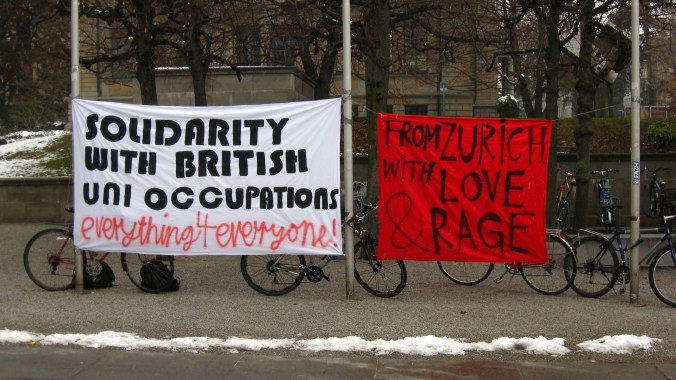
More breaking news. Today LSE students occupied in protest at education cuts, demanding that LSE management produce at least some murmurs of opposition before the Parliamentary vote next Thursday.

Follow here, with updates here. Petition of support here.