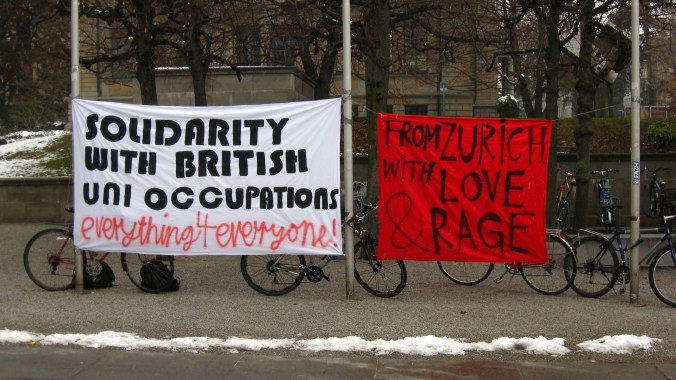
Everything 4 Everyone! From Zurich, with Love and Rage

As a public service, some of the best of recent (and older) diagnosis and critique, largely an extension of work already done over at Infinite ThØught:
It is fascinating, and very revealing, to see how Browne’s unreal confidence in the rationality of subjective consumer choice is matched by his lack of belief in reasoned argument and judgment. The sentence that immediately follows the vacuous one about students’ ‘wants’ reads: ‘We have looked carefully at the scope to distribute funding by some objective metric of quality; but there is no robust way to do this and we doubt whether the choices of a central funding body should be put before those of students.’ It is, first of all, striking that the only alternative envisaged to the random play of subjective consumer choice is an ‘objective metric of quality’, i.e. some purely quantitative indicator. And second, it is no less striking that instead of allowing that an informed judgment might be based on reasons, arguments and evidence, there are simply the ‘choices’ made by two groups, treated as though they are just two equivalent expressions of subjective preference. We can have the money for a national system of higher education distributed either in accordance with the tastes of 18-year-olds or in accordance with the tastes of a group of older people in London: there’s no other way to do it.
Stefan Collini, Browne’s Gamble

György Lukács used to say that the objective unity of the capitalist order was never so apparent as in a phase of crisis. Then, the relative autonomy of expansionary times, which were so often asserted as the reality of social relations, would be abruptly suspended. The power of discretion would flow back to the centre, to the strategic politics of the state and to those prepared to launch a fundamental challenge to it.
What is objectionable is the ascendency of quantification, the emergence of quantifiability as a qualifying condition of relevance and admissibility. A species of transcendental reductionism. We need look no further than the familiar, degraded world of academic research. Scientific and scholarly projects, we all know, do well in these times to internalise the definitions, the priorities and the timescales of the REF as a main condition of finding institutional support. Reputation – the regard of one’s peers and serious audiences – is a frothy measure of achievement if it cannot be captured in scores and tables…League tables generally do not only reduce particular and distinct activity to a single numerical scale. As numerical procedures, they offer perverse compensation by generating distinctions where none can credibly be thought to exist in reality. 10 or 15 institutions differ within the space of 1%. But the visual code of the table – equal spacing in the plane of the vertical – renders such trivia grave and lapidary, carves them in stone…These processes of quantification and financialisation are effecting a progressive abstraction of university functions, in which exchange value is the homogeneous substance of working life. Now the labour of perfecting and defending these processes calls for an equally abstract organisational stratum of leader-managers, in a classic process of bureaucratisation.
Francis Mulhern, Humanities and University Corporatism
Wendy Brown, Why Privatisation Is About More Than Who Pays
It is no accident that American pragmatism once again rises to the surface of North Atlantic intellectual life at the present moment. For its major themes of evading epistemology-centered philosophy, accenting human powers, and transforming antiquated modes of social hierarchies in light of religious and/or ethical ideals make it relevant and attractive. The distinctive appeal of American pragmatism in our postmodern moment is its unashamedly moral emphasis and its unequivocally ameliorative impulse. In this world-weary period of pervasive cynicisms, nihilisms, terrorisms, and possible extermination, there is a longing for norms and values that can make a difference, a yearning for principled resistance and struggle that can change our desperate plight.
Prophetic pragmatism worships at no ideological altars. It condemns oppression anywhere and everywhere, be it the brutal butchery of thirdworld dictators, the regimentation and repression of peoples in the Soviet Union and Soviet-bloc countries, or the racism, patriarchy, homophobia, and economic injustice in the first-world capitalist nations. In this way, the precious ideals of individuality and democracy of prophetic pragmatism oppose all those power structures that lack public accountability, be they headed by military generals, bureaucratic party bosses, or corporate tycoons. Nor is prophetic pragmatism confined to any preordained historical agent, such as the working class, black people, or women. Rather, it invites all people of goodwill both here and abroad to fight for an Emersonian culture of creative democracy in which the plight of the wretched of the earth is alleviated.
– Cornel West, The American Evasion of Philosophy: A Genealogy of Pragmatism
But I see motivating students, passing on enthusiasm, as the first and most important task of a teacher. (Which isn’t to say that one has to blindly encourage everything a student says or writes; far from it.) That’s why I would say that one of the most despicable figures in the academic bestiary is the Troll-Master: the figure who feeds on the crushed enthusiasm of belittled students. The easiest way to win a cheap kind of respect is by adopting a nothing-can-impress-me hyper-critical stance, doused in cool weltweltschmerz, finding fault everywhere, handing out praise and encouragement only very rarely; it’s a transparent tactic, but one that works surprisingly well, and not only on jejune students, but also on very accomplished people, even those who have written a number of books. Often, the Troll-Master’s own intellectual project will be mediocre and/or suspended – it’s clear that all their libidinal energy is tied up in enslaving students into neurotic servitude. Troll-Masters can permanently insinuate themselves into students’ heads, but usually their power depends upon the hothouse claustrophobia of the university department – they are village despots, whose charismatic tyranny seldom works outside their own turf. If they have a long-term effect, it is only to produce more grey vampires.
K-Punk, ‘Break Through in Grey Lair’

One temptation is the patronizing attempt to over-identify with the imperative “not to learn” supposedly possessed by students. We could call this the “slacker” temptation – of course all students want to do is smoke dope and play Playstation! This model of teaching presupposes two intellectual classes: those who (contingently) want to learn (the lecturer him- or herself) and those who do not (most students, and by extension, most everybody). This approach is a kind of mastery, disavowed in this case and all the more pernicious for it – I know enough to tell you that you do not need to know. It is the supercilious attitude of the newspaper columnist who chucks in references to Marx, postmodernism, etc. before airily informing the less-informed reader that he or she doesn’t need to bother finding out anything about them for him- or herself. Equality of intelligence is here smothered by the laziness, not of the students, but of the teacher, who churns out information without really believing that the audience will be interested in receiving it. As Rancière puts it, “explication is the work of laziness”. The fear masked here, both by assuming student apathy and by preserving the knowledge you yourself possess, is the idea that actually there is nothing “special” about your capacity to learn…
…We must acknowledge a changed landscape: not exclusion, straightforwardly, but a peculiar form of staggered expansion. The supposedly elite institutions are still there at the top, the old-boys and girls networks still churning out elite fodder for the same kinds of jobs – politics, diplomacy, high-end culture industry work, etc. At the same time, the expansion of higher education and the re-branding of ex-Polytechnics as universities in the UK has created a situation in which no one need be excluded. It is no longer a question of keeping them out, but of ensuring they go where they are supposed to. A further change comes at the economic level. As noted, fees have created a kind of split-subject of the university: the “client” who pays for a service and yet is still a subject “supposed to be criticized” or even failed. Endless feedback forms, along the lines of customer satisfaction surveys, entail that students are supposed to know how well that which they don’t yet know is being conveyed.
Nina Power, ‘Axiomatic Equality: Rancière and the Politics of Contemporary Education’

 The Disorder Of Things