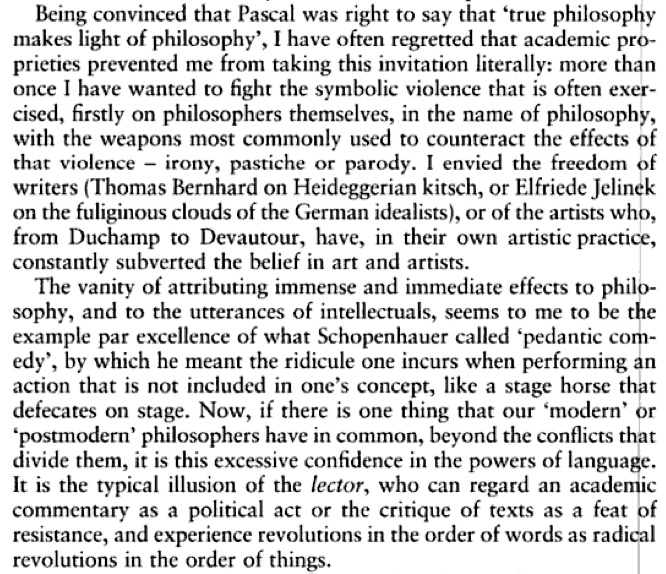
A Kind Of Blank Spot

[M]y wife and I realized you cannot pay attention to everything, so I said to myself “one continent that I am going to leave aside is Africa.” I preferred to concentrate on Europe and China. I did a pretty good deal of work on China because I saw it ripe to become one of the most important parts of the world of which I knew nothing. So, I proceeded to do a lot of work on China in order to know something about it. But Africa is kind of a blank spot for me, apart from casual observation. Even though, I would say that the whole notion of anarchy applies very well to Africa.

In fact, a criticism people used to make to me was that Africa was clearly an anarchic arena, and yet African states did not fight much among themselves. How, then, would a Realist like myself explain that? Well, I did by invoking Turney-High’s book in anthropology, which was published—I believe—in the 1920s. There, he made the very valid point that countries have to obtain a certain level of self-consciousness as being a political entity, and a certain level of competence before they are able to fight one another. Turney-High’s illustration was very clear with his study of the peoples he referred to as the “Californians,” who were such a primitive people that they did not have the ability to form groups or fight as a group. A consciousness and competence at a certain level is needed before a group is able to systematically impose on another group—whether in the form of warfare or in other ways. I think that, for a long time, Africa was in that condition, and that, as it proceeds away from that condition, African countries will be able to fight wars against one another. In a historical sense, though, that is an implication of advancement.

Kenneth N. Waltz, ‘Theory Talks #40: The Physiocrat Of International Politics’, 3 June 2011

Pragmatist Notes, part II

To be set on fire by a thought or scene is to be inspired. What is kindled must either burn itself out, turning to ashes, or must press itself out in material that changes the latter from crude metal into a refined product. Many a person is unhappy, tortured within, because he has at command no art of expressive action. What under happier conditions might be used to convert objective material into material of an intense and clear experience, seethes within in unruly turmoil which finally dies down after, perhaps, a painful inner disruption.

Persons who are conventionally set off from artists, “thinkers,” scientists, do not opperate by conscious wit and will to anything like the extent popularly supposed. They, too, press forward toward some end dimly and imprecisely prefigured, groping their way as they are lured on by the identity of an aura in which their observations and reflections swim. Only the psychology that has separated things which in reality belong together holds that scientists and philosophers think while poets and painters follow their feelings. In both, and to the same extent in the degree in which they are of comparable rank, there is emotionalized thinking, and there are feelings whose substance consists of appreciated meanings or ideas.

The psychology underlying this bifurcation was exploded in advance by William James when he pointed out that there are direct feelings of such relations as “if,” “then,” “and,” “but,” “from,” “with.” For he showed that there is no relation so comprehensive that it may not become a matter of immediate experience. Every work of art that ever existed had indeed already contradicted the theory in question. It is quite true that certain things, namely ideas, exercise a mediating function. But only a twisted and aborted logic can hold that because something is mediated, it cannot, therefore, be immediately experienced. The reverse is the case. We cannot grasp any idea, any organ of mediation, we cannot possess it in its full force, until we have felt and sensed it, as much so as if it were an odor or a color.

Whenever an idea loses its immediate felt quality, it ceases to be an idea and becomes, like an algebraic symbol, a mere stimulus to execute an operation within the need of thinking. For this reason certain trains of ideas leading to their appropriate consummation (or conclusion) are beautiful or elegant. They have an esthetic character. In reflection it is often necessary to make a distinction between matters of sense and matters of thought. But the distinction does not exist in all modes of experience. When there is genuine artistry in scientific inquiry and philosophical speculation, a thinker proceeds neither by rule nor yet blindly, but by means of meanings that exist immediately as feelings having qualitative color.

Santayana has truly remarked: “Perceptions do not remain in the mind, as would be suggested by the trite simile of the seal and the wax, passive and changeless, until time wears off their rough edges and makes them fade. No, perception falls into the brain rather as seeds into a furrowed field or even as sparks into a keg of gunpowder. Each image breeds a hundred more, sometimes slowly and subterraneously, sometimes (as when a passionate train is started) with a sudden burst of fancy.” Even in abstract processes of thought, connection with the primary motor apparatus is not entirely severed, and the motor mechanism is linked up with reservoirs of energy in the sympathetic and endocrine system. An observation, an idea flashing into the mind, starts something. The result may be a too direct discharge to be rhythmic. There may be a displace of rude undisciplined force. There may be a feebleness that allows energy to dissipate itself in idle day-dreaming. There may be too great openness of certain channels due to habits having become blind routines – when activity takes the form sometimes identified exclusively with “practical” doing. Unconscious fears of a world unfrienly to dominating desires breed inhibition of all action or confine it within familiar channels. There are multitudes of ways, varying between poles of tepid apathy and rough impatience, in which energy once aroused, fails to move in an ordered relation of accumulation, opposition, suspence and pause, toward final consummation of an experience. The latter is then inchoate, mechanical, or loose and diffuse. Such cases define, by contrast, the nature of rhythm and expression.

-John Dewey, Art as Experience

Dr Hoover, I Presume?

Disordered congratulations are in order. Yesterday, following a few hours of rigorous questioning by Anne Phillips and David Owen, our very own Joe was awarded the title of Doctor of Philosophy from LSE for his thesis: Reconstructing Human Rights: A Pragmatic and Pluralist Inquiry in Global Ethics. No corrections. We’ll do our best to get him to tell us all about it soon.

Sociology Is A Martial Art

A May Day found object (appropriately enough). Pierre Carles’ 2001 documentary on Pierre Bourdieu, in seven connected parts (missing, unfortunately the end). Besides the biographical, cinematic and intellectual value, it may also be of interest to Disordered readers for the scattered touches on science and its relation to politics and on the character and reproduction of inequality.


A Feminist Ideography

Ending is such sweet sorrow. Yesterday the alphabet series over at Bad Reputation came to a close. Its task: “..to address (with reasonable neutrality), the make-up of the English mother-tongue, to consider how the language has evolved over the centuries, and in the process to prompt some questions about how gender issues are woven into the fabric of the language we use everyday.”

And what an unravelling it was. Here are some disordered excerpts. Direct your thanks at Hodge.

Z is for Zone:

The Medieval West was not to be left behind in all this sexy-talk: no right-thinking female of the thirteen-hundreds considered herself fully sexed-up without a gipon, a type of corset designed to flatten the breasts and emphasise the stomach. And in case this proved insufficient, she might also pad her belly out for extra effect – well-rounded bellies appear again and again in contemporary art – and, as with the Cranach Venus, a decorative zone was the perfect way to emphasise its shape, making this a garment no less sexually charged in the 1340s than the 1940s (when, of course, its job was to hold the belly in). Like a garter, then, a girdle could serve as a fetishistic focal point for erotic (and indeed erogenous) zones, marking them out and keeping them restrained at the same time.

H is for Hysteria:

One explanation for [Hysteria’s] seeming explosion during the nineteenth and early twentieth centuries is its use as a catch-all term for Generic Women’s Troubles (hence calling it, essentially, ‘womb-problem’), and indeed, it does seem to have been partially conflated with chlorosis (a type of anaemia), which is perhaps better known to Renaissance drama fans as ‘green sickness’. Thus, in John Ford’s play ‘Tis Pity She’s A Whore (you’d think you couldn’t top that title, wouldn’t you?) Annabella is thought to be suffering from ‘an overflux of youth’, in which case ‘there is no such present remedy as present marriage’. Translation: get a willy in her, quick.

Continue reading

Suggestion


Why can’t I walk down the street
Free of suggestion?
Why can’t I walk down a street
Free of suggestion?
Is my body my only trait
In the eyes of men?
I’ve got some skin
You want to look in
….
Suffer your words, suffer your eyes, suffer your hands
Suffer your interpretation of what it is
To be a Man
….
We don’t want anyone to mind us
Play the roles that they assign us
She does nothing to conceal it
He touches her because he wants to feel it
We blame her
For being there
But we are all here
We are all
Guilty

Fugazi, Suggestion (1989)

Revolution in Egypt

Because of the politics of becoming, gaps and fissures open up periodically between positional sovereignty as the highest authority to interpret the law and sovereignty as the effective power to decide what it will be. These two dimensions of sovereignty often shade into one another. But the discrepancy sometimes becomes a fissure that is too dramatic to ignore

William E. Connolly, Pluralism

International Relations versus Punk Rock (Slight Return)

Nothing could compromise a joint blog project more than disagreement over music. Luckily, this much-delayed follow-up to Joe’s sonic assault on global politics gets to play the role of supplement and supplicant, and not that of adversary. And no, it’s not bloody Christmas-themed.


Nobody was as fully aware of the properly traumatic dimension of the human voice, the human voice not as the sublime, ethereal medium for expressing the depth of human subjectivity, but the human voice as a foreign intruder, nobody was more aware of this than Charlie Chaplin [in The Great Dictator]…Silent figures are basically like figures in cartoons, they don’t know death, they don’t know sexuality even, they don’t know suffering, they just go on in their oral egotistic striving, like cats and mouse in a cartoon: you cut them into pieces, they’re reconstituted. There is no finitude, there is no mortality here. There is evil, but a kind of a naïve, good evil, you are just egotistical, you want to compete, you want to hit the other, but there is no guilt proper. What we get with sound is interiority, depth, guilt, pulpability, in other words the complex oedipal universe. The problem of the film is not only the political problem, how to get rid of totalitarianism, of its terrible seductive power, but it is also this more formal problem, how to get rid of this terrifying dimension of the voice. Or, since we cannot get rid of it, how to domesticate it, how to transform this voice nonetheless into the means of expressing humanity, love, and so on…

[Chaplin’s character] delivers his big speech about the need of love, understanding between people, but there is a catch, even a double catch: people applaud exactly in the same way as they were applauding Hitler. The music that accompanies this great humanist finale, the overture to Wagner’s opera Lohenngrin is the same music as the one we hear when Hitler is daydreaming about conquering the entire world and where he has a balloon in the shape of the globe, the music is the same. This can be read as the ultimate redemption of music, that the same music which served evil purposes can be redeemed to served the good, or it can be read – and I think it should be read – in a much more ambiguous way, that with music we cannot ever be sure, insofar as it externalises our inner passion music is always potentially a threat.

Slavoj Žižek, The Pervert’s Guide To Cinema

We humans are a musical species no less than a linguistic one.

Oliver Sacks, Musicophilia: Tales of Music and the Brain


1. Fugazi, ‘Smallpox Champion’, In On The Kill Taker (1993)

Smallpox champion, U S of A
Give natives some blankets
Warm like the grave
This is the pattern cut from the cloth
This is the pattern designed to take you right out, right out, right out
This is the frontier with winter’s so cold
Greed informs action where action makes bold
To take all the cotton that’s cut from the stalk
Weave the disease that’s gonna take you right out, right out, right out
What is good for the future what was good for the past
What is good for the future…won’t last
Bury your heart U S of A
History rears up to spit in your face
You saw what you wanted
You took what you saw
We know how you got it
Your method equals wipe out, wipe out, wipe out
The end of the frontier and all that you own
Under the blankets of all that you’ve done
Memory serves us to serve you
Yet memory serves us to never let you wipe out, wipe out, wipe out
Cha-cha-cha-champion
You’ll get yours
Wipe out

2. Ani Difranco, ‘Fuel’, Little Plastic Castle (1998)

Continue reading