Economy of Force

We return from the holidays with gusto and a book symposium on Patricia Owens’ Economy of Force: Counterinsurgency and the Historical Rise of the Social (Cambridge, 2015). Patricia is Professor of International Relations at the University of Sussex, co-editor of European Journal of International Relations, and a former fellow of the Radcliffe Institute for Advanced Study at Harvard University and of Oriel College, Oxford. Patricia’s first book was Between War and Politics: International Relations and the thought of Hannah Arendt (Oxford, 2007). Economy of Force is in the Cambridge University Press series ‘Studies in International Relations’ and is out in paperback next summer (the introduction is available in full here). The book will also be the subject of a forthcoming special section of Security Dialogue.
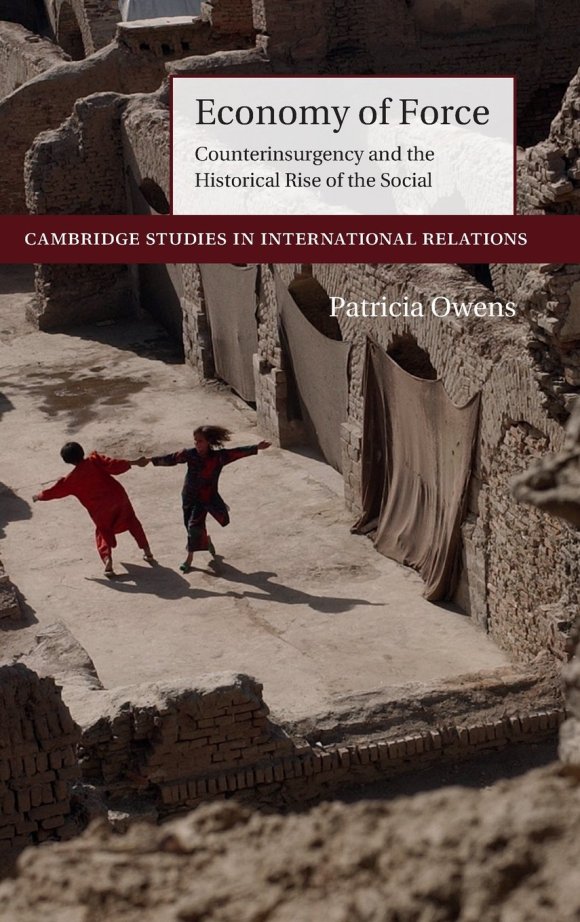

Economy of Force

Economy of Force seeks to rekindle interest in one of the oldest but neglected languages and techniques of government administration – household governance – that it uses to write a new history and theory of counterinsurgency with broad implications for social, political, and international thought. The book is a study of oikonomia in the use of force, from oikos, ancient Greek for household. But it also makes a larger claim, that household governance underlies the relatively recent rise of distinctly social forms of government and thought more broadly. Since the late eighteenth-century, modern, capitalist state and imperial administrators have drawn on and innovated different forms of household governance, scaling up and transforming the units of rule in which populations are domesticated. To really understand the significance of households-as-government we need to dispense with the relatively recent and bourgeois notion of households as houses, homes, or family-as-kin. Instead, households are best understood through the nature of the hierarchical relations between people in a particular spatial arrangement. Households are the persistent but historically variable spaces in which the life processes of members – real, vulnerable bodies needing food, water, shelter – are administered and the household itself is maintained.

There is a very long tradition of thinking of households-as-government in the history of political and economic thought and in anthropology, archeology and comparative studies of different household forms. There is also excellent and wide-ranging scholarship in literary and gender studies on practices and ideologies of domesticity (from domus, Latin for house). In drawing on and extending these and other literatures, Economy of Force suggests that there is a far deeper significance of households and forms of domesticity than captured in International Relations debates about the so-called ‘domestic analogy’. Household administration is highly portable and plays a remarkably significant role in imperial and international relations. These are grounds to make a stronger claim than one based on mere analogy. I argue that there is a domestic homology connecting different households, despite their historical and geographical variability, based on the genealogy of household governance in the history of social and political thought, but also the human experience of basic life necessities and the stubborn but contingent attempts to domesticate people through the administration and control of life needs.
Continue reading

Societies Under Siege: Exploring How International Economic Sanctions (Do Not) Work

This is the first in a series of posts on Lee Jones’ Societies Under Siege: Exploring How International Economic Sanctions (Do Not) Work. Responses will follow from guest authors Elin Hellquist, Clara Portela and Katie Attwell over the next few days.


It doesn’t seem to matter what the international crisis is: be it an inter-state war (Russia-Ukraine), civil strife (Syria), gross violations of human rights (Israel), or violent non-state actors on the rampage (ISIS, al-Qaeda), the ‘answer’ from governments and civil society always seems to be the same: impose economic sanctions. In the mid-20th century, only five countries were targeted by sanctions; by 2000, the number had increased tenfold. Once an obscure, rarely used and widely dismissed form of statecraft, sanctions are now clearly central to the exercise of power in international relations – particularly when dominant powers are reluctant to put ‘boots on the ground’.

My new book, Societies Under Siege: Exploring How International Economic Sanctions (Do Not) Work, is the first comparative effort to explore how these sanctions ‘work’ in practice – on the ground, in target states. This post introduces the book and the forum that will follow.

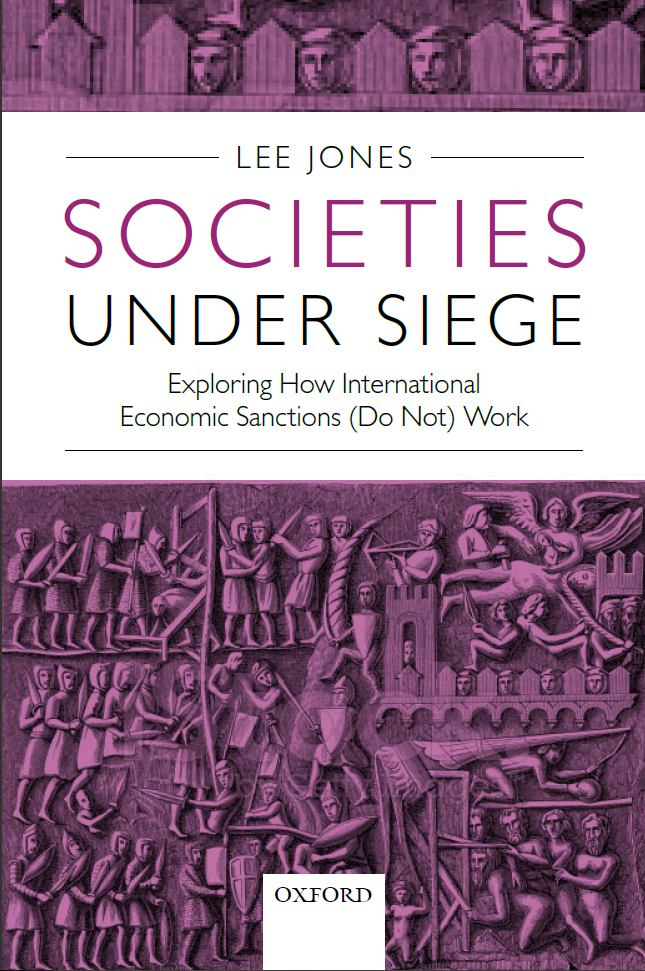
Societies Under Siege cover. The image is an engraving of a (failed) siege during the Albigensian crusade.

Societies Under Siege cover. The image is an engraving of a (failed) siege during the Albigensian crusade.

Continue reading

Myths of Invention

The fifth commentary, and sixth post, on Nick Srnicek and Alex Williams’ Inventing the Futurefrom DoT’s own Joe Hoover. A reply from Nick and Alex will follow.


Inventing the Future begins with a lament.

Where did the future go? For most of the twentieth century, the future held sway over our dreams. On the horizons of the political left a vast assortment of emancipatory visions gathered, often springing from the conjunction of popular political power and the liberating potential of technology.

The authors resent that they have been denied a future with more promise than the present. They mourn the absence of the object of their desire, the impossibility of its fulfilment, the lives to be lived in these lost leftist utopias. This seems to be a widely felt disappointment, if we are to judge by how often the complaint has been made of late. Disappointment leads to diffuse anger, directed at the status quo on the “Left”, its lack of vision. At the root of this discontent is anger at the world itself, for all of the ways it impedes us, frustrates our hopes and gives no comfort to our dreams – it is a world in need of re-making. I do not want to suggest that because the book’s narrative is motivated by such feeling that it can be reduced to an outburst against the vagaries of existence, the work is too focused and the problem it addresses too serious for such crude criticism. Yet, this fundamental emotional resentment colours the project in an important way.

Orpheus plays his lament

The lament shapes the inquiry itself. We are wounded by the loss of our desire – a future flush with possibility – and we are angry at capitalism for stealing our future. Obviously the detail is more sophisticated than this curt summary, but a stark statement of the underlining logic reveals the essential narrative. The problem of contemporary Left politics is not the desire for a universal utopian future but rather that this future has been lost, which runs counter to important criticisms of progressive leftism (a point taken up by Aggie Hirst and Tom Houseman). Therefore, the authors’  task is to remind us why we desire the future, then to consider where to look for a new one and how to seek after it. Inventing the Future is a quest to find what was lost, so we can become whole in our desires. We may set out on such a quest with great optimism but we still carry a worrisome anger with us.

There are a great many barbarities in our world attributable, at least in part, to “capitalism” but it is not a villain stealing away with our ladylove (the difficulties of determining what capitalism is are taken up later). Our lost future is not the exceptional crime of some neoliberal conspiracy. Yes, I know the book does not say anything quite so crude. Nonetheless, the narrative structure is driven by a conflict that finds its resolution with the us (the protagonist) achieving wholeness in a future fulfilment of our desire. The authors make the caveat that contestation will not end in this postcapitalist future, but this future still holds out the promise that the conflicts of today will melt away. The world is always messy, unfinished, stubborn, cruel, confused, and, I posit, resistant to the kind of  breaks with past ways of being that are suggested here (Sophie Lewis and David Bell look at the temporalities involved in greater detail). If we lament that, we risk resentment against the world itself, against human existence and against flesh and blood people who move slowly and impede our dreams. Love of the future sits dangerously close to hatred of the present – which is not to say we should have no love of the future, but rather that we ought to be wary of too much of it.
Continue reading

Pyrrhic Victories: The Endgames of Accelerationist Efficacy

The fourth commentary, and fifth post, on Nick and Alex Williams’ Inventing the Future, delivered by Aggie Hirst and Tom Houseman. Aggie is a Lecturer in International Politics at City University London. She works on issues relating to violence and international theory/philosophy, including war and wargaming, US foreign policy, Derrida, Nietzsche, and post-foundational ethics/politics. Tom is a Lecturer in International Politics at the University of Manchester, focusing on capitalism, development, and ideology. He is variously interested in (in no particular order) the politics of epistemology, apocalypticism, Adorno, international development, and concepts of science.


In a climate of successive defeats, missed opportunities and the consolidation (and even exacerbation) of unequal and exploitative social relations, there are few acts more thankless than turning the weapons of iconoclasm against those already waging a struggle against insurmountable odds. Inventing the Future seeks to rescue the Left from what its authors term ‘folk politics’: a commitment to horizontal, local, consensual and prefigurative forms of political action, which the authors claim result ultimately in impotence and irrelevance, aimlessness and lack of focus. In condemning a host of the post-68 Left’s most dearly held praxiological and ethical commitments, Srnicek and Williams wilfully risk aggravating and alienating those they seek to influence.

There will be many readers who will find their prescriptions – the revival of universalism, the aspiration to hegemony, the mobilisation of state power – outdated, odious and even obscene. And for good reason: the attack on ‘folk politics’ doesn’t end after the critique that opens the book. Instead, the sheer audacity of the authors’ wager – essentially that our only hope of defeating the Godzilla of neoliberal capitalism is the creation of an equally powerful Mechagodzilla capable of supplanting the former’s hegemony with its own – performs an ongoing rejection of a parochialism and modesty they see as having corrupted Leftist activism and academia. Like all iconoclasm, such a move is necessarily scandalous in response to the perceived sanctity of that at which it takes aim.[1]

It is precisely this scandalous character of both the book and its precursor, the ‘Manifesto for an Accelerationist Politics’ (MAP), which goes some way to accounting for the attention the authors have generated across the Left. The book’s stated goals are both vast in scope and highly controversial, yet its tone is one of consistent and calm self-assuredness. The magnitude of the risks associated with the project – the casualties of automation (both human and environmental), the tyrannies of engineering consent, the violences of assuming the task of constructing people’s very identities, to point to just a few – would suffice to make most recoil in dread. The authors’ composed confidence in the face of such potential horror makes reading and responding to the seductions of such book a complex and disorientating task.

Continue reading

Three Theses on ISIS: The Universal, the Millenarian, and the Philistine

Nimer SultanyA warm welcome to Nimer Sultany who brings us a guest post on thinking about ISIS. Nimer is Lecturer in Public Law, School of Law, SOAS, University of London. He holds an SJD from Harvard Law School. He practiced human rights law in Israel/Palestine, and was the director of the Political Monitoring Project at Mada al-Carmel – The Arab Research Center for Applied Social Research. His recent publications include: “The State of Progressive Constitutional Theory: The Paradox of Constitutional Democracy and the Project of Political Justification” in the Harvard Civil Rights – Civil Liberties Law Review and “Religion and Constitutionalism: Lessons from American and Islamic Constitutionalism” in the Emory International Law Review.


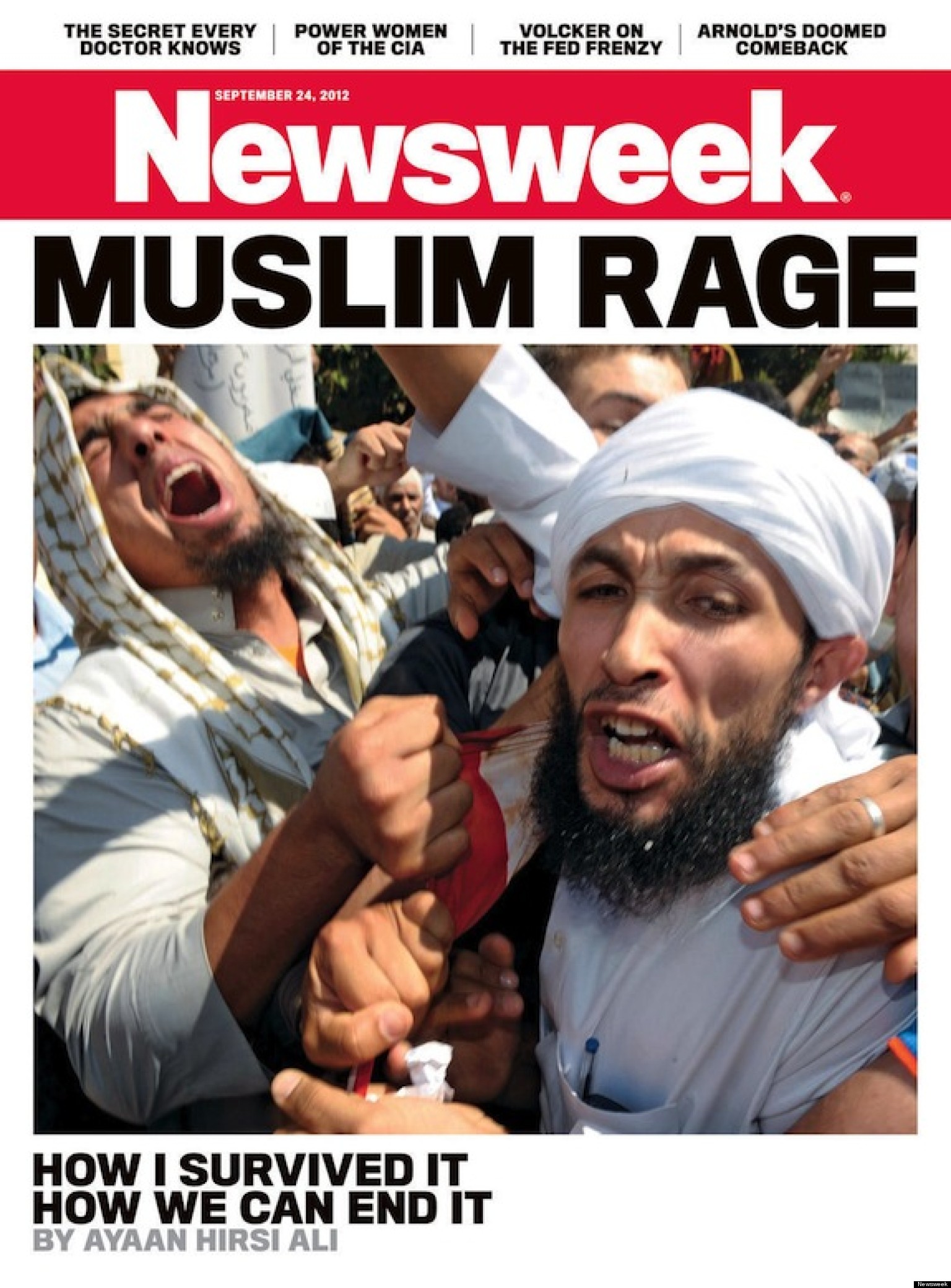
The ruthless brutality of the Islamic State in Iraq and Syria (ISIS or ISIL) unfolds before our eyes on the screens. As commentators struggle to explain and understand it, it becomes convenient to revive old Orientalist tropes. Beyond the spectacular brutality, the reason that ISIS invites attention (both fascination and fear) is that it seems easy to fit in confrontational narratives of Islam (us v. them, anti-American, etc.). Muslims are clearly angry at something. In his infamous article “The Roots of Muslim Outrage”, Bernard Lewis simplistically explained that Muslims are envious of, and angry at, Western modernity and secularism. The U.S. magazine Newsweek illustrated this knee jerk reaction, and recourse to run of the mill thinking patterns, in a Muslim Rage cover in September 2012.

o-NEWSWEEK-MUSLIM-COVER-facebook

In his book “Covering Islam” (1981) Edward Said has effectively critiqued these binary simplifications that dominate not only journalistic discourse about “Islam”, but also expert-talk about Islam. For Said, all attempts to conceptualise other cultures are a value-laden interpretive exercise. He showed the deficiencies of orthodox writings on—and views of—Islam, and called for “antithetical knowledge” to challenge the orthodoxy’s claims of value-free objectivity.

It seems little has changed, however, since Said wrote his book in the wake of the Iranian revolution. In this brief commentary I want to examine three attempts to understand ISIS. These are long treatments in respected liberal media outlets. To use Said’s phrase, these are treatments that fit in different “communities of interpretation.” These three essays are all aware of the need to provide “context” for ISIS. However, their contextualisation differs. The success of this contextualisation in shedding a light on ISIS varies. Let me call these interpretive techniques: universalization; Millenarian confrontation; and intellectual bewilderment. These three attempts operate mostly on the ideational/ cultural domain.

Continue reading

Theorizing Embodiment and Making Bodies ‘Matter’

Bringing to a close our symposium on Bodies of Violence is Lauren’s rejoinder to all our contributors, Kevin McSorley, Ali Howell, Pablo and Antoine.


First, a huge thank you to the (Dis)order of Things and especially Antoine for organizing this forum and to each of the contributors. It’s been a huge honor to have my work read so carefully and responded to so thoughtfully and I welcome the opportunity to try to clarify some of my work and acknowledge where the contributors have pointed out helpful areas for future research.

As Pablo K and others noticed, Bodies of Violence it is not meant to be a general theory of embodiment in IR (I’m not sure such a project is feasible or politically desirable in any event).  It is a more specific intervention with a different ambition: both to speak to ‘mainstream’ concerns about theorizing violence, particularly forms of political violence associated with the ‘war on terror’ and to make not only a theoretical argument about how we might or should theorize embodiment and violence, but also to show that understanding these different ‘modes of violence’ necessitates such an understanding of the relationship between bodies, subjects and violence.  My rationale for using feminist theory to think about the relationship between bodies, subjects and violence in IR was not meant to be exclusive: certainly (other) people working with concepts of biopolitics as well as anti-colonial/anti-racist theorists, disability theorists, phenomenologists and more also have much to say on this topic, some insights of which have been very important in my analysis, if not as fully fleshed out (if you will) as my engagement with feminist theory is.[i] For me, it was a particular reading of feminist theories of embodiment, not solely based on Butler, but on a particular feminist problematic in which women, as a category of those constituted, as Pablo K put it, the “improperly bodied”, are politically disenfranchised and generally excluded from their status as a fully human subject that served as a starting point, but far from an ‘ending’ for thinking about the subject of embodiment.  Rather, it is, as Kevin noted, “the specific tradition of trying to think through women’s subordination in terms of the relationship between bodies, subjects and power” that feminist theory entails that I wanted to use to think about violence and embodiment in ways that I hope will speak not only to feminists in IR but also to other critical and the more pluralistically and trans-disciplinarily minded scholars in IR and beyond as well.

Continue reading

Secular Bodies of Pain and the Posthuman Martial Corps

The penultimate post in the symposium on Lauren Wilcox’s Bodies of Violence before the author gets the opportunity to respond to all the participants. Previous contributions come courtesy of Kevin McSorley, Ali Howell and Pablo – Lauren’s opening post can be found here.


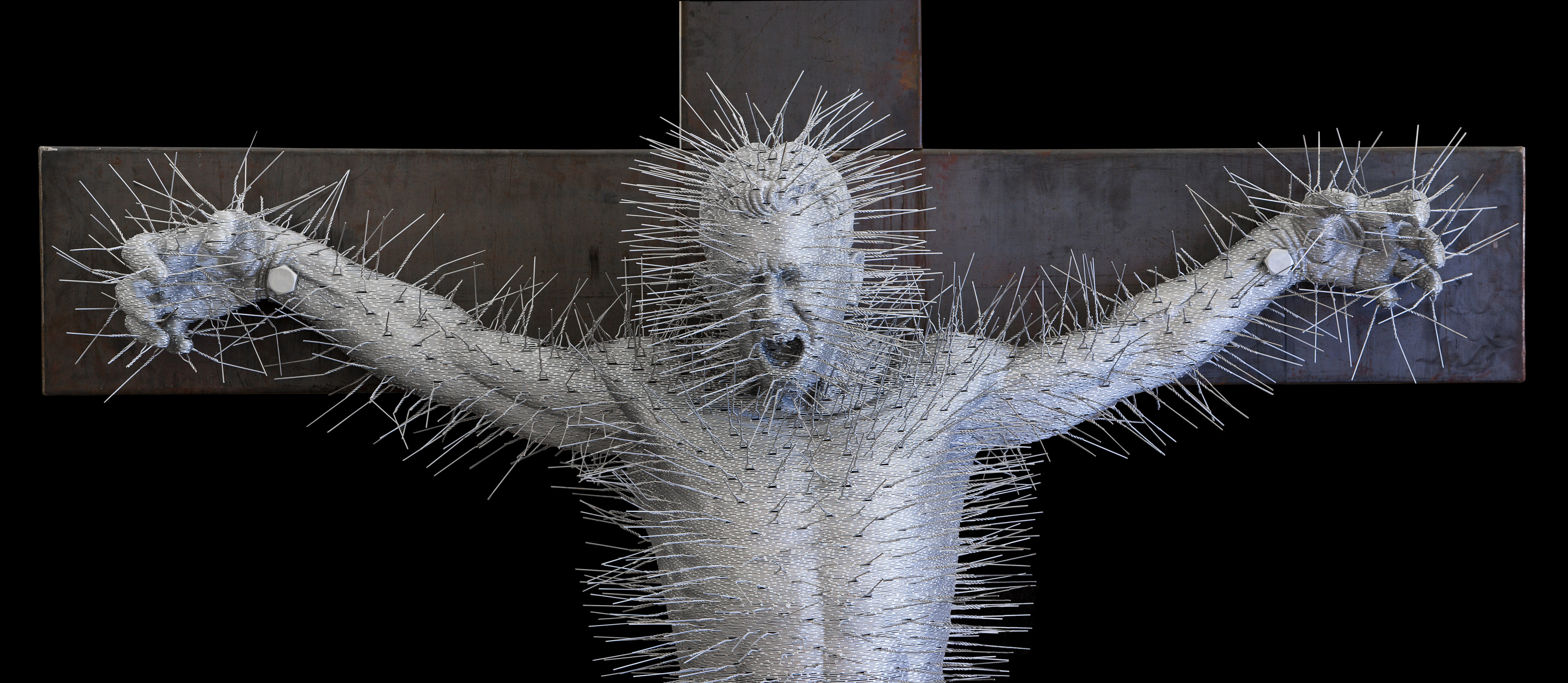
David Mach, Die Harder (2011)

David Mach, Die Harder (2011)

With Bodies of Violence, Lauren Wilcox performs the much-needed service of bringing the body back to the foreground of international politics. Through both sophisticated theoretical exegesis and a rich treatment of relevant empirical material, the work insistently underlines why embodiment matters in contemporary practices of violence and how so many accounts of international relations to date have been deficient in this regard. To any that might still doubt it, Wilcox further demonstrates how the insights developed by feminist theory are not restricted to its primary object of gender and makes a compelling case that we find in this body of work one of the most important repositories of conceptual resources for thinking physical embodiment and the normative social frameworks in which such embodiment is lived out.

Perhaps Wilcox’s most important theoretical commitment in the book is her steadfast refusal to take bodies, and by extension political subjects, as given. Instead, bodies are always to be conceived of as in-formation, produced within and bound by normative orders all the while resisting and exceeding them. The human body should therefore not be treated as the basic unit of social ontology or serve as the fixed atom upon which the edifice of political theory is to be constructed (as exemplified by liberalism’s usual reliance on the sovereign rational individual). Drawing in particular on Judith Butler’s work, Wilcox proposes rather to conceptualise the subject as ‘ontologically precarious’ (p.190) and our political orders as accordingly contingent and open-ended. Violence is here taken to be of critical importance since it cannot be considered as ‘merely harmful but is constitutive of the embodied subjects of IR’ (p.28).

Bodies of Violence offers much stimulus for reflection but I will limit my comments to developing two lines of thoughts which are presented here as much as general provocations than as pointed questions to Wilcox. The first concerns the status of pain within the ethico-political imaginaries of modern societies, the second pertains to the relation of the posthuman military body to prevalent corporeal norms.

Continue reading

Bodies, What Matter?

And now, the fourth post in our symposium on Lauren Wilcox’s Bodies of Violence.[1] It follows Lauren’s opener, Kevin McSorley’s take on embodiment and Alison Howell on the value of feminist IR in such a project. Posts by Antoine and a rejoinder from Lauren follow.


Type Any Name Bodies

Lauren Wilcox seeks something like a theory of the body (and embodiment, crucially different) in international political violence. The body not as inert or as the mere vehicle for mind, but malleable, and indeed “deeply political”. As she puts it early on in Bodies of Violence, we therefore require a conceptual framework for seeing “how bodies are enabling and generative of war and practices of political violence more broadly”. And it is part of her case that such a theory of bodies – or, at least, a theoretical inquiry into violent embodiment – would be among the first in the discipline of International Relations, which has thus far failed to understand how bodies matter, how bodies are produced, and how violence acts upon and through bodies, even as it claims to be the discipline most concerned with human survival in the face of organised violence. And despite IR being in thrall to an unsustainable individualism, which might at least be expected to bias it towards discrete human experience.[2]

In short, international theory is disembodied, and the body an “absent presence” (aptly put, and true). Since we all have bodies, and can only encounter the world through our bodies, we should thus in some sense seek to include – perhaps even ‘centre’ – the body in theory. Even as poststructural scholarship evades the injunction to produce systematic theory, it is able to reveal the absence of bodies in our dominant paradigms. Wilcox pushes us in the same direction, arguing that, as subjects, we are embodied, precarious and have physical forms that are both produced by, and are in turn productive of, the world of ‘politics’. This is both a conceptual and a normative question, since those who have been considered improperly bodied have historically been excluded from politics, from the means of social reproduction and autonomy, and from recognition as human itself.

To not see the body is thus not to entertain a neutral and cerebral vision of the human, but instead to reproduce the historical exclusions by which some bodies (in the familiar refrain, those that are male, white, cisgender, heterosexual, Eurocentric, able-bodied and rational) are taken to be the benchmark by which others (framed as deviant, inadequate, juvenile or dangerous) are measured and found wanting. Bodies of Violence moves through a series of sites (the US Naval Base, Guantanamo; the suicide bomber’s vest; the airport scanner; the drone operator’s screen-throne; the rhetoric of humanitarian intervention), mapping how the body figures in each of them. It is a book thoroughly about bodies, but not therefore necessarily a theory of bodies and embodiment. And it is theory of em-bodies-ment that we may in need of.

Continue reading

Bodies, and Violence: Thinking With and Beyond Feminist IR

10170814_10203788729029655_7004664852126275170_nOur third post in the symposium on Lauren Wilcox’s Bodies of Violence comes courtesy of Alison Howell (the first two posts can be found here and here). Alison is an Assistant Professor of Political Science at Rutgers University, Newark. She has written on topics relating to the international relations of medicine, health, security and warfare. Her first book, Madness in International Relations examined the role of psychology in global security practices.


I have a confession to make: at the last ISA, swept up in the magic of New Orleans, I rekindled a romance. I should probably clarify that I’m not talking about one of those salacious romances that one hears rumors of on the Hilton elevator. No, I’m talking about my relationship to FTGS specifically, and feminist IR more generally.

tacky rose

When I first started going to the ISA a little over ten years ago, I felt strongly identified with FTGS. Though I consider my research feminist (amongst other things), and though, for that matter, I’ve continued to pay dues to the FTGS section as a kind of hopeful political act – still the romance didn’t last. Partly my intellectual curiosities took me in different directions. I also had trouble articulating some of the problems I had with the deployment of some concepts in feminist IR (especially the concepts of trauma, and also violence, which I’ll return to in a few paragraphs).

But lately I’ve been feeling flirtatious with feminist IR again. In part, this is because I’m finally getting some clarity on why I have disagreements with some feminist thought in IR (and thoughtful disagreement is a kind of engagement). It’s also because I think that feminist IR is beginning to be more diversely peopled and theorized. For these reasons, I was excited to find Lauren Wilcox’s impressive book in my possession, a book that appears as part of Oxford University Press’s Gender and International Relations series, a perch from which it is pushing feminist IR in some new directions.

Wilcox’s book is novel in that it works to systematize an approach to the body in IR. To date, a focus on the body as a site of theoretical concern in IR has been piecemeal, though certainly not absent. Yet what Wilcox achieves in placing the body and embodiment as central conceptual artifacts in Bodies of Violence, is to freshly open up a number of thematic concerns and questions for the study of global politics.

Continue reading

Violence, Norms and Embodiment

McSorleyWe are delighted to welcome Kevin McSorley for the second post of our symposium on Lauren Wilcox’s Bodies of Violence. Kevin lectures in Sociology at the University of Portsmouth. His work explores war, violence and militarism through the lens of embodied, emotional and sensory experience. His scholarship has explored contemporary conflicts including those in Chechnya, Iraq and Afghanistan, as well as analysing phenomena including the global arms trade, military fitness regimes, and helmetcam technologies. Recent publications are available at Academia.edu.


Lauren Wilcox’s Bodies of Violence: Theorising Embodied Subjects in International Relations is an extremely welcome addition to a growing corpus of recent scholarship that attempts to foreground the body and embodiment in the analysis of topics such as war, violence and security. Wilcox argues that IR has historically constituted itself as a discipline partly in terms of the exclusion of the detailed consideration of the body and embodiment, concerns which have rarely been admitted as core to a discipline whose interests supposedly lay at higher levels of abstraction. Indeed, the absenting and sequestering of the bodily and particular bodies has been central to the formation and history of many academic disciplines, modern social and cultural formations, and the organisation of much mundane experience. Relatedly, it is often specifically in occurrences and encounters of bodily discomfort, illness, estrangement, harm, failure, violence and pain that the body may assume a renewed experiential salience in everyday life. The under-theorisation of embodiment thus seems particularly paradoxical for a discipline such as IR, whose analytic remit encompasses the organisation of violence and pain for political ends, phenomena which can hardly be adequately understood without attempting to think through the multiple ways that violence and pain are intimately related to the in/abilities of bodies to engage in particular sense-making, meaning-making and worlding practices. Indeed, such under-theorisation may be more than just paradoxical, for abstract strategic thinking that avoids acknowledging bodies has historically been complicit with particular expert modes of knowing and doing violence.

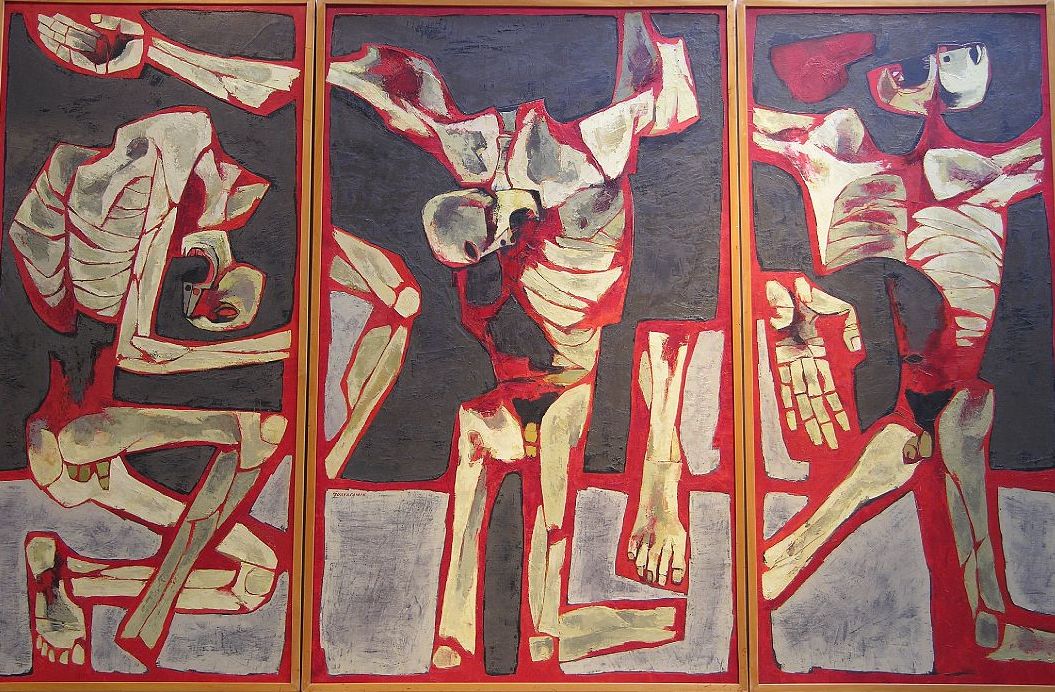
Oswaldo Guayasamín, Los Torturados (1976)

Oswaldo Guayasamín, Los Torturados (1976)

Wilcox’s project is thus a necessary intervention that grapples meaningfully with the disembodied soul of IR and I am thoroughly supportive of its ambitions. The body is one of the most plural and contested concepts in social science but Wilcox initially argues that, when considered at all, the way that it has typically been rendered through the realist and liberal traditions of political thought that inform IR and security studies is as a stable, singular, bounded and natural entity whose flourishing is dependent upon protection from various inevitable risks and threats. This narrow understanding of the body is thus of something essentially thing-like, fixed and existing outside the realm of the political. In contrast, biopolitical and particularly feminist analytics – the latter having a specific tradition of trying to think through women’s subordination in terms of the relationship between bodies, subjects and power – provide the alternative conceptual underpinning for Wilcox’s own analysis.

Continue reading