The third response in our symposium on Radhika Mongia’s Indian Migration and Empire: A Colonial Genealogy of the Modern State is by Sanjay Seth, who is Professor of Politics at Goldsmiths, University of London. He is the author of Marxist Theory and Nationalist Politics: The Case of Colonial India (Sage, 1995), Subject Lessons: The Western Education of Colonial India (Duke University Press, 2007 and Oxford University Press, 2008) and, most recently, Beyond Reason: Postcolonial Theory and the Social Sciences (Oxford University Press, 2020).
Radhika’s Indian Migration and Empire is subtitled ‘A Colonial Genealogy of the Modern State’, and part of the book’s argument is that while it is assumed that control of migration ‘is a defining, definitive, unchanging, and unchangeable element of (state) sovereignty’ (p. 7), in fact control of migration within the British empire occurred late and helped to produce state sovereignty. In making this argument Radhika traces how, in the wake of the abolition of slavery in 1834, the British empire played an active role in facilitating the movement of its Indian citizens into its ex-slave plantation colonies as much needed indentured labour, and developed elaborate governmental machinery to do so; by contrast, the movement of peoples other than indentured labourers within the British empire was largely unregulated and not constrained. It was in fact the white dominions of the empire that sought to restrict and regulate the entry of non-white imperial subjects, finally achieving their aim following the Komagata Maru incident in 1914. It was only after this that the freedom of British subjects to move from one part of the empire to another was abandoned, and a passport system allowing race-based restriction was introduced. Mongia concludes, ‘control over mobility does not occur after the formation of the nation-state … the very development of the nation-state occurred, in part, to control mobility across the axis of the nation/race’ (p. 139, emphasis in original). The modern sovereign state thus has a colonial and imperial genealogy.

This book is a distinguished addition to a growing literature that requires us to recognise that the conventional picture of the sovereign state as the foundation of certain practices has things the wrong way around. Another recent example is Tarak Barkawi’s Soldiers of Empire (2017), which similarly challenges the assumption that modern wars between states have been fought by the armies of these states, such that we may assume a ‘sovereign territorial package of state, army, and society’. In fact, this has been the exception rather than the rule. The armies that fought in most of the colonial campaigns of the coloniser countries, and in the world wars, were imperial armies, most notably in the cases of France and Britain. The British Indian army numbered some one million men during World War I, and 10% of the soldiers who fought for the British Empire in this war were in the British Indian army; in World War II the Indian army comprised more than two million members and operated across three continents. The nation-state army is in significant measure an outcome of World War II, rather than the basis of it and the mode in which it was fought; it was only well after that war that national armies and sovereign states became isomorphous, and thus, as Barkawi colourfully expresses it, this war ‘consumed one world order and spat out another’.
Although her book crosses many disciplinary boundaries, Radhika writes, I think, above all as a historian (as do I, though interestingly, we are respectively in departments of sociology and politics), and part of the strength of the book is the varied and dispersed archive upon which it is able to draw. But the import of her argument, as she recognises and seeks to develop it, applies to all disciplines and forms of intellectual activity which take the sovereign, territorial state as a given – that is to say, almost all social science and humanities disciplines.


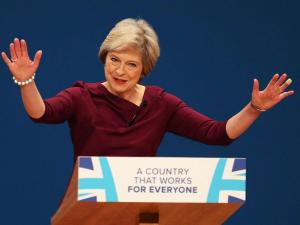 ‘commitment to the men and women who live around you’, ‘recognizing the social contract that says you train up local young people before you take on cheap labour from overseas.’ And perhaps astonishingly, for a Conservative Prime Minister, May promised to deploy the full wherewithal of the state to revitalize that elusive social contract by protecting workers’ rights and cracking down on tax evasion to build ‘an economy that works for everyone’. Picture the Brexit debate as a 2X2 matrix with ideological positions mapped along an x-axis, and Remain/Leave options mapped along a y-axis to yield four possibilities: Right Leave (Brexit), Left Leave (Lexit), Right Remain (things are great) and Left Remain (things are grim, but the alternative is worse). Having been a quiet Right Remainer in the run-up to the referendum, May has now become the Brexit Prime Minister while posing, in parts of this speech, as a Lexiter (Lexiteer?).

 Disrupting ethical theories that are rooted in abstractions and assumptions of universal moral principles is, I believe, urgently required if we are to better understand the moral responsibility we have toward our fellow human beings, particularly in environments of conflict and violence. And so for me, what resonates most strongly in Reconstructing Human Rights is the ethical project contained within the book. Like Hoover, I am not at all convinced that universalising accounts of morality can adequately address ethical problems in political contexts. And like Hoover, I am concerned with how the quest for certainty and universality shapes how we understand, see, and treat one another in social and political life. What is at stake here, in my view, is nothing less than the capacity for ethical action itself, which is at risk of being entirely subsumed by the pursuit of absolutes, leaving little room for contingency, alterity, uncertainty, or indeed anything unknown that might arise out of the specificity of any one ethical moment.
 The Disorder Of Things