Following the Radical Left Assembly #2 last weekend, Nivi and Kerem caught up with Luke Cooper to discuss the implications of the Conservative Party majority for British politics. What does the election result tell us about the political composition of Britain? What is the significance of the Tory pledge for a referendum on the EU? And what future is there for a politics of the Left?
Political Economy
Shipboard Travels: A conversation between Charmaine Chua and Laleh Khalili (Part II)
Part One just over here.
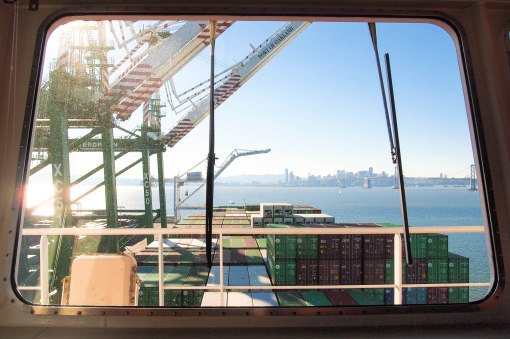
LK: First of all, before we proceed, can I say how much I am enjoying this conversation? Part of this is the ability to compare my experiences with someone of the same political disposition and theoretical commitments who can comment on the contrasts and similarities of the experience of travel aboard a containership, but part of it is also our gender identification.
I felt a kinship with you upon meeting you (as I did with Deb Cowen upon reading her amazing book) precisely because of us confounding gendered expectations of who would do this sort of research in an area –maritime labour, security, travel, and labour– that has always been –and continues to be– marked so profoundly as masculine. And I was really curious about your experience.
I think although I experienced one instance of ass-patting, by and large I think I had it a lot easier than you. One reason may have been that CMA CGM, the shipping company on whose ship I was steaming, actually takes onboard passengers as a matter of course, and there were two other women passengers, both in their 70s, on the ship with me. Whereas –and please correct me– my impression is that you were on a shipping line that doesn’t necessarily take on passengers. I also think my age –I am 46– probably to some extent insulated me from some of your experience. Two other factors also mattered hugely: one that there was a woman cadet being trained to be an officer onboard who could really hold her own with the male officers and crew; and the second, that the captain’s wife was also traveling with us, and her presence at the table, for instance, completely changed the tenor of the meals. So there were 5 women on a ship of 37 people.
But what really struck me was the range of masculinities aboard the ship. The European officers certainly performed their manliness very differently than the Filipino and Keralan crew, and even within the rank of the Europeans (most of whom were Croat), the deck officers crafted their bodies in a different way than the deck officers: the latter worked out in the gym to build up their arm muscles and upper bodies into taut masses of muscles; the latter, not so much.
Shipboard Travels: A conversation between Charmaine Chua and Laleh Khalili (Part I)
Following previous series on Charmaine’s slow boat to China, and introducing Laleh’s first contribution to The Disorder, the first of two posts (the second is here) on what it is to study the labour, politics and infrastructure of oceanic logistics.

Laleh Khalili (LK): Charmaine, both you and I have taken a containership trip in the last few months, you from the West Coast of the US across the Pacific to China and Taiwan, I from Malta through Suez Canal and around the Arabian Peninsula to Jabal Ali, Dubai. There are lots of things we can talk about: shipboard labour, the politics of the ports, being women in overwhelmingly masculine spaces, etc. And we both want to know different things about aspects of the other’s searoute which were not similar to our own.
So here is my first question: What struck you the most about the daily routine of the ship?
Charmaine Chua (CC): I’m thrilled to begin this conversation, Laleh. I want to answer your first question in twenty different ways, but the first thing that comes to mind is the regimentation of everyday life, and the boredom it elicited: breakfast at 0630, work orders doled out at 0700, a coffee break at 1000, lunch at 1130, coffee again at 1500, dinner at 1730. On the days when I would do manual jobs with the crew, we agonizingly counted the mind-numbing hours to the next break. The hours were long, the jobs physically demanding, dangerous and intensive. There is so much repetitiveness to the work that the crew often fought over which of the less-boring jobs they would be assigned to – spraying the deck down with a hose was better than mopping it, taking soundings was better than cutting rags. For those who are watch keepers on the bridge, their work four hours on, four off, then four on again. Not only is sleep was hard to come by because of the shift structure, but shore leave has also become a thing of the past, since there is never enough time to get on land before having to be back for your next duties. When asked, most of the crew describe their jobs with these words: “maintenance, just maintenance. Just following orders.”
I’ve since been wondering about the implications of naming maintenance as the primary form of seafaring work. Ships are easy to romanticize: they remind us of adventure, our smallness, our finitude. But if the most important tasks on the ship are not the technical ones of circumnavigation and exploration (those romantic jobs that gesture to the ocean as an endless horizon of opportunity and freedom) but maintenance, then the primary task of the seafarer is prolong the durability of already existing value. Ships break in half, sink, tip over, and are constantly threatened to be compromised by rust and corrosion; in order to continue the mundane task of commerce and transportation, they must appear as if they are running perfectly in order to protect the value already invested in them.
What We Talked About at ISA2015: State Transformation and the Rise of China
At this year’s ISA, Shahar Hameiri and I talked about our new research project on state transformation and rising powers, with specific reference to China. In a nutshell, we suggest that, like other states, those of so-called ‘rising powers’ are undergoing epochal transformations associated with transformations in the global political economy since the late 1970s, profoundly conditioning how they are ‘rising’.
The Chinese Logistical Sublime and Its Wasted Remains
Sent from Taipei, the last post in a container ship ethnography. The entire series can be viewed here.
“We cannot think of a time that is oceanless
Or of an ocean not littered with wastage”
– T. S. Eliot, “The Dry Salvages”

An APL vessel heads out of the port of Hong Kong
On our thirteenth day at sea, after having been battered by 6 meter waves and snow, gale-force winds and storm, having watched the ship’s skeleton snake and bend with the force of rough seas from within the depths of its passageways, I woke up on a calm, quiet morning to a sea that had turned a lighter shade of blue. From my porthole, delighted, I watched as seagulls weaved in an out of the wind currents above the containers, seaweed merrily skimmed the surface of the ocean, and fishing vessels began dotting the horizon. Land was near. Less than a day later, we drew into the port of Kaohsiung, Taiwan. Terminals stretched for miles from two harbor mouths, the air a humid, sticky breeze, the pilot’s Mandarin accent sounding suddenly like home.
The transition from sea to land has been almost too quick. After days suspended over liquid blue, spent imagining the ocean from what Derek Walcott has termed the “subtle and submarine”, the looming horizon of the sedentary state with all its territorial weight seemed almost churlish. Everything since touching land has been a blur. We spent 36 hours in Kaohsiung, during which a majority of the 4000 containers on the vessel were unloaded, then surged onward to Yantian, where 16 hours in port – aided by gantry cranes larger than I have ever seen – allowed not more than a hasty trip to the city center for a dinner of mushroom and chive dumplings (desperately welcomed after a six-week parade of meat and potatoes), before we set sail again for Hong Kong. Now, after a mere 15 hours there, we are in Kaohsiung once more. Tonight we leave for Taipei with four different currencies in my pocket and my head swirling from switching back and forth between two different tongues. After 42 days at sea, in less than twelve hours I will be off the Ever Cthulhu forever, never to return.
In the meantime, I am allowing myself to be taken in by the fearsome, monstrous smoothness of the East Asian logistical sublime. I had expected the delays we experienced on the US west coast to have created a massive backlog in China, but we arrived to clear seas and empty anchorages. The Chinese ports have a clockwork, kinetic edge. The transitions are quick – almost blinding. Once the ship berths, security rolls out a portable security checkpoint on the shore below, gangs of workers appear from under the towering gantries, and a rolling stream of workers climbs up the gangway. Lashings go off, trucks and straddle cranes slide into place, the agent appears, papers and loading plans are signed, and the cargo operations begin. There are no breaks, no pauses, no delays. The entire machinery of the port, already in gear, accommodates the ship in one smooth gesture.
In Non-Places, No One Can Hear You Cry
Post 4 in a series of ethnographic notes sent from the Pacific Ocean. View more from the series here.

Keeping watch at sunset from the bridge
The 3rd mate’s seafaring career began with a desire for basketball shoes. “When I was really young, I saw these guys coming home – seamen from my province – and they looked really amazing,” he shares one afternoon as we stare across the ocean from the bridge, where he is on watchkeeping duty for 8 hours a day. “They had these fancy dresses, basketball shoes… at that time I really liked basketball, so when I saw those brand new shoes, I said, ‘ok, I want that too’. The other men in my town, they were not the same. Even if they had a higher degree of education, they didn’t have those things the seaman were having. So I thought, why study those courses the other guys are studying when I can go with being a seaman?”
Not that his family, in particular two uncles who were seamen, approved: it would be a very hard job, they warned him, and very painful – especially if you have a family. One cousin had died on board a vessel that had sunk over the Atlantic. But the 3rd mate does what he sets his mind to, and so on he went to a Bachelor of Science in Marine Transportation – the college degree a majority of the crew holds.
“And in reality?” I venture, “Is it what you imagined?” The answer is an unequivocal no. “If I had a chance to go back, I would not be here,” he says. “Life on the sea, it’s very different from what I fancied. The stories from previous generations I’ve heard are all quite interesting: no hardships, everything’s ok. But when I got here, I found that everything is saturated. The six months on board… it’s six months of hell. I am constantly missing my loved ones. When I go home, the three months of vacation are even not completely vacations for me.”
Deciphering ‘The International’ in History and Theory
The final post in our symposium in our symposium on Alex Anievas’ Capital, the State, and War: Class Conflict and Geopolitics in Thirty Years’ Crisis, 1914-1945, in which Alex himself replies to his critics and interlocutors.
It brings me great pleasure to be invited to respond to such thoughtful and challenging critiques of my book Capital, the State, and War (CSW). On the (meta-)theoretical front, Mark Rupert and Kamran Matin question my use of uneven and combined development (UCD) as a transhistorical ‘general abstraction’ to be incorporated into a historical materialist framework. On the more historical/historiographical front, Campbell Craig challenges my interpretation of Woodrow Wilson’s foreign policies during and after the First World War, arguing that I rely too heavily on the extant historiographical literature, specifically N. Gordon Levin’s 1968 New Left ‘revisionist’ critique Woodrow Wilson and World Politics. Craig further criticizes my theoretical approach for being overly structuralist and consequently ‘devoid of agency or praexeology’, while pushing me to consider the relevance of UCD to contemporary world politics.
While disagreeing with some of my interlocutors interpretations of what I was trying to do in CSW, it is a breath of fresh air that they have all offered substantive engagements with my work in ways dealing with genuine theoretical disagreements; though, as I hope to demonstrate, in the case of Matin and possibly Rupert, these theoretical disagreements may be less serious than they first appear. So I would be remiss not to express my deep gratitude to Rupert, Matin and Craig for their highly stimulating critiques. In what follows, I engage with the precise standing of UCD and ‘general abstractions’ in filling out of a distinctly historical materialist theory of ‘the international’ before turning to the more specific historical-theoretical issues raised by Craig.
I. Method, Abstraction and Historicity in Marxist Theory
While being ‘largely convinced’ by the ‘relational, historical, and dialectical conceptual apparatus’ I deploy in explaining the interstate conflicts of the Thirty Years’ Crisis of 1914-1945, Rupert remains sceptical of my conceptualization of UCD as a ‘general abstraction’. He raises the question: “In a world where a great deal of epistemological and actual violence is done by universalizing abstractions, why create another as the basis for a theory whose basic impulse is de-reification, re-contextualization, and re-historicization in the interest of opening potentially emancipatory horizons?”. As such, Rupert is ‘unpersuaded’ by my argument that UCD is best understood as a transhistorical phenomenon which can be employed as a ‘general abstraction’.
Kamran Matin, by contrast, argues that I have not realized the full potentials of deploying UCD as a transhistorical abstraction, Continue reading
Capital, the State, and War: A Note on the Relation of Uneven and Combined Development to Historical Materialism
A guest post from Kamran Martin (also the author of this popular and important piece on Kobani, recently liberated from the forces of the Islamic State). It is the third and final commentary in our symposium on Alex Anievas’ Capital, the State, and War: Class Conflict and Geopolitics in Thirty Years’ Crisis, 1914-1945. Kamran is a Senior Lecturer in International Relations at the University of Sussex, and the author most recently of Recasting Iranian Modernity: International Relations and Social Change, as well as ‘Redeeming the Universal: Postcolonialism and the Inner-Life of Eurocentrism’. Kamran is also the incoming co-convenor of the BISA Historical Sociology Working Group, and is beginning work on a project tracing the international history of the Kurdish national liberation movement.
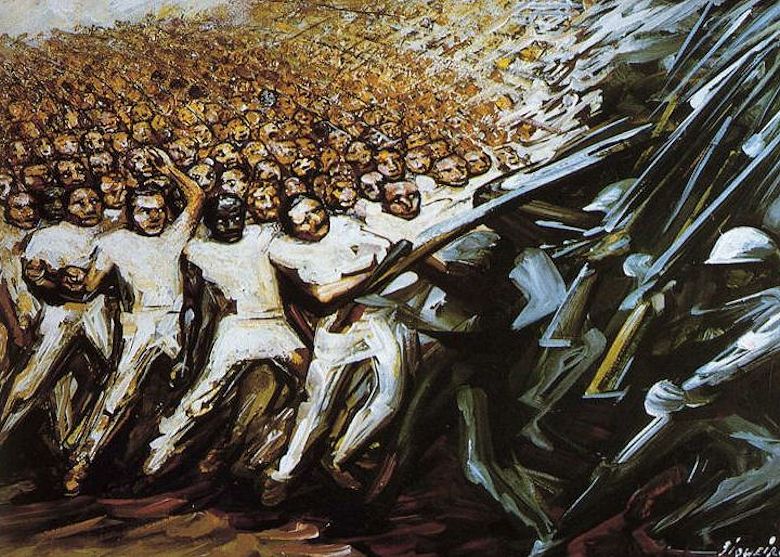
Over the past 10 years or so Leon Trotsky’s idea of ‘uneven and combined development’ has gained considerable traction within the fields of International Relations (IR) and historical sociology. It has been critically and productively deployed or rethought to address a diverse group of international and sociological problematics ranging from anarchy, contingency, and eurocentrism to the rise of capitalism, premodern societies, and non-western modernities. Alex Anievas’s new book Capital, the State, and War: Class Conflict and Geopolitics in the Thirty Years’ Crisis, 1914-1945 is an extremely invaluable addition to this rich and growing body of scholarship on uneven and combined development.
Through a masterful deployment of uneven and combined development, Anievas provides a compelling alternative account of the two world wars that fundamentally challenges the existing polarized ‘internalist’ and ‘externalist’ modes of explanations. Weaving social, economic, (geo)political and ideological moments of the making of the ‘Thirty Years Crisis’ into a theoretically informed, historically grounded and empirically rich account Capital, the State, and War is a tour de force for anyone interested in Marxist historiography of the World Wars and the rise and demise of the twentieth century world order.
As someone who’s also contributed to the literature on uneven and combined development I’m particularly interested in Anievas’s explicit discussion of the precise relation of the idea of uneven and combined development to historical materialism in Capital, the State, and War. Explicit interrogations of this relation have been relatively neglected in much of the publications on uneven and combined development. As a leading Marxist thinker and political activist Trotsky himself saw his idea of uneven and combined development as simply derivative of Marxist dialectics and materialist conception of history and as such did not seem to have believed that the idea had any transformative implications for materialist conceptions of history.
Capital, the State, and War: Reflections of a Codger
A guest post from Mark Rupert, the second reply in our symposium discussing Alex Anievas’ Capital, the State, and War: Class Conflict and Geopolitics in Thirty Years’ Crisis, 1914-1945. Mark is Professor of Political Science at Syracuse University and the author of three books: Producing Hegemony: The Politics of Mass Production and American Global Power (1995), Ideologies of Globalization: Contending Visions of a New World Order (2000) and Globalization and International Political Economy (2006, with Scott Solomon). His recent papers focus principally on the politics of the far right.
I’ve been following Alex Anievas’ project for a while. Now that it’s come to fruition in this book, I find myself both delighted and saddened. I’m delighted to see that Alex has produced such a superb book, perhaps as close as any I’ve seen to realizing the potential of an historical materialist approach to IR. I’m also saddened that the book arrives in an intellectual context – some thirty years after the project of critical IR was launched – in which critical approaches to IR-IPE have been largely neutered or marginalized, at least in the US academic community where I work. I congratulate Alex on his achievement. I thank him for all I have learned from his work. But I fear that the role of IR theory as ideology, and the sociology of knowledge so powerfully operative within the still-dominant US wing of the profession, mean that this book might have the ability to convince but it will not win (if I may appropriate and invert the courageous words of Miguel de Unamuno).
This book takes direct aim at the very foundations of IR theory, laid down in attempts to understand the great crises of the early twentieth century. Much of our intellectual discipline, as well as the 20th century world, was constructed in this epic conjuncture. Deploying a theory of uneven and combined development, Alex re-narrates it well. The intersection of various temporalities of capitalist development – the “whip of external necessity,” the “privilege of historical backwardness,” and the “contradictions of sociological amalgamation” – play crucial roles in his analyses of 1914, Wilsonian statecraft, the rise of Nazi Germany, and the so-called policy of “appeasement”. His command of the relevant bodies of scholarship is deeply impressive (the bibliography alone would make this book worth buying). And at the end of the book I find myself largely convinced that this formative era cannot be understood without a relational, historical, and dialectical conceptual apparatus such as the one Alex deploys, and that a quest for parsimonious covering laws based on hyper-abstracted “levels of analysis” is an analytical trap that has radically decontextualized and dehistoricized prevailing modes of IR scholarship.
Capital, the State and War: The Risks of Method
 A forum contribution from Campbell Craig, the first in our series responding to Alex Anievas’ new book, Capital, the State and War. Campbell is Professor in International Politics at Aberystwyth University, and the author of several books, including Glimmer of a New Leviathan: Total War in the thought of Niebuhr, Morgenthau and Waltz (2003), The Atomic Bomb and the Origins of the Cold War (2008, with Sergey Radchenko), and more recently America’s Cold War: the Politics of Insecurity (2012, with Fredrik Logevall). Campbell’s work has appeared in World Politics, Ethics & International Affairs and the Review of International Studies. He is also currently finishing an article on the nuclear revolution and neo-Trotskyism.
In 1959 Kenneth Waltz published Man, the State and War, a study of three different levels of analysing international relations and their attempts to answer the question why war recurs. Waltz tackled his subject by demonstrating how the two most common levels of analysis – human nature, and regime type – ran into insuperable logical obstacles, and especially the problem of reductionism that social theorists such as Durkheim and Lakatos identified. His solution was to posit a third level – anarchy, or, as his title suggested, war – that could explain the recurrence of war without succumbing to the reductionist fallacy. The result was a study that has shaped the field of modern international relations more than any other single volume.
Anievas, as the title suggests, seeks to build upon Waltz’s ambition in his new book. He argues that the Marxian theory of uneven and combined development (UCD), a concept invented by Trotsky which explains international conflict by pointing to the uneven economic competition among more and less developed states whose economies are intertwined, can be used to theorise contemporary IR. This is a project being undertaken by other scholars, most notably Justin Rosenberg, but Anievas’s book is the most ambitious and thorough attempt yet to deploy Trotsky’s idea in a systematic way. However, Anievas’s method is quite different from the one used by Waltz (and Rosenberg). Rather than developing a logical or epistemological case for UCD, Anievas tries to use it as a means of shaping a detailed historical explanation of the two world wars of the twentieth century. What he is trying to do, as far as I can see, is to use UCD as a tool to explain and revise a key historical problem, as theorists in other schools of IR have done, rather than put forward an abstract case for the theory in the first place—a necessary move, for Anievas, because extant work on UCD suffers from “unsustainably high levels of analytical abstraction” (57). He concludes that the pressures of UCD upon capitalist states (particularly Germany, Great Britain, and the US) effectively explain the two world wars, and that they paved the way for a ‘proto-Cold War’ between the West and the USSR that began basically with the formation of the Soviet state in 1917.
In many ways the book is an impressive work. The narrative chapters on German, British, and American foreign relations are rich with historical detail and focused, often polemical argumentation. The engagement with competing theories is intensive and Anievas’s mastery of the debates among the neo-Marxian left is evident. Yet I was in the end not convinced by some of the main historical claims of the book nor by the method Anievas has deployed. In the spirit of Anievas’s blend of historical and theoretical inquiry, I will now present two critiques of the work from the respective points of view of the historian and the IR theorist.
 The Disorder Of Things