At the end of a week that saw Maggie “There Is No Alternative” Thatcher’s funeral, it just might be worth stopping to remember the human disaster that is global capitalism. (video courtesy of The Rules)
At the end of a week that saw Maggie “There Is No Alternative” Thatcher’s funeral, it just might be worth stopping to remember the human disaster that is global capitalism. (video courtesy of The Rules)
A guest post by Philippe Fournier, following up on his analysis of the Quebec student movement in May last year. Philippe is Postdoctoral Fellow at the Canada Research Chair in Globalisation, Citizenship and Democracy (Chaire MDC) at Université du Québec à Montréal’s Sociology Department, and works primarily on Michel Foucault in global politics.

A Quebec student march route
Quebec’s protracted student crisis, which laid heavy on voters’ minds, has been fixed, at least for now. In early September, the Parti Québécois (PQ) was ushered in as a minority government. The PQ campaigned on a tuition freeze, higher taxes for society’s upper echelons and a fairly ambitious environmental agenda. These aspirations notwithstanding, popular discontent with the Liberal’s handling of the student crisis, widespread accusations of corruption (see the ongoing Commission Charbonneau) and a collective displeasure with Premier Jean Charest’s smug ways, all contributed to the previous government’s demise. All things considered, the Liberals did very well, taking 31% of the vote. The PQ took a mere 32%, hardly a glowing endorsement from the general public. Most analysts believe that it was also a clear message to the incoming rulers that Quebecers had no interest in one of the more fundamental objectives of the PQ’s platform, that is sovereignty.
There are several dimensions and consequences to the PQ’s election, most of which provide an example of things-that-are or of things-that-will-be in western countries facing economic woe.
Students and Protests
The majority of students see the electoral results as a victory and feel vindicated for their continued efforts. A minority of students, many of whom are affiliated or sympathetic to the now recently defunct CLASSE (now the ASSÉ), which was set up especially for the strike, are less enthused and sense that this is only a reprieve in the long and arduous fight for free education.
The PQ has called for a summit on higher education, which will take place sometime in February and is meant to involve a wide-ranging consultation between state officials, student representatives, chancellors and business leaders. The likely outcome will be an indexation of tuition fees to the cost of living and new innovative means to cut costs in University management. Opposition parties are already accusing the PQ of having bowed down to the vociferous demands of ‘the street’ and have warned that this blank cheque would have consequences on the allocation of funds to other social programs. The ASSÉ is predictably sceptical of such proceedings and is not yet sure whether it will participate. After being told by the government that they had to cut a further 120 million before the negotiations even started, University chancellors are ticked off.
Insofar as the student crisis was widely heralded as a social movement and not just a sectorial claim, it is important to assess its overall effect on Quebec’s current political landscape. Continue reading
The fifth post this week on open access and its impact on IR (amongst other social sciences) from previous guest poster Nathan Coombs (follow the blue underlines for the first, second, third, fourth and sixth posts). Nathan is completing a PhD in politics and philosophy in the Department of Politics and International Relations, Royal Holloway, University of London. He is co-founder and co-editor of the transdisciplinary, open-access journal, the Journal of Critical Globalisation Studies. He has a book forthcoming in 2013: The British Ideology. Images by Pablo.

When my colleagues and I established the open-access journal, the Journal of Critical Globalisation Studies in 2009, to us open-access publishing meant placing an academic journal online which would be free for both our contributors and our readers. We took inspiration from open-access journals in critical philosophy such as Parrhesia and Cosmos and History, the efforts of the Open Humanities Press, and the Australian book publisher Re.Press, who make PDFs of their releases available online simultaneously with their distribution to bookstores.
Since this time, however, the term open-access seems to have become increasingly polyvalent. As discussed in contributions to this series of reflections by Pablo, Colin Wight and David Mainwaring, open-access publishing is now endorsed by government and publishers. Yet the price of this move into the mainstream has unfortunately been a watering down of the term. In the ‘gold’ open-access publishing scheme proposed by the Finch report, for instance, universal access to academic publications is secured, but only by preserving the existing journal subscription system and by introducing Article Processing Charges (APCs) for authors.
Whether these pseudo open-access schemes will prove to be unstable transitional forms or lasting models only time will tell. In any event, for my contribution I want to focus on open-access in its fully fledged form: ‘full open-access’ we will call it. The model of full open-access, as operated by the JCGS, does not permit any persistent role for the private (profit motivated) sector within academic journal publishing. Full open-access journals are housed on independent or University affiliated websites, freely available to everyone in the world within an internet connection, and provide a free anonymous peer-review service for contributors.
Let us imagine a world where academic journal publishing turned over completely to this approach. Journal subscription fees would be swept away. Academics would take control over their publishing arrangements. The profits of corporate publishers would dwindle to zero. An enticing scenario for anyone exasperated with the current status quo.
As with all things that sound too good to be true, though, caution is required. Continue reading
(wild bells) A warm Disordered welcome to Wanda Vrasti, who previously guested on the topic of the neoliberal tourist-citizen imaginary, and now joins the collective permanently. And glad we are to have her. Her academic writings thus far include Volunteer Tourism in the Global South: Giving Back in Neoliberal Times (which came out with the Routledge Interventions series a few months ago), ‘The Strange Case of Ethnography in International Relations’ (which caused its own debate), ‘”Caring” Capitalism and the Duplicity of Critique’, and most recently ‘Universal But Not Truly “Global”: Governmentality, Economic Liberalism and the International’.
It’s often been said that this is not only a socio-economic crisis of systemic proportions, but also a crisis of the imagination. And how could this be otherwise? Decades of being told There Is No Alternative, that liberal capitalism is the only rational way of organizing society, has atrophied our ability to imagine social forms of life that defy the bottom line. Yet positive affirmations of another world do exist here and there, in neighbourhood assemblies, community organizations, art collectives and collective practices, the Occupy camps… It is only difficult to tell what exactly the notion of progress is that ties these disparate small-is-beautiful alternatives together: What type of utopias can we imagine today? And how do concrete representations or prefigurations of utopia incite transformative action?
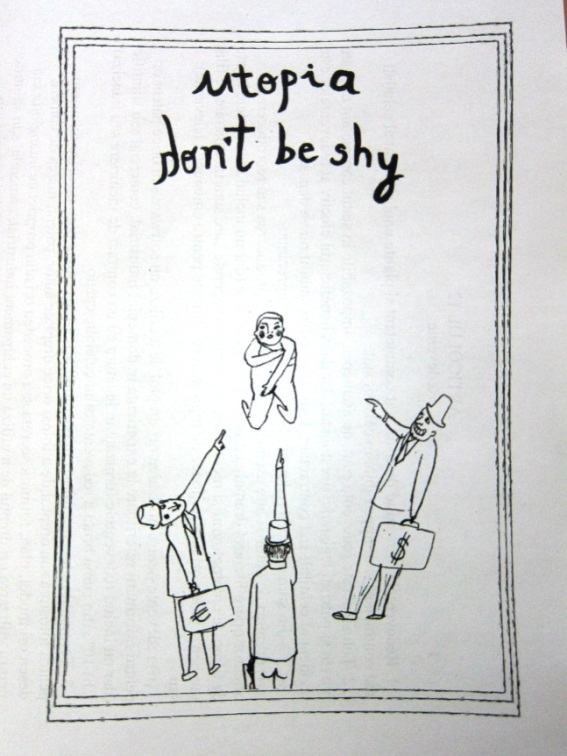
Javier Lozano Jaén
First thing one has to notice about utopia is its paradoxical position: grave anxiety about having lost sight of utopia (see Jameson’s famous quote: “it has become easier to imagine the end of the world than the end of capitalism”) meets great scepticism about all efforts to represent utopia. The so-called “Jewish tradition of utopianism,” featuring Adorno, Bloch, and later on Jameson, for instance, welcomes utopianism as an immanent critique of the dominant order, but warns against the authoritarian tendencies inherent in concrete representations of utopia. Excessively detailed pictures of fulfilment or positive affirmations of radiance reek of “bourgeois comfort.” With one sweep, these luminaries rid utopianism of utopia, reducing it to a solipsistic exercise of wishing another world were possible without the faintest suggestion of what that world might look like.
But doing away with the positive dimension of utopia, treating utopia only as a negative impulse is to lose the specificity of utopia, namely, its distinctive affective value. The merit of concrete representations of utopia, no matter how imperfect or implausible, is to allow us to become emotionally and corporeally invested in the promise of a better future. As zones of sentience, utopias rouse the desire for another world that might seem ridiculous or illusory when set against the present, but which is indispensable for turning radical politics into something more than just a thought exercise. Even a classic like “Workers of the World Unite!” has an undeniable erotic (embodied) quality to it, which, if denied, banishes politics to the space of boredom and bureaucracy. It is one thing to tell people that another world is possible and another entirely to let them experience this, for however shortly.
Most concrete representations and prefigurations of utopia from the past half century or so have been of the anti-authoritarian sort. Continue reading
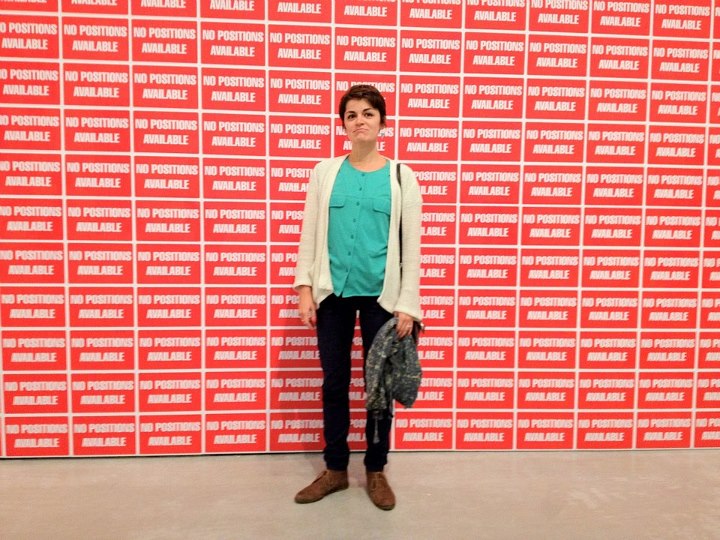 A guest post from our sometime co-conspirator Wanda Vrasti. Wanda teaches social studies at the Humbolt University and international politics at the Feie Universitaet in Berlin. Her book Volunteer Tourism in the Global South just came out with Routledge. She has also written on the uses of ethnographic methods in IR (in Millennium, twice) and on questions of global governmentality (in Theory & Event and Review of International Studies). Her current interests (still) include the politics of work and leisure, social movements on the Left, and anarchism and autonomism. Images by Pablo.
UPDATE (9 Nov): Wanda is now happily a member of the Disordered collective. And thus, this is retrospectively no longer a guest post.
 Last week my PhD dissertation entitled Volunteer Tourism in the Global South: How to Give Back in Neoliberal Times came out as a book with Routledge’s Interventions series. Publication usually marks the end or the completion of a research project, but in this case I feel like the puzzles that animated it are still very much alive in my mind. Rehashing some of these, at my blog hosts’ invitation (also considering that the book goes for a price I imagine not many people will be able to afford outside university libraries), is an exercise in keeping the thinking and writing that went into this book alive beyond its publication date.
In a sentence, the book is an ethnographic study of volunteer tourism projects in the Global South (Ghana and Guatemala specifically) with a particular focus on the kinds of subjects and social relations this rite of passage cultivates and the reasons why we attach so much value to them. The argument I make in the book is not very different from the common indictment against voluntourism seen in the media. The accusation is that volunteer tourism does more for the Western (in my case exclusively white middle-class) tourists who enrol in these all-inclusive tours of charity than for the impoverished communities they are claiming to serve. Volunteering programs, most of which focus on English teaching, medical assistance or minor construction projects, have neither the trained staff nor the organizational capacity to make a lasting impact upon the lives of developing populations. Often the commercial travel agencies offering these tours fail to deliver even basic assistance goods, let alone encourage grassroots community initiatives that could lead to more sustainable change. What they can offer, however, to Western customers willing to pay $500 to $2,500/month is the chance to travel to places outside the Lonely Planet circuit without being a tourist. A tourist, as we have all experienced it at some point, is a rather pitiable figure reduced to gazing at things or being gazed at, their only meaningful encounter being with the guide book. A volunteer, on the other hand, can live with a local family, get to know traditional cultures, and participate in the collective good. Not surprisingly, the formula has become a growing trend among high-school and college graduates hard pressed to find many opportunities for meaningful participation in the alienated (and austere) market societies they come from.
Sadly, the majority of volunteers I worked with in Ghana and Guatemala did not have their feelings of lack and longing satisfied on these tours. Besides having to cope with all sorts of cultural frustrations and racial tensions, the work we were doing felt boring and useless. Our tour organizers failed to provide work that was challenging and gratifying for the volunteers and socially useful for the local community. Still, most people returned home with an improved sense of self, feeling like these trying circumstances had helped them develop greater confidence and cultural awareness.
Volunteer tourism appears here as yet another form of aesthetic consumption designed to confirm the racial, economic and emotional superiority of white middle-class individuals who are able to afford it. Continue reading
The chafing constraints of a thesis prevent any original reflection on our hallowed Olympic moment (not least because Rahul has already said so much, and so well). There was little to better Iain Sinclair’s apt diagnosis of “a wonderful national hallucination: a beautiful conjuring between William Borroughs and Charles Satchi…the combination of paranoia and advertising run wild” (a clip worth watching for Jon Snow’s outraged ignorance at the origins of the Olympic Flame [clue: Nazis]). Reports had filtered through that the economic miracle was not as originally billed, with talk of Central London’s ‘ghost town’, stimulating a description elsewhere of the Olympics as an “economic bomb deployed against world cities”. And now there is the most welcome return of K-Punk. At length:
Welcome to the Hunger Games. The function of the Hunger Games is to suppress antagonism, via spectacle and terror. In the same way, London – 2012 preceded and accompanied by the authoritarian lockdown and militarisation of the city – are being held up as the antidote to all discontent. The feelgood Olympics, we are being assured, will do everything from making good the damage done by last year’s riots to seeing off the “threat” of Scottish independence. Any disquiet about London 2012 is being repositioned as “griping” or “cynicism”. Such “whinging”, it is claimed, assumed its proper place of marginality as the vast majority enjoy the Games, and LOCOG is vindicated…
…But once the Olympic floodlights are turned off, most will switch back from an attitude of mild interest to indifference towards even the most dramatic Olympic sports, never mind those many Olympic sports which plainly have limited specator appeal. This isn’t the point though: disquiet about London 2012 was never necessarily based in any hostility towards the sports. Enjoyment of the sport and loathing for LOCOG and the IOC are perfectly compatible.
Cynicism is just about the only rational response to the doublethink of the McDonalds and Coca Cola sponsorship (one of the most prominent things you see as you pass the Olympic site on the train line up from Liverpool Street is the McDonalds logo). As Paolo Virno argues, cynicism is now an attitude that is simply a requirement for late capitalist subjectivity, a way of navigating a world governed by rules that are groundless and arbitrary. But as Virno also argues, “It is no accident … that the most brazen cynicism is accompanied by unrestrained sentimentalism.” Once the Games started, cynicism could be replaced by a managed sentimentality.

Affective exploitation is crucial to late capitalism. The BBC’s own Caesar Flickerman (the interviewer who extracts maximum sentimental affect from the Hunger Games contestants before they face their deaths in the arena) is the creepily tactile trackside interviewer Phil Jones. Jones’s “interviews” with exhausted athletes, are surely as ritualised as any Chinese state broadcast. Emote. Emote again. Emote differently. Praise the crowd.
And, just in case you somehow missed it, the irrepressible CassetteBoy:
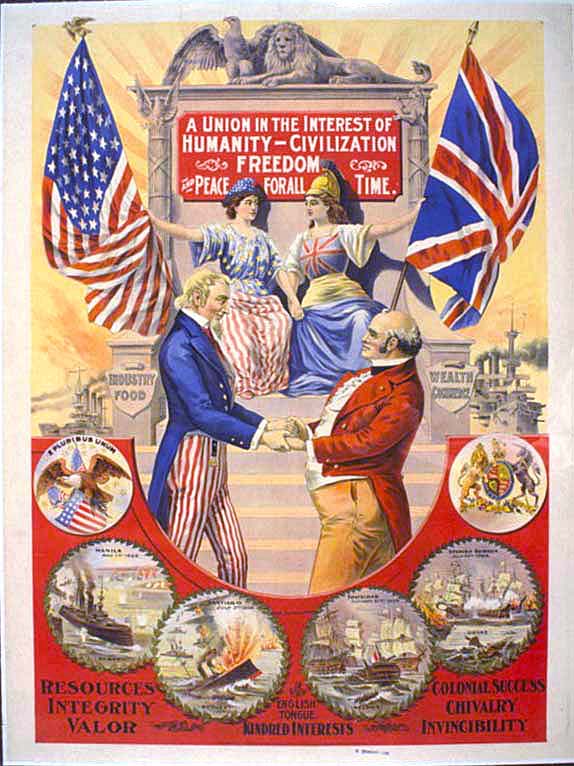
Viewed from the perspective of liberal IR, Britain’s globe-spanning empire can be described as “Liberal Internationalism 1.0.” According to G. John Ikenberry, the “liberal ascendancy” had everything to do with the “growth and sheer geopolitical heft of the world’s liberal democracies.” The British may have been the first to harmonize national interest with the stability, openness and rule-following in the international systems, but it was the Americans who “fused” them. “If the liberal order was built after World War II primarily within the West, the end of the Cold War turned that order into a sprawling global system” [1].
The question that has always fascinated me is how we got from Liberal Internationalism 1.0 to Liberal Internationalism 2.0, or how, to freely borrow from Ikenberry, power shifted between two liberal Leviathans, Britain and the U.S. What is puzzling here is the absence of the Wars of Anglophone Succession. Instead of fighting each other at least once or twice, the two empires first found ways to cooperate and coordinate their imperial activities around the globe, then engaged in what can be described as a pacted transition, even as a corporate merger. Here’s one verdict, taken from “The imperialism of decolonization” piece by Wm Roger Louis and Ronald Robinson:
The British were welcoming the Americans back into the British family of nations and, informally at least, into the Commonwealth . . . [the post-war empire operated] as part of the Anglo- American coalition . . . like a multinational company.
Putting aside the historiography debates about its scope, timing and sequencing, this historical process was no doubt of momentous importance for the evolution of the liberal order, both in terms of the accumulation of hegemonic power, and in terms of social and institutional learning. The Anglosphere, in other words, begins here. So how do we explain it? Strategic calculus and/or a putatively liberal predilection for cooperation, compromise, and conciliation (last word Churchill’s) are only parts of this story, as Charles Kupchan notes in his How Enemies Become Friends:
British appeasement of the United States and the practice of reciprocal restraint that followed cleared the way for rapprochement. But it was the emergence of a new discourse on both sides of the Atlantic – one that propagated notions such as a “shared Anglo-Saxon race” and an “Anglo-American family” – that produced a compatible identity, consolidated stable peace, and laid the foundations for the strategic partnership that exists to this day.
I could not agree more. Racialized identities operate as social structures of power, and this was a time when they explicitly authorized unity and superiority for Us against Them in ways that had profound consequences for the evolution of the so-called liberal international order. Anglo-Saxonism enabled the U.S. and Britain – or their elites – not only to position themselves favourably vis-à-vis each other at the turn of the twentieth century, but also with respect to the rest of the world and in a longer term. The Anglo-American rapprochement was no “global turn” of the sort that Kupchan talks about in his latest book, but it arguably comes close to it in macro-historical term. For one, the paths, pace and outcomes of the 1945-1951 international institution-building spree – that foundation of Liberal Internationalism 2.0 –followed the patterns of UK-U.S. cooperation first established during the colonial wars and near-wars in the 1890s. The much-disclaimed “special relationship” has its origins in this period – something to keep in mind next time we hear that U.S.-hugging remains in someone’s national interest, as General Sir David Richards, the head of Britain’s armed forces, argued last week.
This story I wish to tell can be expanded and contracted empirically (Anglo-Saxonism is dead today, but its effects can be found everywhere from university scholarships to contemporary military alliances) and theoretically (through, say, an account of core-periphery relations that made global capitalism possible), but the main substantive point remains the same, and that is that we cannot fully understand the “liberal ascendancy” without pausing (as Siba Grovogui might say) over the pervasiveness and power of racialized identities that connected Liberal Internationalism 1.0 and 2.0 [2]. Continue reading
 Despite some news coverage and discussions on Twitter, we’ve seen little on the continuing educational and political crisis in Quebec. Hence, a guest post from our friend and colleague Philippe Fournier. Philippe teaches political thought and International Relations at the Université de Montréal and the Université du Québec à Montréal. He has published research on Foucault and International Relations, Governmentality in the contemporary United States and Violence and Responsibility. He is currently working on the government of security in the US and on the theoretical conflation of sovereign power and government in Foucault. His other research interests include critical cultural theory and political economy.
A little background info and some thoughts on the student crisis in Quebec, which has been going on for 101 days now and shows no signs of waning in the face of the government’s disturbing intransigence. The recent adoption of Bill 78, which circumvents the right to protest without prior notice and gives the police the right to change a demonstration’s itinerary, among other things, has shocked and angered many Quebecers and made the news worldwide. On Tuesday May 22, over 250 000 people expressed their discontent with the current government and it was quite a sight.

Ever since the ‘quiet revolution’ in the early 1960s, which saw the institution of important social provisions and the attribution of several socio-economic entitlements to the francophone majority, Quebec has been holding fast to its social-democratic heritage. Jean Charest’s liberal party, in power since 2003, is determined to fight off the modern-day antichrist of debt and rationalise state activity. The Charest government’s attack on hard fought social entitlements, including accessible post-secondary education (Quebec has the lowest tuition fees in Canada), has been going steady since 2003 but has intensified since 2008. Quebecers were told that it was no longer reasonable to expect affordable public services and that it was high time that we join the pay as you go party.
What is at play in this conflict is no less than the fate of social-democratic expectations in Quebec. These expectations are actively discouraged and discredited by the current political elite. The demands for a tuition freeze by sizeable portions of Quebec’s students are considered unreasonable in many quarters, and seen as a plane expression of bad faith and overindulgence by a majority of Canadians, seemingly stuck in a Stephen Harper induced stupor. The words ‘pragmatic’, ‘realistic’ and ‘rational’ have been duly appropriated by the partisans of deregulation, free-enterprise and individual responsibility. Any suggestions that the latter orientations are based on an ideological choice are ridiculed; they simply express a sounder and more logical way to manage society.
Up to now, there seemed to be a dour resignation to the decimation of our social programs. This young generation of Quebecers, which many had touted as completely apathetic and apolitical, has taken a resolute stand against restricting access to a public good, against the further commodification of knowledge and against the uncompromising law and order approach of an arrogant and irresponsible government. Those that have taken to the streets day after day and sacrificed their terms and put their professional lives on hold for the students that will come after them, have shown extraordinary resilience and bravery. It came as a surprise to many, because they did it on their own, with little or no help from their political science professors, who have long abandoned critical thinking for functionalist replications of reality sanctioned by government money.
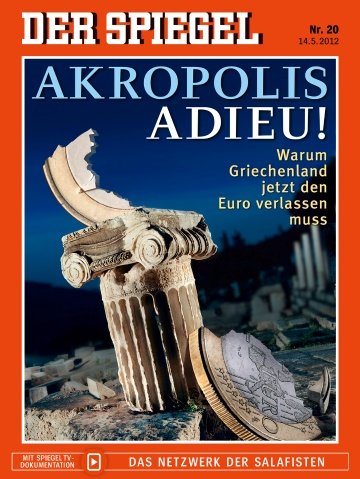
As the inevitable Greek exit from the eurozone seemingly approaches, it’s worth comparing current statements about Greece to how the financial press and regulators considered Lehman Brothers the week before its collapse set the global markets into panic mode. (See below for a selection of illuminating comments from officials about Lehman Brothers pre-collapse and about Greece pre-exit.) Reading these misplaced predictions, one thing becomes clear: the contemporary financial system is far too complex and opaque for anyone to determine the precise consequences of a Greek exit. Add into that the unpredictable nature of crisis politics (e.g. today sees rumors of Greek governing coalitions flying all over the place), and one has a system that quickly surpasses our capacities for forecasting. In this regard it’s interesting to read reports about the current Greek exit fears versus the reports in February when it also looked like Greece might leave (prior to the second of ECB’s long-term refinancing operations (LTROs) that managed to calm markets for a short while). In the earlier reports many commentators considered that French and German banks had largely separated themselves from Greek exposure, while the initial LTRO had purportedly given the financial system the flexibility it needed to survive any temporary disruption. Intriguingly, today’s fears about Greece, after the failure of the LTROs to significantly improve the situation and combined with fears over Spain’s banking system, are much more apocalyptic than in February.
The unfortunate truth is that while a Greek exit will be devastating to the Greek people (of this everyone is confident), it is still a better option than the continued austerity regime. Even the most optimistic IMF estimates of Greece’s economy under the austerity regime only see them returning to 120% debt-to-GDP ratio by 2020 – i.e. the same level that so worries commentators about Italy today. What is being asked of Greece is a state of permanent austerity and permanent social chaos.

Milos Bicanski/Getty Images
September 9, 2008 – http://www.nytimes.com/2008/09/10/business/10place.html?pagewanted=all
Unlike Bear Stearns, which effectively collapsed when customers fled for the exits and the firm could not finance itself, Lehman Brothers has more sources of long-term financing and like other broker-dealers, access to emergency financing from the Federal Reserve. Mr. Fuld said that the existence of that lending facility should take any question of Lehman facing a liquidity crisis “off the table.
September 12, 2008 – http://www.ft.com/intl/cms/s/0/b3506214-80d5-11dd-82dd-000077b07658.html#axzz1mXeJ33ET
While the crisis at Bear stunned the markets, other financial institutions have had six months to prepare for the possible failure of Lehman. In the Bear crisis, the risks were extreme in part because they were unknown and unmanaged. The New York Fed has conducted extensive stress tests in order to attempt to evaluate the impact of a Lehman failure on markets such as the CDS market and it believes the systemic risk is quantifiable and lower than the risk that was posed by the imminent collapse of Bear back in March. Regulators have also evaluated the risk mitigation strategies put in place by other banks and the authorities believe them to be robust. That suggests the risk that a Lehman collapse could trigger a domino effect of failures at other financial institutions ought not to be great.
September 14, 2008 – http://www.ft.com/intl/cms/s/0/f3586ede-80ca-11dd-82dd-000077b07658.html#axzz1mXeJ33ET
Mr Paulson believes that the systemic risks associated with the potential failure of Lehman have been reduced because the market has had time to prepare for its possible demise, and a new Fed funding facility would assist an orderly unwinding of its positions.
February 15, 2012 – http://blogs.channel4.com/faisal-islam-on-economics/eurozone-reaches-its-lehman-moment-as-germany-insults-greece/16278
All the while, the chatter in euro policy circles, as I wrote on Monday, is that the Greek rot will not infect the rest of the euro area. A default could be managed. Even the odd French bank has managed to dispose of much of its exposure. We’ve had months to prepare. And, so the Lehman moment comes full circle. Three and a half years ago we were told exactly the same by Hank Paulson and co re Lehmans: The system, we were told, was strong enough. Finns, Dutch and some Germans increasingly think the same about a Greek default.
Hot on Roberto’s heels, and the third of us to achieve doctorhood since the inception of The Disorder Of Things, our very own Meera today survived the critical questioning of Robbie Shilliam and Christopher Cramer. She is henceforth Dr Sabaratnam, certified by virtue of her thesis: Re-Thinking the Liberal Peace: Anti-Colonial Thought and Post-War Intervention in Mozambique. For the record, I’m assured that any violence inflicted was purely intellectual.

 The Disorder Of Things