The Corbyn Effect

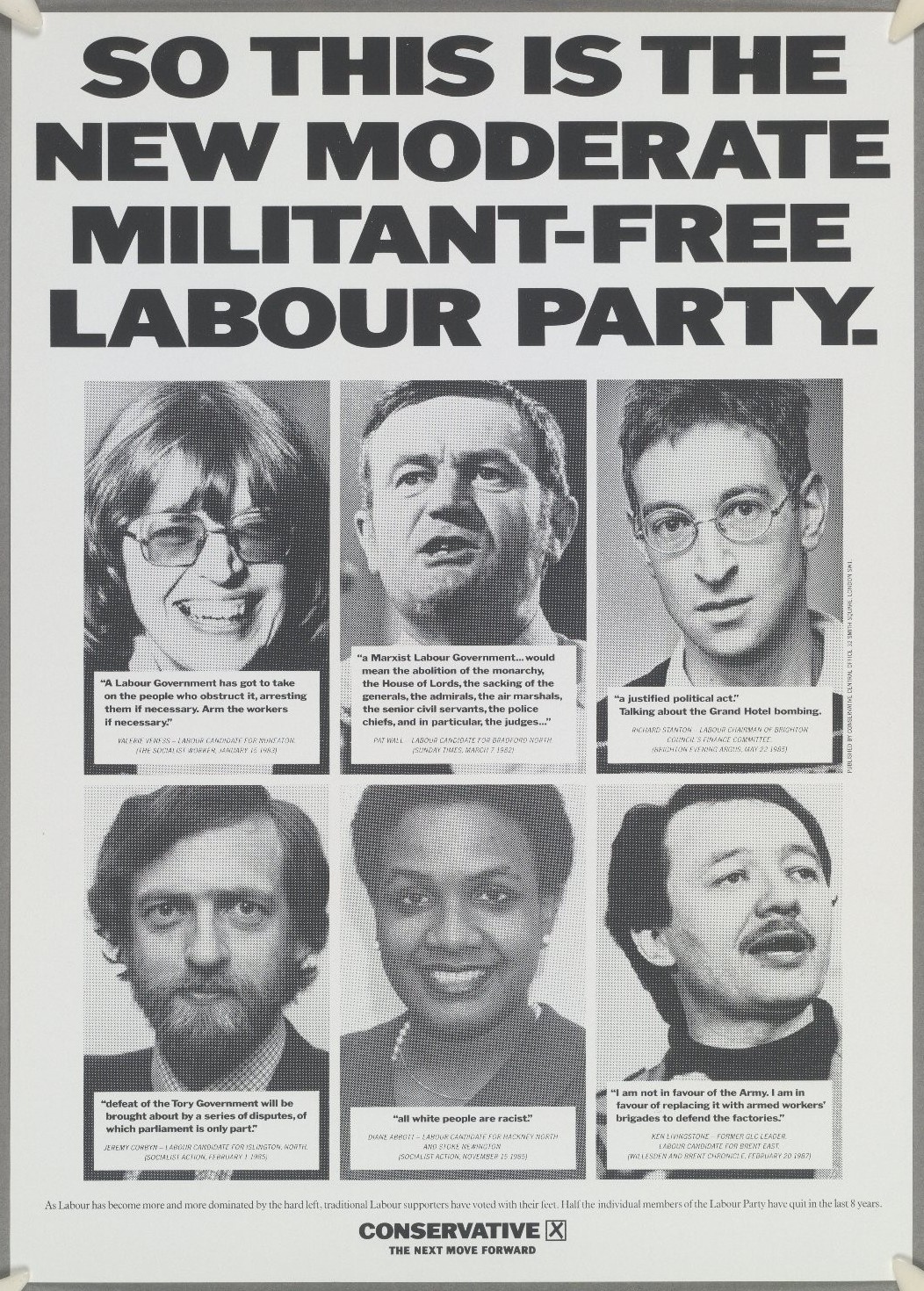
Moderate Militant-Free Labour Conservative Poster

In the last days, the Labour mainstream has not so much fallen as fully leapt into a fit of apoplexy. The cause an opinion poll – by no means solid, by no means a guarantee of future stock value – placing Jeremy Corbyn as the likely winner of the party’s leadership contest. Labour MPs, some now publicly flagellating themselves, nominated Corbyn for a ‘balanced debate’, but apparently couldn’t countenance that it might actually lead anyone to, you know, debate. Corbyn’s moment of popularity is thus sketched as, among other things, “the emotional spasm…an apocalyptic tendency”. John McTernan – a prime mover in the utter implosion of Labour in Scotland – was invited to hold forth on national TV as an oracle nevertheless, where he showed off his great talent in persuasion by calling Labour supporters “morons”. John Rentoul, that other great passé hack, thought recognising the left-wing appeal of the SNP as a factor in Labour’s defeat was like believing in space lizard conspiracy theories.

There was an equal portion of patronising bullshit to go with the name-calling. “Do some research” before you dare to a preference, chided Anne Perkins. Don’t be a “petulant child”, admonished Chuka Umunna. Sunny Hundal came at logic with customary cack-handedness, transforming the clear articulation of principles into a pathology. These are some of the same people who bemoan the detachment of politicians from real people, the decline in party membership, and so on, only to rise up as vengeful furies when a candidate dares to stir energies. All down to an unsavoury populism, natch. This, says Helen Lewis, is ‘purity leftism’, nothing like the necessary compromises of opposition, where you have to be bold enough to endorse 2% defence spending (something “the public” indeed likes, although hardly top of their polled priorities). Blair, of course, can only relate in the terms of triangulation, regurgitating the 1990s whilst pretending to the terrain of the future.

It doesn’t matter that Corbyn’s record is one of social democracy (remember that?). It doesn’t matter that there are trends in his favour. It doesn’t matter that his economic policies are comparatively bold and redistributive. It doesn’t even matter that many of Corbyn’s policies are popular. One line of Blair’s intervention was widely cited: “I wouldn’t want to win on an old fashioned leftist platform”. Few completed the quote: “…even if it was the route to victory“. This is not political argument, nor even Machiavellian electoral planning, but the tantrum-jitters of the self-appointed aristocracy. Having passed out lectures on loyalty and collective responsibility on Monday during the second reading of the Welfare Bill, the dauphins were by Thursday pre-declaring a coup should Corbyn win and practically spitting on their own activists besides. They saw no contradiction. Labour’s experts advocate not political communication but political manipulation, impersonating the enemy to take their place in our collective consciousness.

And so it will go on if any of the appeasement candidates win. Continue reading

Can Metrics Be Used Responsibly? Why Structural Conditions Push Against This

Not waving, exactly, but...

Not waving, exactly, but…

Today, the long-awaited ‘Metric Tide’ report from the Independent Review of the Role of Metrics in Research Assessment and Management was published, along with appendices detailing its literature review and correlation studies. The main take-away is: IF you’re going to use metrics, you should use them responsibly (NB NOT: You should use metrics and use them responsibly). The findings and ethos are covered in the Times Higher and summarised in Nature by the Review Chair James Wilsdon, and further comments from Stephen Curry (Review team) and Steven Hill (HEFCE) are published. I highly recommend this response to the findings by David Colquhoun. You can also follow #HEFCEMetrics on Twitter for more snippets of the day. Comments by Cambridge lab head Professor Ottoline Leyser were a particular highlight.

I was asked to give a response to the report at today’s launch event, following up on the significance of mine and Pablo’s widely endorsed submission to the review. I am told that the event was recorded by video and audio so I will add links to that when they show up. But before then, a short summary record of the main points I made: Continue reading

The Quiet Port is Logistics’ Nightmare

Dispatch #2 from Charmaine’s ethnography of a container ship comes to us from the port of Tacoma, where the ship is currently experiencing severe delays. Continue to follow the Ever Cthulhu with the tag ‘Slow Boat to China’.


Source: author

Source: author

It is 3am on a Wednesday when we pick up the Port Angeles pilot who will take the ship through the Puget Sound. All day, we have been sailing through a fog that has hung so thickly around the ship that it has seemed we are drifting through clouds. The fog has delayed our pilot by four hours: sailing through the Puget Sound’s narrow channel is already a formidable task, made Herculean by the fact that no one can see past the ship’s nose. Take that, multiply it by the fact that the port of Tacoma is situated in a tight bottleneck of an inlet, that an unusual volume of vessels are docked in anchorages clogging passage to the port, and that the captain is being hounded by the charterer to get us to berth on time, and you get the shipper’s molotov cocktail. Short of risking navigating by radar, avoiding ships via yellow blips on a screen, waiting the fog out is the best option. At dinner, the captain sighs. “Fog, congestion, work slowdowns: at this rate, we will never get to China.”

There is a massive traffic jam on the ocean, and the Ever Cthulhu is stuck in the thick of it. Already, we have been delayed for almost two weeks: the ship stayed for five days longer than the forecasted two in both Oakland and Los Angeles, and is expected to be in Tacoma for ten. Regularity, it turns out, can no longer be expected in the logistics industry, and my 26-day trip on the Ever Cthulhu is turning into a 40-day one. All along the West Coast, ports and berths have been choked with vessels in every terminal, and waiting ships have crowded into anchorages for days in far higher numbers than the captain has ever seen. Imagine the ripple effects of all this congestion: if a single ship takes six days longer than the usual 2.5 to be unloaded at berth, and ships that have been waiting experience those same delays when their turn at berth arrives, those backlogs reverberate outward in unfathomable ways, affecting ships’ travel times to other ports around the world, trucking rates inland, air freight pricing, rail service delays across the U.S., and the availability of empty containers in China.

The reasons for this coast-wide congestion are unclear. In July, when the current International Longshore and Warehouse Union (ILWU) contract ran out, more than 70 multinational maritime companies and ocean carriers represented by the Pacific Maritime Association (PMA) began to negotiate a new contract with the ILWU for the 29 U.S. West Coast ports in its jurisdiction. The process soon turned ugly. The PMA blamed the increasing port congestion on an organised work slowdown by the union, alleging that the ILWU was deliberately not dispatching enough gangs to the waterfront. The union vehemently denied this, and countered that the PMA was deliberately mounting a smear campaign against them by cutting the number of workers at terminals and cancelling critical night shifts that would speed the cargo operations. The media, of course, lapped this all up, blaming rotten agricultural productions, anchored ships, and delayed shipment arrivals on the ILWU, one outlet going so far as to ask whether longshoremen were “spoiling Christmas”.

Continue reading

Pinkwashing Apple

The gays, we love our Mac toys – and now it seems that our conspicuous consumption of such has paid off: Tim Cook, CEO of Apple, has come out gay. And we are never going to hear the end of it. The hyperbole has been extra-ordinary. He is, in short, the new messiah: “Tim Cook’s announcement today will save countless lives.” That, from Human Rights Campaign (HRC) – the same people who also think same sex marriage will dissolve homophobia and cause the LGBTs to be treated equally. Clearly, there is a lot of wishful thinking going on. How should we navigate it? Well, we have an excellent guide over at A Paper Bird. Scott Long, who authors the must read blog on “sex, rights and the world”, has written a “medium length read” on the matter, and you really should read all of it. Here’s a few highlights (but go on, read it in full on your IOS device when time permits!)

Unknown

Continue reading

Among the Atavists

If there is one especially lazy characterization among the many about Scotland’s independence referendum, it is the description of the Yes movement as motivated by ‘atavistic ethnic tribalism’ or the like. Toss a pebble at the UK commentariat and you will come across it soon enough: from the Guardian to the Financial Times, the argument is the same. Britain is the outward-looking future, an independent Scotland a reversion to the barbaric past.

Taken literally, the idea of reverting to a period before Scot and Englishman jointly exported the apparatus of colonial power and racial supremacy they forged in Ireland to the rest of the world does not seem at all regressive. One can scarcely imagine an Indian or Ghanaian, for example, objecting to the move on these grounds. In the same breath as condemning the Yes campaign’s alleged ethnic tribalism, Unionist commentators give as their prime reason for retaining the UK its 300 years of success. Of what, in large part, does that success consist? Why, expanding into other territories and enforcing a hierarchy by which the indigenous inhabitants were plundered of their resources and denied self-government on the grounds of their alleged genetic or cultural inferiority. A textbook case of ethnic nationalism, you might say. One might think that someone celebrating centuries of such behaviour would baulk at condemning the ‘tribalism’ of others.

There is no insincerity in such condemnations. We can have no doubt that when Sir Jeremy Greenstock says of the referendum:

in this ­complex, unpredictable and sometimes threatening environment, the instinct to return to the tribe is understandable. Yet it is creating momentum for global chaos.

he believes it. So profound a substratum is British nationalism that men such as these, its prime beneficiaries, cannot see that their tribe – easily identified by its common modes of dress, speech and rituals of adolescent sequestration – dominate all the institutions of the British state and therefore articulate their interests as universal. Were a Kenyan of Gikuyu heritage, or a Syrian of the Alawite faith to do the same, we can imagine what would be made of her.

Continue reading

Modelling Worlds: The Politics of Simulation

A guest post from Nathan Coombs who is an incoming Leverhulme Early Career Research Fellow at the University of Edinburgh. He edits the Journal of Critical Globalisation Studies, and is the author of the forthcoming book, Politics of the Event: From Marxism to Contemporary French Theory (Edinburgh University Press, 2015). His current research interests are in financial algorithms and financial regulation. He can be contacted at n.coombs (at) fastmail.co.uk


hft

Over the last decade, scholars have become increasingly interested in what we do when we make use of models and simulations. An emerging consensus – often legitimated through reference to Bruno Latour’s Actor-Network Theory – is that mathematical models and computer simulations are not passive tools but rather a material force in their own right. Agents may employ such technologies in order to achieve pre-determined ends, but the technologies themselves have an effectivity that exceeds their users’ intentions, and set in place path-dependencies that serve to proscribe the range of political and economic possibility.

This concern with the politics of technology cuts across multiple disciplines including Sociology, Communication Studies, International Relations, International Political Economy, and Management Studies. However, the Social Studies of Finance (SSF) has perhaps gone furthest in exploring the practical implications of modelling and simulation technologies. Applying Austinian and Barnesian notions of performativity, researchers in this field have sought to grasp the way in which economic models shape markets, and to dig into the mathematical and technical details that underpin this process.

Donald MacKenzie’s book An Engine, Not a Camera (2008) is exemplary of this approach, and a common point of reference for scholars in SSF and all the aforementioned disciplines. In his analysis of the development and uptake of the Black-Scholes option-pricing model in the 1970s, MacKenzie aims to show how the model’s employment of the efficient market hypothesis – where stock prices are considered to accurately reflect their risk – led to a period in which the pricing of options came to reflect that predicted by the model. The point of MacKenzie’s analysis is not to endorse the neoclassical economic assumptions codified in the model. Rather, it is to point out how models serve to socially facilitate evaluation practices in the face of complexity, uncertainty, and epistemological opacity. On this basis a model can also contribute to financial instability when it is both widely employed and based on assumptions that are confounded by ‘real world’ contingencies.

Continue reading

Why Metrics Cannot Measure Research Quality: A Response to the HEFCE Consultation

Pacioli Euclid Measurement

Update 24th June: 7,500+ views, 100s of shares, 200+ signatories! And a new post with some responses to further issues raised.

The Higher Education Funding Council for England are reviewing the idea of using metrics (or citation counts) in research assessment. We think using metrics to measure research quality is a terrible idea, and we’ll be sending the response to them below explaining why. The deadline for receiving responses is 12pm on Monday 30th June (to metrics@hefce.ac.uk). If you want to add an endorsement to this paper to be added to what we send to HEFCE, please write your name, role and institutional affiliation below in the comments, or email either ms140[at]soas.ac.uk or p.c.kirby[at]sussex.ac.uk before Saturday 28th June. If you want to write your own response, please feel free to borrow as you like from the ideas below, or append the PDF version of our paper available here.


Response to the Independent Review of the Role of Metrics in Research Assessment
June 2014

Authored by:
Dr Meera Sabaratnam, Lecturer in International Relations, SOAS, University of London
Dr Paul Kirby, Lecturer in International Security, University of Sussex

Summary

Whilst metrics may capture some partial dimensions of research ‘impact’, they cannot be used as any kind of proxy for measuring research ‘quality’. Not only is there no logical connection between citation counts and the quality of academic research, but the adoption of such a system could systematically discriminate against less established scholars and against work by women and ethnic minorities. Moreover, as we know, citation counts are highly vulnerable to gaming and manipulation. The overall effects of using citations as a substantive proxy for either ‘impact’ or ‘quality’ could be extremely deleterious to the standing and quality of UK academic research as a whole.

Why metrics? Why now? Continue reading

Between Fetishization and Thrift? A Response to Dave Eden’s Autonomy: Capitalism, Class and Politics.

Nick faceAhoi, Disorders! We’re thrilled to host a guest post by Nicholas J. Kiersey, Assistant Professor at Ohio University, indefatigable student of Foucault, Italian Autonomism and Deleuze and Guattari, plus a die-hard fan of Battlestar Galactica. Nick is the author of papers on governmentality in Global Society, the biopolitics of the war on terror in New Political Science, everyday neoliberalism in the Journal of Critical Globalisation Studies, and is due to be published on the occupy movement and affective labour in the financial crisis in Global Discourse and Global Society respectively. Oh, and he’s also Irish. That’s also important. Below is Nick’s review of Dave Eden’s new book on Autonomist thought, which one can only hope has not gone entirely unnoticed because it’s one of the finest on the subject!

All quotes in the below are to Eden’s text, unless otherwise stated.


Eden Autonomy

No doubt, a return to the commodity is a risky venture. As Dave Eden puts it in his exceptional new book, certain framings of the power of the commodity can lead to an embrace of austerity, a “romanticization of poverty” or, worse, “a reactionary anti-capitalism”. Nevertheless, he asserts, a return to the commodity may ultimately be required. Currently popular framings of social movements, such as those of Hardt and Negri, he notes (citing Franco Berardi), offer very bright and “jolly” interpretations of the possibilities of the age, pretty much ignoring the need for a critique of the commodity form altogether. As such, they appear to have little sense of what it is that keeps capitalism going, or what it is that might finally send it on its way! However, while Eden wishes to convince us that we cannot do without the critique of the commodity, it is unclear if he ultimately achieves this goal. For his argument stands or falls on his ability to convince us that it is possible both to embrace this critique and remain faithful to an internal theory of capitalist power. This is a difficult circle to square and, by the end of the book, Eden seems to have done little to address it – an irony given that this is actually one of the areas where the targets of his critique are especially strong.

At the heart of Eden’s explanation of Autonomism, its virtues and its flaws, is the “Copernican inversion” of Marxism in which Mario Tronti asserts that the true dynamic force behind capitalism’s development is the workers rather than capital. Starting from this core observation, Eden proceeds to offer a survey and critque of Tronti’s heirs, particularly Antonio Negri. For Negri, the current order in world power is defined most completely by the antagonism between ‘Empire’ and the ‘multitude,’ where the latter term endeavors to expand the definition of the proletariat in order to capture not only the vitality of “labour as a whole” but to encompass the full diversity of the identities which compose it, and Empire is the power which dominates the multitude. Breaking with traditional Marxism, however, Empire is not capitalism. Rather, it is a multi-valent regime which proscribes democracy in order to bolster a global order of things which is capitalist, statist, racist, and gendered, among other things. Challenging this power, however, the Multitude realises the creative possibilities of today’s intellectual and affectively efficacious labour, and incorporates them in its struggle for self-actualisation.

Continue reading

Struggling with Precarity: From More and Better Jobs to Less and Lesser Work

Once a French neologism, precarity is now a household name describing in equal measure the fate of low-wage, part-time holders of bullshit jobs, seasonal and migrant workers, creative entrepreneurs of the self, “graduates with no future,” foreclosed homeowners, debtors and increasingly even segments of the salaried bourgeoisie. At its most basic, a term for the economic uncertainty and existential angst associated with the dissolution of fixed employment, precarity also suggests the disintegration of stable societal bonds, occupational identities, social protections and a sense of entitlement and belonging characteristic of the old proletariat. In short, then, precarity is the experiential dimension of the crisis of the society of work dating back to the 70s and 80s.

Diego Rivera Detroit Industry Mural 1923

Increasingly advanced production methods, introduced since the 70s to tame shop-floor insubordination as well as reap the untapped potentials of global competition, have caused a decline in growth rates, which no amount of privatization, financialization and austerity measures has been able to make up for since. Andrew Kliman and others have argued that it is this real crisis in capitalist productivity that lies at the heart of the current slump, and not simply unrestrained financial gluttony, as the more short-termist analysis offer. As capitalist production develops, machines replace people and the rate of profitability, which is given by the human labor theory of value, drops, causing sluggish investment and slow growth. This is essentially Marx’s theory of economy crisis, aka the tendency of the profit rate to fall, but also a story we should know by now from Autonomist accounts about the transition from Fordism to post-Fordism (Hardt and Negri) or from profit extraction to rent-becoming-profit (Christian Marazzi), and from David Harvey’s accumulation by dispossession.

If we shift the scale of our focus from capital to labor, though, we see that the crisis of capitalist productivity is, in fact, a crisis of work or a crisis of a society built around work as the only legitimate point of access for income, status and citizenship rights. Again, Marx is instructive here: “Capital itself is the moving contradiction, [in] that it presses to reduce labour time to a minimum, while it posits labour time, on the other side, as sole measure and source of wealth.” Socially necessary labor is reduced to a minimum (through things like automation, outsourcing, and financialization) at the same time that human participation in paid work continues to remain our only measure and source of wealth. Work doesn’t disappear as a result. It becomes fragmented, devalued, and wasteful, ceasing to provide a social identity or a collective language of experience.

Image

Precarity is a word for our time. It describes the slow disintegration of the historic bond between capitalism, democracy and the welfare state. But it also entails a rallying cry to reverse this situation. Continue reading

What We Talked About At ISA: Cognitive Assemblages

HFT

What follows is the text of my presentation for a roundtable discussion on the use of assemblage thinking for International Relations at ISA in early April.


In this short presentation I want to try and demonstrate some of the qualities assemblage thinking brings with it, and I’ll attempt to do so by showing how it can develop the notion of epistemic communities. First, and most importantly, what I will call ‘cognitive assemblages’ builds on epistemic communities by emphasising the material means to produce, record, and distribute knowledge. I’ll focus on this aspect and try to show what this means for understanding knowledge production in world politics. From there, since this is a roundtable, I’ll try and raise some open questions that I think assemblage thinking highlights about the nature of agency. Third and finally, I want to raise another open question about how to develop assemblage theory and ask whether it remains parasitic on other discourses.

Throughout this, I’ll follow recent work on the concept and take ‘epistemic communities’ to mean more than simply a group of scientists.[1] Instead the term invokes any group that seeks to construct and transmit knowledge, and to influence politics (though not necessarily policy) via their expertise in knowledge. The value of this move is that it recognises the necessity of constructing knowledge in all areas of international politics – this process of producing knowledge isn’t limited solely to highly technical areas, but is instead utterly ubiquitous.

1 / Materiality

Constructivism has, of course, emphasised this more general process as well, highlighting the ways in which identities, norms, interests, and knowledge are a matter of psychological ideas and social forces. In Emanuel Adler’s exemplary words, knowledge for IR “means not only information that people carry in their heads, but also, and primarily, the intersubjective background or context of expectations, dispositions, and language that gives meaning to material reality”.[2] Knowledge here is both mental, inside the head, and social, distributed via communication. The problem with this formulation of what knowledge is, is that decades of research in science and technology studies, and in cognitive science, have shown this to be an impartial view of the nature of knowledge. Instead, knowledge is comprised of a heterogeneous set of materials, only a small portion of which are in fact identifiably ‘social’ or ‘in our heads’. It’s precisely this heterogeneity – and more specifically, the materiality of knowledge – that assemblage thinking focuses our attention on.

Knowledge is inseparable from measuring instruments, from data collection tools, from computer models and physical models, from archives, from databases and from all the material means we use to communicate research findings. In a rather persuasive article, Bruno Latour argues that what separates pre-scientific minds from scientific minds isn’t anything to do with a change inside of our heads.[3] There was no sudden advance in brainpower that made 17th century humans more scientific than 15th century humans, and as philosophy of science has shown, there’s no clear scientific method that we simply started to follow. Instead, Latour argues the shift was in the production and circulation of various new technologies which enabled our rather limited cognitive abilities to become more regimented and to see at a glance a much wider array of facts and theories. The printing press is the most obvious example here, but also the production of rationalised geometrical perspectives and new means of circulating knowledge – all of this contributed to the processes of standardisation, comparison, and categorisation that are essential to the scientific project. Therefore, what changed between the pre-scientific to the scientific was the materiality of knowledge, not our minds. And it’s assemblage thinking which focuses our attention on this aspect, emphasising that any social formation is always a collection of material and immaterial elements.

In this sense, questions about the divide between the material and the ideational can be recognised as false problems. The ideational is always material, and the constructivist is also a materialist.

Continue reading