Renounce Spoonfeeding!; Or, What’s Wrong With International Relations Textbooks Anyway?

Term is upon us, and with it new cohorts of students eager for the accumulated wisdom of IR condensed into textbook form. e-IR recently promoted two such texts, and I took gentle exception.

But what’s so wrong with textbooks anyway? It’s not so much the simplification itself. All theory (including some much-lauded high theory) does that. Nor is it any particular problem with the qualifications of the authors (the contributors to Baylis, Smith and Owens, for example, are pretty well the dominant names in their respective sub-fields).

Still, textbooks do seem to take on a strange epistemic authority, at least in undergraduate study. Confused by the relationship between ethics and self-interest in Morgenthau? Settle it with some bullet-points! IR is a young discipline, and none of its canonical texts approach the difficulty of, say, political, social or cultural theory proper. Any competence is going to come from understanding those texts, so why not do it sooner rather than later? Moreover, the relentless simplifications of the ‘paradigms’ debates (can we drop the mutilation of Kuhn yet?) provide an easy tool for obliterating complexity. This is not unrelated to a patronising attitude towards students, gently shepherded through the early years before being told harsher truths.

Textbooks, especially ones recommended at the start of courses as the intellectual crutches of choice, reinforce those dynamics. But it gets worse. Textbooks also lie.

Continue reading

Commodification, the Academic Journal Racket and the Digital Commons

David, my erstwhile ‘parasitic overlord’ from when I was co-editing Millennium, points me to some posts by Kent Anderson of the Society for Scholarly Publishing, who defends the industry on a number of grounds from Monbiot’s polemic against the journal racket. The comments threads on both pieces are populated by academics who agree with Monbiot and by publishing industry colleagues who agree with Anderson (and who alternate between dismissing and being personally offended by the original Monbiot column). The core counter-argument is that this anti-corporate, out of touch, ‘wannabe-academic’ day dreaming is old hat, and stands up no better now than it did when it was demolished at some unspecified point in the past.

Most crucially, Monbiot’s central exhibit (that companies consistently make 30-40% margins on the distribution of work already paid for by the public purse) is almost entirely passed over. Anderson coyly suggests that maybe publisher margins are that high, but maybe they’re not. Despite working rather closer to the heart of matters financial than do the rest of us, he provides no settling of accounts either way. In any case, however much it costs, and however much publishers make, it’s good value, apparently by definitional fiat. Since libraries keep paying the money, and since academics keep submitting papers, it is ‘idealism’ (remember that?) to complain about the current balance of power.

This is the familiar circular logic of neoliberal reason: privatised arrangements are beneficial because they will make the system more efficient and less costly. But if the rate of profit does not fall in line with the expectations of open competition, then it must mean that the rates charged are true equilibrium prices. Nevertheless, complainants citing high margins are referred to the benefits of privatised arrangements and assured that competition will bring prices down. Even though £200 million each year, or 10% of all research funding distributed by HEFCE (the academic funding council for England), ends up being spent on journal and database access by academic libraries. [1]

Continue reading

Beneath The University, The (Digital) Commons

UPDATE (8 September): In the comments, Lee Jones reminds me of the Directory of Open Access Journals, which gives some more info on existing outlets. Monbiot also tweeted details of a petition to make all publicly-funded research available for free within a year of publication, which you should sign (yes, I know it’s just a petition, but start somewhere OK?)


1. Any time someone puts a lock on something that belongs to you, and doesn’t give you a key, the lock is not there for your benefit;

2. It’s hard to monetise fame, but it’s impossible to monetise obscurity;

3. Information doesn’t want to be free. People do.

Despite the focus on the artist and her output, Cory Doctorow’s three propositions for understanding copyright against creativity also speak to the products of the university (and both videos are worth watching). In short, the addition of copyright ‘protection’ to your work acts to restrict it, doesn’t actually drive higher resources to artists, and can’t really work in practice, thus requiring extending circles of criminalisation and monitoring. Contemporary copyright is a way of creating an obstacle course, one where the people who put in the work of limiting access are also the ones who you pay down the line for the access. In short, “they have created a problem that they know how to solve, and it works for them”.

In July, Aaron Swartz was charged under US federal hacking laws for downloading more than a few academic articles via MIT. It was about 4.8 million papers, since you ask. Wired reports that the penalty for this may amount to 35 years in prison and a $1 million fine. Worse, there is some evidence that the prosecution is being driven by the state rather than JSTOR alone. He’s due in court this Thursday. After some germination, both George Monbiot and Ben Goldacre have entered the fray with astute and biting pieces on the profitable stupidity of these arrangements and their detrimental impact on the free exchange of knowledge, scientific progress, the public good, etcetera.

The problems of intellectual property and who gets to profit from it are general, but the scandal is in the specificity of different productive spheres. After all, an artist is not like a university lecturer.

Continue reading

And there will be the most beautiful silence never heard

Dinosauria, We

Born like this
Into this
As the chalk faces smile
As Mrs. Death laughs
As the elevators break
As political landscapes dissolve
As the supermarket bag boy holds a college degree
As the oily fish spit out their oily prey
As the sun is masked
We are
Born like this
Into this
Into these carefully mad wars
Into the sight of broken factory windows of emptiness
Into bars where people no longer speak to each other
Into fist fights that end as shootings and knifings
Continue reading

Looking Beyond Spring for the Season: Echoes of Time Before Tahrir Square

This is the fifth and last part in a series of posts from Siba Grovogui, Professor of International Relations and Political Theory at John Hopkins University. The first part is here; the second here; the third here; the fourth here. The series considers the character and dimensions of the tension between the African Union and ‘the West’ over interventions in Africa. As before, responsibility for visuals adheres solely to Pablo K.


It would be disingenuous to relate events in North Africa and the Middle East (or MENA) today without reference to the media. Here too, there are many possible angles to examine. I will focus on the institutional support that the media provide in shaping consensus in support of foreign policy. In this regard, so-called mainstream Western media and networks (BBC, CNN, Fox, RFI and the like) have played a significant role in generating domestic support for the Libyan campaign. The media find themselves in the contradictory positions of both providing sustenance to foreign policy rationales and reporting on government actions. In this role the media either wittingly or unwittingly assumed the position of justifying contradictory Western foreign policy aims while trying to satisfy the needs of their audiences (especially domestic constituencies and home governments) for information from the front. Consistently, the media often generate sympathy for foreign actors or entities that either support Western interests or have affinities for Western values.

This role is not without a cost, especially when foreign policy actions, including wars, fail to attain their objectives. When the outcome of foreign policy proves disastrous, Western media also have an inexhaustible capacity to either ignore their prior support for the underlying causes or to reposition themselves as mere commentators on events over which they had no control or could not prevent. Increasingly, these tendencies have spread around the world as evidenced in the techniques and styles that have propelled the Qatari-based Al Jazeera into prominence as key contender in the emergent game of production, circulation, and consumption of foreign policy-concordant images for their affective and ideological effects.

So it is not surprising that the backdrop and background scenarios for most reporting on the 2011 revolts in MENA are dimensions of Orientalism, of which they are many. But the most constant is one of autocratic ‘barbarism’. In this regard, the discourses and media techniques for creating and supporting sympathetic figures are just as constant (or invariable) as Western states rationales for intervention. The media-hyped stories of Oriental despotism that preceded Operation Desert Storm, when the US expelled Iraq from Kuwait, have provided the template. During that event, for instance, media feted their viewers with stories of invading Iraqi hordes storming through hospital only to disconnect incubators and let helpless infants die a slow death. These and many stories of heroic bids by US soldiers to prevent such barbarism were later discredited but not the other horrific stories which convinced US citizens of the need to wage war on Saddam Hussein’s occupying army. In the Libyan case today, one of the earlier images of the aura of impunity created by Gaddafi was that of a Libyan female lawyer who was allegedly raped by Gaddafi’s forces. There was also a reported event of military takeover of a hospital.

Continue reading

Looking Beyond Spring for the Season: Democratic and Non-Democratic Cultures

This is the fourth part in a series of five posts from Siba Grovogui, Professor of International Relations and Political Theory at John Hopkins University. The first part is here; the second here; the third here. The series considers the character and dimensions of the tension between the African Union and ‘the West’ over interventions in Africa. As before, responsibility for visuals adheres solely to Pablo K.


It is not accurate to say that the African Union has been indifferent to the conflict in Libya. If there has been silence in Africa, it has to do with the extent to which the ‘maverick’ Colonel (Gaddafi) has angered some of his peers over the years by interfering in the affairs of such states as Nigeria, Liberia, Burkina Faso, Sierra Leone and others, with disastrous effects. Even when, as in Sudan and Uganda, officeholders have welcomed his entreaties, large segments of the populations have not appreciated them. Yet, regardless of their personal views of Gaddafi and their political differences with him, African elites and populations have yearned for a more positive, conciliatory, and participatory solution to outright regime change or the removal of Gaddafi preferred by the West. This variance, I surmise, comes from a positive understanding of postcoloniality that include forgiveness, solidarity, and democracy and justice, as exhibited in post-apartheid South Africa and post-conflict Liberia, Angola, Mozambique, and the like.

In opting for negotiated mediation and a new constitutional compact, therefore, the African Union (or AU) aimed to foster a different kind of politics in Libya – admittedly one that has escaped many of the states endorsing that position. As articulated by Jean Ping, the Secretary General of the AU, the Libyan crisis offered an opportunity “to enhance a self-nourishing relationship between authority, accountability and responsibility” in order to “reconstitute African politics from being a zero sum to a positive sum game” toward one “characterized by reciprocal behavior and legitimate relations between the governors and the governed.” Mr. Ping added two other dimensions to his vision. The first is an acknowledgement that events in Libya point to the fact that all Africans “yearn for liberty and equality’ and this yearning is “something more consequential than big and strong men.” The second is that Africa’s destiny should be shaped by Africans themselves based on an actualized “sense of common identity based, not on the narrow lenses of state, race or religion, but constructed on Africa’s belief in democracy, good governance and unity as the most viable option to mediate, reconcile and accommodate our individual and collective interests.”

Coming from a politician, these words may read like slogans. But the uniform refusal of the AU to endorse Western intervention tells another story. Continue reading

Reading violence: what’s political about the London riots(?)

To reiterate somewhat, there is a politics to these riots. Panicking, political leaders and many others, have queued up to deny this, labelling it “pure violence,” “criminality, pure and simple“, or “mindless violence“. Over and over again, the distance between the rioters and the ‘community’ or ‘Londoners’ has been set up and reinforced. This is not without some public backing. After all, many Londoners are, rightly, angry, frightened, upset, frustrated, shocked and saddened by the sight of homes and businesses not just smashed but burning voraciously into the night whilst looters showed off their new gear. We were a world away, it seemed, from the specific, dignified, coherent demands for justice being made by Mark Duggan’s family and their supporters. Many asked themselves: what do they want? The answer seemed to be: trainers. What could be political about stealing from Foot Locker?

First things first. This post is not about constructing a narrative of social apologia via moral determinism – i.e. the idea that people couldn’t help themselves, or were bound to do it by their economic status etc. Between this and the ‘mindless violence’ line of argument, there are plenty of fools (sadly many, powerful, wealthy, and in charge of your country) trading in pretty stupid accounts of human behaviour and social causation. Continue reading

The Politics of Austerity: Emergency Economics and Debtocracy

austerity |ôˈsteritē| noun – sternness or severity of manner or attitude
It was possible, therefore, to commit a sin without knowing that you committed it, without wanting to commit it, and without being able to avoid it. Sin was not necessarily something that you did: it might be something that happened to you.

– George Orwell, “Such, Such Were the Joys”

Why what have you thought of yourself?

Is it you then that thought yourself less?

Is it you that thought the President greater than you?

Or the rich better off than you? or the educated wiser than you?

 I do not affirm that what you see beyond is futile, I do not advise that you stop,

I do not say leadings you thought great are not great,

But I say that none lead to greater than these lead to.

– Walt Whitman, “A Song for Occupations,” Leaves of Grass

The Politics of Austerity – Part I

This is the first in a series of posts that look at the political implications of the ongoing global economic crisis. I begin by examining the way that crisis is being used to attack the very idea of democracy through an assertion of the political imperatives of “the market” and the violation, bending and re-writing of the law by capitalist elites. I conclude by laying out how understanding the economic crisis in political terms shapes our ability to respond to it.

In the second post I’ll look at the ethos of austerity, which justifies the pain inflicted on largely innocent people, while suggesting that an affirmative democratic response to the economic crisis must begin with its own ethos, which I suggest should be an ethos of care for the world – which can provide orientation and inspiration for political struggles seeking to address the deeper causes of our current crisis. In the third post, I turn to the structures of the economy and of politics that define the current crisis, looking at the banking crisis, the bailouts, the politics of recovery/austerity and also reflecting of the structural imperatives of capitalism that led us to crisis. This, then, leads to the question of how to respond to the politics of austerity, and of what alternative actions are available to us, which is where the fourth and final post will pick up – with an affirmation of a caring ethos that supports a radically democratic economic vision.

Emergency Economics

In a previous post I briefly highlighted Bonnie Honig’s work, Emergency Politics, to examine the way that the ethical case for austerity is made; most basically, the existence of a supreme emergency, in this case economic, justifies actions that would normally be considered unacceptable. Honig’s work looks at how the appeal to emergency is used to reassert the exceptional political power of the sovereign over and against the law, with a focus on the reassertion of sovereignty witnessed over the past ten years in response to the threat of terrorist attack in the US and Europe.

Rather than accepting the necessarily intractable conflict between the power of the sovereign and the power of the law, Honig attempts to deflate this paradox by turning her attention to the always ongoing contestation that defines democratic politics, a contest over both the content of the law and the institutional embodiment of sovereign power. She suggests, then, that attending to the ambiguities of the “people”, who are both the democratic sovereign and a diffuse multitude, as well as the political element in the law – as new laws come into being through political action – enables us to avoid thinking about emergencies as moments of exception in which the rule of law is lost to the play of political power, while also acknowledging the limits of established law in moments of profound crisis. By undermining the exceptional nature of crises and emergencies Honig alters the challenge we face when circumstances force us to make choices or carry out actions we know are harmful and wrong by asking what we (democratic publics and citizens) can do to survive an emergency with our integrity in tact.

What do we need to do to ensure our continuity as selves and/or our survival as a democracy with integrity? Our survival depends very much on how we handle ourselves in the aftermath of a wrong. We will not recover from some kinds of tragic conflict. But when faced with such situations, we must act and we must inhabit the aftermath of the situation in ways that promote our survival as a democracy.

I continue to find this a useful way to understand our current economic crisis. Appeals to austerity depend upon the exceptional state created by crisis in order to justify the pain inflicted upon masses of people and the priority given to private interests (the markets, investors and bankers) over democratic publics. So, as democratically enacted laws must bow before the sovereign power threatened by exceptional attacks, so economic justice and democratic equality must bow before the commands of market forces, of economic inevitability, in this time of crisis.

The economic version of this argument is stronger still. While the space of political contestation that remains open when we accept the framing of emergency politics is limited, it does exist in the clashing of opposing sovereigns. The prospect of a substantive alternative to neoliberal economic ideology is dim, a light flickering weakly on antiquated appeals for a return to Keynesianism or watered down triangulations of the moderate-middle that sell off dreams of a just economy bit by bit – capitalist realism in action.
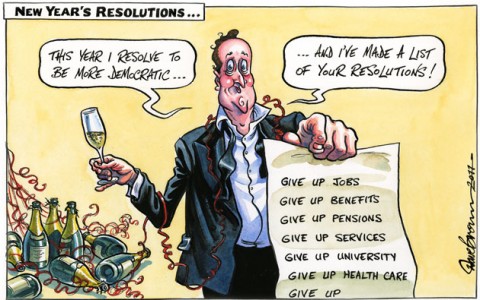
Honig awakens us to an important aspects of our current crisis: that “the market” is not in fact supremely sovereign, and the move to re-establish and further neoliberal policies and push through austerity measures requires an engagement in democratic politics – albeit one that undermines the notion of the public itself and seeks to use the power of the law to subvert democracy. Recognising the current crisis in these terms not only challenges us to consider how to survive our current troubles without giving up democratic virtues, it also reinvigorates and clarifies the political challenge we face. Emergency economics – with its assertion of debtocracy over democracy – is not an inevitable response to the crisis, it is a political one that we can, and should, fight against.

Continue reading

Grayling’s Eminence; Or, For That Kind Of Money, I Would Demand A Team Of Live-In, Round-The-Clock Tutors, Ready To Fill Me In About Renaissance Art Or Logical Positivism At The Snap Of A Finger.


I do feel somewhat sorry for A.C. Grayling. Following his sudden exit from the Birkbeck scene, former colleagues sent a short but apt letter to The Guardian, expressing appropriate levels of dismay and resistance to the innovation of the New College of the Humanities. They raised basically two objections. First, that the New College is for-profit, substituting the business of teaching in place of the vocation of research. And second, that it is in the ‘vanguard’ of efforts to link education to wealth, partly via a leaching of public resources.

Although many prominent names were used to unveil New College, few seem in sight now that it is under sustained attack (Peter Singer, where are you?). And Grayling, somewhat to his credit, keeps replying to the antiquated nay-sayers desperately clinging to the sinking ship of public provision. Perhaps the fullest public defence has come in response to the Birkbeck letter. Although garlanded by academic niceties (“with respect”; “I would be very grateful”), the ultimate conclusion is that his critics lack some basic faculties of reason: “I have seen only an emotional case for scapegoating our project”.

Surely, then, there are firm responses to the proliferating critiques? Grayling’s fuller case for New College turns primarily on the idea that students are being under-charged rather than over-charged. The relevant comparisons? That an MSc in Finance at LSE for an overseas student costs almost £26,000 (with many other programmes charging in the £15-21,000 range) and that a DPhil in cardiovascular medicine at Oxford will set you back nearly £27,000 if you’re not from the EU. The point being that high fees for some already subsidise lower fees for others. Now, you’ll notice what has been done here: £18,000 for an undergraduate degree for all students is being justified on the grounds that you can find a handful of prominent programmes elsewhere that charge more than this for masters programmes for non-EU students.

As an argument for justice it has some merits (Why the disparity here? What are the ‘real’ costs of educating a doctor or financial specialist?). But as a defence of New College as prosaic rather than parasitic it doesn’t stand up to much. And I’m sure there’s a latin term for this kind of fallacy. A direct comparison with liberal arts funding in the US would have offered us more, but that would have required admitting that there is something new about the New College in the UK setting. You’ll recall that, before people starting off letting flares at Grayling’s talks, this was very much the selling point of New College. Its online welcome still announces: “New College of the Humanities is a new concept in university-level education”.

Lots of the new then, which makes it worth thinking through some of the older ideas of the university, as Steve Fuller did so wonderfully back in February. But there is something yet more damning in Grayling’s reply. He says that his project can’t be vanguardist. In a repeat of the AHRC debacle, apparently bright people conclude that you can’t be complicit if the Minister didn’t call you directly and tell you to do something. Grayling clarifies that he is under no compulsion of Government and has no love for the current reconstitution of UK higher education, as if that matters. Moreover, “we cannot be in the vanguard of what has long been happening”. This is the crux of a claim made before: that New College is simultaneously following an economic pathway outside of its control and that it will have no detrimental impact outside of its own halls.

Other engaged in privatised education do happen to think that the New College will accelerate some market openings. But notice that Grayling can’t have it both ways. His argument against allegations of vanguardism is that New College is too small and insignificant for anyone to follow its lead. But his argument for an £18,000 fee compares New College to comparatively small and unrepresentative courses which charge more than he intends to (about 80 people take that MSc in Finance at LSE). An accidentally immanent critique, this mode of argument illustrates exactly how a vanguardist framing works, and has worked over the last years. Find an institution that charges more than you do and has a good reputation. Point out that you could do more, and do it better, if you had their money. Campaign for that outcome while ignoring or dismissing arguments for higher levels of public investment. Repeat. Change the discursive and economic landscape in a series of comparative expansions.

Grayling suggests high fees elsewhere as justification for his high fees, but then expects us to believe that his high fees (which are much more clearly comparable with undergraduate provision than are the courses he cites) won’t be used by anyone anywhere to militate for a further uncapping or greater move to student debt and ‘consumer-led’ education over equal access and public goods. It is hard to see the logic in such a position, not least when it already provides indications of how such an appeal by others would run:

Note one thing: the deafening silence of the vice-chancellors in the controversy over our college project. Why? Because as the individuals most acutely involved in battling with impossible arithmetic, they understand the realities.

Please.

Andrew McGettigan’s excellent and much circulated analysis points out that marketisation requires the softening up of older providers via the introduction of one or more exemplars of new learning: 1) independent, non-profit providers like the University of Buckingham; 2) private, for-profit providers like BPP and now NCH (perhaps owned by people like Apollo); 3) Edexcel in relation with colleges; 4) Cameron’s planned ‘Big Society University’; and 5) globalised multi-nationals. New College has to be viewed in this context and not, as Grayling wants, as some minor footnote. Here’s McGettigan:

The new market conditions must first be created. A significant amount of intervention is required to bring about a ‘level playing field’ in which new, more commercial, operations can compete successfully to drive down costs. The first steps here have already been achieved. First, the complete removal of central funding to arts, humanities and social science degrees exposes the established provision to potential competition in a manner that gives the lie to Willetts’s claim that the cuts have been ‘scrupulously neutral’. (No new provider is currently planning to offer STEM degrees, which are expensive to run and require large overhead and start-up costs.) Second, students at private establishments have already been granted access to the student loans and grants…Third, when viewed in conjunction with the new visa restrictions on overseas students (a political decision affecting an otherwise independent and substantial income stream) and the cuts just announced from HEFCE for the 2011/12 budget, we can conclude that universities are being softened up. Prior to a major reorganization of higher education these cuts are punitive and part of a concerted effort to destabilize the sector for the entry of new agents… What is proposed does not simply benefit small, niche operations but creates the conditions for ‘creative chaos’ similar to that to be unleashed on the National Health Service.

Administrative Offences; Or, In Terrorem, University of Nottingham Branch (The Sequel)

Like Ryan Giggs, the University of Nottingham is by now learning something of the Streisand Effect, where attempting to hide information and silence critics inadvertently leads to much greater levels of discussion and critique than would otherwise have been the case. Recall that Dr Rod Thornton was suspended in early May for a paper he wrote for the BISA conference (an academic gathering for those working on all matters ‘international’, from foreign policy to anti-globalisation). But the story isn’t going away and now the paper itself is available at Scribd (or in pdf if you prefer). It’s 112 pages of description and analysis which, among other things, charges named senior staff at the University of Nottingham as implicated in breaches of law and good conduct.

Particularly of interest is the disclosure in the paper that much of the documentation drawn on to build Thornton’s case is already in the public domain, having been the subject of a series of Freedom of Information (FoI) requests in the years since the arrests. Much of the most damning material comes from a comparison of emails, reports and other documentation that has been released under FoI, or which is linked to written documents that Thornton says he possesses, and so which could be easily checked in a court of law. There is reference to meetings, but even here quotes are linked to transcripts. All of which rather puts into question Nottingham’s contention that defamation was a serious threat. Moreover, Thornton makes a good defence of naming names on other grounds – which is precisely that he is not seeking to bring the University into disrepute, but to single out those most responsible for a calumnious series of events.

It turns out, for example, that Thornton has been subjected to a series of investigations since 2008, apparently of increasing triviality. At one point he was charged with providing faulty reading lists on the grounds that he did not add his office hours to the front page and included too many essays on a module guide. The fallout for Hicham Yezza and Rizwaan Sabir has been somewhat more serious – in addition to continual stops-and-searches after the incident, both have been listed on Home Office documents enumerating ‘major Islamist plots’ against the UK.

But what of the trigger for the arrests in the first place? We might assume an innocent misunderstanding occurred, with regrettable consequences. But:

what were these three documents that had ‘no valid reason whatsoever…to exist’ [as the University Registrar described them to the police]; documents which were ‘utterly indefensible’ for Yezza (and, later, for Sabir) to have, and documents which count not be sent via the university’s computer system? Well, two were articles from the journals Foreign Affairs and the Middle East Policy Council Journal, while the other was a publicly available document downloaded from the United States Department of Justice (US DoJ) website.

It’s hard to say anything positive about anyone who thinks work published in Foreign Policy is illegal. Criminal in some slighlty different sense, perhaps, but not illegal. As Thornton dryly comments, you can buy it in airports. Sadly, it gets worse: Continue reading