Societies Under Siege: Exploring How International Economic Sanctions (Do Not) Work

This is the first in a series of posts on Lee Jones’ Societies Under Siege: Exploring How International Economic Sanctions (Do Not) Work. Responses will follow from guest authors Elin Hellquist, Clara Portela and Katie Attwell over the next few days.


It doesn’t seem to matter what the international crisis is: be it an inter-state war (Russia-Ukraine), civil strife (Syria), gross violations of human rights (Israel), or violent non-state actors on the rampage (ISIS, al-Qaeda), the ‘answer’ from governments and civil society always seems to be the same: impose economic sanctions. In the mid-20th century, only five countries were targeted by sanctions; by 2000, the number had increased tenfold. Once an obscure, rarely used and widely dismissed form of statecraft, sanctions are now clearly central to the exercise of power in international relations – particularly when dominant powers are reluctant to put ‘boots on the ground’.

My new book, Societies Under Siege: Exploring How International Economic Sanctions (Do Not) Work, is the first comparative effort to explore how these sanctions ‘work’ in practice – on the ground, in target states. This post introduces the book and the forum that will follow.

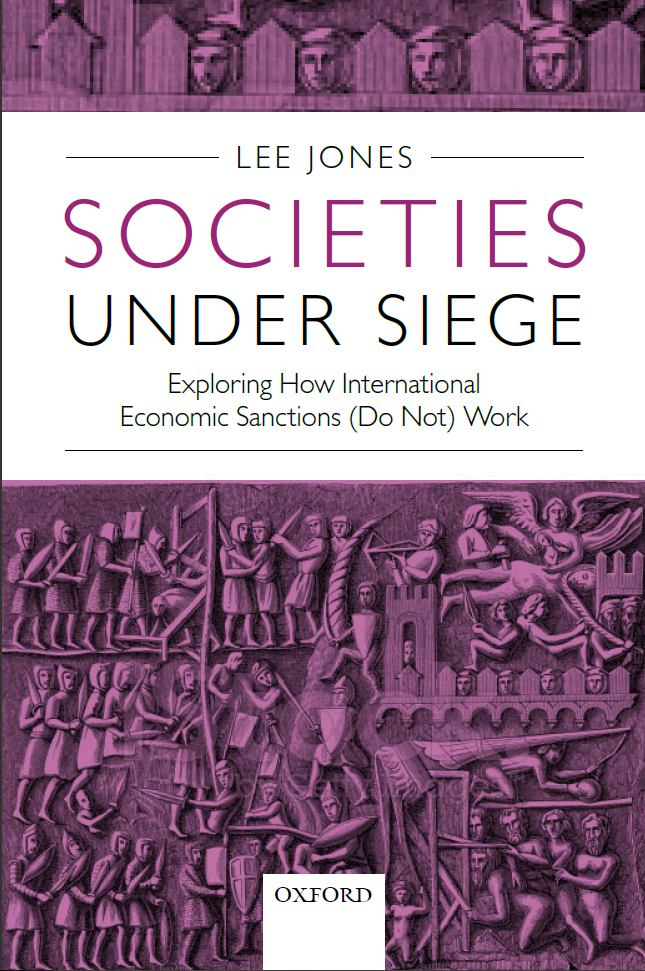
Societies Under Siege cover. The image is an engraving of a (failed) siege during the Albigensian crusade.

Societies Under Siege cover. The image is an engraving of a (failed) siege during the Albigensian crusade.

Continue reading

What Is It Like To Be Lebanese And To Work On China?

elamineredA guest post from Loubna El Amine. Loubna teaches political theory, with a particular focus on early Chinese political thought at the Department of Government, Georgetown University (her teaching was mentioned on this blog last year).  Before Georgetown, Loubna was a postdoctoral fellow at the Whitney Humanities Center at Yale University. She holds a PhD in Politics from Princeton University and a BA in Political Studies from the American University of Beirut.  Classical Confucian Political Thought: A New Interpretation (Princeton University Press, 2015) is her freshly pressed first book.

elaminebook

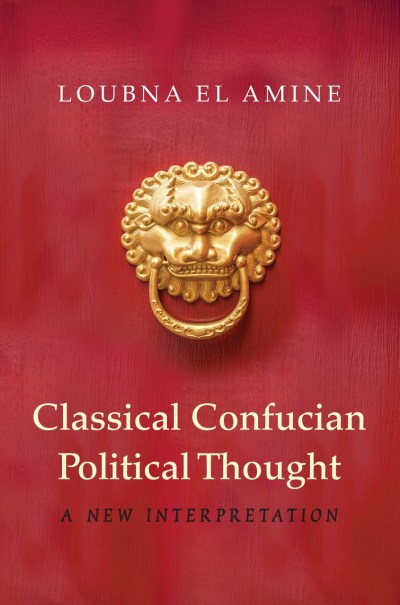
I recently wrote a book. Its cover is (very) red and features an ornate golden doorknob shaped like the face of a lion. I have always dreamt of writing a book. The experience of seeing one with my name on it fills me with a combination of delight and incredulity. I am sure all first-time authors experience a similar feeling. In my case, however, the feeling is heightened by the sense that I wrote a book that, for the first two-thirds of my life, I could never have even conceived of writing.

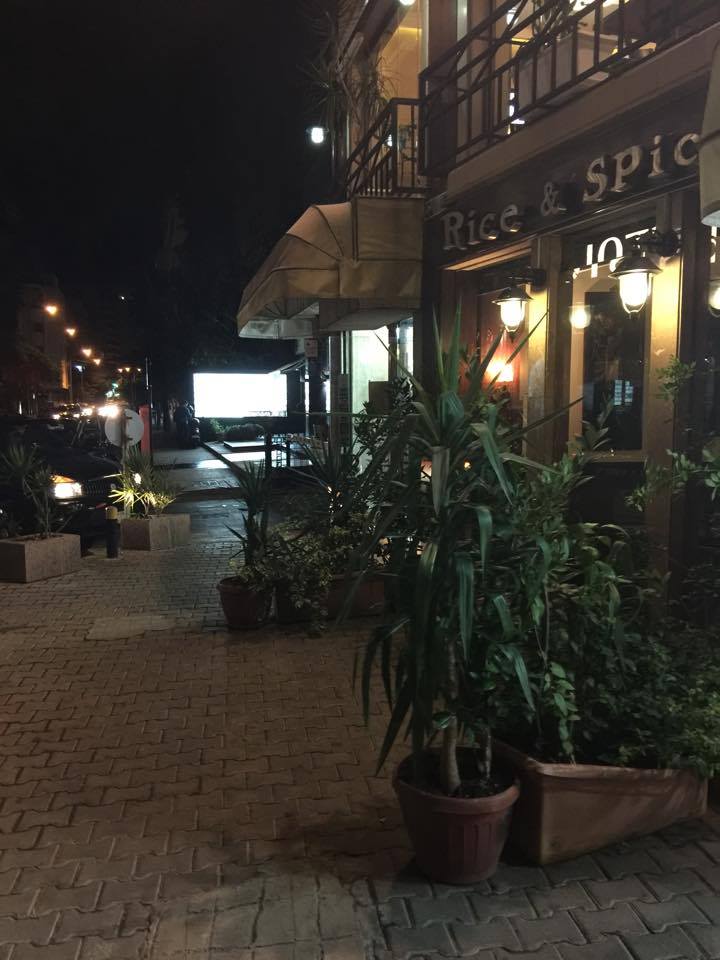
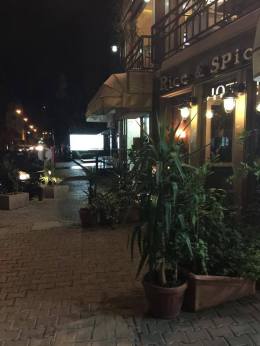
The book is on early Confucianism in China, and I did not know anything about China until I was twenty. China was so foreign to the intellectual, political, and cultural world in which I grew up that the two ways in which it was usually mentioned were the proverb, often attributed to the prophet Muhammad, which says “Seek knowledge, even in China” and the description of anything that sounded incomprehensible as Chinese (the Arabic equivalent of the American “It’s Greek to me.”). More mundanely, there was only one Chinese restaurant in Beirut when I was growing up, a small, family-owned place called Rice and Spice (today there are many more, with names ranging from Chopsticks to Wok Wok).
riceandspiceAlthough I studied political science as an undergraduate at the American University of Beirut, the curriculum rarely covered areas beyond the Middle East, and when it did, it only reached as far as Europe. It was only because of one professor, Yahya Sadowski, that I discovered China. He taught courses on global political economy and on development in the Arab world, and frequently cited both East and Southeast Asian countries as case studies. When I started graduate school in the US, I decided to explore East Asia further. This exploration took a few twists and turns, and I finally landed, having foregone empirical for philosophical pursuits, in the intellectual world of 3rd century BCE China.

Every once in a while, someone describes what I do as “contrarian,” “crazy,” or “looney.” I never know quite how to react. The description is, in some ways, true. I studied Confucianism because it spoke to me and because I was intrigued by it, but I also sometimes wonder whether I studied it because I did not want to study the Middle East. I sensed that it was expected of me that, as a non-Westerner, I study my own region. This expectation bothered me. When people now call what I do “contrarian,” this only reminds me that the expectation is still at play. Not that I think that there is anything wrong with someone from the Middle East working on the Middle East, just as there is nothing wrong with someone from the US studying the US. The problem is simply that no one thinks it is contrarian or crazy when Americans or Europeans choose to study societies other than their own.  In other words, my worry is that the surprised reactions I get about my work point to the existence of an unconscious bias, generated and maintained by the current make-up of academia, against the ability of non-Westerners to produce knowledge that is not about ourselves. We cannot transcend, like our European and American counterparts can, our own world. We are our own case studies, so to speak. This means that if we are successful at studying our own regions, the success is likely to be attributed to our “inside knowledge,” rather than the work itself. It also means that when we do happen to study a topic that is seen as “Western,” say European philosophy, the default assumption is that we do so from the standpoint of our colonial experience. And finally it means that studying another non-Western region is simply “contrarian.”

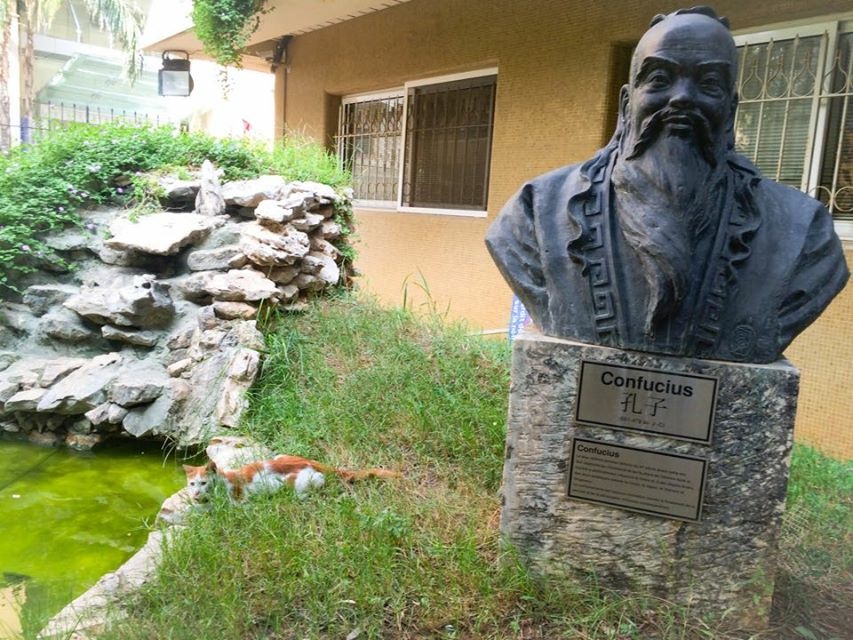
statue

Though it has not happened to me personally, friends of mine from Lebanon have reported being encouraged, even if gently, to focus their doctoral work on Lebanon, the Arab world, or Islam. Other friends who have chosen to work on the Middle East have complained about their work being mislabeled to the same effect, its theoretical import downplayed in favor of its ‘regional flavor’. I have also heard of new professors being encouraged to teach courses on topics that they do not necessarily work on (who else is going to teach Islamic philosophy but the new Iranian professor?!). And my suspicion is that this arrangement also likely guides decisions on admission to US and European PhD programs in the humanities and social sciences: if you are from a non-Western country, you are more likely to get accepted if your work is directly related to the geographic area where you are from.

This expectation also feeds into the way in which academic institutions in non-Western countries are framed and present themselves. When I inquired some years ago about what it would take to be hired at the American University of Beirut, I was told clearly that I would need to shift my work toward Islamic thought. Middle Eastern and Islamic studies are, after all, AUB’s claim to fame, the primary reason it is able to place graduate students in American and European institutions and to attract foreign MA students. It was also telling that, when in Seoul this past summer, my work was described by a couple of people I met as the “Islamic view of Confucianism.” The equivalent here would be to describe American and European work on China as representing “the Christian view.” But while this sounds as odd as it is problematic, it is actually not much different from the charge of contrarianism: both descriptions belie the need to place me back into the world in which I grew up. I absolutely love the world in which I grew up, but I would like to think that, like my Western colleagues, my intellectual horizons are not limited by my place of birth.
Twilight of the Journal Vampire Squid

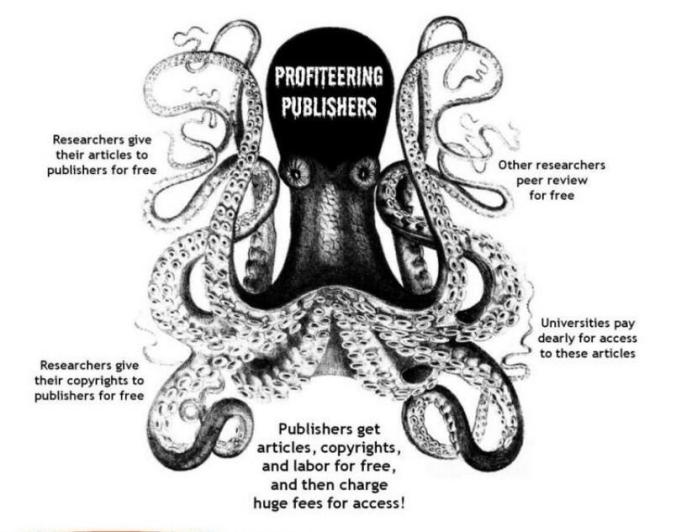
This was in someone's open access slide show someplace, but the name, and therefore the credit, escapes me.

This was in someone’s open access slide show someplace, but the name, and therefore the credit, escapes me.

I have a piece up at e-IR today returning to the question of open access. It is partly an introduction to the issues, partly a manifesto on why academics should take the digital commons more seriously. But it is mainly intended as a provocation for the discipline (proto-discipline, non-discipline, borg-discipline, what you will) of IR, and a challenge to the in my view excessive resistance to open access that characterises its upper echelons. To wit:

What is IR’s contribution to the open access movement? Almost nothing, arguable less than nothing. There is no IR equivalent of ArXiV  – the hugely successful online repository favoured by physicists and mathematicians. Nor of PLOS  – the gigantic open access mega-journal suite favoured by hard scientists, which sustains itself on low relative processing charges. Nor of Cultural Anthropology – a learned society journal gone fully open access. No experiment like the Open Library of the Humanities – a new platform-cum-mega-journal funded by a conglomerate of libraries. No appetite for something like Sociological Science – an open access journal with quick review times and low, means-tested article publishing costs. There are a handful of open access IR journals, like Ethics & Global Politics (not to be confused with Ethics & International Affairs), the Journal of Critical Globalisation Studies, and the Journal of Narrative Politics, run largely on goodwill, but they are sadly lacking a disciplinary presence. Publishing in them will not make a career, and is unlikely to impress hiring committees which have an eye to bankrupt measures of quality like the journal impact factor.

Worse still, the discipline of IR has missed opportunities to make itself more open and relevant, all the while fretting over its introversion and lack of relevance. Some of our responses to the open access movement have been sadly conservative and dismissive. New journals like the European Journal of International Security and the Journal of Global Security Studies are run on the standard closed model. Neither the leadership of the British International Studies Association nor the International Studies Association have followed the innovations carved out by colleagues in anthropology, sociology or STEM subjects. And young journals that position themselves as disrupting orthodoxy (such as Critical Studies on Security) have nevertheless emerged under the imprint of familiar publishing houses. While Editorial Boards in other disciplines are considering resignation and boycott to force change on the system, IR scholars are joining an ever-growing list of titles that promote business as usual. Closed journal publishing has become common sense: unquestioned despite its manifest failings.

Continue reading

Let’s Talk About the “Ugly Briton”: Shashi Tharoor on Winston Churchill

October is always a good time to catch up on one’s correspondence from July.  “FYI,” noted a friend though FB’s messaging system, linking to this:

The video’s title, “Dr Shashi Tharoor MP – Britain Does Owe Reparations,” sums it up.  The other videos from the same debate event are worth watching, too, but Tharoor’s is quite simply a must-see for anyone interested in the British Empire.  Indeed, you have probably seen it already.  With 3 million views, 6000+ comments plus what seem to be hundreds of reactions by all kinds of people in all kinds of media of communication, this one 15-minute video alone can legitimate Oxford Union Society claim’s that it aims “to promote debate and discussion not just in Oxford University, but across the globe.”

Why is it that Oxford Union struck social media gold with this debate but not with some others (“socialism does (not) work,” anyone)?  Even if it is safe to assume that “many” people would be familiar the reparations argument in general and even that “some” would be familiar with Britain’s reparations to the Maori, the fact is that “no one” had given a fig about the case for Indian reparations [1].  My scare quotes are meant to signal that these quantifications are relative.  It was a century ago that Dadabhai Naoroji, known to some as the Grand Old Man of India, argued that “immediate” self-government, a.k.a. swaraj, would constitute Britain’s “reparation”.  But this is precisely the point: reparations-talk becomes itself only when subjected to a sufficient degree of metropolization or mainstreaming [2].  White academics like Boris Bittker started paying attention to the legal argument for “black reparations” only in 1969, after James Forman famously stood up in a New York City church to argue that white churches owed a lot of money to a lot of people.

Continue reading

The Dissonance Of Things #4: Leftist Foreign Policy After Corbyn

The fourth of our monthly podcasts, turning our attention with ever greater political precision to Corbynmania, Jacorbynism, #JezWeCan, or however you prefer to characterise the arrival of Jeremy Corbyn as Leader of the UK Labour Party. Since before his victory, Corbyn has been stalked by, and occasionally celebrated for, his views on international politics, from the crisis in Ukraine and associated Great Power rivalries to his views on Hamas and from the (non-)renewal of Trident to the UK’s future role in NATO. David Cameron, for one, has attempted to securitise Corbyn, repeatedly arguing that “the Labour Party is now a threat to our national security, our economic security and your family’s security”.

And so we ask: what is a leftist foreign policy? Is such a thing even possible? Should the left, in whatever form, be seeking to capture, remake or resist foreign policy? What do the wishlist strands of a left foreign policy look like? Lee, Meera and I are herded into some kind of order by Kerem, and joined by Chris Emery of the University of Plymouth. author of US Policy in Iran: The Cold War Dynamics of Engagement and Strategic Alliance 1978-81 and this post on the history of covert action in Iran.

As ever, consume, cogitate, argue, and share, share, share. Past and future casts are available on soundcloud.

Further resources, including articles discussed in the podcast:

Thinking Internationally About The Arms Trade

A guest post, following our recent podcast on the arms trade and its discontents, from Anna Stavrianakis. Anna is a Senior Lecturer in International Relations at the University of Sussex. Her research focuses on the arms trade, arms transfer control and militarism.


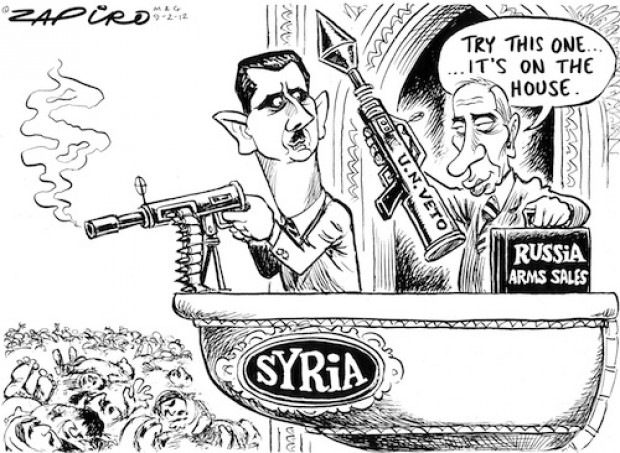
Zapiro - Russia Syria Arms Trade

September 2015, ExCel Centre, London: Stop The Arms Fair activists block the road and prevent military vehicles entering the Defence and Security Equipment International (DSEI) exhibition. They are protesting against one of the largest arms fairs in the world – sending a message to the UK government and arms companies that “inviting representatives of repressive regimes and their armed forces to hob-nob and do dodgy deals at DSEI … with representatives from the UK government and unscrupulous arms companies from around the world IS NOT OK.” Two weeks previously, Cancun, Mexico: Control Arms activists build a life-size sand sculpture of a Stormer 30 tank on Baracuda Beach, Cancun, calling on states to save lives! by ensuring the toughest possible standards at the first Conference of State Parties to the Arms Trade Treaty, the biggest game in town for contemporary international arms transfer control.

These two campaigns share the language of “dodgy deals” but are otherwise quite different visions of the arms trade and its control. The Control Arms campaign focuses on encouraging, informing and embarrassing diplomats into agreeing a multilateral treaty that enshrines higher common international standards and establishes stronger norms against arms transfers that violate human rights and international humanitarian law. The Stop The Arms Fair coalition, meanwhile, takes direct action to halt the operation of arms fairs in the UK by physically blockading the exhibition centre, in protest at the relationship between arms companies and the UK government, and the relationships between the UK government and authoritarian, repressive and war-fighting foreign governments.

I’ve written in the past about the international politics of NGO and campaign group strategy – whether reformist, insider approaches are more effective than transformist, outsider ones – in the context of debates about global civil society. Yet what continues to trouble me, intellectually and politically, is a raft of questions about the operation of the arms trade itself. Namely: where, or with whom, does political responsibility lie for the negative effects of the arms trade in a world of formally national states that are home to internationalising arms companies and operate in a multilateral system based on sovereignty? What social forces drive the arms trade, how does their power operate, what is the character of the problems they generate, and how should scholars and activists best respond? Competing understandings of the operation of the arms trade can be seen in the varied activist responses to it: is the problem one of lack of regulation, the need for improved multilateral action, improved normative standards and international law, as per the Arms Trade Treaty? Or is the problem the relationship between the state and arms capital, and government promotion of the trade, as per the anti-DSEI protests? In the case of DSEI, how are we to understand the operation of internationalising arms capital that has an intimate yet fractious relationship with national states? And in the case of the Arms Trade Treaty, how should we make sense of efforts to create a level playing field of respect for human rights and humanitarian law in the context of a vastly asymmetric and hierarchical world military order?

Thinking theoretically, I have come to see that a large part of the difficulty in answering these questions lies in the grip that methodological nationalism continues to hold on IR as a discipline. Continue reading

The European Gaze and the EISA Asylum Seekers Campaign

Gulsah

Gulsah

ayse

Ayse

A reply to Federica’s recent post on the asylum crisis by Zeynep Gülşah Çapan from Bilkent University and Ayşe Zarakol at the University of Cambridge. Gulsah is a Post-Doctoral researcher at Bilkent University. Her research focuses on Eurocentrism in international relations theory and postcolonial and decolonial thought. Ayşe is a Lecturer in International Relations at the University of Cambridge. Her research focuses on social hierarchies in world politics. Her first book After Defeat: How the East Learned to Live with the West explored the responses of defeated non-Western powers to stigmatisation.


The increasing attention to the European refugee crisis in Western media has also galvanized the IR academic community into thinking about possible ways to address the issue. There have been blog posts and Twitter discussions (On Doing ‘Something’ as AcademicsWant to Help the Refugees? Teach Migration as part of IRHow to Speak Out As An Academic Community? Help Needed!) about possible actions, especially with respect to the EISA conference that will be held in Sicily in two weeks. On September 11th, EISA section chairs received an email urging them 1) to sign and circulate an open letter to EU policy makers penned in the name of “the academic community”, 2) to bring up the issue in EISA panels and 3) to wear black ribbons/armbands as a sign of mourning and protest.

We applaud the motivations that led to this effort and agree that EU countries could be doing much more to help refugees. We also concur that European scholars could do much more to raise awareness about the complicity of their own governments in various global political crises. Nevertheless, for the reasons detailed below, we have some reservations about both the desire to frame this effort as an EISA effort involving section chairs and the claim to speak in the name of the entire “academic community”. In the blog post Ivory Towers and Sleeping Beauties that discusses these efforts the author urges the “academic community” to do two things; to check their privilege and make themselves feel uncomfortable. These are suggestions that we completely agree with and this post is an effort to continue the dialogue on how we might think of issues in the international system in a way that checks our privileges and makes us feel uncomfortable.

To begin with, the refugee crisis is not new and it is not primarily a European problem that can be solved by some small gesture from the EU. Most refugees from the Syrian War, for instance, are hosted in non-European countries. According to Amnesty International, more than 95% of the refugees (4 million) are in five countries: Turkey (1.9 million), Lebanon (1.2 million), Jordan (650000), Egypt (249,463), Iraq (132,375). Another region hosting huge numbers of refugees is East Africa – based on UNHCR’s latest numbers, Chad hosts about 450000 refugees, Ethiopia hosts 650000 and Kenya has 550000. In fact, almost every world region except Europe is hosting hundreds of thousands to millions of refugees and has been doing so for far longer than Western newspapers have been covering “the refugee crisis”. By most estimates, there are sixty million refugees in the world at the moment.

We understand why European colleagues may want to pressure their own governments to change policy and we wholeheartedly support their individual and/or collective efforts to do so. But to organise a professional effort only now (and without providing any of the larger context) in the name of the entire “academic community”  may actually reinforce the Western public misperception that this is a recent or a uniquely European problem or that European countries that have agreed to take comparatively small numbers of refugees are doing something unusually selfless. Continue reading

‘Quality Assessment’ and ‘Student Outcomes’: An Open Letter

This is a follow-up to my earlier post on HEFCE’s Quality Assessment consultation. This post elaborates the reasons why using student outcomes data to assess educational quality is unacceptable, in the form of an open letter that all academic colleagues are invited to sign. To do so, just add your name, title and institutional affiliation in the comments.

UPDATE 23.09.15: UUK has just circulated their response to HEFCE, which endorses the use of student outcomes data, making this letter all the more urgent and necessary. They write:

We agree that a core set of quantitative student outcome metrics should be included in institutional reporting. These should be the benchmarked UK performance indicator set, covering retention, widening participation, 6 months destination of leavers from higher education, plus relevant benchmarked results from the national student survey, primarily question 22 ‘overall satisfaction with course’…

*    *    *

To: HEFCE and Universities UK

We are university educators who are deeply disturbed by the proposed use of ‘student outcomes’ metrics as proxy measures of teaching quality in HEFCE’s proposed new ‘quality assessment’ regime and the mooted ‘Teaching Excellence Framework’. We call upon HEFCE to reject, and upon UUK to campaign vociferously against, this use.

The use of ‘student outcomes’ to measure teaching quality is completely inappropriate for the following reasons. Continue reading

‘Quality Assessment’ and Completing the Market in UK Higher Education

Amid all the talk of a ‘Teaching Excellence Framework’ (TEF), a consultation on Quality Assessment (QA) launched by the Higher Education Funding Council for England (HEFCE) on behalf of all UK funding councils has received considerably less attention. But academics, students and others should be paying close attention because HEFCE’s proposals are clearly intended both to soften up the sector for the TEF and – more importantly – spur its hitherto partial marketisation.

I have written a response to the consultation, with very useful input from Meera and from John Holmwood, cofounder of the Campaign for the Public University. You can read the full thing here (it is signed by 50+ other academics). There is still a little time to associate yourself with the document if you wish (email me directly by 18 September). Below I highlight the core points, and in a follow-up post I also provide an open letter that colleagues can sign to oppose the worst aspects of these plans, which are also likely to be reflected in the proposals for a TEF, expected later this autumn.

Continue reading

The Status of Syrian Nationals Residing in Turkey

migrants-boat-capsize-mediterranean

Preface.

I have written this blog post about three weeks ago and have been sitting on it, reflecting about it since then, I was not sure if I wanted to write yet another piece on the “Syrian refugees”. But yesterday, we all woke up to the images of two young children lying on the beach lifeless around Bodrum, Turkey, and having read some of the posts available, I felt the need to post this. This is not a happy or “cool” post. This is a post about dire conditions and technicalities on the status of Syrian nationals living in Turkey, and it should be seen as a plea for assistance, and action.

The children in the pictures were Aylan Kurdi, 3 years old, and his brother Galip Kurdi 5, who drowned along with their mother Rehan Kurdi, on their way to Kos, Greece. They were from Kobane, trying the irregular route after their application for private sponsorship was refused by the Citizenship and Immigration Canada (CIC), and presumably the Immigration and Refugee Board (IRB) of Canada this summer.

As an expectant father, and a human being, those pictures are too brutally heartbreaking for me. They are too real, yet unfortunately they are not exceptional or extraordinary. I was unable to look at the pictures for more than a second, and I don’t think I can ever get to share them or look at them again. Elsewhere on the Visual Cultures Blog, @MarcoBohr makes the point on how we can only confront the inhumanity of the situation by confronting such pictures directly, but I just can’t get myself to look at them again, so I am not posting them or really talking about them in this post. Instead, I look at some of the reasons (structural, institutional, situational) that pushes people to seek such a risky route out of Turkey. The images, in tandem with all those individuals dying in the Mediterranean, en route to Europe, represents a moral/humanitarian crisis and demonstrates the hollowness of the so-called “normative power Europe.” The European Union, US, Canada, Australia, and every other capable country – including the Middle Eastern countries – must be ashamed of their actions, or the lack thereof, in addressing this crisis. As scholars, individuals, and human beings we must not just read about these deaths, we must whatever we can stop others from dying the same way. 

Continue reading