Ethical Encounters – Parsing the Pluriverse: empathy and deliberation in a post-MDG ethics of international development

DSC00921

Our fifth post in the forum is a guest post from Diego de Merich. Diego got his PhD from LSE and is now an LSE 100 Fellow and a research associate at the Institute for Intersectionality Research and Policy at Simon Fraser University. His work focuses on human empathy and the ethics of care in service of alternative frameworks for International Development (post-Millennium Development Goals). For earlier posts in the forum do look for Myriam’s here, Joe’s here, Elke’s here and Jillian’s here. Kim’s discussion post can be found here.


With the Millennium Development Goals (MDGs) set to expire in 2015, focus has turned to a new framework which might replace them. Heavily influenced by the Human Capabilities Approach (HCA), the MDGs and the recently-proposed ‘Golden Thread’ frameworks posit a relatively monolithic, liberal understanding of what ‘development’ is meant to signify. As such, each new iteration of an international agreement on development seems destined to miss the potential for more creative and context-appropriate political action in response to the shortcomings of the approaches which preceded them. Using as a starting point Arturo Escobar’s Encountering Development, I suggest that his notion of the pluriverse – which stands in opposition to the ‘universal and homolingual thrust of modernity’ – both challenges the post-2015 discourse and implies the need for different ethical practices upon which ‘development’ might instead be re-cast. Realisation of the pluriverse and notions of care, responsibility, democracy and pluralism would require that closer attention be paid to narrative voice and to the role that empathic processes should play in the deliberation surrounding development.

The ‘promise’ of empathy in pursuit of a post-MDG development practice can be understood by contrasting two approaches to deliberative democracy – one which would hold the HCA as its guiding ethical impulse and one which suggests that an ethics of care and responsibility in international development requires a better appreciation for the role that empathy and narrative play in understanding the development possibilities and realities of the constituent elements of Escobar’s pluriverse. Here, the focus of ethical enquiry is shifted from a more abstract notion of social justice to a recognition of shared/lived vulnerability, alternatively-imagined ways of being and thus, to an ‘international development’ which is differently understood and practiced.

Untitled Continue reading

Black Academia in Britain

The last few years have witnessed a growing concern with the challenges that peoples of African heritage – who I will define in this blog as Black peoples – face working and studying in the UK higher education system. Issues of the relative absence of Black people in influential positions have taken centre stage, alongside the direct and indirect discrimination that both black students and staff might confront. These are long standing issues. Indeed, for a number of years now, some British Black academics have made careers in North America more easily than in their domicile country. 

These challenges have been met by various recent initiatives, for example, a concerted effort to formally institute a British Black Studies, and the creation of a network of Black British Academics. To repeat, concerns as to the presence and experience of Black people in British academia are by no means new. But these concerns have been re-engaged with in a new context marked by austerity, the growing internationalisation of universities, and the radical changes to the public university system in Britain implemented by the coalition government who  are turning “multiversities” into “monoversities” organized singularly along the lines of commercial logic and interest.

Having been involved in a small way in recent re-engagements with the place and standing of Black academics and staff in UK academia I thought I would take stock and look at a few recent statistical and qualitative studies that appraise the state of Black academia in Britain, from both an academic and student standpoint.

Before I start, though, I want to say a few words about the internal composition of Black peoples in the UK. According to the 2011 Census, Black people now compose 3.3% of the population. However, the pronounced immigration over the last twenty or so years of peoples from the African continent has significantly shifted the demographics and dynamics of the Black population itself. Whereas, in the 1950s to 80s, Black Britain referred primarily to the “historical” African Diaspora – mainly those from an African-Caribbean background – it now predominantly refers to a new Diaspora with a continental background.

Continue reading

Every Ghetto, Every City

Really insightful video on displacement in Washington DC from Al Jazeera English. This piece traces a dynamic that is seen across the US and around the globe – including example of residents fighting for a human right to housing and featuring One DC.


And some tunes to go along with the news…


Cavity Searches in Intern(ation)al Relations

In the most darkly comic scene in Mohammed Hanif’s brilliant A Case of Exploding Mangoes, General Zia—the thinly mustachioed dictator of Pakistan from 1977-88—suffering from a bad case of worms, enlists the services of the physician of his Saudi friend Prince Naif. ‘Birather, bend please’, requests Dr. Sarwari, in a strange mixture of Arabic and American accents. Zia unfastens his belt, slips his trousers down and leans forward, laying his right cheek on his desk. His head is between two flags, Pakistan’s national flag and the flag of the Pakistan Army, as Dr. Sirawar slips a lubricated probing finger into his itchy rectum. The allegory is crystal clear: this is Pakistan being fucked by Saudi and US money and weapons during the anti-Soviet jihad in Afghanistan.

In Mohsin Hamid’s The Reluctant Fundamentalist, the terror attacks of September 11 provide the pivotal moment in the transformation of young Pakistani Princeton graduate Changez Khan from Wall Street analyst to Islamist radical. Watching 9/11 unfold on television while away on a work trip, Khan feels something akin to schadenfreude, as if the attacks were payback for the daily humiliation of being Muslim in America, giving vent to a reservoir of grievance hitherto fiercely suppressed, even denied, in his pursuit of the American dream. Returning to the US, Changez can see that Americans see him differently. In Mira Nair’s film version of the book, he is separated from his white colleagues at immigration and subjected to a cavity search: this is Pakistan being fucked by the US in the aftermath of 9/11.

Continue reading

A Crisis of Immediacy

I wonder if other writers feel as though they are throwing words by the hopeful fistful into a void, into the place where an audience might be. This hoped-for-reader is on my mind because I feel I should apologise for having taken so long to think these thoughts and align them so that I can throw them into that void.

There is no reason for apologies, however, because my hoped-for-reader doesn’t know that my current thoughts are inspired by a planned but only partly written series of posts from two-and-a-half years ago. Yet I feel I am writing an overdue assignment on the last day of class.

My thoughts are not timely. I worry this means they are no good. This is a strange feeling, to worry not that the words that carry our thoughts are inadequate but rather that they have gestated too long, such that tossing them into the void ceases to be a hopeful act of communication and becomes rather like dropping a crumpled page into the nearest bin.

Artwork from wraphome.org

Artwork from wraphome.org

Those many months past I wanted to write more about the economic crisis, about the disaster in the making that was “austerity”. In particular I wanted to consider what virtues might help us to navigate what seemed an all-encompassing crisis. But the moment has passed, surely. Right? There’s talk now of recovery even in Britain and signs of changing attitudes in Europe. Continue reading

Where Have All The Black Professors Gone?

A new documentary, Absent From The Academy, on the status of black scholars in the UK. Alongside Paul Gilroy, Adam Elliott-Cooper, Denise Noble and others, it features our own Robbie Shilliam. The problem is simple enough: why are only 85 Professors in the UK – that’s 0.4% of the total – black? The official statistics show that only 1.4% of all academic staff are black or black British, whether African or Caribbean, compared to 4.5% of manual staff and around 3% of the general population (those, alongside assorted “mixed” and “other” are the categories available for contemporary biopolitics).

This accounting – while necessary – leaves some identities unreconstructed, not least when the inclusion of marginalised groups is read as synonymous with an intellectual identity politics. Gilroy channels C.L.R. James to warn of the reductionism, of making the status of whoever an issue of ‘X studies’, whilst privilege remains invisibly white. Or, as James argued in ‘Black Studies and the Contemporary Student’ (1969):

Now to talk to me about black studies as if it’s something that concerned black people is an utter denial. This is the history of Western Civilization. I can’t see it otherwise. This is the history that black people and white people and all serious students of modern history and the history of the world have to know. To say it’s some kind of ethnic problem is a lot of nonsense.

Struggling with Precarity: From More and Better Jobs to Less and Lesser Work

Once a French neologism, precarity is now a household name describing in equal measure the fate of low-wage, part-time holders of bullshit jobs, seasonal and migrant workers, creative entrepreneurs of the self, “graduates with no future,” foreclosed homeowners, debtors and increasingly even segments of the salaried bourgeoisie. At its most basic, a term for the economic uncertainty and existential angst associated with the dissolution of fixed employment, precarity also suggests the disintegration of stable societal bonds, occupational identities, social protections and a sense of entitlement and belonging characteristic of the old proletariat. In short, then, precarity is the experiential dimension of the crisis of the society of work dating back to the 70s and 80s.

Diego Rivera Detroit Industry Mural 1923

Increasingly advanced production methods, introduced since the 70s to tame shop-floor insubordination as well as reap the untapped potentials of global competition, have caused a decline in growth rates, which no amount of privatization, financialization and austerity measures has been able to make up for since. Andrew Kliman and others have argued that it is this real crisis in capitalist productivity that lies at the heart of the current slump, and not simply unrestrained financial gluttony, as the more short-termist analysis offer. As capitalist production develops, machines replace people and the rate of profitability, which is given by the human labor theory of value, drops, causing sluggish investment and slow growth. This is essentially Marx’s theory of economy crisis, aka the tendency of the profit rate to fall, but also a story we should know by now from Autonomist accounts about the transition from Fordism to post-Fordism (Hardt and Negri) or from profit extraction to rent-becoming-profit (Christian Marazzi), and from David Harvey’s accumulation by dispossession.

If we shift the scale of our focus from capital to labor, though, we see that the crisis of capitalist productivity is, in fact, a crisis of work or a crisis of a society built around work as the only legitimate point of access for income, status and citizenship rights. Again, Marx is instructive here: “Capital itself is the moving contradiction, [in] that it presses to reduce labour time to a minimum, while it posits labour time, on the other side, as sole measure and source of wealth.” Socially necessary labor is reduced to a minimum (through things like automation, outsourcing, and financialization) at the same time that human participation in paid work continues to remain our only measure and source of wealth. Work doesn’t disappear as a result. It becomes fragmented, devalued, and wasteful, ceasing to provide a social identity or a collective language of experience.

Image

Precarity is a word for our time. It describes the slow disintegration of the historic bond between capitalism, democracy and the welfare state. But it also entails a rallying cry to reverse this situation. Continue reading

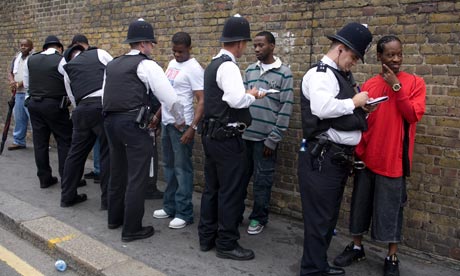
Stop and Search: Race and the Politics of Suspicion

banksy-searchStop and search at Notting Hill carnival

BETWEEN me and the other world there is ever an unasked question: unasked by some through feelings of delicacy; by others through the difficulty of rightly framing it. All, nevertheless, flutter round it. They approach me in a half-hesitant sort of way, eye me curiously or compassionately, and then, instead of saying directly, How does it feel to be a problem? they say, I know an excellent colored man in my town; or, I fought at Mechanicsville; or, Do not these Southern outrages make your blood boil? At these I smile, or am interested, or reduce the boiling to a simmer, as the occasion may require. To the real question, How does it feel to be a problem? I answer seldom a word.

– W. E. B. Du Bois, The Souls of Black Folk, (1905)

Video from excellent activist group Stop-Watch.

The political pause over Stop and Search

The riots of 2011, and the research that was conducted afterwards, have had multiple political effects. Of these, one of the most important has been a clearer public exposure of the deep animosities generated by police use of stop and search powers against young people and especially those of black and Asian backgrounds. Whilst the idea that stop and search causes animosity is not news to anyone interested in British race relations or human rights, it has unusually become the focus of increasing political attention. For many years the Independent Police Complaints Commission has warned that the use of stop and search powers may be being exercised in a discriminatory and unaccountable way, and the Equalities and Human Rights Commission have been investigating police forces on this front.  Yet it was only following the riots that the Metropolitan Police Commissioner Sir Bernard Hogan-Howe began a large overhaul of the use of the power in London in 2012. Following this, parliamentary briefings were issued which pointed to the broader ineffectiveness and abuse of the powers, and the Home Office has launched a consultation into the use of stop and search. In launching this consultation, equality-sceptic Home Secretary Theresa May acknowledged, in very measly terms, the discriminatory ways in which these powers had been exercised:

The official statistics show that, if someone is from a black or minority ethnic background, they are up to seven times more likely to be stopped and searched by the police than if they are white. Now we should not rush to conclusions about those statistics, but everybody involved in policing has a duty to make sure that nobody is ever stopped just on the basis of their skin colour or ethnicity. The law is clear that in normal circumstances, stop and search should only ever be used where there is a reasonable suspicion of criminality—and that is how it should be. I am sure we have all been told stories by constituents and members of the public about what it is like to be a young, law-abiding black man who has been stopped and searched by the police on more than one occasion. If anybody thinks it is sustainable to allow that to continue, with all its consequences for public confidence in the police, they need to think again.

House of Commons Debate, 2 July 2013 Continue reading

Notes on Ex-Yu Justice, Part III

Following Part I and Part II


The court is incompetent

The ICTY is constantly criticized for its organizational and procedural shortcomings, but is it fatally “incompetent”? To the extent that it resonates with ex-Yugos this charge must be made in the abstract only – the living ICTY is incompetent compared to the ideal ICTY. Compared to national legal venues, especially as they operated until recently, the court is indispensable, however (more on this below). Further, the ICTY is perceived as the big fish court, and the ability to get those “most responsible” is regarded as one of its strengths. And yet, much of this hard-earned reputation is being squandered in a series of rulings that acquitted some very big and very nasty fish.  Even its supporters feel like the ICTY has lost its mojo.

Consider the Momčilo Perišić case. Here the Yugoslav National Army commander who was first convicted (27 years in prison!) for aiding and abetting war crimes perpetuated by Serb forces across the river Drina, and then completely acquitted by the Appeals Chamber. Logistically and financially supporting génocidaires may not be a crime after all! Putting aside the inability of the prosecutor to ever establish a clear chain of command going from Belgrade to Pale and Knin respectively, this ruling changes the current legal understanding of the principle of command responsibility so decisively that it will almost surely protect many miscreants in the future. Some have even used it read back past ICTY rulings, breaking the chains of causation that lead to Belgrade (“this is a posthumous acquittal of Milošević!”) as well as Zagreb, and blaming  the massacres on the small fish (what’s next? Isolated cases of extremism?).

smallfry

Then there is the acquittal of Ramush Haradinaj, the prime minister of Kosovo, and that particular joint criminal enterprise (the presence of witness intimidation, note, was mentioned in this ruling). Next, the Ante Gotovina and Mladen Markač decision. The 2011 Trial Chamber ruling convicted them to 24 years for their role in, among other things, the joint criminal enterprise to expel the Serb population in Krajina following the 1995 Operation Storm (with Tudjman as the enterprise’s CEO again). Then, earlier this year, the Appeals Chamber ruled, in a split decision, that no such joint criminal enterprise existed (as well as that some Mladić-style military actions might be ok, but let’s put that aside for now). And last, the Jovica Stanišić and Franko Simatović case: the ICTY found no qualms with their arms dealing, bankrolling para-military formations and otherwise supporting of the Serb administrations in Bosnia, Croatia, and Kosovo, and, above all, no evidence of conspiracy to bring about the removal of the non-Serb population from any part of the former Yugoslavia (the rest of their ghastly dossier, so much of which is easily accessible via YouTube, fell outside the court’s scope).

Continue reading

Visualising Global Inequality

At the end of a week that saw Maggie “There Is No Alternative” Thatcher’s funeral, it just might be worth stopping to remember the human disaster that is global capitalism. (video courtesy of The Rules)