Washington, DC: a human rights city?

Below are some initial reflections on the work I’ve been doing in Washington DC on the human right to housing. They are not terribly substantive and serve as much as a tribute and thank you to those who hosted me as disquisition on the topic. But I wanted to post the piece for those who might be interested in my broader project, or what’s going on in Washington DC. Enjoy.

In December 2008 Washington DC was declared a human rights city. The DC City Council passed the resolution, pushed for by the American Friends Service Committee. While this is a lovely idea, it leaves one wondering what does it mean to be a human rights city. In particular, what does it mean in a city defined by inequality, where more than 15,000 citizens do not have homes, where 20% of the population lives in poverty, where housing is more unaffordable than anywhere in the United States, and where public and affordable housing is under constant threat. Perhaps the declaration of DC as a human rights city would seem less cynical if the DC City Council or the Federal Government had shown themselves committed to protecting the human rights of residents of the District, particularly the right to housing.
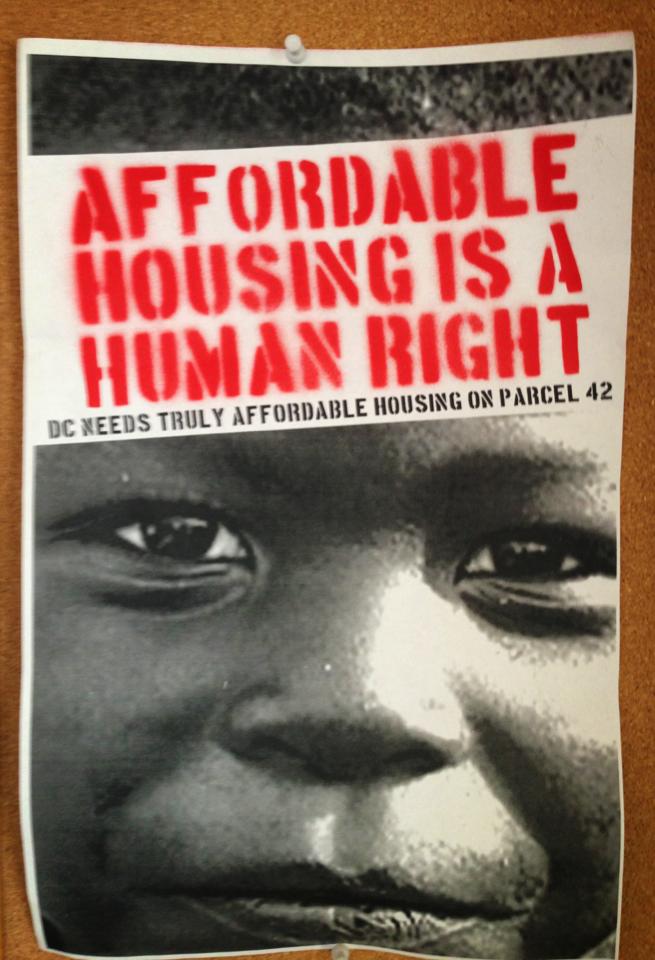
Housing is a Human Right

Human rights promise us many things. The right to housing, however, is perhaps the most fundamental. What do our rights mean if we do not have a place to call home? Article 25 of the Universal Declaration of Human Rights promises that

Everyone has the right to a standard of living adequate for the health and well-being of himself and of his family, including food, clothing, housing and medical care and necessary social services, and the right to security in the event of unemployment, sickness, disability, widowhood, old age or other lack of livelihood in circumstances beyond his control.

The right to housing is fundamental because it is in our homes that we find the space to rest, to pursue wellness, to find love, to raise families, and build communities, to collect our energy and thoughts so that we can participate in democratic politics, and it is where we find the safety, security and privacy that make a dignified life possible. Continue reading
Un-Manning; Or, Queering Bradley

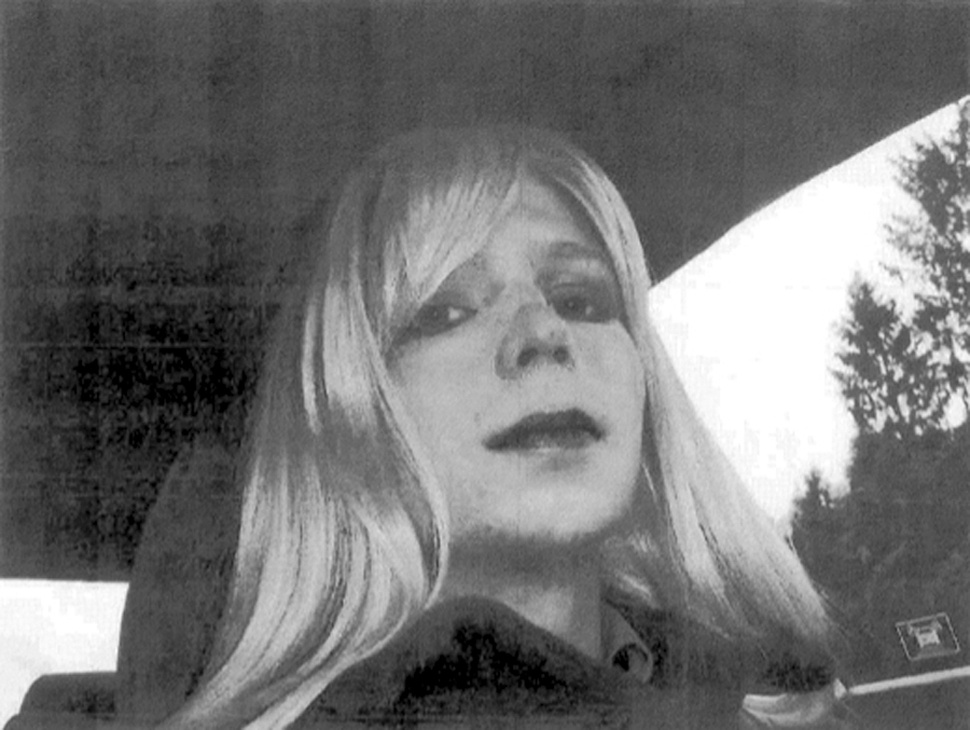
Bradley Manning Trans Wig

Private First Class Chelsea (formerly Bradley) E. Manning has serious gender issues. Or so goes the story of the moment. In the wake of her statement, the question of identity (and language) has somewhat displaced that of the conviction and sentence. Another dimension in the smearing of whistleblowers, perchance. A way to denigrate and emasculate her still further, and so to reinforce the patriarchal entitlement of that shining city on the hill. Except that Manning’s sexual personhood is more contested than that.[1]

Navy Captain and psychiatrist David Moulton, according to CBC, testified that Manning’s ‘gender disorder’, amongst other things, “caused him to conclude he could change the world by leaking classified information”. But Moulton was a defence witness. Captain Steven Lim, Manning’s brigade commander, also pointed towards gender trouble, and revealed the existence of the now much-seen photo of Manning in a wig to the Fort Meade court. Again, a defence witness. Manning’s lawyers were forbidden from seeing much of the (non-)evidence against him, thanks to techniques of classification, and this surely influenced their strategy. Since they could not openly contest claims of the most traitorous harm (claims that were in the end unsubstantiated), why not try and reduce the sentence with whatever biographical resources were available? Where gender identity sometimes served as justification for the leaks, at others it was made irrelevant (to wit: “It was never an excuse because that’s not what drove his actions. What drove his actions was a strong moral compass.”). Interviewed today, David Coombs (Manning’s lawyer) again juggled his client’s personhood somewhat unsuccessfully, maintaining both that “we weren’t offering it as an excuse” but also that Manning’s gender explorations were relevant because they “happened at the same time [as the leaks and therefore] that provides context”.

Paradoxically enough, it is at times Republicans who have had to point out the shamefulness of this strategy:

Now that he prepares to stand trial, he has shown himself to be willing to sacrifice honorable gay and lesbian servicemembers to avoid responsibility. Lawyers for Manning are claiming that his struggle with his sexual orientation contributed to emotional problems that should have precluded him from working in a classified environment. This shameful defense is an offense to the tens of thousands of gay servicemembers who served honorably under “don’t ask, don’t tell.” We all served under the same law, with the same challenges and struggles. We did not commit treason because of it.

Despite the appeal to homonationalism, there is here an actual defence of LGBTQ identity against perpetual fears of a deviance that cannot be trusted with full equality. Fairly obviously, framings of ‘disorder’ put trans* and genderqueer back in the realm of medical pathology from which they have only just begun to escape. And yet this is not a one-sided story of medical bio-politics. Continue reading

Notes on Ex-Yu Justice, Part III

Following Part I and Part II


The court is incompetent

The ICTY is constantly criticized for its organizational and procedural shortcomings, but is it fatally “incompetent”? To the extent that it resonates with ex-Yugos this charge must be made in the abstract only – the living ICTY is incompetent compared to the ideal ICTY. Compared to national legal venues, especially as they operated until recently, the court is indispensable, however (more on this below). Further, the ICTY is perceived as the big fish court, and the ability to get those “most responsible” is regarded as one of its strengths. And yet, much of this hard-earned reputation is being squandered in a series of rulings that acquitted some very big and very nasty fish.  Even its supporters feel like the ICTY has lost its mojo.

Consider the Momčilo Perišić case. Here the Yugoslav National Army commander who was first convicted (27 years in prison!) for aiding and abetting war crimes perpetuated by Serb forces across the river Drina, and then completely acquitted by the Appeals Chamber. Logistically and financially supporting génocidaires may not be a crime after all! Putting aside the inability of the prosecutor to ever establish a clear chain of command going from Belgrade to Pale and Knin respectively, this ruling changes the current legal understanding of the principle of command responsibility so decisively that it will almost surely protect many miscreants in the future. Some have even used it read back past ICTY rulings, breaking the chains of causation that lead to Belgrade (“this is a posthumous acquittal of Milošević!”) as well as Zagreb, and blaming  the massacres on the small fish (what’s next? Isolated cases of extremism?).

smallfry

Then there is the acquittal of Ramush Haradinaj, the prime minister of Kosovo, and that particular joint criminal enterprise (the presence of witness intimidation, note, was mentioned in this ruling). Next, the Ante Gotovina and Mladen Markač decision. The 2011 Trial Chamber ruling convicted them to 24 years for their role in, among other things, the joint criminal enterprise to expel the Serb population in Krajina following the 1995 Operation Storm (with Tudjman as the enterprise’s CEO again). Then, earlier this year, the Appeals Chamber ruled, in a split decision, that no such joint criminal enterprise existed (as well as that some Mladić-style military actions might be ok, but let’s put that aside for now). And last, the Jovica Stanišić and Franko Simatović case: the ICTY found no qualms with their arms dealing, bankrolling para-military formations and otherwise supporting of the Serb administrations in Bosnia, Croatia, and Kosovo, and, above all, no evidence of conspiracy to bring about the removal of the non-Serb population from any part of the former Yugoslavia (the rest of their ghastly dossier, so much of which is easily accessible via YouTube, fell outside the court’s scope).

Continue reading

Notes on Ex-Yu Justice, Part II

Following Part I, and in advance of Part III.


The court is political  

The smartass response goes something likes this: “Of course it’s political; what’s not political? Haven’t you read the ICTY’s website? It says clearly that the tribunal was established for explicitly political reasons, too, by the UNSC, which is political by definition.” But the smartass response is a rude interruption. The above assertive prefaces monologue, not dialogue. The monologue is a story about world politics as a dog-eat-dog contest in which the strong always devour the weak with a focus on the origins of the ICTY. “Of course an international judicial institution cannot be created on the basis of an UNSC resolution alone. Of course Chapter VII of the UN Charter does not specify the conditions under which war crimes tribunals can be set up. Of course the ICTY quickly discovered that it could not bother with the question of own legality. But when have great powers ever cared about law and institutions? Might makes right, right? The ICTY is based on the consent of states – big states, not our banana republics.”

This story varies in terms of breadth and depth, but its modal conclusion is that the tribunal cannot represent anything but “victor’s justice” and/or Western and specifically American oppression of those living on the periphery. As for the motive, the supposedly aggressive prosecution of Bosno-Serbo-Croat baddies practiced by the ICTY is a function of the desire for retribution for every case of ex-Yu insolence in recent history, starting with the Trieste crisis of 1945. As discipline and punishment at once, trials are also meant to serve as a warning to the rest of the peripheral and semi-peripheral world. This type of theorizing could be described as a cross between pop-realism and pop-Marxism with a whiff of the crudest forms of pop-anti-Americanism and some other, far less respectable prejudices. While it is not exactly a closed loop, for every new newstory indexing Western and specifically American double standards and double visions in international law, the theory gains strength. Who in the former Yugoslavia doesn’t have an informed opinion on the “Hague Invasion Act”?

imgfrontisThe two accounts of the origins of the ICTY that I have on my shelf make something of an opposite case. Pierre Hazan’s book, subtitled ‘The True Story Behind the ICTY’, suggests that the weak (international justice activists) outfoxed the strong (realist diplomats and state-centric lawyers) and, against all odds, managed to turn the tribunal into such a revolutionary achievement (more on this below). Hazan is no theorist of norms and transnational advocacy networks, but there are more than a few parallels with this literature. The second account is Rachel Kerr’s 2004 book, which begins and ends with the thorny issue of “politicization,” including the issue of “prosecutorial discretion” as its special subset. Kerr has the ICTY walking on a tightrope. Sidle up too closely to justice, and you alienate those who rule the world; let politics in, even to manipulate it for judicial ends, and you lose credibility. While infinitely more nuanced than Hazan’s, Kerr’s framework for analyzing politics (it, too, chimes with 1990s IR theory, namely the “bringing international law back in” literature) follows the same binary – let me personify it a little as a contest between “realists” versus “legalists” – and it reaches the same conclusion. And judging by both the quotidian operation of the court as well as its key decisions up to 2002-3, Kerr finds, “legalists” had the upper hand.

I am not sure what stock-taking exercises based on the realist vs. legalist framework look like today (again, this post is my attempt to reconnect with the literature I stopped following years ago), but what struck me in my conversations is how adamant my interlocutors were in rejecting even the most carefully drawn legalist claims. It’s simple, the typical response goes, the ICTY is subject to constant political pressures and it shouldn’t be surprising to see so much judicial malpractice. Lest one is keen to dismiss this as “typical” ex-communist (and transitionalist) disdain for the notion that law serves to ensure that valuable social goods are distributed in ways that protect equal respect for everyone, note that some of the most critical arguments about the “hopelessly political court” are drawn from the texts left behind by bona fide ICTY insiders like Antonio Cassese (he of  those great international law textbooks), Gabrielle Kirk McDonald, Louise Arbour, Graham Blewitt, Carla Del Ponte, Serge Brammerz, and Florence Hartmann (more below). Anyone can cherry-pick a few memorable lines from a few memoirs and journalistic accounts (Hartmann, if I recall correctly: “the ICTY was formed so that war criminals could negotiate on the level of their innocence”), but what I find interesting is that these types of arguments have gained more and more adherents over the years.

Continue reading

Notes on Ex-Yu Justice, Part I

I don’t recall when I first heard of Radovan Karadžić, but I know it wasn’t any time before the run-up to the first democratic, multi-party elections in Bosnia and Herzegovina. Radovan, with sarcastic endearment called Rašo in my family, emerged as the leader of something called the Serbian Democratic Party, one of the three main “national” political parties that were formed to steer us away from Marxist politics and economics and towards Western, liberal, democratic capitalism.  I do recall voicing scepticism about their promises, and trying to convince my eight grade classmates that ‘national’ really meant ‘nationalist’ and that with “them” at the helm Bosnia would soon look like Lebanon rather than Switzerland. And forget Lebanon, one only had to look over to Croatia to see what parties with the same names were doing, and how well that particular Westernization was going. I remember arguing that there was an alternative, pointing to Ante Marković (a.k.a. Antara, but with slightly less sarcasm) and his “reconstituted” Commies (and to drive the point home I pasted Union of Reform Forces of Yugoslavia campaign posters all over my room).  But there was no alternative, not really. Not with the bad guys in Belgrade, far more powerful than Marković, itching for “armed battles,” and not with the vast majority of citizenry successfully interpellated into political, mutually exclusive Muslims, Serbs & Croats. A Cerberus coalition of said national parties won the elections in November 1990 and took us all to hell.

karadzic_AP

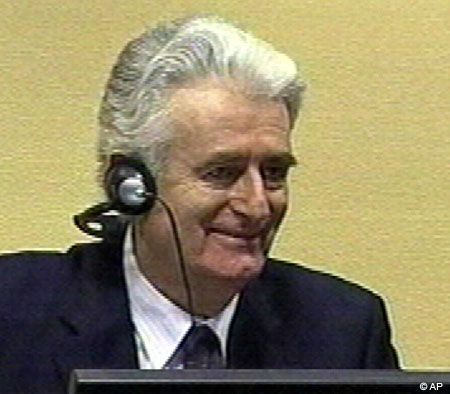
Fast forward to June 2013: it’s a Monday morning and I am looking into Courtroom 1 of the International Criminal Tribunal for the former Yugoslavia (ICTY) in The Hague. Karadžić, sitting behind a huge glass screen, is complaining about some key meaning lost in translation. He appears uncomfortable, at least compared to the other nasty blast from my past: Vojislav Šešelj, a.k.a., Šešo. In the 1990s, he was Serbia’s one-man version of the Radio Télévision Libre des Mille Collines; today, Šešelj is the tribunal’s bête noire. Those who follow the life of the ICTY are familiar with his mixed-methods approach to delegitimizing the court and its proceedings. Hissy fits, impossible demands, hunger strikes, insults, bullying, speechifying, filibustering. Then there is the regular uploading of confidential court documents onto http://www.vseselj.com‎ such that the names of protected witnesses are no longer protected. This certified political scientist (while writing a PhD dissertation on fascism in late 1970s Šešelj apparently spent a year teaching at the University of Michigan) knows how to assess the power of the strong as well as of the weakHe has repeatedly justified his behaviour as “only politics” (“this court is political, I am political, and I am here to destroy you”). And whenever he gets convicted of contempt of court (twice or thrice now), he laughs it off: “I don’t care, I am having the time of my life.”   

He was on fire that morning as well. Invited to Karadžić’s trial as a key witness, Šešelj manages to waste hours of the court’s time on stories that feature, among other things, Swedish prostitutes, Serbian folk heroes, and European medieval history (I paraphrase again, this time from my notes: “Magdeburg, the city that’s now flooded, yes, make sure it goes into the court’s record just like I explained in my book and on my website: it was the Croat armies that massacred its citizens back in 1631”). The little time devoted to answering the questions posed by the prosecutor Alan Tieger – Karadžić, recall, is indicted for genocide; extermination; murder; persecutions; deportation; inhumane acts; terrorizing of, and unlawful attack on, civilians; and taking of hostages – testifies to Šešelj’s focus and impeccable memory. “Absolutely not,” he concludes, Karadžić had nothing to do with any conspiracy to ethnically cleanse parts of Eastern Bosnia. “What happened was a natural population transfer, that’s all.” Continue reading

Addressing Wartime Sexual Violence at the United Nations Security Council

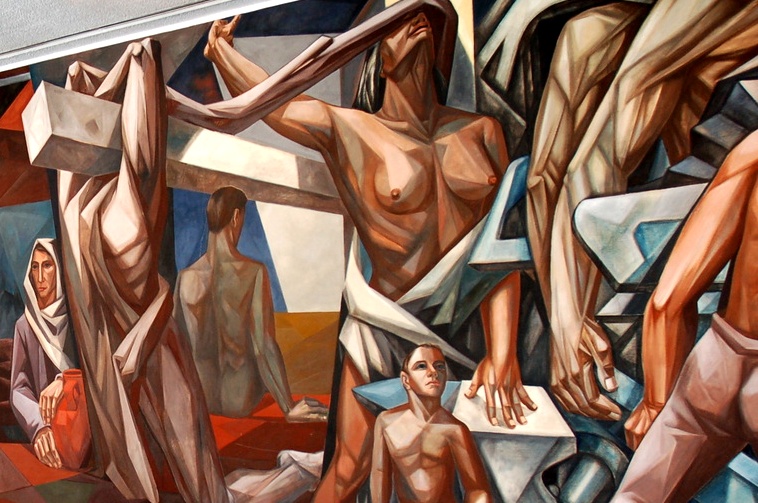
A mural at UN HQ by José Vela Zanetti, via Robin Stevens.

Detail from a José Vela Zanetti mural at the United Nations, New York (original image via Robin Stevens)

Yesterday, the United Nations Security Council met to vote on a new resolution on wartime sexual violence (under the more general rubric of ‘women, peace and security’). Resolution 2106, as it now is, was passed unanimously, and so joins those other numerical signifiers in the chain of gender mainstreaming: 1325, 1820, 1888 and 1960. The session had been convened by William Hague (the UK holds the Security Council chair for June), and the presence of Angelina Jolie (or ‘Angelina Jolly’, as more than one state representative called her) brought obvious publicity advantages, although that in itself is not so surprising both given her close work with Hague on the UK’s Preventing Sexual Violence Initiative and her role as Special Envoy for the UN High Commission for Refugees.

UNSCR 2106 seems designed mainly as a political symbol that the Council “remains actively seized” of the importance of conflict-related sexual violence, and essentially extends a number of themes already in play (there’s a whole bunch of urges, calls for, recognizes, requests in the text). It seeks the expanded use of targeted sanctions against perpetrators and commanders involved in sexual violence and reiterates the connection of that thing called ‘gender’ to DDR, security sector and justice reforms. It repeats the ‘zero tolerance policy’ on sexual violence and abuse by UN forces, requests further reports on progress to the Council, and so on. There were some other points of note, partly in the mention of men and boys as victims, and partly in some puzzling recessive points such as the Resolution’s demand (its word) that women and children abducted into armed forces be released (given that they are especially vulnerable), with no concomitant mention of kidnapped men.

The resolution also called for sexual and gender-based violence training for all pre-deployment and ‘in-mission’ peacekeeper training, and it is here that perhaps the biggest substantive contribution lies. Numerous references were made in the debate to an expanded role for Women Protection Advisers. Like the discussion of targeted sanctions (mentioned first in UNSCR 1820) this is not brand new, since Women Protection Advisers were themselves an innovation of 1888, which upgraded them from existing gender and human rights advisers. The exact nature of the new role is as yet unclear, but it seems to involve an expansion of their mandate to apply to all UN deployments, since they are currently active in just eight peacekeeping missions (which is just over half).

A few other quick observations on the text and the debate.  Continue reading

Russia’s Anti-Gay Laws: The Politics and Consequences of a Moral Panic

A guest post from Cai Wilkinson on recent LGBTQ developments in Russia. Cai is a Lecturer in International Relations in the School of Humanities and Social Sciences at Deakin University, Australia. Her research interests include critical approaches to security, fieldwork-based securitization studies, norm contestation and resistance, and genders and sexualities in International Relations. Her geographic focus is on the former Soviet Union, and she is currently working on projects about LGBT rights and human rights norms in Kyrgyzstan and Russia. She received her PhD from the University of Birmingham, UK, in 2009 for a thesis entitled Interpreting Security: Grounding the Copenhagen School in Kyrgyzstan, which drew upon seven months of fieldwork conducted in Bishkek and Osh in the aftermath of the 2005 overthrow of the Akaev regime. Her work has been published in Security Dialogue, Central Asian Survey and Europe-Asia Studies, and she has contributed chapters to volumes on securitization theory, statehood in Central Asia, and fieldwork-based research methods. Cai is also Chair of the International Studies Association LGBTQA Caucus.


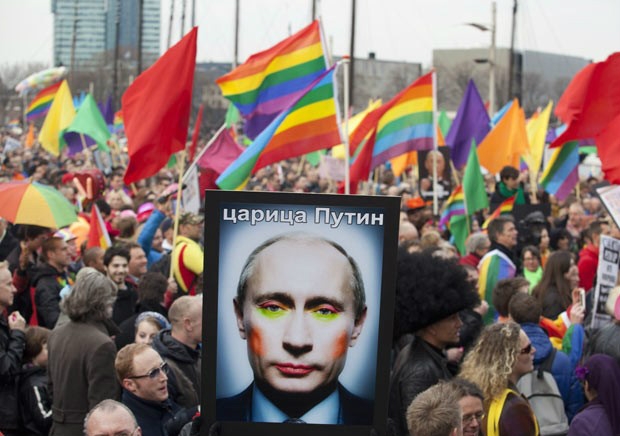
Russia Gay Pride Putin

The issue of LGBT rights in Russia first properly came to mainstream international attention in March 2012, when the St Petersburg Duma passed a law prohibiting “public acts aimed at the propaganda of sodomy, lesbianism, bisexualism and transgenderism amongst minors“. The law provoked an international outcry, including calls for tourists to boycott St Petersburg, sister-cities to consider cut off ties with Russia’s “window on Europe”, and condemnation from the EU, with the European Parliament passing a resolution noting that it was “gravely concerned by developments which restrict freedom of expression and assembly on the basis of misconceptions about homosexuality and transgenderism” and calling on Russia and other countries considering the adoption of similar legislation to “demonstrate, and ensure respect for, the principle of non-discrimination”.

In actual fact, this was not the first “anti-gay” law to be passed in Russia; Ryazan Oblast’s Duma adopted an amendment to local legislation to outlaw the “propaganda of homosexualism” in May 2006, and Arkhangelsk and Kostroma Oblasts followed suit in 2011. Yet the passing of the St Petersburg law proved to be a catalyst for other administrations to introduce similar laws, with a further six subsequently adopting similar legislation and others considering it (so far only the Moscow Regional Duma has rejected legislation). Most significantly, these laws paved the way for consideration of a federal bill outlawing the “propaganda of non-traditional sexual relations to minors”, which the Russian Duma passed on June 11 despite continuing international condemnation and the fierce opposition of local LGBTQ activists and their supporters, who frequently endured physical attacks and arrests while protesting against the law.

Despite being a long-time Russia-watcher, the swiftness at which anti-gay laws have spread and at the ferocity of both popular and state homophobia has been striking. This is not, I should add, simply the result of not paying close enough attention. As a queer undergraduate student studying Russian with a compulsory year abroad to plan for, I was extremely conscious of attitudes towards homosexuality and queerness and the stigma and dangers that local LGBTQ people faced (Laurie Essig’s Queer in Russia was an essential primer), and was extremely careful not to out myself to anyone who wasn’t definitely queer-friendly while living with families first in Krasnoyarsk and then Voronezh in 2001-2002.

At the same time, it appeared until the mid-2000s that slowly but surely Russia was becoming more tolerant. Homosexuality was decriminalised in 1993 without any notable opposition, declassified as a mental illness in 1999, and the percentage of survey respondents advocating for the “liquidation” of homosexuals fell from 31% in 1989 to 22% in 1994 and all of 5% in 2013 (although inevitably survey results are heavily contingent on the phrasing of questions and, as Alexander Kondakov demonstrates, attitudes to homosexuality are no exception). Attempts to recriminalise homosexual relationships between men failed in 2002, 2003 and 2004.

Popular culture in the first half of the 2000s appeared to offer further evidence of the trend: Continue reading

The Manning Trial, Truth-Telling, and The Precariousness of Democractic Society

The following is a piece written as part of an interview I did at City University on the political and ethical significance of the Bradley Manning trial currently ongoing (links to potentially embarrassing video to follow).

I think that the most important thing that the Bradley Manning trial shows us is the gap that opens up between our legal institutions and our sense of right and wrong, between the law and morality. Many people around the world are shocked by Manning’s imprisonment. People are shocked partly because he has been held under conditions that the UN said violated his human rights, but also because Manning is being tried for exposing the actions of US soldiers and diplomats, including evidence of many potential and confirmed human rights violations. Manning’s supporters are incredulous and view the proceedings now taking place at Fort Meade as illegitimate.Bradley Manning War Crimes

I understand this incredulity and on a level I share it. What I want to suggest, however, is that what we are seeing in the trial of this young man is even more troubling than the corruption of the law by politics – it reveals that the law is always suffused with politics. The law is a technical code. Yes, it is also a normative system that is supposed to determine right and wrong, guilt and innocence. But it is vital that we do not forget that it is a technical code first and foremost, a code that political authorities use to justify their power. Therefore, those with the capacity to influence and manipulate the legal code will always be at an advantage, will always be able to shape that code not towards the pursuit of justice but towards their own interests. This is what Finnish legal scholar Martti Koskenniemi calls this the gap between apology and utopia. The law has its utopian moments and this is especially true of human rights law – for example, Manning supporters see him as a hero who has exposed the grievous crimes of the US government and its military, particularly in Iraq and Afghanistan. They appeal to human rights standards that are quintessential moral claims, but which sadly lack the force of political authority and so are not reliably protected. This is important, but the law also has its moment of apology, where it serves the interests of established authorities, of powerful actors like the US government.

Continue reading

Love, Sex, Money and Meaning

UPDATE (8 September 2014): Megan originally wrote this as a guest post, but is now with us more permanently.

This post is based on stories about sex, love, tourism and identity relayed in Cuba in 2010, and is (loosely) based on, and at times excerpted from, an article of the same name just published in Alternatives: Global, Local, Political. All names, many locations, and some additional identifying details have been changed in accordance with the interviewees’ wishes.


Havana's Malecón, or seawall, close to Calle 23 and not far from where I interviewed Yakelín.

Havana’s Malecón, or seawall, close to Calle 23 and not far from where I interviewed Yakelín.

Yakelín comes to the Hotel St. John nearly every day around two o’clock in the afternoon. Most days, Jean-Claude is already there, ensconced on the terrace with a glass of dark rum, chatting amiably with the staff, or pensively smoking a cigar as he waits. When she arrives, she kisses him discreetly before settling down for a drink on the terrace. The hotel is rather unassuming, but it sits just steps from the busy east end of Calle 23, known as La Rampa, and blocks from the historic University of Havana, and as such Hotel St. John has become a haven for tourists and foreign students who come here for strong coffee and cold beer. After an hour or so, Yakelín and Jean-Claude walk away together, hand in hand.

This same routine has been going on for more than two years now, since the day that Yakelín first met Jean-Claude, walking along Calle 23 with a friend. She was 21 years old, living in a small flat with her mother, father, brother, two sisters, aunt, uncle, two cousins and her grandmother. After spending her teenage years at a boarding school in the countryside, she had elected not to continue to university and was back in Havana with her family. Like so many others, her family worked hard to make ends meet, and Yakelín was looking for ways to lighten the burden. Not long after they met, Jean-Claude made her a proposition.

He suggested that, since I was en la lucha [struggling to get by], you know, he suggested that I no longer be in the streets [looking for leads on work, food, clothes] and that he was going to help me resolver mis problemas [solve my problems]. And since then, he’s my boyfriend.

Jean-Claude is married, but Yakelín says that in spite of that they have a “formal relationship” – she lives in a comfortable casa particular, for which he pays, and they spend every afternoon together. As a retiree, Claude lives more or less permanently in Cuba, leaving only to attend to his affairs in France and returning laden with gifts including clothing, jewellery, and even a television. He provides her with spending money and helps to support her family as well. She says she loves the independence he has given her, even though she readily acknowledges the implied contradiction – she has found her freedom in total dependence on him. Yakelín has no official work at present, because she feels that the meagre salary is simply not worth the trouble.

Continue reading

Call for Papers: The Power of Rights and/or the Rights of Power in Global Politics

Call for Papers for the 1st European Workshops for International Studies (EWIS), 5th – 8th June 2013, Tartu (http://www.sgir.eu/upcoming.php)

Workshop 12: The Power of Rights and/or the Rights of Power in Global Politics

Conveners: Louiza Odysseos and Anna Selmeczi

While detractors of human rights have long argued that they form the moral and intellectual keystone of a liberal hegemony, their proponents have countered that ‘human rights are meant to be good news for the underprivileged, the downtrodden, and the dispossessed’ (Dallmayr), historically demarcating the growing power of the king and, later, the state and today enabling the politics of resistance in symbolic, discursive and legal terms. This proposed workshop seeks to combine theoretical discussions and empirical examinations to explore how human rights are essential to both the sustenance of hegemony and to the politics of resistance in global politics. The workshop will examine how human rights instruments and discourses aim to curtail power while often legitimating and reinforcing its operations in distinct political and ethical ways. It will facilitate discussions exploring how rights ‘enable disciplinary projects’ (Golder) by channeling practices of resistance into legal frameworks that delimit campaigns for justice. Central to its objectives is to assess how human rights also provide opportunities for challenging such projects of power, opportunities that are grounded on a rethinking of humanity as the ‘community of the governed’ understood within the history of colonialism.

A number of scholars have expressed interest in interrogating this important dualism of human rights. The workshop therefore would generate discussions about the emergence of human rights’ subjectivities and discourses within struggles towards emancipation that have had varying success in challenging preexisting power relations, for example, in the recent waves of protest in the Middle East. Other potential contributions would analyse how neoliberal technologies of governing use the discourses of human worth to discipline human rights in cases of immigration; how the tension between human and positive rights incites resistance practices by political subjects in the case of undocumented migrants; how, in varied geographical locations such as India, South Africa, Italy and Mexico, neoliberal governmental rationalities deny the subjectivity of the rights-bearing citizen to the poor; how direct action by activists seeks to reconstruct particular rights as strategies of resistance, such as the right to housing in the midst of the global financial crisis.

Please submit your 200 words abstract online through the EWIS website:
https://docs.google.com/spreadsheet/viewform?formkey=dC05d3BnaVp4V3R3b2NCVXV3bmxoM2c6MQ.

Deadline: 15 December 2012. Applicants will be notified by 15 January 2013 about the outcome of the selection process.