Economy of Force

We return from the holidays with gusto and a book symposium on Patricia Owens’ Economy of Force: Counterinsurgency and the Historical Rise of the Social (Cambridge, 2015). Patricia is Professor of International Relations at the University of Sussex, co-editor of European Journal of International Relations, and a former fellow of the Radcliffe Institute for Advanced Study at Harvard University and of Oriel College, Oxford. Patricia’s first book was Between War and Politics: International Relations and the thought of Hannah Arendt (Oxford, 2007). Economy of Force is in the Cambridge University Press series ‘Studies in International Relations’ and is out in paperback next summer (the introduction is available in full here). The book will also be the subject of a forthcoming special section of Security Dialogue.
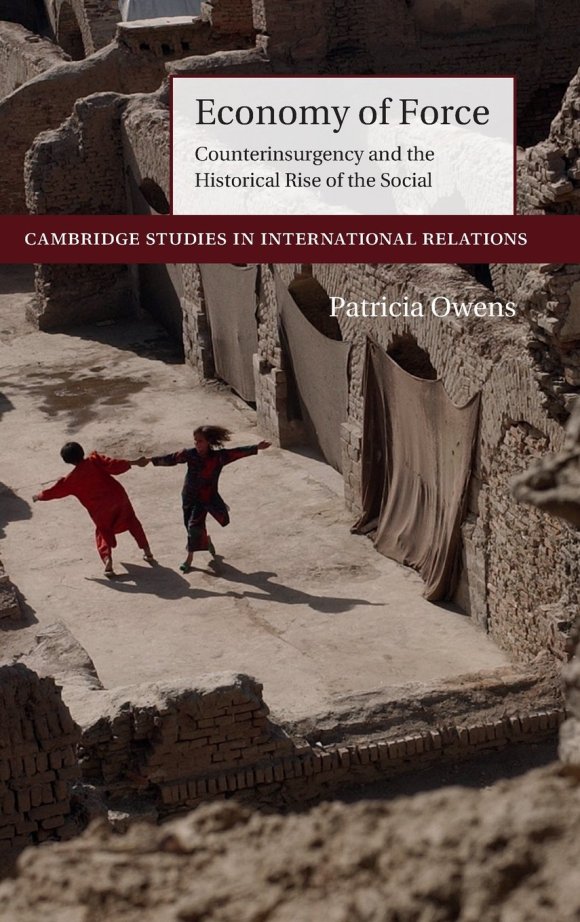

Economy of Force

Economy of Force seeks to rekindle interest in one of the oldest but neglected languages and techniques of government administration – household governance – that it uses to write a new history and theory of counterinsurgency with broad implications for social, political, and international thought. The book is a study of oikonomia in the use of force, from oikos, ancient Greek for household. But it also makes a larger claim, that household governance underlies the relatively recent rise of distinctly social forms of government and thought more broadly. Since the late eighteenth-century, modern, capitalist state and imperial administrators have drawn on and innovated different forms of household governance, scaling up and transforming the units of rule in which populations are domesticated. To really understand the significance of households-as-government we need to dispense with the relatively recent and bourgeois notion of households as houses, homes, or family-as-kin. Instead, households are best understood through the nature of the hierarchical relations between people in a particular spatial arrangement. Households are the persistent but historically variable spaces in which the life processes of members – real, vulnerable bodies needing food, water, shelter – are administered and the household itself is maintained.

There is a very long tradition of thinking of households-as-government in the history of political and economic thought and in anthropology, archeology and comparative studies of different household forms. There is also excellent and wide-ranging scholarship in literary and gender studies on practices and ideologies of domesticity (from domus, Latin for house). In drawing on and extending these and other literatures, Economy of Force suggests that there is a far deeper significance of households and forms of domesticity than captured in International Relations debates about the so-called ‘domestic analogy’. Household administration is highly portable and plays a remarkably significant role in imperial and international relations. These are grounds to make a stronger claim than one based on mere analogy. I argue that there is a domestic homology connecting different households, despite their historical and geographical variability, based on the genealogy of household governance in the history of social and political thought, but also the human experience of basic life necessities and the stubborn but contingent attempts to domesticate people through the administration and control of life needs.

Continue reading

There’s A Focus On The Boats Because The Sea Is Sexier Than The Land: A Reflection on the Centrality of the Boats in the Recent ‘Migration Crisis’

Pallister-Wilkins.Profile PictureA guest post from Polly Pallister-Wilkins, Assistant Professor in Political Science at the University of Amsterdam. Polly’s work broadly sits in the borderlands between International Relations, Critical Security Studies and Political Geography. More specifically she specialises in the intersection of humanitarian intervention and border control. Her current research is concerned with what she terms ‘humanitarian borderwork’ building on previous research into humanitarianism, border policing and the political sociologies of walls, fences and security barriers. Her regional areas of focus are the Mediterranean, specifically Greece, and the Middle East. She has been an assistant professor in the Department of Politics at the University of Amsterdam since 2012 after undertaking her doctoral research at SOAS, University of London. Recent work has appeared in International Political Sociology and Geopolitics. She is also the editor of a forthcoming forum in Mediterranean Politics on the ‘Migration Crisis’.
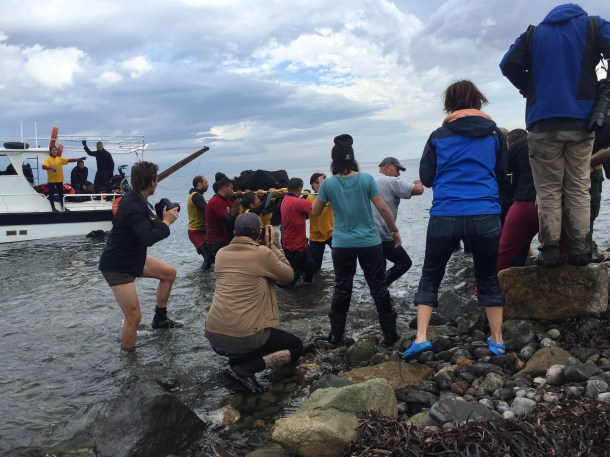

Lesvos boat landing, November 2015.Pallister-Wilkins

I grew up watching Baywatch. Saturday evenings were the highlight of my week. All that sun, sea, sand and heroics. This may account for my poor bastardisation—and for this I apologise—of Warsan Shire’s evocative verse. In addition I am not suggesting that all focus is on the boats that transport people and the sea they cross even as journeys and modes of travel become a central theme in border and mobility policing and the study thereof. I am labouring under artistic license here.

The appearance of search and rescue operations (SAR) in the Mediterranean and Aegean—beyond those undertaken continuously by commercial vessels and the daily routines of state coastguards—is, Cap Anamur aside, a relatively new phenomenon. The Migrant Offshore Aid Station (MOAS) was the first non-state actor to engage in humanitarian driven SAR in 2014, joined in 2015 by Médecins Sans Frontières (MSF) and later Seawatch in the southern Mediterranean. These actors are also present in the Aegean, a wholly different operating environment, with smaller SAR vessels, where they operate amongst a plethora of other groups and individuals focused on responding to the danger of the boat journeys of people on the move.

I have the utmost respect for those engaged in a range of practices that I call humanitarian borderwork. These humanitarian borderworkers, mostly volunteers, work tirelessly to alleviate the violence of a European border regime that makes safe and legal travel an impossibility for those seeking life. These people step in and step up to provide assistance for people on the move where Europe, its member states and its large-scale humanitarian organisations, so used to acting the sovereign and intervening elsewhere beyond the borders of Europe, have failed.

Continue reading

‘Once more unto the breach’ – On Hilary Benn and Fighting Wars with Words

IMG-20150308-WA0003 (3)A guest post from Nadya Ali. Nadya is a Teaching Fellow in Politics and IR at the University of Reading. Her thesis was written on the topic of UK counter-terrorism and it’s role in the governance of the domestic Muslim population. Her research interests include gendered understandings of political violence and postcolonial approaches in IR. She is also a convenor of the BISA Critical Studies on Terrorism Working Group.


Shadow Home Secretary Hilary Benn has emerged as the unlikely oratory hero through his speech to the House of Commons during the debate on whether to carry out airstrikes in Syria. It has been hailed as ‘extraordinary’ and as one “that will go down as one of the truly great speeches made in this House of Commons”. Benn has been described as ‘the mouse that roared’ and now even as a potential leadership candidate. The effusive coverage of the speech comes in the aftermath of the successful vote which enables the extension of British airstrikes targeting Islamic State (IS) from Iraq into Syria. Leaving aside the context of internal Labour party politics, Benn’s words have a resonance and political utility that extend far beyond the party. Despite the plaudits and unlike Shakespeare’s Henry V, Benn did not deliver a great speech but simply the right speech.

His dramatic moment in the House of Commons was the culmination of the successful move to, once more, mobilise British military capability as part of the ‘War on Terror’. According to one journalist the speech was written while the debate took place with Benn sitting on the front bench. This was no doubt intended as a compliment but it needn’t be: everything he said was could have been lifted out of the ‘War on Terror Handbook of Justifications to Fight Wars’, if indeed it existed. Since 9/11 Western leaders have deployed the same set of claims about particular actors, states and terrorist organisations to make the case for military interventions. Benn ticked all the relevant boxes; he talked suitably about the ‘fascist’ threat of IS, of ‘our values’ and the necessity to use further violence.

Continue reading

Between Truth-Telling and Doom-Saying: Sanctions and Activism

933This is the fourth in a series of posts on Lee Jones’ Societies Under Siege: Exploring How International Economic Sanctions (Do Not) Work. We are delighted to welcome Dr Katie Attwell, she is the Capstone Co-ordinator at Sir Walter Murdoch School of Public Policy and International Affairs, Murdoch University. Her book, Jewish-Israeli National Identity and Dissidence: The Contradictions of Zionism and Resistance, considers the contradictions faced by left-wing Israeli Jews trying to connect with their Palestinian Other. Ethnicity, nationalism and identity politics remain her fundamental academic interest, but she now focuses on health policy, pursuing research into how to engage with vaccine-hesitant parents. Lee’s original post can be found here. With responses from Dr Elin Hellquist here, and Dr Clara Portela here.


I became familiar with the project that would become Societies Under Siege in 2013. A mutual friend shared a conference paper by Lee Jones, reflecting on the Boycott, Divestment and Sanctions (BDS) campaign called for by Palestinian nationalist activists, and eagerly adopted by their international counterparts. I was one such international enthusiast, in addition to being a political scientist researching how progressive Israeli Jews were attempting to reform their society from the inside. My work took a different approach to Lee’s, looking at how discourses of identity, nationalism and ethnicity constrain notions of what is morally and politically possible. I never saw much crossover between our approaches, though some of my subjects were BDS advocates. I suppose my work could contribute to an understanding of the kind of impact that sanctions might have (or not) on a fraction of the target society.

I was far more captivated by what Lee’s early conference paper meant for activism. Outside of academia, I wanted to talk about Palestine with anyone who’d listen, and I had been inspired to join a tiny collective of mostly radical leftists in my home city of Perth, Western Australia. Working within this collective, I believed that the first step to changing minds was education and awareness, and soon BDS became the catchphrase by which we’d do this. Or so we thought.

By the time I read Lee’s paper – soon to be a chapter in Sanctioning Apartheid: Comparing the South African and Palestinian BDS Campaigns, edited by David Feldman and out next year with Palgrave Macmillan – I had dropped out of activism for Palestine somewhat, primarily due to life (a young family and a PhD) getting in the way. But the fire still burned within. I read Lee’s contribution with eagerness and interest. It elicited in me the same sentiments that followed my consumption of Societies Under Siege: enlightenment and admiration, combined with frustration. Thanks to this work, I understand the world in ways that I did not before – which has to turn on any academic who genuinely enjoys engaging with inquiry, wherever it may lead. However, thanks to that new understanding, I also understand – to quote another colleague’s rather jaded perspective on Social Conflict Analysis – that everything is f$*#ed. This is somewhat less a cause for celebration. Continue reading

Mind the Gap: Evaluating the Success of Sanctions

This is the third in a series of posts on Lee Jones’ Societies Under Siege: Exploring How International Economic Sanctions (Do Not) Work. We are delighted to welcome Dr Clara Portela,  she is Assistant Professor of Political Science at Singapore Management University. She is the author of the monograph European Union Sanctions and Foreign Policy, for which she received the 2011 THESEUS Award for Promising Research on European Integration. She recently participated in the High Level Review of United Nations sanctions, in the EUISS Task Force on Targeted Sanctions and has consulted for the European Parliament on several occasions.
A further response will follow from  Katie Attwell, followed by a response from Lee. You can find Lee’s original post here and Elin Hellquist’s here.


The volume undoubtedly makes a key contribution to the field – indeed, one that was sorely needed: an evaluation of how sanctions interact with the economic and political dynamics in the target society, and more specifically, how they affect domestic power relations. This agenda is not entirely new in sanctions scholarship. It had been wisely identified by Jonathan Kirshner in a famous article as far back as in 1997. However, having pointed to the need to ascertain how sanctions affect the internal balance of power between ruling elites and political opposition, and the incentives and disincentives they faced, this analytical challenge had not been taken up by himself or any other scholar so far. The book also contributes to a highly promising if still embryonic literature: that of coping strategies by the targets, briefly explored in works by Hurd or Adler-Nissen.

Departing from the idea that whether sanctions can work can only be determined by close study of the target society and estimating the economic damage required to shift conflict dynamics in a progressive direction, the study proposes a novel analytical framework: Social Conflict Analysis. The volume concludes that socio-political dynamics in the target society overwhelmingly determine the outcomes of sanctions episodes: “Where a society has multiple clusters of authority, resources, and power rather than a single group enjoying a monopoly, and where key groups enjoy relative autonomy from state power and the capacity for collective action, sanctions may stand some chance of changing domestic political trajectories. In the absence of these conditions, their leverage will be extremely limited” (p.182).

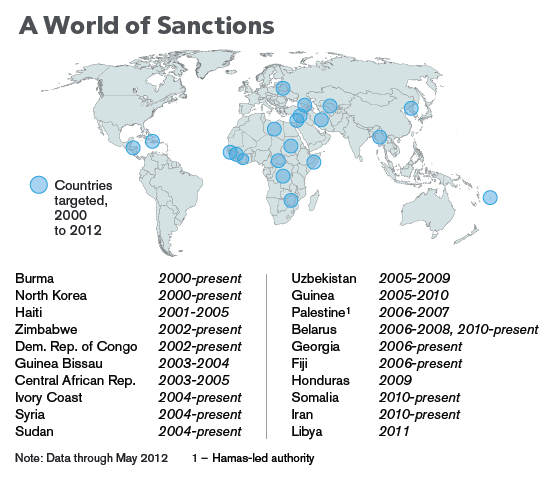
World of Sanctions

Source: Peterson Institute for International Economics

Continue reading

Shoddy Sanctions

photoEH

This is the second in a series of posts on Lee Jones’ Societies Under Siege: Exploring How International Economic Sanctions (Do Not) Work. We are delighted to welcome Dr Elin Hellquist, a Swedish Research Council International Postdoctoral Fellow at the Freie Universität, Berlin and the Department of Political Science, Stockholm University. Elin’s research is currently focused on the historical origins of different regional sanctions policies. She is also interested in the prospect that sanctions used by regional organizations against members could mature to take ground from foreign policy sanctions, as well as the implications of such a development for international relations at large.  Her most recent article is in International Relations.

Further responses will follow from guest authors Clara Portela and Katie Attwell over the next few days. You can find Lee’s original post here.


The debate about the effectiveness of sanctions is among the most tired in international relations scholarship. Rather than tackling the big political, social and ethical issues related to the practice of punishing one another in international relations, the literature has relentlessly debated what percentage of sanctions cases have been successful. Articles on sanctions in our finest journals have battled measurement technicalities and how to design maximally efficient sanctions instruments. In the real world, change always comes. Sooner or later, with or without sanctions, regimes fall, political prisoners are released, nuclear deals are made, and elections are held. If sanctions are involved, sanctions optimists are quick to attribute such changes to their use. Yet, it is hardly ever possible to say whether sanctions specifically, among an infinite number of co-existing factors, have caused a certain political outcome.

At first view, Lee Jones’ book Societies under Siege might appear yet another book on sanctions effectiveness. It is not. Instead, Lee brings us behind the scenes of three of the most influential sanctions cases in modern times: South Africa, Burma/Myanmar, and Iraq. Relying on a thorough historical-sociological analysis, we are led deep into these societies to understand how sanctions have worked to reshape social conflicts and thereby possibly influence politics (for better or worse).  The message is clear: in order to understand sanctions we have to understand the domestic context inside out. This message is both timely and timeless. It is an extremely timely wake-up call reminding any remaining intervention optimists of the moral and practical responsibility that follows from using sanctions without a qualified idea of how they will work on the ground. Highlighting the importance of local conditions is also a timeless message to an IR audience that far too often disregards qualitative difference in the search for quantifiable measurements. Sanctions do transform societies, Lee argues, but they can only be expected to contribute to political change if a number of favourable conditions allow so (e.g. the South African case).

This post will not repeat or summarize the arguments that Lee makes with wit and skill. Buy the book, or ask your library to do so. You will have the pleasure to read an unusually elegant and thought-provoking piece of solid scholarly work. What I would like to do is to pick up the ball where I think that Lee left it and draft a few propositions that complement and sometimes challenge Societies under Siege. I will propose that beyond their workings in the target states, sanctions also operate by (re)drawing normative boundaries in international relations. I will use the example of blacklists to underscore how sanctions work through a combination of material and symbolic features. Finally, I will follow-up on Lee’s discussion of the ethics of sanctions. In light of his findings, I will argue that the use of foreign policy sanctions should be minimized in accordance with the ‘harm principle’. Continue reading

What Is It Like To Be Lebanese And To Work On China?

elamineredA guest post from Loubna El Amine. Loubna teaches political theory, with a particular focus on early Chinese political thought at the Department of Government, Georgetown University (her teaching was mentioned on this blog last year).  Before Georgetown, Loubna was a postdoctoral fellow at the Whitney Humanities Center at Yale University. She holds a PhD in Politics from Princeton University and a BA in Political Studies from the American University of Beirut.  Classical Confucian Political Thought: A New Interpretation (Princeton University Press, 2015) is her freshly pressed first book.


elaminebook

I recently wrote a book. Its cover is (very) red and features an ornate golden doorknob shaped like the face of a lion. I have always dreamt of writing a book. The experience of seeing one with my name on it fills me with a combination of delight and incredulity. I am sure all first-time authors experience a similar feeling. In my case, however, the feeling is heightened by the sense that I wrote a book that, for the first two-thirds of my life, I could never have even conceived of writing.

The book is on early Confucianism in China, and I did not know anything about China until I was twenty. China was so foreign to the intellectual, political, and cultural world in which I grew up that the two ways in which it was usually mentioned were the proverb, often attributed to the prophet Muhammad, which says “Seek knowledge, even in China” and the description of anything that sounded incomprehensible as Chinese (the Arabic equivalent of the American “It’s Greek to me.”). More mundanely, there was only one Chinese restaurant in Beirut when I was growing up, a small, family-owned place called Rice and Spice (today there are many more, with names ranging from Chopsticks to Wok Wok).

riceandspiceAlthough I studied political science as an undergraduate at the American University of Beirut, the curriculum rarely covered areas beyond the Middle East, and when it did, it only reached as far as Europe. It was only because of one professor, Yahya Sadowski, that I discovered China. He taught courses on global political economy and on development in the Arab world, and frequently cited both East and Southeast Asian countries as case studies. When I started graduate school in the US, I decided to explore East Asia further. This exploration took a few twists and turns, and I finally landed, having foregone empirical for philosophical pursuits, in the intellectual world of 3rd century BCE China.

Every once in a while, someone describes what I do as “contrarian,” “crazy,” or “looney.” I never know quite how to react. The description is, in some ways, true. I studied Confucianism because it spoke to me and because I was intrigued by it, but I also sometimes wonder whether I studied it because I did not want to study the Middle East. I sensed that it was expected of me that, as a non-Westerner, I study my own region. This expectation bothered me. When people now call what I do “contrarian,” this only reminds me that the expectation is still at play. Not that I think that there is anything wrong with someone from the Middle East working on the Middle East, just as there is nothing wrong with someone from the US studying the US. The problem is simply that no one thinks it is contrarian or crazy when Americans or Europeans choose to study societies other than their own.  In other words, my worry is that the surprised reactions I get about my work point to the existence of an unconscious bias, generated and maintained by the current make-up of academia, against the ability of non-Westerners to produce knowledge that is not about ourselves. We cannot transcend, like our European and American counterparts can, our own world. We are our own case studies, so to speak. This means that if we are successful at studying our own regions, the success is likely to be attributed to our “inside knowledge,” rather than the work itself. It also means that when we do happen to study a topic that is seen as “Western,” say European philosophy, the default assumption is that we do so from the standpoint of our colonial experience. And finally it means that studying another non-Western region is simply “contrarian.”

statue

Though it has not happened to me personally, friends of mine from Lebanon have reported being encouraged, even if gently, to focus their doctoral work on Lebanon, the Arab world, or Islam. Other friends who have chosen to work on the Middle East have complained about their work being mislabeled to the same effect, its theoretical import downplayed in favor of its ‘regional flavor’. I have also heard of new professors being encouraged to teach courses on topics that they do not necessarily work on (who else is going to teach Islamic philosophy but the new Iranian professor?!). And my suspicion is that this arrangement also likely guides decisions on admission to US and European PhD programs in the humanities and social sciences: if you are from a non-Western country, you are more likely to get accepted if your work is directly related to the geographic area where you are from.

This expectation also feeds into the way in which academic institutions in non-Western countries are framed and present themselves. When I inquired some years ago about what it would take to be hired at the American University of Beirut, I was told clearly that I would need to shift my work toward Islamic thought. Middle Eastern and Islamic studies are, after all, AUB’s claim to fame, the primary reason it is able to place graduate students in American and European institutions and to attract foreign MA students. It was also telling that, when in Seoul this past summer, my work was described by a couple of people I met as the “Islamic view of Confucianism.” The equivalent here would be to describe American and European work on China as representing “the Christian view.” But while this sounds as odd as it is problematic, it is actually not much different from the charge of contrarianism: both descriptions belie the need to place me back into the world in which I grew up. I absolutely love the world in which I grew up, but I would like to think that, like my Western colleagues, my intellectual horizons are not limited by my place of birth.

Pyrrhic Victories: The Endgames of Accelerationist Efficacy

The fourth commentary, and fifth post, on Nick and Alex Williams’ Inventing the Future, delivered by Aggie Hirst and Tom Houseman. Aggie is a Lecturer in International Politics at City University London. She works on issues relating to violence and international theory/philosophy, including war and wargaming, US foreign policy, Derrida, Nietzsche, and post-foundational ethics/politics. Tom is a Lecturer in International Politics at the University of Manchester, focusing on capitalism, development, and ideology. He is variously interested in (in no particular order) the politics of epistemology, apocalypticism, Adorno, international development, and concepts of science.


In a climate of successive defeats, missed opportunities and the consolidation (and even exacerbation) of unequal and exploitative social relations, there are few acts more thankless than turning the weapons of iconoclasm against those already waging a struggle against insurmountable odds. Inventing the Future seeks to rescue the Left from what its authors term ‘folk politics’: a commitment to horizontal, local, consensual and prefigurative forms of political action, which the authors claim result ultimately in impotence and irrelevance, aimlessness and lack of focus. In condemning a host of the post-68 Left’s most dearly held praxiological and ethical commitments, Srnicek and Williams wilfully risk aggravating and alienating those they seek to influence.

There will be many readers who will find their prescriptions – the revival of universalism, the aspiration to hegemony, the mobilisation of state power – outdated, odious and even obscene. And for good reason: the attack on ‘folk politics’ doesn’t end after the critique that opens the book. Instead, the sheer audacity of the authors’ wager – essentially that our only hope of defeating the Godzilla of neoliberal capitalism is the creation of an equally powerful Mechagodzilla capable of supplanting the former’s hegemony with its own – performs an ongoing rejection of a parochialism and modesty they see as having corrupted Leftist activism and academia. Like all iconoclasm, such a move is necessarily scandalous in response to the perceived sanctity of that at which it takes aim.[1]

It is precisely this scandalous character of both the book and its precursor, the ‘Manifesto for an Accelerationist Politics’ (MAP), which goes some way to accounting for the attention the authors have generated across the Left. The book’s stated goals are both vast in scope and highly controversial, yet its tone is one of consistent and calm self-assuredness. The magnitude of the risks associated with the project – the casualties of automation (both human and environmental), the tyrannies of engineering consent, the violences of assuming the task of constructing people’s very identities, to point to just a few – would suffice to make most recoil in dread. The authors’ composed confidence in the face of such potential horror makes reading and responding to the seductions of such book a complex and disorientating task.

Continue reading

(Why We Can’t) Let the Machines Do It: A Response to Inventing the Future

The fourth post in our (already pretty popular) forum on Nick and Alex Williams’ Inventing the Future, this time from Sophie Lewis and David M. Bell. Sophie is at the University of Manchester, writing up a PhD on surrogacy’s uneven ‘cyborg’ geography and thinking about its utopian potential. She has written about surrogates for JacobinThe New Inquiry, and The Occupied Times; currently, excerpts are included in the 2015 “Technotopia” symposium. She also writes with the Out of the Woods (anticapitalist ecology) collective. She has co-translated Bini Adamczak’s Communism For Kids and written things that appear in Mute, Open Democracy, the ‘Demanding the Future’ tumblr, and on Novara WireDavid M. Bell is a Research Associate on the ‘Imagine’ project in the Department of Geography, University of Sheffield. He is interested in the potentials and dangers of utopia(nism) within, against and beyond capital, the state and itself. He has written on the politics of musical improvisation, utopian fiction and participatory arts practice; and is currently working on two book projects: Rethinking Utopia: Place, Power, Affect, to be published by Routledge in 2016; and A Future History of Sheffield: Art Practice, Hope and the City, with Jessica Dubow and Richard Steadman-Jones.


To The Future! But Whose?

To The Future! But Whose?

1. 

Inventing the Future provides a ‘plausible programme for ‘a world free of work’. It ‘shows us how we can organise’ to ‘realise a postcapitalist world’. So state its back-cover endorsements by Mark Fisher and Paul Mason. You should never judge a book by its blurb, but these claims are not to be sniffed at: here are two prominent thinkers of the UK left positioning this book as, if not a blueprint for utopia, a blueprint for utopianism – a roadmap that doesn’t quite cover the future but certainly takes us to its outskirts. The hyperbole continues away from Verso’s official promotional campaign too: Novara Media founder Aaron Bastani has publicly suggested that Corbyn’s Shadow Cabinet receive copies of the book’s chapters as bedtime reading pamphlets. We are not so sure. There is much of value in Inventing the Future (hereafter ItF); and it certainly opens up space for thinking about what might be and how we might get there. But there are serious questions about who this future is for, whose labour (re)produces it, and who it will continue to exclude.

Before the reader is let in on how we can invent the future, however, they need to be disabused of various notions that are holding it back. These are grouped together under the rubric of ‘folk politics’ – a supposed ‘constellation of ideas and intuitions within the contemporary left that informs the common-sense ways of organising, acting and thinking politics’ (p. 10). Its key features are the privileging of ‘local particularisms’; the spatially and temporally ‘immediate’ (and ‘unmediated’); ‘resistance’; and the ‘natural’. The attitude that Srnicek and Williams (hereafter S&W) take to this assemblage is remarkably similar to Marx and Engels’ position on utopian socialism: it was necessary in that it locally kept alive the possibility of alternative ways of living while large-scale political change was impossible, but once the material conditions for totalizing political change (supposedly) arrive, revolutionaries should embrace them and move beyond their quaintly uninspiring New Lanarks, exchange banks and workers’ associations. The time! is! (was!) now! (then!).

Against ‘folk politics’, S&W believe that a return to universalism is necessary for the invention of the future. Whilst acknowledging the colonial history (p. 76) of the universal and rejecting ‘Eurocentricism’ (pp. 77-78), they nonetheless argue that abandoning this structure of thought entails ‘licensing all sorts of oppressions as simply the inevitable consequence of plural cultural forms.’ (p. 77) This seems odd given that so many Indigenous and pre-colonial practices, identities, sexualities and cosmologies with liberatory potential have been destroyed in the name of universalism; and whilst these are acknowledged with the claim that there are non-European forms of ‘reason’, ‘science’, ‘progress’ and ‘freedom’ (p. 77), we are not convinced that these decidedly European terms are the most suitable labels for them. (What does ‘progress’ mean for cultures whose temporalities are nonlinear, for example?). We are more heartened, however, by the call for a universalism that is ‘pluri-versal’ and ‘does not entail homogeneity…does not necessarily involve converting diverse things into the same kind of thing’ (here, S&W refer to capitalism’s ability to sustain and draw power from diverse forms of social organization); and which ‘must recognise the agency of those outside Europe…in building truly planetary and universal futures.’ (p. 78) Continue reading

Postcapitalist Ecology: A Comment on Inventing the Future

The third post, and second guest, in the Disorder’s forum on Nick and Alex Williams’ Inventing the Future. Joseph Kay writes on climate change and libertarian communism with the collaborative blog Out of the Woods.


Having drafted the following comment on Nick Srnicek and Alex Williams’ (henceforth S&W) Inventing the Future: Postcapitalism and a World Without Work, it reads more critically than I expected. In mitigation, I should say that I’m on-board with many of the key themes of the book. I am wholly sympathetic to anti-work politics, generally in favour of automating away toil (with qualifications which will become apparent), and agree that the replacement of global capitalism requires scalability, comfort with complexity, long-term strategy, utopian imagination, and a plurality of organisational forms and infrastructure.

The critical tenor of what follows arises less from disagreement as such, than from my focus on what appear to be the ecological silences in the text. In particular, I focus on the implied conception of nature imported through S&W’s adoption of an avowedly modern rhetoric of progress and control, and on the unmentioned premises of both the project of full automation, and their more general contention that “we are usually not better off taking the precautionary path” (p.177). My argument is not to reject a high-tech, low-work future, but to outline some of the problems to be addressed in rendering such a ‘hyperstitional’ image ecological.

Modernity and the Ideology of Nature

Early on in Inventing the Future, S&W summarise their thesis:

If complexity presently outstrips humanity’s capacities to think and control, there are two options: one is to reduce complexity down to a human scale; the other is to expand humanity’s capacities. We endorse the latter position.

Read in an ecological light, the conjunction of ‘think and control’ affords two readings. The first and obvious reading is that their argument is situated within what Neil Smith called the ideology of nature. Smith argued that the ideology of nature had two poles. The first, a modernising politico-theological argument which saw scientific progress as the means to conquer and subdue nature. Here, the imaginary is mechanical, and separation from – as dominion over – nature is understood as an emancipatory process.

Continue reading