The Limits of Decolonising Intervention: A Response to Sabaratnam

This post is part of a syposium on Meera Sabaratnam’s Decolonising Intervention. Meera’s original post, with links to the other contributions, is here. If tweeting, please use #DecolonisingIntervention!


Postcolonial/ decolonial research seems to be entering into what might be called a “second generation”, moving past early, de-constructive critiques of the IR discipline as racist and colonial, and into showing the “value added” of a decolonial approach in studying concrete problems in international politics. Decolonising Intervention is an important contribution to this effort.

Sabaratnam’s basic argument is quite straightforward. Like many critical scholars of intervention, she documents multiple failures of Western statebuilding interventions (SBIs) to resolve the problems they (allegedly) seek to address. Unlike them, however, she attributes these recurrent failures – persistent, despite widespread acknowledgement, even among interveners, and within a gargantuan “lessons learned” literature – to the “colonial” structure of global politics. Put simply: Western donors feel superior to the targets of intervention, and so simply cannot learn from their mistakes. They are obsessed with their own starring role (protagonismo), making them congenitally incapable of deferring to their targets’ concerns, ideas, knowledge or demands. They garner the lion’s share of donor funds, scarcely caring if interventions work or not, implicitly seeing targets’ time and resources as “disposable”. Dependent recipients have little choice but to engage, or lose what resources are offered.
49563_600 Continue reading

Living on the Wrong Side of the Redline

On Valentine’s day 2018, Admiral Harry Harris revealed that an evacuation plan for Non-essential personnel and military dependents was being developed for South Korea. A few weeks earlier the public was given a brief preview of this policy when almost-U.S. Ambassador to South Korea, Victor Cha, announced that he was dismissed by the Trump administration in part because of his resistance to undertaking an evacuation.  In his words, an evacuation would provoke North Korea and hasten the pace of invasion plans by the White House. Admiral Harris’ testimony before congress confirmed Cha’s incredulity regarding such a plan as he described the unrealistic logistics of moving thousands of American military dependents and potentially hundreds of thousands of U.S. citizens residing primarily in Seoul. Adm. Harris’ testimony is not encouraging, particularly in light of Trump’s ominous foreshadowing of a worldthreatening “phase II” if another round of sanctions do not produce complete nuclear disarmament on the part of North Korea.

unnamed

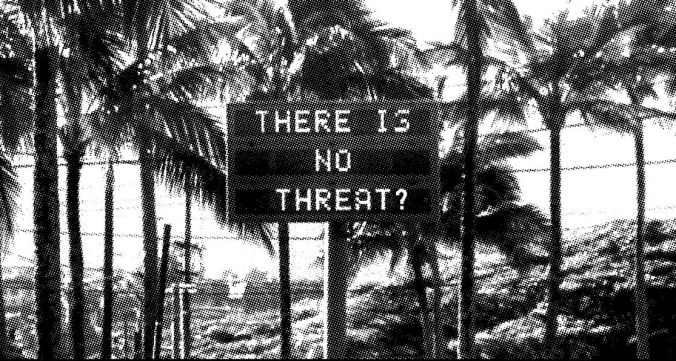
From the island of Oahu the response is: what about us? Seoul is 5 to 10 minutes from North Korean retaliation but Honolulu is only 15 minutes further away by ICBM. Where is our evacuation plan? The already unimpressive track record of U.S. nuclear interceptors has been joined by another very public failure of an interceptor test here in Hawai’i. Add to this the lingering collective dread after our mistaken missile alert on January 13th of this year, and we want to know where our militaryassisted evacuation plans are. Unlike South Korea which has thousands of bomb shelters, Honolulu has no approved public bomb shelters. This is a fact reinforced by recent statements by state civil defense authorities recommending that we all shelter in place despite the fact that most Honolulu homes are of wooden construction and do not have basements. We have nowhere to go, nowhere to hide, and we have received a taste of what it is like to wait for unstoppable death with those we love most.

What makes our collective vulnerability all the more terrifying is the palpable panic on the faces of our active duty service personnel in our communities, classrooms, and families. They are being told to prepare themselves to die for their country in Korea, are being issued a new generation of body armor, trained for tunnel warfare, and tasked to move the last of the necessary tactical equipment to South Korea. States move B-2 bombers to Guam to send a signal to North Korea. They move body armor to Seoul to prepare for invasion. Here in Hawai`i, we take the Trump administration at its word when they say there is no ‘bloody nose strike’ in the works. That is because we can see a full scale attack is being planned. If this seems unthinkable on the mainland, consider how often you have said Donald Trump’s behavior was unthinkable just before he proved you wrong.

Continue reading

The End of The Hague Yugoslavia

The Hague campus of Leiden University today hosted the “Final Reflections” symposium of the International Criminal Tribunal for the former Yugoslavia (ICTY). Everyone from the institution showed up: current and past presidents, current and past judges as well as ad hoc judges, current and past prosecutors, media officers and archivists, plus a bunch of guests—gender advisors, professors, judges from other courts, and so on. Even the president of the International Criminal Court (ICC) spoke at the last panel. This was not a mere stock-taking exercise “between a variety of stakeholders,” says the agenda.  Rather, it was an opportunity for said stakeholders to reflect on the ICTY’s legacy, ideally via a set of “short but emphatic statement[s] on the importance of international criminal courts and tribunals – particularly in today’s political climate.”

Continue reading

Trump, Russia, and the Global Right: IR’s Difficulty with the Political Present

Christopher McIntosh is a Visiting Assistant Professor in Political Studies at Bard College whose published research examines the concept of war, “terrorism,” and the intersection of time and temporality in international politics. He most recently co-edited a volume called Time, Temporality, and Global Politics, and he is currently completing a book project entitled, Theorizing the Interim: IR as Study of the Present.

Given recent events in the United States and Europe, it appears IR scholars have fallen victim, in the words of Robert F. Kennedy (among others), to an ancient “Chinese curse”: “may [you] live in interesting times.” From my position as an American citizen writing in the United States, American politics—both foreign and domestic—appears completely consumed by Trump’s actions, the moves of his “administration,” and the role of Russia in the 2016 election and potentially beyond. Nationally televised Congressional hearings during the day and seemingly daily “bombshell” news stories breaking at night have made it appear as if the US polity is in a unique, ongoing crisis. As overwhelming as it sometimes appears, as IR scholars we cannot afford to look away, as much as we might like to do so. By all accounts, these are, indeed, “interesting times.” Trump’s rise and the rise of the global right potentially upends much of what we think we know and could create a series of natural experiments that confirm or disconfirm our theories.

Continue reading

Militarism in the Age of Trump, Part I

Part I of a post based on a paper I am co-authoring with Bryan Mabee, Senior Lecturer at Queen Mary, University of London. Bryan is the author of Understanding American Power (Palgrave, 2013), The Globalization of Security (Palgrave, 2009) and co-editor with Alejandro Colás, Mercenaries, Pirates, Bandits and Empires (Hurst/Oxford University Press, 2010).  The paper is being prepared for “Militarism and Security,” a workshop organized later this month at the School of Global Studies, University of Gothenburg by Anna Stravianakis (for her latest appearance on this blog see The Dissonance of Things No 3) & Maria Stern.

Update: Part II added on 18/03/17.

With Donald Trump as the president of the United States, militarism is once again becoming a hot topic. Trump’s appointment of right-wing generals to senior posts in both the White House and his cabinet legitimate militaristic policy discourses and positions, as do the president’s pronouncements about the need to “modernize” the country’s nuclear capability, put America’s enemies “on notice,” massively “rebuild” the military, hold “more military parades” in American cities, deploy the national guard to “restore order” (and possibly “hunt illegal immigrants”) and “streamline” U.S. defence exports.

And all of this is only the proverbial tip of the iceberg. For one thing, the Trump presidency merely empowers an already deeply militaristic and militarized American culture, one that is forever in love with guns and prisons and forever reticent to acknowledge the inherently racialized dimensions of both. For another thing, Trump’s top advisor is the “ethnonationalist” Steven Bannon, who is so influential in the White House that some describe him, tongue only halfway in cheek, as the actual president of the United States. Apparently, Bannon reasons that war between the U.S. and China is likely, given the thorny nature of international disputes in the South China Sea. One could in fact say that beneath the visible iceberg lie powerful and long-standing militarized realities—most of which have been ignored, temporized or marginalized in the earlier, ‘normal’ periods.

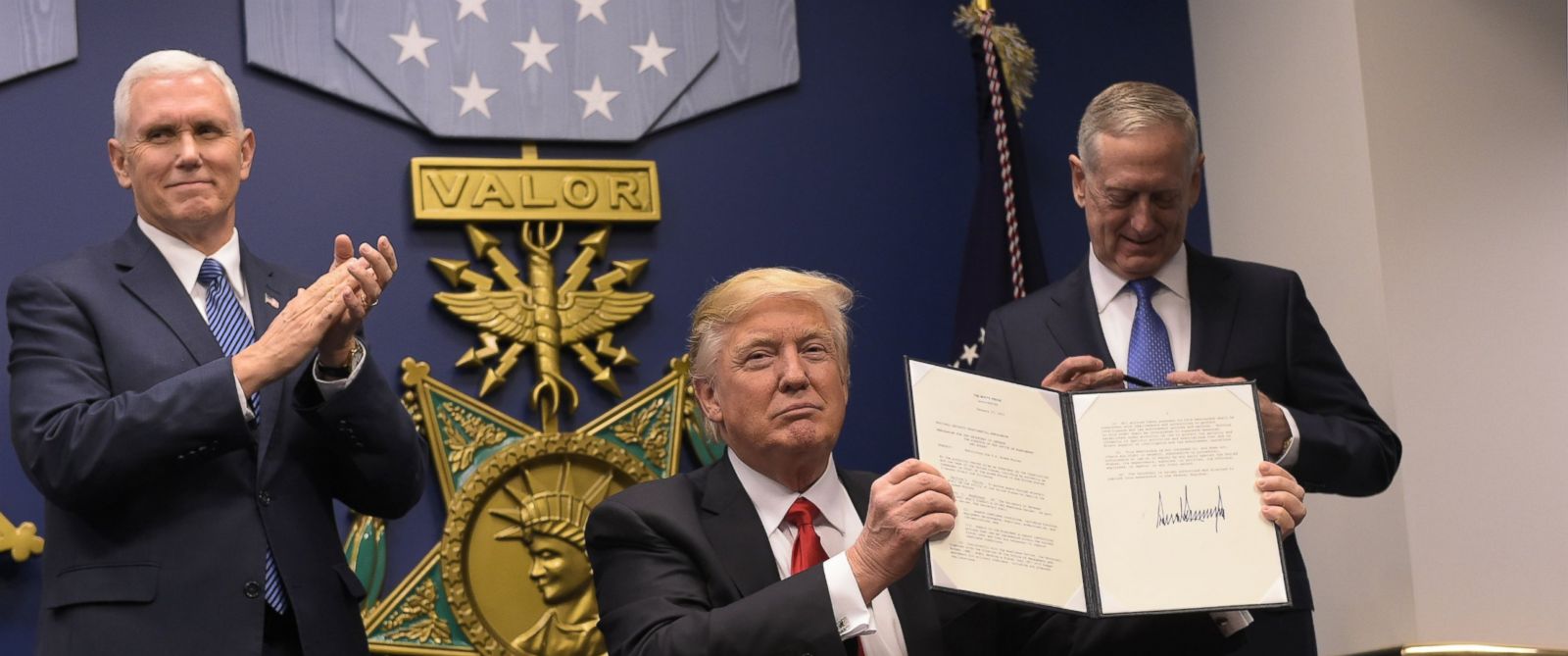
ABC News

Can Critical Security Studies (CSS) help us illuminate militarism in the age of Trump? On one level, yes. Militarism is central to the field’s go-to framework on securitization—meaning, the scrutiny of the ways in which constitutional or ‘normal’ politics are transformed, via speech acts, into ‘exceptions’. The above image, Trump signing the Executive Order banning immigrants, dual nationals and US residents with citizenships from seven Muslim-majority countries from entering the country, suspend refugee admission and bar all Syrian refugees indefinitely, can be said to capture ‘exceptionalist militarism’ at work. Yet, beyond theorizing this one form of militarism, CSS has mostly been silent on the ‘classic’ concern of the literature on militarism—its sources, consequences, and the changing character.

In this two-part post we build on insights from historical sociology to develop a typology of militarism that CSS schools could consider as they try to make sense of political violence today.

Continue reading

A Faustian Special Relationship

Donald Trump has a thing for rebuking America’s democratic allies and their leaders—his latest target being Australia’s prime minister, Malcolm Turnbull. The UK appears to be an exception to this trend. In his first interview with the British press as president-elect, Trump explained that the UK has a “special place” in his half-Scottish heart and pledged to support a post-Brexit UK-US trade deal. Reportedly a big fan of Winston Churchill—and of Boris Johnson’s Churchill Factor—he also asked the UK government to loan him a Churchill bust that his Republican predecessor George W. Bush kept in the Oval Office.

Continue reading

Can’t Lose For Winning: Victory In The Trump Presidency

media_185980_enx161127205934_70462-jpg-pagespeed-ic-1ww2qbdqbIn our second post marking the inauguration of the latest president of the United States, Andrew Hom and Cian O’Driscoll reflect on what “winning” means for Trump and his followers — semantically, operationally, ideologically. Andrew is lecturer in international relations at the University of Edinburgh and works on timing, temporality, and the politics of victory in IR theory. Cian, a specialist on victory in just war theory and international ethics, is senior lecturer in politics at the University of Glasgow. This post is based on the ESRC-funded project ‘Moral Victories: Ethics, Exit Strategies, and the Ending of Wars’ (ES/L013363/1) and an ESRC Impact Acceleration Grant (ES/M500471/1). Edit: The other two posts in this series can be found here and here.

Donald Trump has been one of the most critically scrutinized political figures in recent history. But what has so far escaped much attention is how Trump promised to ‘Make America Great Again’ by ‘winning’ on all fronts. Yet victory has long been a centrepiece of Trump’s vision for American renewal. Here is Trump on the stump in April 2016:

You’re going to be so proud of your country. […] We’re going to turn it around. We’re going to start winning again: we’re going to win at every level, we’re going to win economically […] we’re going to win militarily, we’re going to win with healthcare and for our veterans, we’re going to win with every single facet, we’re going to win so much, you may even get tired of winning, and you’ll say “please, please, it’s too much winning, we can’t take it anymore” and I’ll say “no it isn’t”, we have to keep winning, we have to win more, we’re going to win more!

This repeated themes he had been expressing since the Republican primaries, and victory resurfaced in Trump’s inaugural address: ‘America will start winning again, winning like never before.’

Continue reading

What in the world is populist foreign policy?

Andrew Priest is senior lecturer in Modern US History at the Univers6555ity of Essex. He is co-editor, with Andrew Johnstone, of US Presidential Elections and Foreign Policy: Candidates, Campaigns, and Global Politics from FDR to Bill Clinton (University of Kentucky, forthcoming 2017), and he is currently writing a new book on US foreign policy and notions of empire in the post-Civil War period. Here, the day before Donald Trump is inaugurated as the 45th US president, Andrew sets him in the context of American populism through the centuries and offers some thoughts on Trump’s foreign policy in the making.

Edit: This is the first in a three-part series of posts around the presidential inauguration. The other two can be found here and here.


As hard as it is to believe, only on Friday will Donald Trump finally become president of the United States. During the ultra-marathon that is the modern presidential election, which has given way to a transition period that has felt almost as long, Trump has given us many hints but few details of what his presidency will actually bring. While strident in his views about America’s place in the world, he shows little interest in the details of foreign policy and disdain for diplomatic niceties. This will have important implications for Trump’s role as architect of American foreign policy for the next four years.

pjimage

American populists L-R: Andrew Jackson, Donald J. Trump, Thomas Jefferson, Ross Perot, and Huey “The Kingfish” Long.

Continue reading

The many deaths of Fidel Castro

A few weeks ago, when I checked Twitter and saw that Fidel Castro had died, the news felt strangely distant. True, Fidel was a giant of the twentieth century rather than the twenty-first, but I think that feeling of observing the news of his death from afar had more to do with the fact that we (Cubans and Cuba-watchers, journalists, scholars, beret-wearing backpackers) have already been living with the spectre of his death for so long. And, as he has faced death so many times through the years, the mere fact of his death – now material, tangible – seems hardly enough to stop him from living on.

A political map of Cuba

Political cartoon by Graeme Mackay, 2 August 2006.

Continue reading

“But What On Earth Is Whiteness That One Should So Desire It?”

This is the fifth post in our symposium on White World Order, Black Power Politics, which will be followed shortly by a response from the author. Earlier responses are here from Naeem, Nivi and Srdjan. This piece expands on, and in some senses muddies, a short review I wrote of the book for a symposium in Perspectives in Politics.


This book is an indispensable and provocative account of the genesis of International Relations in the US as a discipline expressly concerned with the maintenance and expansion of global white supremacy. It is an enormously significant contribution to the understanding of the past, present and future of how we study world politics, which has thus far ‘disappeared’ racism and racial politics from its foundational narratives. [1]  It seems, this time anyway, that people are paying attention – the book is receiving wide acclaim and attention in the roundtables, symposia and review sections of the very journals, conferences and institutions that constitute the historical objects of its narrative. Does this mean that the ‘rising tide’ of calls for the discipline to deal with its racist foundations are being answered?

We will have to wait and see. Vitalis’s book makes some important headway in that direction but the rearguard is already being mobilised. Gideon Rose’s capsule review for Foreign Affairs, the journal once named for Race Development, perfectly captures precisely how this rearguard can function, in the process re-inscribing the ‘norm against noticing’ the operation of racism and white supremacy in both world politics and the discipline (IR) that claims to study it. Marking the book as ‘flawed’ and ‘political’, Rose accepts that the origins of the discipline were racialized and characterized by discussions about race relations. However, his rhetoric effectively consigns the analytic case that there are continuities in these ideas to a conspiratorial form of politics (attributing to Vitalis, bizarrely, a rather childish view of the US as ‘evil’).

Matt Wuerker, The Military Industrial Complex

Matt Wuerker, The Military Industrial Complex

The most prominent of these linkages in the text is Vitalis’s juxtaposition of Lorthrop Stoddard’s The Rising Tide of Color, which foretold of coming race wars in the twentieth century, with Samuel Huntington’s The Clash of Civilizations which does the same for the twenty-first (4, 62-4, 177).  It is true that Vitalis does not work through a point by point analysis of the two texts; however, it is also equally demonstrated that there are clear overlaps in form and content between the arguments. Both are grounded in the belief in coherent civilizations existing in fundamentally antagonistic relations, of which the white (or Western) is the most advanced and against which others will attempt to rise. For Rose to refuse to acknowledge the argumentation at all, even in a capsule review, seems odd until one reads the same reviewer’s graceful, generous assessment of Huntington’s famous work in the same journal in 2013, commemorating the 20th anniversary of its publication:

The origins of “The Clash of Civilizations?” lie in the conjunction of a special scholar and a special time. By the beginning of the 1990s, Samuel P. Huntington was already one of the most important social scientists of the second half of the twentieth century, having authored major works in every subfield of political science. The hallmarks of his efforts were big questions, strong answers, independent thought, and clear expression. The end of the Cold War, meanwhile, had ushered in a new era of international relations along with a host of questions about what would drive it. Drawn, as always, to the major practical and theoretical questions of the day, Huntington set himself the task of limning this new world.

The more he thought about it, the more he decided that most existing analyses were heading in the wrong direction. The future was not likely to be an easy run toward democracy, peace, and harmonious convergence, nor was it likely to be a return to the old games of traditional great-power politics or ideological rivalry. “The great divisions among humankind and the dominating source of conflict will be cultural,” he concluded; “the clash of civilizations will dominate global politics. [Rose, Foreign Affairs, The Clash at 20]

What can we make of this? Continue reading