 We are delighted to welcome Kevin McSorley for the second post of our symposium on Lauren Wilcox’s Bodies of Violence. Kevin lectures in Sociology at the University of Portsmouth. His work explores war, violence and militarism through the lens of embodied, emotional and sensory experience. His scholarship has explored contemporary conflicts including those in Chechnya, Iraq and Afghanistan, as well as analysing phenomena including the global arms trade, military fitness regimes, and helmetcam technologies. Recent publications are available at Academia.edu.
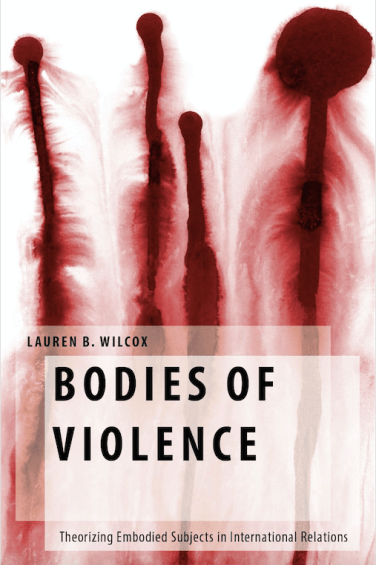
Lauren Wilcox’s Bodies of Violence: Theorising Embodied Subjects in International Relations is an extremely welcome addition to a growing corpus of recent scholarship that attempts to foreground the body and embodiment in the analysis of topics such as war, violence and security. Wilcox argues that IR has historically constituted itself as a discipline partly in terms of the exclusion of the detailed consideration of the body and embodiment, concerns which have rarely been admitted as core to a discipline whose interests supposedly lay at higher levels of abstraction. Indeed, the absenting and sequestering of the bodily and particular bodies has been central to the formation and history of many academic disciplines, modern social and cultural formations, and the organisation of much mundane experience. Relatedly, it is often specifically in occurrences and encounters of bodily discomfort, illness, estrangement, harm, failure, violence and pain that the body may assume a renewed experiential salience in everyday life. The under-theorisation of embodiment thus seems particularly paradoxical for a discipline such as IR, whose analytic remit encompasses the organisation of violence and pain for political ends, phenomena which can hardly be adequately understood without attempting to think through the multiple ways that violence and pain are intimately related to the in/abilities of bodies to engage in particular sense-making, meaning-making and worlding practices. Indeed, such under-theorisation may be more than just paradoxical, for abstract strategic thinking that avoids acknowledging bodies has historically been complicit with particular expert modes of knowing and doing violence.
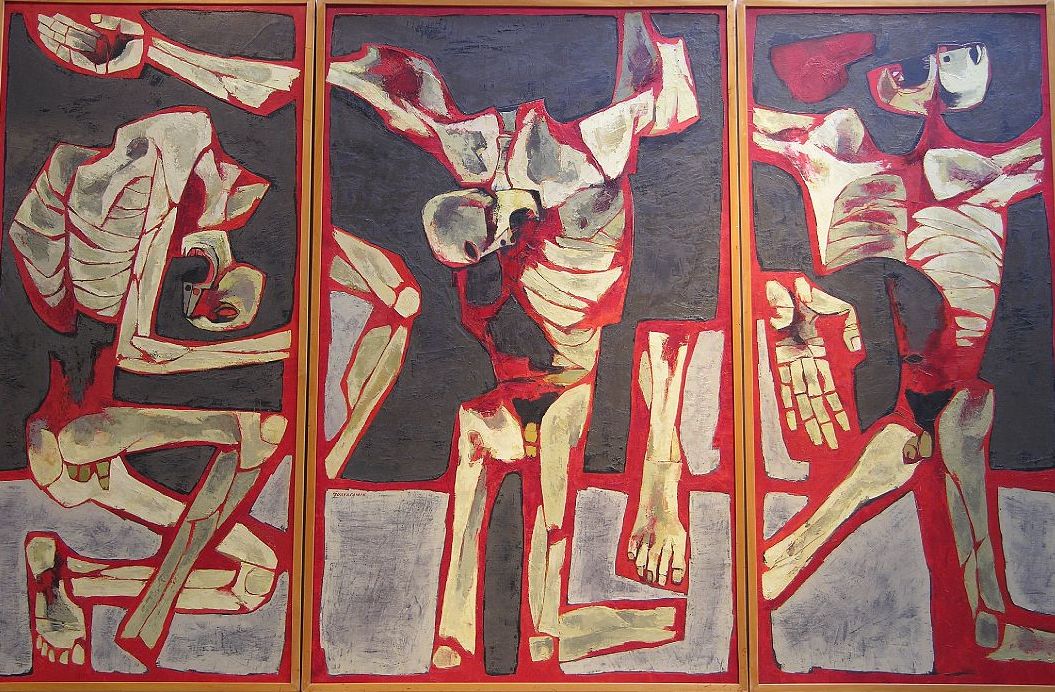
Oswaldo Guayasamín, Los Torturados (1976)
Wilcox’s project is thus a necessary intervention that grapples meaningfully with the disembodied soul of IR and I am thoroughly supportive of its ambitions. The body is one of the most plural and contested concepts in social science but Wilcox initially argues that, when considered at all, the way that it has typically been rendered through the realist and liberal traditions of political thought that inform IR and security studies is as a stable, singular, bounded and natural entity whose flourishing is dependent upon protection from various inevitable risks and threats. This narrow understanding of the body is thus of something essentially thing-like, fixed and existing outside the realm of the political. In contrast, biopolitical and particularly feminist analytics – the latter having a specific tradition of trying to think through women’s subordination in terms of the relationship between bodies, subjects and power – provide the alternative conceptual underpinning for Wilcox’s own analysis.




 The Disorder Of Things