Economy of Force: A Reply

In which Patricia Owens responds to our four commentaries (on patriarchy, colonial counterinsurgency, biopolitics and social theory) on her Economy of Force.


I’m extremely grateful to Pablo K, Elke Schwarz, Jairus Grove, and Andrew Davenport for their serious engagements with Economy of ForceAs noted in the original post, the book is a new history and theory of counterinsurgency with what I think are significant implications for social, political and international thought. It is based on a study of late-colonial British military campaigns in Malaya and Kenya; the US war on Vietnam; and US-led campaigns in Afghanistan and Iraq against the background of the high colonial wars in the American Philippines and nineteenth-century French campaigns in Tonkin, Morocco and Algeria. Probably the emblematic case for the book is Britain’s colonial state terror against Kenya’s Land and Freedom Army and civilians in the 1950s, a campaign that was closer to annihilation than ‘rehabilitation’. Although the so-called ‘hearts and minds’ campaign in Malaya is held up by generations of counterinsurgents as the model for emulation, the assault on Kikuyu civilians shows the real face of Britain’s late-colonial wars. It also points to some profound truths about the so-called ‘population-centric’ character of more recent campaigns in Afghanistan and Iraq. Though offering new readings of some better-known counterinsurgency cases, Jairus Grove suggests that this choice perpetuates an erasure of America’s ‘Indian Wars’.
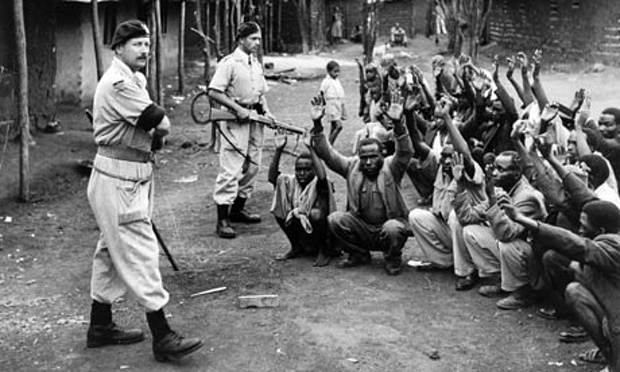
Mau-Mau

Researching Economy of Force, I certainly became aware of the general significance of these wars, including through Andrew J. Birtle’s and Laleh Khalili’s histories of counterinsurgency. However, Grove draws attention to something more relevant to Economy of Force than appreciated before: “one of the first federal bureaucracies with jurisdiction over the home and social issues”, he writes, “was created by and administered by the War Department”. Decades before the distinctly ‘social’ engineering during the Philippines campaign (1899-1902), the Bureau of Indian Affairs was administering indigenous populations on the mainland. In focusing on overseas imperial wars, Economy of Force surely neglects settler colonialism, its genocides, and how “warfare, pacification, and progressivism were an assemblage in the US context from the outset”. While the book was not centrally focussed on US state making, I’m grateful to Grove for insisting that settler colonialism is necessarily a form of counterinsurgency. To be sure, the Philippines campaign was examined not as the founding moment of American counterinsurgency, but because it was explicitly conceived by contemporaries as a form of overseas housekeeping; to problematize progressive social policy; and to challenge the effort to separate good (domestic) social engineering at home from bad social engineering (overseas). I would hesitate to wholly assimilate the Progressive Era (1890s-1920s) into earlier Indian Wars, though its ‘social reforms’ shaped indigenous administration. But these are quibbles. Grove is right that I have neglected something of significance in the ‘historical trajectory from Thanksgiving to Waziristan’. I hope to be able to rectify this in future work.
Continue reading

Home-ology; Being a Comment On Patriarchs and Patriarchy in Economy of Force

This is the second contribution to a forum on Patricia Owens’ Economy of Force. More to follow in the coming days.


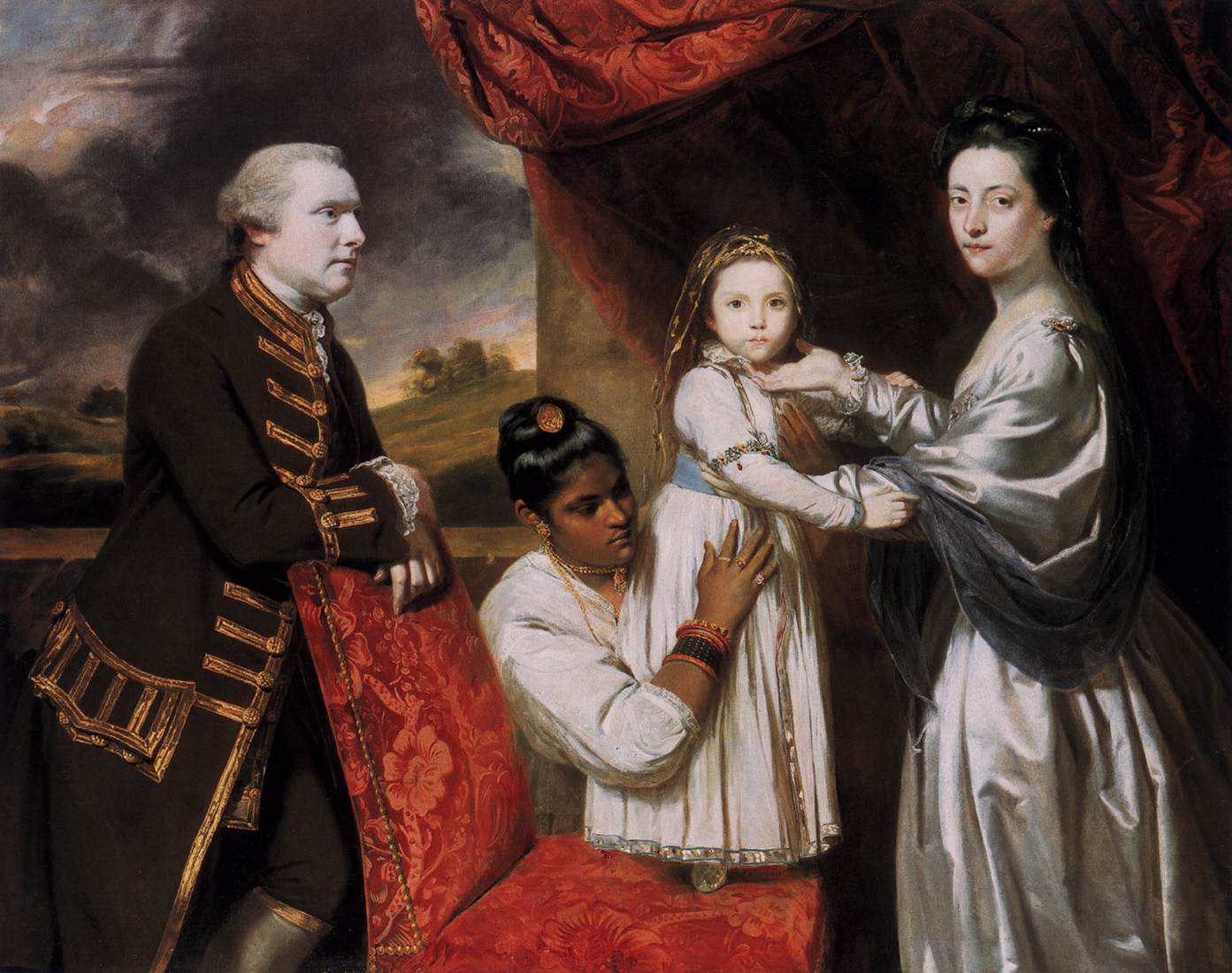
Joshua Reynold's portrait of Clive of India, director of the East India Company, c. 1765

Joshua Reynold’s portrait of Clive of India, director of the East India Company, c. 1765

What to say about Economy of Force, Patricia Owens’ wildly ambitious contribution to international political theory?[1] A book that threatens to overwhelm, whether with the vast literature it marshals or in its brazen assault on (almost all) social theory. A book that consistently degrades the “intellectual crutch” of sociality, offers an arresting agenda for historical and political analysis, and then delivers a revisionist account of late colonial and ‘post-colonial’ counterinsurgency of its own. Amidst the parade of detail and argument, a book in which you will also discover a nascent theory of patriarchy. Arguably more, Economy of Force presages nothing less than the groundwork for a unification of feminist and international political theory.

As we have already seen, Owens’ critique of ‘the social’ as a category of thought and practice involves reviving the alternative to it: oikonomia, economy in its original sense. More precisely, Economy of Force dispenses with the usual distinction between a time when the family household was the primary site of power (feudal, certainly pre-modern, personalist, and status-based) and the contemporary distribution of political, economy and civil power in something we call ‘society’ (properly modern, bureaucratic or networked, and contract-based). Instead of telling stories in which the household is overcome by society, we should, on this account, recognise that ‘the social’ is a historical transformation of the household form. The change in the form of household governance is real, but the stories told about the change are fictions. The current hegemonic story – social theory itself – has as its effect the obscuring of power as domestication. In other words, our conventional narrative of how the household disappeared provides ideological cover for the fact that the household is still very much with us.

Oikonomia, or household governance, is rule characterised by a father figure (paterfamilias) whose power is more or less that of a despot. Since despot means ‘master of the house’, you might expect International Relations scholars to have noticed, or to be alert to their own repeated tendency to name as ‘domestic’ whatever is not part of global politics proper. Instead, these threads must be uncovered, recovered, constructed and mapped anew.

Continue reading

(Why We Can’t) Let the Machines Do It: A Response to Inventing the Future

The fourth post in our (already pretty popular) forum on Nick and Alex Williams’ Inventing the Future, this time from Sophie Lewis and David M. Bell. Sophie is at the University of Manchester, writing up a PhD on surrogacy’s uneven ‘cyborg’ geography and thinking about its utopian potential. She has written about surrogates for JacobinThe New Inquiry, and The Occupied Times; currently, excerpts are included in the 2015 “Technotopia” symposium. She also writes with the Out of the Woods (anticapitalist ecology) collective. She has co-translated Bini Adamczak’s Communism For Kids and written things that appear in Mute, Open Democracy, the ‘Demanding the Future’ tumblr, and on Novara WireDavid M. Bell is a Research Associate on the ‘Imagine’ project in the Department of Geography, University of Sheffield. He is interested in the potentials and dangers of utopia(nism) within, against and beyond capital, the state and itself. He has written on the politics of musical improvisation, utopian fiction and participatory arts practice; and is currently working on two book projects: Rethinking Utopia: Place, Power, Affect, to be published by Routledge in 2016; and A Future History of Sheffield: Art Practice, Hope and the City, with Jessica Dubow and Richard Steadman-Jones.


To The Future! But Whose?

To The Future! But Whose?

1. 

Inventing the Future provides a ‘plausible programme for ‘a world free of work’. It ‘shows us how we can organise’ to ‘realise a postcapitalist world’. So state its back-cover endorsements by Mark Fisher and Paul Mason. You should never judge a book by its blurb, but these claims are not to be sniffed at: here are two prominent thinkers of the UK left positioning this book as, if not a blueprint for utopia, a blueprint for utopianism – a roadmap that doesn’t quite cover the future but certainly takes us to its outskirts. The hyperbole continues away from Verso’s official promotional campaign too: Novara Media founder Aaron Bastani has publicly suggested that Corbyn’s Shadow Cabinet receive copies of the book’s chapters as bedtime reading pamphlets. We are not so sure. There is much of value in Inventing the Future (hereafter ItF); and it certainly opens up space for thinking about what might be and how we might get there. But there are serious questions about who this future is for, whose labour (re)produces it, and who it will continue to exclude.

Before the reader is let in on how we can invent the future, however, they need to be disabused of various notions that are holding it back. These are grouped together under the rubric of ‘folk politics’ – a supposed ‘constellation of ideas and intuitions within the contemporary left that informs the common-sense ways of organising, acting and thinking politics’ (p. 10). Its key features are the privileging of ‘local particularisms’; the spatially and temporally ‘immediate’ (and ‘unmediated’); ‘resistance’; and the ‘natural’. The attitude that Srnicek and Williams (hereafter S&W) take to this assemblage is remarkably similar to Marx and Engels’ position on utopian socialism: it was necessary in that it locally kept alive the possibility of alternative ways of living while large-scale political change was impossible, but once the material conditions for totalizing political change (supposedly) arrive, revolutionaries should embrace them and move beyond their quaintly uninspiring New Lanarks, exchange banks and workers’ associations. The time! is! (was!) now! (then!).

Against ‘folk politics’, S&W believe that a return to universalism is necessary for the invention of the future. Whilst acknowledging the colonial history (p. 76) of the universal and rejecting ‘Eurocentricism’ (pp. 77-78), they nonetheless argue that abandoning this structure of thought entails ‘licensing all sorts of oppressions as simply the inevitable consequence of plural cultural forms.’ (p. 77) This seems odd given that so many Indigenous and pre-colonial practices, identities, sexualities and cosmologies with liberatory potential have been destroyed in the name of universalism; and whilst these are acknowledged with the claim that there are non-European forms of ‘reason’, ‘science’, ‘progress’ and ‘freedom’ (p. 77), we are not convinced that these decidedly European terms are the most suitable labels for them. (What does ‘progress’ mean for cultures whose temporalities are nonlinear, for example?). We are more heartened, however, by the call for a universalism that is ‘pluri-versal’ and ‘does not entail homogeneity…does not necessarily involve converting diverse things into the same kind of thing’ (here, S&W refer to capitalism’s ability to sustain and draw power from diverse forms of social organization); and which ‘must recognise the agency of those outside Europe…in building truly planetary and universal futures.’ (p. 78) Continue reading

Darkness and Light: Re-Visiting Cuba

Let me begin this concluding post by saying how great it has been to have my book, From Cuba with Love, read so closely and receive such thoughtful responses (all of which are collected here).  Thanks so much to Rahul, Dunja, Nivi, and Pablo for their thoughts, and especially to Pablo for organising this symposium.  And now for an attempt to come to terms with some of the questions that have been raised in the last week of posts!

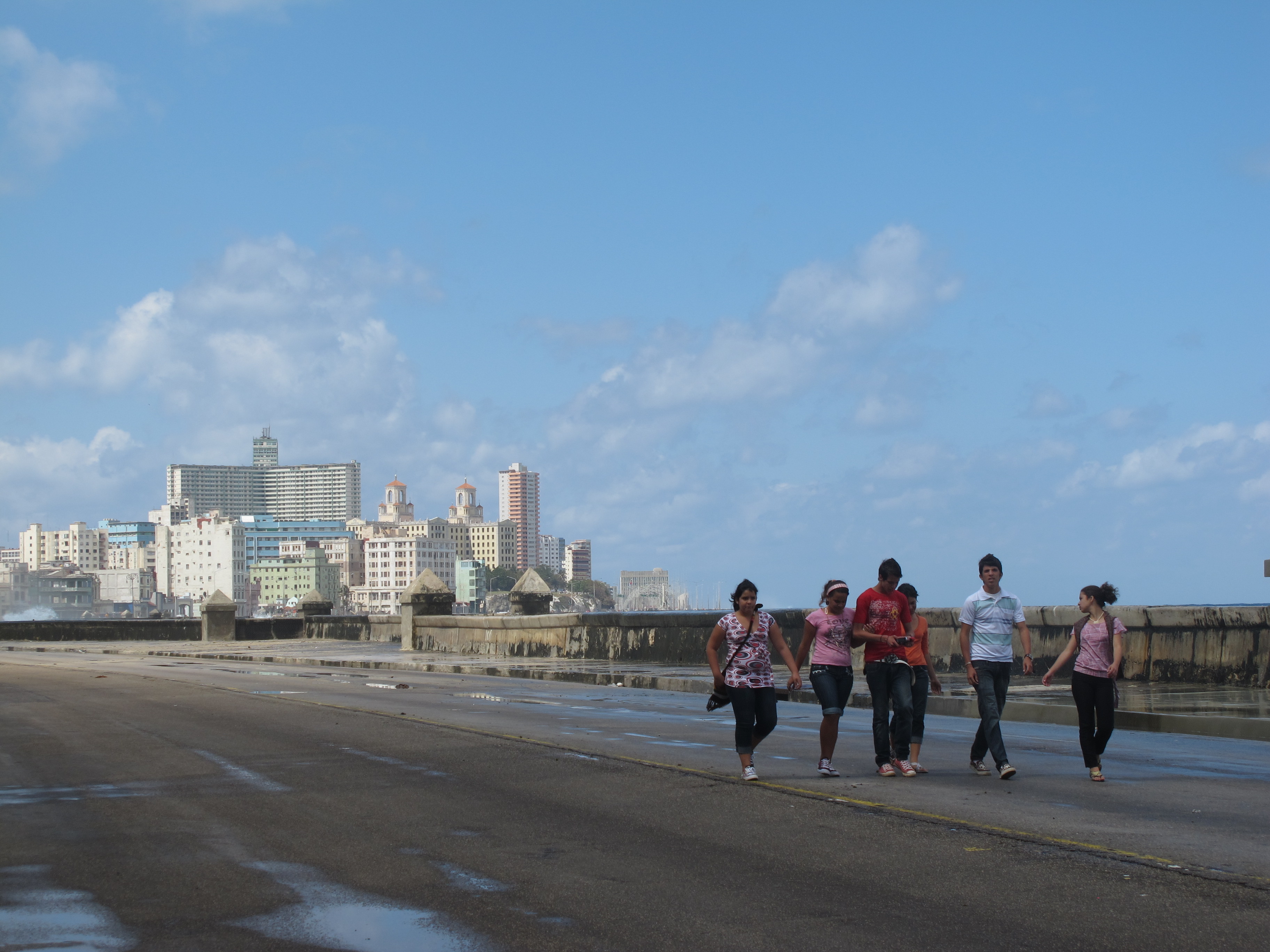
Figure 20_Malecon on a Windy Day

The Malecón in Havana on a windy day, when high waves closed the road to cars, in 2010.

In the book, I expend quite a bit of energy trying to think about sex as a potential site of resistance, so I was fascinated to see a recurring concern (especially from Dunja and Pablo) for the flip side of that coin, or what might be called the darker side of jineterismo-as-sexual-practice.

Continue reading

Knowing Like A Jinetera

The last commentary post in our forum on Megan’s From Cuba With Love, following contributions from Megan herself, Rahul, Dunja Fehimovic and Nivi. Megan’s rejoinder will be up imminently.


Visit Cuba Poster

So near and yet so foreign! declares the advert. Intimate and exotic, Cuba as a repository for fantasy and self-discovery, the neighbour with the mixed-race charms, the imagined nation Cindy Weber once analysed so relentlessly as “the near colony and certain feminine complement” of the United States. Megan’s new, and first, book – From Cuba With Love – exposes the same kind of dynamic, although from a different standpoint.[1] Hers is a near-seamless blend of reportage and feminist IR, moving from autobiography to testimony to political theory, translating from events on the Malecón (the long waterside promenade in Havana dubbed “Cuba’s great sofa”) to the masculine histories of the Cuban state and back again. It is also – for those seduced by such things – a book beautiful to look at, and to hold (which is a way of saying that you should buy a hard copy). It is a book about evasion, repression and muddled motives, but is itself a model of generosity and clarity.

The central figure throughout is the ‘jinetera’, superficially close to the idea of a ‘prostitute’ but evidently much more ambiguous in definition and shifting in practice. As Megan explains, the term ‘jinetera’ and the general practice ‘jineterismo’ are plays on ‘jockeying’, meaning to manoeuvre for advantage and also to have sex, both connotations clearly playful, if also risky (see the previous posts in the forum for more discussion on the meaning and forms of jineterismo).[2] It is with a curiosity about jineterismo that Megan starts. But where we end up is inside an indispensable guide to the ‘sexual-affective economy’, a bold innovation in disciplinary writing, and a testament to the difference gender analysis makes in studying the global political.

From Cuba With Love does what a certain kind of post-structural feminist IR does best, dissecting the identities created by, and in, a concrete historical system. Not the narrow ‘identity politics’ critics abhor, but identity as the fullness of lived experience shot through with power, subjectivities which are at once deeply personal (love, hope, desire, sex) and interwoven with the most brute forms of political violence (the state, the prison camp, the rehabilitation centre, the police system, imperialism and resistance, exclusion and poverty). It is a study that is undeniably ‘global’ in its scope, even about inter-national relations in a rather precise sense, given how often the admixture of sex and money circles the desires of the (usually) western male for a ‘local’ rendezvous, and how implicated notions of race, nation, difference, rivalry, trade, progress, savagery, miscegenation, and geopolitical virility are in that. A kind of diplomacy, even. This is an encounter with ‘the Other’, and a negotiation of the foreign, in its most visceral possible form. Or, as one key informant more bluntly puts it:

It’s different if one goes to bed with a foreigner, or a mountain of foreigners…Do we have to carry such chauvinistic patriotism with us in our pussies too? Is it obligatory to make use of a mambí dick? Or are they trying to avoid alienating penetrations?

Yet From Cuba With Love is not just a great success on those terms. It is also in many ways the stand-out example of ‘narrative IR’, that vague but increasingly popular sub-field (or is it a method?) devoted to exploring world politics from the situated perspective of someone experiencing it (that someone usually being the researcher themselves). Continue reading

From Cuba with Love: Sex and Money in the 21st Century

9780520282988

Five years ago, I spent six months living and working in Cuba – a fact that, in casual conversation, generally provokes expressions of envy and eye rolling about mojitos, salsa music, and academics who don’t really do any work. Cuba is as much a fantasy as a real place. It is totally invested with the romantic and ideological dreams of wildly disparate constituencies: armchair socialists and campus lefties, right-wing US politicians and Cuban émigrés, cocktail-swilling package holiday tourists, and adventure-seeking backpackers, amongst others. Cuba is a steamy and exotic Caribbean island, with rumba dancing and free-flowing rum. Cuba is a repressive and secretive regime. Cuba is a test workshop for socialist ambitions the world over. Cuba is a fantasy.

It was ideas like these about Cuba, Cuban politics, and Cuban people that drew me there in the first place, and the resulting book – built on those months of ethnographic research and on the doctoral dissertation that followed – has recently been released under the title From Cuba with Love: Sex and Money in the Twenty-First Century (University of California Press 2015). Rahul, Nivi, guest poster Dunja, and Pablo will be commenting on it over the next few days, followed by a rejoinder from yours truly.

Continue reading

Theorizing Embodiment and Making Bodies ‘Matter’

Bringing to a close our symposium on Bodies of Violence is Lauren’s rejoinder to all our contributors, Kevin McSorley, Ali Howell, Pablo and Antoine.


First, a huge thank you to the (Dis)order of Things and especially Antoine for organizing this forum and to each of the contributors. It’s been a huge honor to have my work read so carefully and responded to so thoughtfully and I welcome the opportunity to try to clarify some of my work and acknowledge where the contributors have pointed out helpful areas for future research.

As Pablo K and others noticed, Bodies of Violence it is not meant to be a general theory of embodiment in IR (I’m not sure such a project is feasible or politically desirable in any event).  It is a more specific intervention with a different ambition: both to speak to ‘mainstream’ concerns about theorizing violence, particularly forms of political violence associated with the ‘war on terror’ and to make not only a theoretical argument about how we might or should theorize embodiment and violence, but also to show that understanding these different ‘modes of violence’ necessitates such an understanding of the relationship between bodies, subjects and violence.  My rationale for using feminist theory to think about the relationship between bodies, subjects and violence in IR was not meant to be exclusive: certainly (other) people working with concepts of biopolitics as well as anti-colonial/anti-racist theorists, disability theorists, phenomenologists and more also have much to say on this topic, some insights of which have been very important in my analysis, if not as fully fleshed out (if you will) as my engagement with feminist theory is.[i] For me, it was a particular reading of feminist theories of embodiment, not solely based on Butler, but on a particular feminist problematic in which women, as a category of those constituted, as Pablo K put it, the “improperly bodied”, are politically disenfranchised and generally excluded from their status as a fully human subject that served as a starting point, but far from an ‘ending’ for thinking about the subject of embodiment.  Rather, it is, as Kevin noted, “the specific tradition of trying to think through women’s subordination in terms of the relationship between bodies, subjects and power” that feminist theory entails that I wanted to use to think about violence and embodiment in ways that I hope will speak not only to feminists in IR but also to other critical and the more pluralistically and trans-disciplinarily minded scholars in IR and beyond as well.

Continue reading

Secular Bodies of Pain and the Posthuman Martial Corps

The penultimate post in the symposium on Lauren Wilcox’s Bodies of Violence before the author gets the opportunity to respond to all the participants. Previous contributions come courtesy of Kevin McSorley, Ali Howell and Pablo – Lauren’s opening post can be found here.


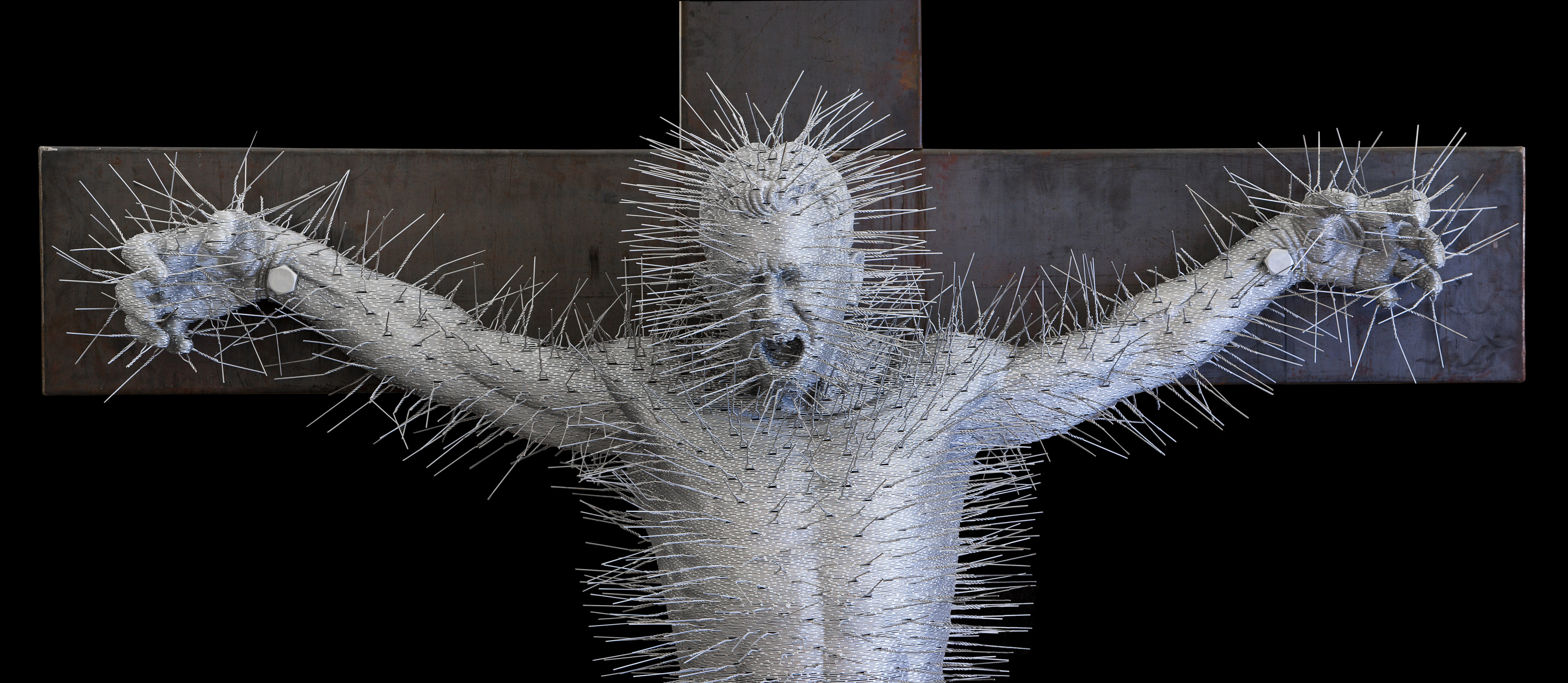
David Mach, Die Harder (2011)

David Mach, Die Harder (2011)

With Bodies of Violence, Lauren Wilcox performs the much-needed service of bringing the body back to the foreground of international politics. Through both sophisticated theoretical exegesis and a rich treatment of relevant empirical material, the work insistently underlines why embodiment matters in contemporary practices of violence and how so many accounts of international relations to date have been deficient in this regard. To any that might still doubt it, Wilcox further demonstrates how the insights developed by feminist theory are not restricted to its primary object of gender and makes a compelling case that we find in this body of work one of the most important repositories of conceptual resources for thinking physical embodiment and the normative social frameworks in which such embodiment is lived out.

Perhaps Wilcox’s most important theoretical commitment in the book is her steadfast refusal to take bodies, and by extension political subjects, as given. Instead, bodies are always to be conceived of as in-formation, produced within and bound by normative orders all the while resisting and exceeding them. The human body should therefore not be treated as the basic unit of social ontology or serve as the fixed atom upon which the edifice of political theory is to be constructed (as exemplified by liberalism’s usual reliance on the sovereign rational individual). Drawing in particular on Judith Butler’s work, Wilcox proposes rather to conceptualise the subject as ‘ontologically precarious’ (p.190) and our political orders as accordingly contingent and open-ended. Violence is here taken to be of critical importance since it cannot be considered as ‘merely harmful but is constitutive of the embodied subjects of IR’ (p.28).

Bodies of Violence offers much stimulus for reflection but I will limit my comments to developing two lines of thoughts which are presented here as much as general provocations than as pointed questions to Wilcox. The first concerns the status of pain within the ethico-political imaginaries of modern societies, the second pertains to the relation of the posthuman military body to prevalent corporeal norms.

Continue reading

Bodies, What Matter?

And now, the fourth post in our symposium on Lauren Wilcox’s Bodies of Violence.[1] It follows Lauren’s opener, Kevin McSorley’s take on embodiment and Alison Howell on the value of feminist IR in such a project. Posts by Antoine and a rejoinder from Lauren follow.


Type Any Name Bodies

Lauren Wilcox seeks something like a theory of the body (and embodiment, crucially different) in international political violence. The body not as inert or as the mere vehicle for mind, but malleable, and indeed “deeply political”. As she puts it early on in Bodies of Violence, we therefore require a conceptual framework for seeing “how bodies are enabling and generative of war and practices of political violence more broadly”. And it is part of her case that such a theory of bodies – or, at least, a theoretical inquiry into violent embodiment – would be among the first in the discipline of International Relations, which has thus far failed to understand how bodies matter, how bodies are produced, and how violence acts upon and through bodies, even as it claims to be the discipline most concerned with human survival in the face of organised violence. And despite IR being in thrall to an unsustainable individualism, which might at least be expected to bias it towards discrete human experience.[2]

In short, international theory is disembodied, and the body an “absent presence” (aptly put, and true). Since we all have bodies, and can only encounter the world through our bodies, we should thus in some sense seek to include – perhaps even ‘centre’ – the body in theory. Even as poststructural scholarship evades the injunction to produce systematic theory, it is able to reveal the absence of bodies in our dominant paradigms. Wilcox pushes us in the same direction, arguing that, as subjects, we are embodied, precarious and have physical forms that are both produced by, and are in turn productive of, the world of ‘politics’. This is both a conceptual and a normative question, since those who have been considered improperly bodied have historically been excluded from politics, from the means of social reproduction and autonomy, and from recognition as human itself.

To not see the body is thus not to entertain a neutral and cerebral vision of the human, but instead to reproduce the historical exclusions by which some bodies (in the familiar refrain, those that are male, white, cisgender, heterosexual, Eurocentric, able-bodied and rational) are taken to be the benchmark by which others (framed as deviant, inadequate, juvenile or dangerous) are measured and found wanting. Bodies of Violence moves through a series of sites (the US Naval Base, Guantanamo; the suicide bomber’s vest; the airport scanner; the drone operator’s screen-throne; the rhetoric of humanitarian intervention), mapping how the body figures in each of them. It is a book thoroughly about bodies, but not therefore necessarily a theory of bodies and embodiment. And it is theory of em-bodies-ment that we may in need of.

Continue reading

Bodies, and Violence: Thinking With and Beyond Feminist IR

10170814_10203788729029655_7004664852126275170_nOur third post in the symposium on Lauren Wilcox’s Bodies of Violence comes courtesy of Alison Howell (the first two posts can be found here and here). Alison is an Assistant Professor of Political Science at Rutgers University, Newark. She has written on topics relating to the international relations of medicine, health, security and warfare. Her first book, Madness in International Relations examined the role of psychology in global security practices.


I have a confession to make: at the last ISA, swept up in the magic of New Orleans, I rekindled a romance. I should probably clarify that I’m not talking about one of those salacious romances that one hears rumors of on the Hilton elevator. No, I’m talking about my relationship to FTGS specifically, and feminist IR more generally.

tacky rose

When I first started going to the ISA a little over ten years ago, I felt strongly identified with FTGS. Though I consider my research feminist (amongst other things), and though, for that matter, I’ve continued to pay dues to the FTGS section as a kind of hopeful political act – still the romance didn’t last. Partly my intellectual curiosities took me in different directions. I also had trouble articulating some of the problems I had with the deployment of some concepts in feminist IR (especially the concepts of trauma, and also violence, which I’ll return to in a few paragraphs).

But lately I’ve been feeling flirtatious with feminist IR again. In part, this is because I’m finally getting some clarity on why I have disagreements with some feminist thought in IR (and thoughtful disagreement is a kind of engagement). It’s also because I think that feminist IR is beginning to be more diversely peopled and theorized. For these reasons, I was excited to find Lauren Wilcox’s impressive book in my possession, a book that appears as part of Oxford University Press’s Gender and International Relations series, a perch from which it is pushing feminist IR in some new directions.

Wilcox’s book is novel in that it works to systematize an approach to the body in IR. To date, a focus on the body as a site of theoretical concern in IR has been piecemeal, though certainly not absent. Yet what Wilcox achieves in placing the body and embodiment as central conceptual artifacts in Bodies of Violence, is to freshly open up a number of thematic concerns and questions for the study of global politics.

Continue reading