The Black Pacific: Thinking Besides the Subaltern

The first in a forum on Robbie’s recently released The Black Pacific: Anti-Colonial Struggles and Oceanic Connections (Bloomsbury, 2015). A number of commentaries will follow in the coming week.


May 1979. A Black theatre troupe from London called Keskidee, along with a RasTafari band called Ras Messengers, land at Auckland airport, Aotearoa New Zealand. They have been invited by activists to undertake a consciousness-raising arts tour of predominantly Māori and Pasifika communities. They are driven almost immediately to the very tip of the North Island. There, at a small hamlet called Te Hāpua, Keskidee and Ras Messengers are greeted by Ngati Kuri, the local people of the land. blk1An elder introduces his guests to the significance of the place where they now stand. Cape Reinga is nearby, where departing souls leap into the waters to find their way back to Hawaiki, the sublime homeland. The elder wants to explain to the visitors that, although they hold an auspicious provenance – the Queen of England lives amongst them in London – Ngāti Kuri live at ‘the spiritual departure place throughout the world’. The elder concludes with the traditional greeting of tātou tātou – ‘everyone being one people’. Rufus Collins, director of Keskidee, then responds on behalf of the visitors:

You talked of your ancestors, how they had taken part in our meeting, and I do agree with you because if it was not for them you would not be here. You talked of our ancestors, taking part and making a meeting some place and somewhere; the ancestors are meeting because we have met. I do agree with you.

But Collins also recalls the association made betweenblk2 the visitors and English royalty, and there he begs to differ: ‘we are here despite the Queen’. Then the Ras Messengers begin the chant that reroutes their provenance from the halls of Buckingham Palace to the highlands of Ethiopia: “Rastafari come from Mount Zion.”

This meeting is emblematic of the story that I tell of The Black Pacific wherein Maori and Pasifika struggles against land dispossession, settler colonialism and racism enfold within them the struggles of African peoples against slavery, (settler) colonialism and racism. Sociologically, historically and geographically speaking, these connections between colonized and postcolonized peoples appear to be extremely thin, almost ephemeral. But those who cultivate these connections know otherwise. How do they know?

Continue reading

The Stories We Tell About Killing

The third piece in our forum on Economy of Force (following Patricia’s opening and Pablo’s piece on patriarchy), and the first contribution to The Disorder of Things from Jairus.


Narrative: The central mechanism, expressed in story form, through which ideologies are expressed and absorbed.

– Glossary, U.S. Army Field Manual 3-24

Patricia Owens Economy of Force is, to date, the most important book that has been written on counter-insurgency. To put it another way, Economy of Force is the first book written with the sobriety of distance from the necessary but often polemical responses to Human Terrain and the high-profile ‘anthropologists’ of war in Iraq and Afghanistan.

The shortcoming of these earlier responses was the tendency to treat contemporary efforts in Afghanistan and Iraq as somehow new. Lost in the flurry of shock over academic involvement in warfare was the understanding that social theory has, in some sense, always been at war. It is this last point that Owens’ book really excels at theorizing. Unlike other explorations of counter-insurgency that emphasize the ‘weaponization’ of social theory and anthropology, Owens locates counter-insurgency as an outgrowth of liberalism and its governance of the social, specifically the domestic. This difference is vitally important. In the work of Roberto Gonzalez and others, we are left with a sense that anthropology and social work could be demilitarized. However, the genealogy of ‘home economics’ given to us by Owens’ suggests that the very concept of the social is rife with the desire for order, which is often established by violent means.

HTT 12
This places the first part of Owens book alongside Michel Foucault’s three biopolitics lectures, in particular Security, Territory and Population, as well as Domenico Losurdo’s Liberalism: A Counter-History. In their own way these works attempt to reconstruct the philosophical and political history of liberalism as beginning with the violence of racial and economic ordering, rather than seeing liberalism as having fallen from grace as a result of the temptation and corrosive effects of empire. Owens, Foucault, and Losurdo all find liberalism’s logic of governance to be in the form of what Foucault famously called ‘war by other means.’ What distinguishes Owens’ work from Foucault and Losurdo is that she follows this line of logic through to the particular formation of a liberal way of war called counter-insurgency. Owens’ foregrounding of counter-insurgency is a much needed corrective to Foucault’s conclusion in Security, Territory, and Population, where he argues that external relations in the state system of Europe were characterized by balance of power politics. Entirely absent in Foucault’s development of the concept of race war in Society Must be Defended and Security, Territory, and Population is the particularities of European imperial and then colonial enterprise. This becomes even more apparent in the final lectures The Birth of Biopolitics, in which the brilliant and prescient account of the rise of neoliberalism in the U.S. leaves out entirely the anti-black racism that animated the war on the welfare state. Owens’ more internationally situated account does not ameliorate all of these shortcomings, but does put us on the road to doing so. In fact, her genealogy of the domestic is not about refining our understanding of the social in social theory, but about showing how essential and under-theorized the domestic is in the field of International Relations, which relies essentially on the difference between the foreign and domestic.

Continue reading

(Why We Can’t) Let the Machines Do It: A Response to Inventing the Future

The fourth post in our (already pretty popular) forum on Nick and Alex Williams’ Inventing the Future, this time from Sophie Lewis and David M. Bell. Sophie is at the University of Manchester, writing up a PhD on surrogacy’s uneven ‘cyborg’ geography and thinking about its utopian potential. She has written about surrogates for JacobinThe New Inquiry, and The Occupied Times; currently, excerpts are included in the 2015 “Technotopia” symposium. She also writes with the Out of the Woods (anticapitalist ecology) collective. She has co-translated Bini Adamczak’s Communism For Kids and written things that appear in Mute, Open Democracy, the ‘Demanding the Future’ tumblr, and on Novara WireDavid M. Bell is a Research Associate on the ‘Imagine’ project in the Department of Geography, University of Sheffield. He is interested in the potentials and dangers of utopia(nism) within, against and beyond capital, the state and itself. He has written on the politics of musical improvisation, utopian fiction and participatory arts practice; and is currently working on two book projects: Rethinking Utopia: Place, Power, Affect, to be published by Routledge in 2016; and A Future History of Sheffield: Art Practice, Hope and the City, with Jessica Dubow and Richard Steadman-Jones.


To The Future! But Whose?

To The Future! But Whose?

1. 

Inventing the Future provides a ‘plausible programme for ‘a world free of work’. It ‘shows us how we can organise’ to ‘realise a postcapitalist world’. So state its back-cover endorsements by Mark Fisher and Paul Mason. You should never judge a book by its blurb, but these claims are not to be sniffed at: here are two prominent thinkers of the UK left positioning this book as, if not a blueprint for utopia, a blueprint for utopianism – a roadmap that doesn’t quite cover the future but certainly takes us to its outskirts. The hyperbole continues away from Verso’s official promotional campaign too: Novara Media founder Aaron Bastani has publicly suggested that Corbyn’s Shadow Cabinet receive copies of the book’s chapters as bedtime reading pamphlets. We are not so sure. There is much of value in Inventing the Future (hereafter ItF); and it certainly opens up space for thinking about what might be and how we might get there. But there are serious questions about who this future is for, whose labour (re)produces it, and who it will continue to exclude.

Before the reader is let in on how we can invent the future, however, they need to be disabused of various notions that are holding it back. These are grouped together under the rubric of ‘folk politics’ – a supposed ‘constellation of ideas and intuitions within the contemporary left that informs the common-sense ways of organising, acting and thinking politics’ (p. 10). Its key features are the privileging of ‘local particularisms’; the spatially and temporally ‘immediate’ (and ‘unmediated’); ‘resistance’; and the ‘natural’. The attitude that Srnicek and Williams (hereafter S&W) take to this assemblage is remarkably similar to Marx and Engels’ position on utopian socialism: it was necessary in that it locally kept alive the possibility of alternative ways of living while large-scale political change was impossible, but once the material conditions for totalizing political change (supposedly) arrive, revolutionaries should embrace them and move beyond their quaintly uninspiring New Lanarks, exchange banks and workers’ associations. The time! is! (was!) now! (then!).

Against ‘folk politics’, S&W believe that a return to universalism is necessary for the invention of the future. Whilst acknowledging the colonial history (p. 76) of the universal and rejecting ‘Eurocentricism’ (pp. 77-78), they nonetheless argue that abandoning this structure of thought entails ‘licensing all sorts of oppressions as simply the inevitable consequence of plural cultural forms.’ (p. 77) This seems odd given that so many Indigenous and pre-colonial practices, identities, sexualities and cosmologies with liberatory potential have been destroyed in the name of universalism; and whilst these are acknowledged with the claim that there are non-European forms of ‘reason’, ‘science’, ‘progress’ and ‘freedom’ (p. 77), we are not convinced that these decidedly European terms are the most suitable labels for them. (What does ‘progress’ mean for cultures whose temporalities are nonlinear, for example?). We are more heartened, however, by the call for a universalism that is ‘pluri-versal’ and ‘does not entail homogeneity…does not necessarily involve converting diverse things into the same kind of thing’ (here, S&W refer to capitalism’s ability to sustain and draw power from diverse forms of social organization); and which ‘must recognise the agency of those outside Europe…in building truly planetary and universal futures.’ (p. 78) Continue reading

Postcapitalist Ecology: A Comment on Inventing the Future

The third post, and second guest, in the Disorder’s forum on Nick and Alex Williams’ Inventing the Future. Joseph Kay writes on climate change and libertarian communism with the collaborative blog Out of the Woods.


Having drafted the following comment on Nick Srnicek and Alex Williams’ (henceforth S&W) Inventing the Future: Postcapitalism and a World Without Work, it reads more critically than I expected. In mitigation, I should say that I’m on-board with many of the key themes of the book. I am wholly sympathetic to anti-work politics, generally in favour of automating away toil (with qualifications which will become apparent), and agree that the replacement of global capitalism requires scalability, comfort with complexity, long-term strategy, utopian imagination, and a plurality of organisational forms and infrastructure.

The critical tenor of what follows arises less from disagreement as such, than from my focus on what appear to be the ecological silences in the text. In particular, I focus on the implied conception of nature imported through S&W’s adoption of an avowedly modern rhetoric of progress and control, and on the unmentioned premises of both the project of full automation, and their more general contention that “we are usually not better off taking the precautionary path” (p.177). My argument is not to reject a high-tech, low-work future, but to outline some of the problems to be addressed in rendering such a ‘hyperstitional’ image ecological.

Modernity and the Ideology of Nature

Early on in Inventing the Future, S&W summarise their thesis:

If complexity presently outstrips humanity’s capacities to think and control, there are two options: one is to reduce complexity down to a human scale; the other is to expand humanity’s capacities. We endorse the latter position.

Read in an ecological light, the conjunction of ‘think and control’ affords two readings. The first and obvious reading is that their argument is situated within what Neil Smith called the ideology of nature. Smith argued that the ideology of nature had two poles. The first, a modernising politico-theological argument which saw scientific progress as the means to conquer and subdue nature. Here, the imaginary is mechanical, and separation from – as dominion over – nature is understood as an emancipatory process.

Continue reading

Thinking Internationally About The Arms Trade

A guest post, following our recent podcast on the arms trade and its discontents, from Anna Stavrianakis. Anna is a Senior Lecturer in International Relations at the University of Sussex. Her research focuses on the arms trade, arms transfer control and militarism.


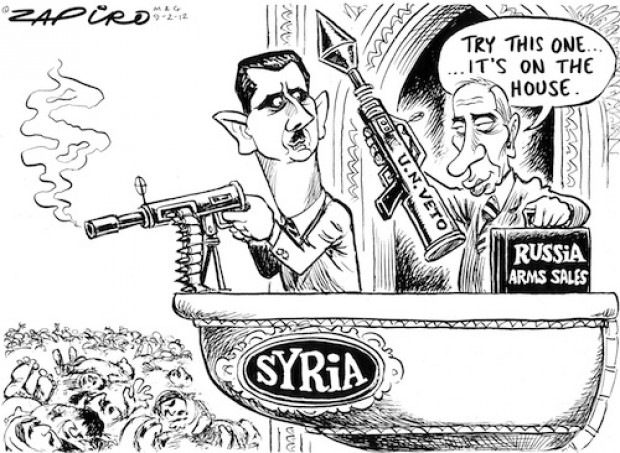
Zapiro - Russia Syria Arms Trade

September 2015, ExCel Centre, London: Stop The Arms Fair activists block the road and prevent military vehicles entering the Defence and Security Equipment International (DSEI) exhibition. They are protesting against one of the largest arms fairs in the world – sending a message to the UK government and arms companies that “inviting representatives of repressive regimes and their armed forces to hob-nob and do dodgy deals at DSEI … with representatives from the UK government and unscrupulous arms companies from around the world IS NOT OK.” Two weeks previously, Cancun, Mexico: Control Arms activists build a life-size sand sculpture of a Stormer 30 tank on Baracuda Beach, Cancun, calling on states to save lives! by ensuring the toughest possible standards at the first Conference of State Parties to the Arms Trade Treaty, the biggest game in town for contemporary international arms transfer control.

These two campaigns share the language of “dodgy deals” but are otherwise quite different visions of the arms trade and its control. The Control Arms campaign focuses on encouraging, informing and embarrassing diplomats into agreeing a multilateral treaty that enshrines higher common international standards and establishes stronger norms against arms transfers that violate human rights and international humanitarian law. The Stop The Arms Fair coalition, meanwhile, takes direct action to halt the operation of arms fairs in the UK by physically blockading the exhibition centre, in protest at the relationship between arms companies and the UK government, and the relationships between the UK government and authoritarian, repressive and war-fighting foreign governments.

I’ve written in the past about the international politics of NGO and campaign group strategy – whether reformist, insider approaches are more effective than transformist, outsider ones – in the context of debates about global civil society. Yet what continues to trouble me, intellectually and politically, is a raft of questions about the operation of the arms trade itself. Namely: where, or with whom, does political responsibility lie for the negative effects of the arms trade in a world of formally national states that are home to internationalising arms companies and operate in a multilateral system based on sovereignty? What social forces drive the arms trade, how does their power operate, what is the character of the problems they generate, and how should scholars and activists best respond? Competing understandings of the operation of the arms trade can be seen in the varied activist responses to it: is the problem one of lack of regulation, the need for improved multilateral action, improved normative standards and international law, as per the Arms Trade Treaty? Or is the problem the relationship between the state and arms capital, and government promotion of the trade, as per the anti-DSEI protests? In the case of DSEI, how are we to understand the operation of internationalising arms capital that has an intimate yet fractious relationship with national states? And in the case of the Arms Trade Treaty, how should we make sense of efforts to create a level playing field of respect for human rights and humanitarian law in the context of a vastly asymmetric and hierarchical world military order?

Thinking theoretically, I have come to see that a large part of the difficulty in answering these questions lies in the grip that methodological nationalism continues to hold on IR as a discipline. Continue reading

Capitalism: A History of Violence

Alexander Anievas and TDOT resident Kerem Nişancıoğlu introduce their new book How The West Came to Rule: The Geopolitical Origins of Capitalism.


‘For the last two decades, challenges to the inequalities and injustices of capitalism have been casually dismissed by a status quo swimming in hubris. From Margaret Thatcher’s infamous proclamation that ‘there is no alternative’ to Francis Fukuyama’s declaration of the ‘end of history’, the study and critique of capitalism has been relegated to margins of public discourse. More recently, Mark Hunter argued that any attack on capitalism is ‘an attack on human nature’, thereby reaffirming the now centuries-old conceit that capitalism is as ‘natural and organic’ as living and breathing.

However, as stock markets came crashing down in 2008, the force of history reasserted itself in a series of revolutions, square occupations, anti-austerity protests, strikes, riots, and anti-state movements taking place from London to Ferguson, Athens, Cairo, Istanbul, Rojava, Santiago and beyond. Such movements have torn at the certainties of ‘capitalist realism’ and started sporadically – if inconsistently – challenging such long-held ‘common sense’ truisms and the power structures that bolster them.

howthewest

Continue reading

Ethical Encounters – The Special Ambiguity of Humanity

This is the second post in a series reflecting on contemporary global ethics that was originally organised as the Ethical Encounters in a Changing World panel for the 2015 ISA convention in New Orleans. Myriam Fotou’s original post can be accessed here, Elke’s is here, and Jillian’s here. Kim’s discussion post is here.


Encountering Humanity

Humanity is special. This sounds like a very conventional claim. We are used to hearing appeals to our common humanity. The appeal works on the presumption that there is something in human beings that we not only share as humans but which also calls us to respond in particular ways when we encounter each other. We are said to have human rights that exceed any of our particular belongings to states, faiths or ethnicities. We intervene to protect human beings beset by violence and catastrophe, disregarding the norms of sovereignty that prevent outside interference. We appeal to our common humanity to solicit resources for distant strangers, often depicted in their suffering as vulnerable human bodies to shake us from our everyday disregard. Humanity is appealed to as a matter of routine, but what does our humanity consist in?

Reflection on the meaning of humanity is less common than our appeals to it, yet this deeper rumination also comes with practiced ease. Knowing what our humanity is has long been a matter of divining what is distinctive about human beings and then moving to grant our distinctively human capacities an exalted status, claiming it as our essential nature. Humanity, as something to which we appeal, is conventionally a judgment on what is prized in human nature, marking out what is elevated amongst all the contradictions of our all too human nature.

Huge Manatee

Humanity then works not only as an appeal – “for the love of humanity!” – but also as a standard to which we should be held. Knowing what is properly human provides a guide to our interactions. What do we owe each other? To be treated in accordance with our essential nature. In a typically modern and Western formulation: to be treated as rational beings, to have our individual freedom respected. These sorts of claims have long echoes and many sources. They also have dissonant reverberations because the standard of humanity not only marks off the human from the animal or the divine, but also differences between those human beings recognised as fully and properly human and those denied recognition, and in their denial degraded as sub-human, primitive and savage. This exclusion from full humanity of the non-human negates the appeal and standard of humanity, opening up the non-human to forms of violence, degradation and abuse. Women, savages, barbarians, Jews, Muslims, Asians, Africans, queers, lunatics, cripples; a brutal list of exceptions to the defining standard, such that even its partial enumeration raises questions about humanity as a standard. Nearly as insidious is the way the self-appointed arbiters of humanity use such distinctions to exculpate themselves. Those who fight for humanity against savagery are always noble in their own eyes. Continue reading

What We Talked About At ISA2015: A Debate Around John Hobson’s ‘The Eurocentric Conception of World Politics’

Below is the text of my intervention at a roundtable organized by Alina Sajed entitled ‘Race and International Relations—A Debate Around John Hobson’s The Eurocentric Conception of World Politics‘. TDoT has hosted a symposium on the book: you can read an initial post by John, commentaries from Meera, Srdjan and Brett, and a reply from John. I’ve tried not to cover the same ground.

While race and racism have recently become topics of increasing interest in the rather parochial world of IR scholarship, few books have ranged so widely across time and thinkers as John Hobson’s The Eurocentric Conception of World Politics. This is a monumental work of scholarship that accumulates a staggering amount of evidence, were further proof necessary, of the white supremacist and/or Eurocentric foundations of IR as a discipline (I use the ‘and/or’ advisedly, because much of the debate that the book has generated and some of my own critique focuses on the complex relationship between the formations that Hobson identifies as ‘scientific racism’ and ‘Eurocentric institutionalism’, about which more in due course). So whatever my problems with the book, I want to endorse it as a deeply necessary intervention in the IR academy. Nonetheless, I find myself in sharp disagreement with some of its central claims in ways that have not been fully addressed in earlier discussions. I will focus here on two areas of disagreement: first, the book’s treatment of Marx, Lenin and Marxism in general; and second, its crucial distinction between ‘scientific racism’ and ‘Eurocentric institutionalism’.

Why focus on a critique of Marxism as Eurocentric and/or imperialist? (Again the ‘and/or’ seems necessary because Hobson’s careful mapping of European thought finds conjunctions of racism and/or Eurocentrism with both imperialist and anti-imperialist sensibilities). Partly this comes out of my own intellectual investment in denying what I believe to be the false choice that is often presented between Marxism and postcolonialism. As such, I find myself troubled as much by Marxist work that repudiates postcolonialism as I am by the opposite tendency (which I think is at work in this book). But partly this also comes out of a sense that if Marxism were in fact as Eurocentric and/or imperialist as Hobson suggests, this would leave inexplicable its enormous appeal in the Third World both in the heyday and aftermath of the great decolonization and liberation movements that it informed. More prosaically, I think Hobson’s readings of Marx and Lenin are temporally truncated and therefore somewhat misleading.

Continue reading

Notes on Europe and Europeans for the Discerning Traveller

Europe has the only classical tradition that is also considered modern.

Europe claimed Greece as its ancestor. But not anymore.

Europe once turned a Black god white.

Once upon a time Europe decided that it was a family of nations. This decision is commemorated as the beginning of international law.

Because indigenous peoples were not mentioned in a very old book, Europeans wondered if these peoples were human.

Some of the Europeans who cleared lands of their indigenous peoples liked to represent themselves as indigenous princesses.

Europeans once thought that if they left Europe they would degenerate. To this day they view their cousins over the seas with suspicion.

European scientists once found a way to break up human beings into a set of quantum parts.

Europe is proud of freeing itself from metaphorical chains.

Europe got rich out of African slavery. Then it freed the slaves.

Europe was so concerned with slavery that it colonized the African continent.

In Europe you can baptises yourself so as to be born again with a humanitarian soul.

Some of Europe’s top philosophers were bigots and racists, even for their own time.

Europeans were so fascinated with primitives that they created a space in the brain called the unconscious.

Europeans say that Unconscious bias is regrettable but that it doesn’t make a person bad.

Europe prefers to narrate its eras of global war as eras of “long peace”.

Europe once had a big war with itself when some Europeans started to practice in Europe what they had been practicing in their colonies.

Algeria was a part of Europe. But Algeria was not part of the pax-Europa.

Anyone can be European so long as you tell Europeans where you come from.

Europeans can only trust women who show their whole face. Exceptions apply.

Europe never said thank you to muslim scholars.

The Mediterranean is currently the deadliest sea crossing in the world

Europeans are experts on Africa, Asia and Oceania.

Europeans prefer to learn about Africa, Asia and Oceania from other Europeans.

Europe is the only cosmopolitan that is allowed to keep its own adjective.

Europe believes that if it wasn’t written down it didn’t happen.

Europeans like to write about themselves.

Only Europeans can know Europe.

Once Europe was narcissitic, but Europeans fixed that by turning the mirror into a window onto the world.

The Global Transformation: A Response

The final post in our forum on The Global Transformation, in which Barry Buzan and George Lawson respond to the points raised by Julian Go, Jeppe Mulich and Jamie Allinson. The original post, summarising the book is available here. The book will also be discussed further at the ISA conference in New Orleans and a launch at LSE.

[Editor’s note: The authors are not responsible for the images in this post. But it’s Friday.]


Given the ‘excess’ of contemporary academic production, it is a rare treat to have colleagues engage seriously with your work. We therefore offer our heartfelt thanks to Julian Go, Jeppe Mulich and Jamie Allinson for their close reading of our book and for their thoughtful critiques of it. We offer our equally heartfelt thanks to the editors of The Disorder of Things, particularly Meera Sabaratnam, for investing a considerable amount of time in organising and publishing these commentaries.

The interventions by Go, Mulich and Allinson raise two main issues: the first relates to our use of, and contribution to, theoretical debates, particularly those around imperialism, and uneven and combined development (UCD); the second concerns the relationship between history and theory, most notably our use of macro-historical frames such as ‘modernity’. We discuss these issues in turn.

On theory

Julian Go is right that The Global Transformation ‘expressly rejects any grand theoretical narratives or systems’. He is also right that we do not use ‘categories derived from a larger and more comprehensive theoretical system’. And, however tiresome it is to keep agreeing with your critics, Go is once more right in saying that our use of uneven and combined development is not meant to correct this shortcoming – as we discuss below, we use UCD as an analytical shorthand rather than as a theoretical schema containing a range of causal claims.

Why is this the case? The first reason is strategic. At the beginning of the project, we had several choices to make: whether to pitch the book primarily to an IR audience or whether to also take some swings at cognate disciplines; whether to get drawn into internal debates associated with particular theoretical schemas or seek out a position in-between, or perhaps above, the fray; how to balance big picture and fine-grained historical analysis, and more. In each of these instances we chose the easy option – easy not in the sense of being straightforward to do, but in the sense of ‘less is more’. For example, rather than spend much time on the shortcomings of disciplinary historical sociology when it comes to its ‘occlusion of the global’, we concentrated on what historical sociology (and economic and world history) contributes to IR debates. Given that the answer to this was ‘quite a lot’, we made this our primary concern. Similarly, rather than distract ourselves – and readers – with the minutiae of debates internal to the whys and wherefores of ‘the global transformation’, we constructed a composite argument that assembled diverse storylines into a single narrative. To be clear – we are not saying that we neither built on, nor took a stand on, many of these debates, not least around the ‘internalism’ and Eurocentrism of many existing accounts. Rather, we made a deliberate decision to take an ecumenical approach, building on insights from a variety of theoretical churches rather than sticking to a single tradition.

Hindu-Jesus Continue reading