Flag-waving And Drowning: On The New Branding Policy Of UKaid

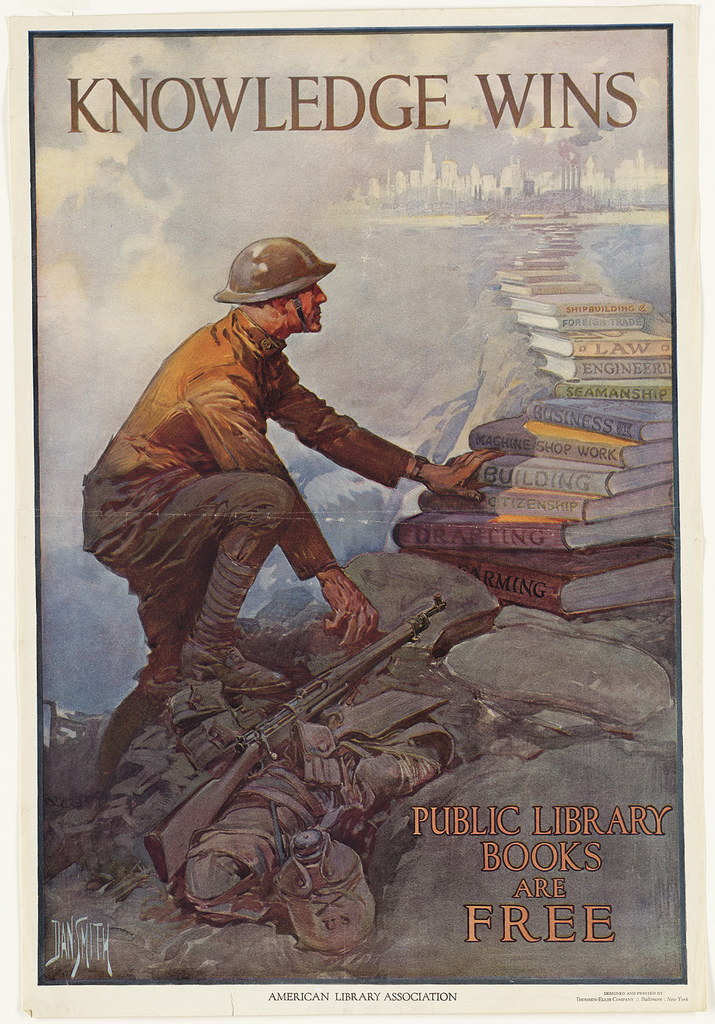
They say that discretion is the better part of valour. But DfID, or at least its boss, has decided otherwise. It was announced last month that “Aid from Britain will now be badged with a Union Flag when it is sent overseas, as a clear symbol that it comes from the United Kingdom.” In these times of urgently, relentlessly celebrating Britishness in all possible ways, this little ‘tweak’ to development policy may have slipped under the radar.

The ministerial statement in the press release is worth quoting in full, because it is both strange and revealing of a particular – and, I think, regressive – political turn in international development policy:

“For too long, Britain has not received the credit it deserves for the amazing results we achieve in tackling global poverty. Some in the development community have been reluctant to ‘badge’ our aid with the Union Flag.

“I disagree: I believe it is important that aid funded by the British people should be easily and clearly identified as coming from the UK. It is right that people in villages, towns and cities around the world can see by whom aid is provided.

“British aid is achieving results of which everyone in the United Kingdom can be proud. And I am determined that, from now on, Britain will not shy away from celebrating and taking credit for them.” Continue reading

Feminist Notes, part I

By including what violates women under civil and human rights law, the meaning of “citizen” and “human” begins to have a woman’s face. As women’s actual conditions are recognized as inhuman, those conditions are being changed by requiring that they meet a standard of citizenship and humanity that previously did not apply because they were women. In other words, women both change the standard as we come under it and change the reality it governs by having it applied to us. This democratic process describes not only the common law when it works but also a cardinal tenet of feminist analysis: women are entitled to access to things as they are and also to change them into something worth our having.

Thus women are transforming the definition of equality not by making ourselves the same as men, entitled to violate and silence, or by reifying women’s so-called differences, but by insisting that equal citizenship must encompass what women need to be human, including a right not be sexually violated and silenced. This was done in the Bosnian case by recognizing ethnic particularity, not by denying it. Adapting the words of the philosopher Richard Rorty, we are making the word “woman” a “name of a way of being human.” We are challenging and changing the process of knowing and the practice of power at the same time.

-Catharine MacKinnon, “Postmodernism and Human Rights,” Are Women Human?

What We Talked About at ISA 2012: A Human Right to Housing

Housing is a Human Right Exhibition, Philadelphia (original photo by Annie Seng)

I ain’t got no home. I’m just a roamin’ round, just a wandering worker, I go from town to town. And the police make it hard wherever I may go. And I ain’t got no home in this world anymore.

My brothers and my sisters they’re stranded on this road. A hot and dusty road that a million feet have trod. Rich man took my home and drove me from my door. And I ain’t got no home in this world anymore.

Was a farmin’ on the shares and always I was poor. My crops I lay into the banker’s store. My wife took down and died upon the cabin floor. And I ain’t got no home in this world anymore.

Now as I look around it’s mighty plain to see this world is such a great and funny place to be. Ah, the gamblin’ man is rich and the working man is poor. And I ain’t got no home in this world anymore.

-“I Ain’t Got No Home in this World” by Woodie Guthrie

Beginnings Are Difficult

How to start something new? This question troubles the academic as well as the activist. At the moment it troubles me both as a question of inquiry and as a meta-question of method.

In my previous work I have argued that human rights should be judged first and foremost by the consequences they bring about. Do human rights enable new forms of politics? Do they enable politics that increase the control we have over our lives, or that reduce the suffering and humiliation we are exposed to? Or do they confine us in a liberal subjectivity that makes wider visions of justice impossible, which push us to reconcile our beautiful revolutionary dreams to the limited horizon that contemporary liberal capitalism imposes?

I have offered a qualified defense of human rights as a democratising ethos, which suggests that human rights can enable everyday people to challenge the terms of legitimate political authority, including the institutional shape of their government and the makeup of their communities. This is done by formally opening up the identity of “rights holder” to anyone, regardless of their social position. This opening, however, is only formal and in that formality human rights have an ambiguous significance. For this reason, I have argued that to think of human rights as a democratising ethos also requires that we attend to the politics of human rights. This means that ensuring that human rights support democracy and equality is a political struggle as well as an ethical vision.

Continue reading

The Crisis of Europe and Colonial Amnesia

Recent commentary on the Eurozone crisis has started to pick up the grammar of colonial rule. The centre for Research on Finance and Money at SOAS, for example, has published an influential report wherein northern Europe (Germany especially) is framed as the core and southern Europe (especially Greece) as the periphery. Meanwhile, Ulrich Beck, European cosmopolitan par excellence, wonders whether the European Union will become “a European Empire with a German stamp”. Beck notes that Merkel’s sense of power “conforms to the imperial difference between lender and borrower countries.” At stake, agree many prominent European intellectuals in the pages of The Guardian, Eurozine and Der Spiegel, is no less than the promise of freedom and democracy immanent to the European project itself. All variously agree that, against the imperial sclerosis spread by capitalist and bureaucratic functionaries at the highest levels of governance, what is needed is a rejuvenation of meaningful democracy at a grass-roots level.

Faced with a dismantling of democracy Jürgen Habermas mounts a plea to save the old “biotope of Europe”. The constitutive components of this threatened ecosystem are freedom and democratisation, and its genesis lies in the Second World War and the fight against fascism and “internal” barbarism. The president of the European Central Bank has himself proclaimed that Europe now faces its “most difficult situation since the Second World War”. Alternatively, for many social democratic and leftist commentators, the danger of the situation lies in the loss of the “internal” struggle of labour and capital that defined the Cold War landscape. In the new context of EU institutional “empire” and its neoliberal tentacles, the defeat of labour quickens the erosion of social democracy, thus deciding the fate of the European project.

Europe, then, is perceived to be “colonizing” itself and in the process destroying freedoms and democratic structures that had been hard fought for by the general populace against political oppression and economic exploitation. But this angst-ridden imaginary of European crisis has very little to say about the substantive historical and global dimensions of European colonialism. Does cosmopolitan and social democratic angst cover these legacies and contemporary effects? In fact, in most recent treatises on the crisis the struggle for decolonization is given no integral status, even though these particular struggles were inseparable to and spanned the formative time period of the European project – the Second World War (and the Cold War). Some do mention current issues of migration and xenophobia. Nevertheless the implication, in general, is that colonial legacies are derivative of, or additional to, the core struggle for democracy and freedom in Europe. Fascism, Cold War, class struggle: yes; colonization, imperialism, decolonization and liberation struggle: not really.

Not all intellectuals suffer from this colonial amnesia. A number of scholars including Robert Young, Pal Ahluwalia, Paige Arthur and Alina Sajed have argued that in some key strands of post-War French thought, the issue of colonialism and decolonization was integral to discussions of European re-democratization and humanist concerns. This engagement reached a peak in the Algerian war of independence in the late 50s before falling into abeyance. And this was precisely the same time, we should note, as the Treaty of Rome, which bound European countries together in a tighter economic union simultaneoulsy sought to re-bind (post-)colonial African polities, peoples and resources into this union.

More generally, there has accumulated a significant amount of scholarship that reveals the colonial influences that shaped and were woven into quintessentially “European” intellectual/political movements such as Enlightenment and modernity. Continue reading

What We Talked About At ISA: Researching Sexuality in ‘Difficult’ Contexts

In September 2009, Ugandan Parliamentarian David Bahati introduced a draft ‘Anti Homosexuality Bill’ that proposed enhancing existing punishments for homosexual conduct in the Ugandan Penal Code, introducing new ‘related offences’ including ‘aiding and abetting’ homosexuality, ‘conspiracy to engage’ in homosexuality, the ‘promotion of homosexuality’, or ‘failure to disclose the offence’ of homosexuality to authorities within 24 hours, and mandating the death penalty for a select class of offences categorized as ‘aggravated homosexuality’. The bill remained bottled up in parliamentary committees for the duration of the 8th Parliament, thanks in large part to a sophisticated local campaign that sought to bring international pressure to bear on the government of President Yoweri Museveni, but has since been reintroduced in the current 9th Parliament and therefore remains a live concern. In August 2010, I travelled to Uganda to interview a range of actors associated with ongoing debates over sexuality in the country. Rather than commenting on the urgent and pressing substantive concerns at issue in these debates, at an ISA panel entitled ‘Researching sexuality in difficult contexts’, I chose to reflect on some of the methodological dilemmas I encountered in the field, for which my training in international relations had left me unprepared. Emboldened by recent ISA panels on storytelling and auto-ethnography (and utterly bored by what passes for mainstream IR), these reflections take the form of excerpts from my diary (italicized), interspersed with the more censorious, academic voice that I trotted out at ISA. (I make no apology for not writing about the more ‘serious’ issues at stake—on this occasion—because it occurs to me that where sexuality is concerned, the pursuit of fun can raise deadly serious questions, making distinctions between the trivial and the serious difficult to sustain.)

Uganda, August 2010: I am here to do interviews and I spend most of my day setting them up, preparing for them, travelling to or from them, or conducting them. The rest of the time I hang out, people watch, trying to piece together a picture of how life outside heteronormativity survives in a climate that seems—on the surface at least—as inhospitable as Uganda is supposed to be. On Friday, Al (name changed, and this account provided with permission) invited me to a strip-tease. This was going to be a straight strip-tease, but one that some of the gay men went to so that they could watch the straight men getting off on watching the women strip. It sounded convoluted, but unmissable. Plus, I’d never been to a straight strip-tease, so it seemed important to plug this gaping orifice in my sexual history. We entered a dimly lit hall and took seats at the back in a group near the bar. I think I was the only brown man there. There was also one white man in the whole place, in our group. He had evidently been to the place before, and because he came with the same motivations as Al, he had been traumatized on a previous occasion by the way the women flocked to him (money?). So Al was instructed to tell the emcee (a short guy dressed in a white track suit) to make sure that the women didn’t come to our corner. The real attraction, from the point of view of the gay guys, was that the women sometimes got the straight guys to get on stage and strip. Al told the emcee to do his best to encourage this possibility. Call it Straight Guy for the Queer Eye. I was impressed by the brazenness with which Al communicated all this to the emcee. As for the show, let’s just say it took the ‘tease’ out of strip-tease. The first woman (girl? all the performers looked like they were in their 30s, but they could have been younger and prematurely aged by their work) danced to some vaguely familiar Western pop number. She was followed by another woman with bigger hips. Somebody in the group, setting himself up as my informant, tells me that she is ‘a real African woman’. She danced to Shania Twain’s ‘From this Moment On’ (a song I played to my last (and final, I think) girlfriend on the first day I met her, after a year-long correspondence). Just when Shania reached the second verse, the woman dropped her panties. None of the performers took off their bras. ‘African men aren’t interested in breasts’, my self-appointed informant intones. The next half-hour is a blur of female anatomy. So here I am, in a country that people have been calling ‘conservative’ and that American evangelist Rick Warren has decided is ripe for transformation into the world’s first ‘purpose driven’ nation, looking at more naked women in ten minutes than I have seen in ten years, to the soundtrack of my failed romantic history.

Continue reading

Open Access, Harvard Delight Edition

An extraordinary and delightful communiqué from Harvard on journal pricing has surfaced (early reactions here and here and here). It was actually issued almost a week back, but the Twitter hive mind (or my corner of it) appears only now to have noticed (h/t to JamieSW for that). The contents are pretty extraordinary, even too good to be true. The preamble is brutal about the current state of the journal system, observing that Harvard spent almost $3.75 million last year on bundled journal provision from some publishers (10% of all collection costs and 20% of all periodical costs for 2010); that “profit margins of 35% and more suggest that the prices we must pay do not solely result from an increasing supply of new articles”; that “[t]he Library has never received anything close to full reimbursement for these expenditures from overhead collected by the University on grant and research funds”; and that “[i]t is untenable for contracts with at least two major providers to continue on the basis identical with past agreements. Costs are now prohibitive” (I’m guessing one provider at least is Elsevier).

Then some options-cum-recommendations for Faculty are laid out:

1. Make sure that all of your own papers are accessible by submitting them to DASH in accordance with the faculty-initiated open-access policies.

2. Consider submitting articles to open-access journals, or to ones that have reasonable, sustainable subscription costs; move prestige to open access.

3. If on the editorial board of a journal involved, determine if it can be published as open access material, or independently from publishers that practice pricing described above. If not, consider resigning.

4. Contact professional organizations to raise these issues.

5. Encourage professional associations to take control of scholarly literature in their field or shift the management of their e-journals to library-friendly organizations.

6. Encourage colleagues to consider and to discuss these or other options.

7. Sign contracts that unbundle subscriptions and concentrate on higher-use journals.

8. Move journals to a sustainable pay per use system.

9. Insist on subscription contracts in which the terms can be made public.

Note in particular point 3. Harvard is asking its academics to seriously consider resigning from major journals if substantive good-faith moves are not made towards open access or “sustainable subscription costs” (read: a major reversal of current practice). As previously suggested, only serious insurgencies within major centres of academic prestige will undo the private stranglehold on knowledge-in-common. On those grounds, I’m tempted to giddy excitement. The question, of course, is which other major institutions (and which serious academic figures) will have the solidarity and good sense to follow this example. As a rallying point, social sciences and social theory need some version of The Cost Of Knowledge manifesto that spans the entire issue of journals and knowledge production. At the very least, we now have a new rhetorical device: open access is good enough for Harvard: why isn’t it good enough for you?

What We Talked About At ISA: The U.S. Military-Industrial Complex, Part 2

Part two of a post on my presentation at this year’s ISA. Part one is here.


So what would be the normative-political case for the Military-Industrial Complex (MIC)? As Ledbetter notes, the defence industry never had a shortage of defenders, proponents, beneficiaries, and apologists. Various critiques of the MIC notwithstanding, numerous American commentators are now firmly united in the belief that their country needs a large defence budget in order to protect and project its identities and interests in the world. According to Maddow, this collective belief had a lot to do with the discursive and institutional success of the infamous “Team B” reports on Soviet power, which so profoundly enthused Ronald Reagan and his administration, leading to the gigantic military buildup in the 1980s. Maddow’s assessment is worth citing at length:

The Think Tanks and Very Important Committees of the permanent national security peanut gallery are now so mature and entrenched that almost no one thinks they’re creepy anymore, and national security liberals have simply decided it’s best to add their own voices to them rather than criticize them. But like we lefties learned in trying (and failing) to add a liberal network to the all-right-wing, decades-old medium of political talk radio, the permanent defense gadfly world can’t really grow a liberal wing. It’s an inherently hawkish enterprise. Where’s the inherent urgency in arguing that the threats aren’t as bad as the hype, that military power is being overused, that the defense budget could be safely and wisely scaled back, that maybe this next war doesn’t need us? The only audience for defense wonkery is defense enthusiasts, and they’re not paying the price of admission to hear that defense is overrated.

But knotted into the right-wing discourse on defence spending is a number of corollary arguments that are associated with a variety of lefty positions in the U.S. context.  America’s mainstream media outlets rarely fail to acknowledge how the twinning of the country’s economic and armed forces not only creates high-skilled jobs, but also – and critically – keeps them in the country. The move is mainly rhetorical. Not only have successive U.S. administrations encouraged American defence industry to globalize, but there is also little evidence to suggest that defence spending creates more jobs relative to spending on, say, health care or education (see, for example, Pollin and Garrett-Peltier, 2011). I would suggest, then, that what lies behind contemporary pro-MIC arguments is, in fact, a creative and complex combination of certain economic theories, (realist?) beliefs in war (or the threat of war) as a manifest destiny of the international system, as well as an overarching (liberal?) commitment to a powerful, sovereign state capable of exercising global leadership (aka., a “force for good”, in still favoured New Labour parlance.)

Let us revisit the pro-MIC rhetoric from the era of “Team B.” In a footnote, Ledbetter directs the reader to The Lonely Warriors (1970) by John Stanley Baumgartner, who is described as “one notable true defender of the MIC.” Written by an expert in public management and business administration, Baumgartner’s book makes three arguments for the MIC: 1) defending the free world is a moral thing to do (“Sputnik is only one example of the reasons for MIC”); 2) by definition, defence is a big enterprise and all big enterprises (directly or indirectly, the MIC employs one in ten Americans) occasionally make big mistakes, especially when they respond to the murky and changing specifications set by the government (“the tiger” or “the monster”) and its contracting officers; and last, 3) “unconscionable profit” is not so unconscionable in comparative terms (profit on sales, profit on investment, price/earning ratios etc. tend to be below the industrial average).

Continue reading

What We Talked About At ISA: From #occupyirtheory to #OpenIR?

A write up of my comments at the #occupyirtheory event in San Diego. The event itself was both hope-filled and occasionally frustrating, not least for the small group of walk-outs, apparently ‘political’ ‘scientists’ lacking in any conception of what it actually means to engage in the political (note: this bothered me especially, but was a rather minor irritation in the grander scheme of things). Despite the late hour, there were between 40 and 60 people there throughout, and a number of very positive things have come of it. It looks like there’ll be some gathering at BISA/ISA to discuss further, and we’re pitching something for the Millennium conference on some of the themes addressed below, and there will of course be ISA 2013 too. In the meantime, there’s the Facebook group, the blog, and a mailing list. The term OpenIR is owed to Kathryn Fisher, and seems to several of us to be a better umbrella term for the many things we want to address in the discipline and the academy. I also just want to give a public shout-out to Nick, Wanda, Robbie and Meera for doing so much on this.


The #occupy practice/meme has antecedents. Physical manifestations of a ‘public’, horizontalism, prefigurative politics and more can be traced in all sorts of histories. One such lineage is the foreshadowing of Zucotti Park in recent struggles over education. Take the slogan in March 2010 over privatisation at the University of California, which was ‘STRIKE / OCCUPY / TAKEOVER’. Or Middlesex, where students resisting the dismantling of the Philosophy Department in that same year unfurled a banner during their occupation, one that proclaimed: ‘THE UNIVERSITY IS A FACTORY! STRIKE! OCCUPY!’.

I want briefly, then, to think about the space of the university in our discussions of #occupy. There have been rich and suggestive calls to re-politicise ourselves as academic-activists, to look again at our work and its claims, and to turn our abilities, such as they are, to projects of resistance and transformation. But we risk a displacement. When we talk of ‘the street’, or politics enacted in the reconfigured space of #occupy, or of the ‘real world’ that we must be relevant to, we already miss the university itself as that factory in which we labour. We are tempted by a view of ourselves as leaving ivory towers to do politics, instead of seeing those towers themselves as spaces of politics. As if our institutions and practices were not already part of the world.

Whether you see #occupy as transformational or nor, or whether you simply prefer a different vocabulary, I think a demand remains: a demand to politicise our own positionality. This politicisation can have many dimensions, but I want to suggestively highlight four, each being a sphere in which we should be diagnosing and transforming our own practices.

Continue reading

Whitewashing History


The Morning Post, 1913 – on the violence of the suffragette movement:

Early yesterday morning some women succeeded in burning a valuable house near Trowbridge. In the night of Monday to Tuesday ROUGH’S boathouse on the river at Oxford, near the Long Bridges, was seen to be on fire. It was impossible to save the building or the boats which it contained. Nailed to the bridge near was found a card with the words “Votes for women. No peace till we get the vote.” The presumption is that the boathouse was set on fire, the KING’S horse was stopped, and the Trowbridge mansion was destroyed by some of the females who are discontented with the structure of society. Whether that be the case or not – it is quite possible that the truth may not be ascertained – the action is typical of much that has happened lately and deserves thinking about. Indeed, if we are to believe the leaders of the “movement”, the purpose with which these things are done is to make men think. The question is, What are we to think? The planned and deliberate destruction of property is intelligible as an expression of anger against the owner. But as the wellbeing of society depends upon the security of persons and property against wilful attacks, such attacks are regarded as crimes, and one of the principal purpose for which society is organised is to prevent such acts and to punish those who commit them. But in the class or cases which we are considering there is not motive or animosity against the particular person whose property is destroyed. Those who do them have not the personal hatred which usually explains such doings. If this were an isolated case, if it were found that a house had been wilfully set on fire by a young lady well brought up and accustomed in other respects to behave herself well, a jury would probably come to the conclusion that she was not in her right mind, and the Court order that she should be taken care of until she was restored to complete sanity. But the present case is not isolated. There is an epidemic of the state of mind which produced it; it is but one of a large number of similar cases. This frame of mind cannot possibly be considered healthy. The acts which it produces constitute a war, not only upon society as at present constituted but upon any conceivable state of society because it is impossible to imagine any community of human beings not based upon laws for preserving the security of property as well as of life and society, the propounds of the most astounding schemes for the reconstruction of the community, have ever propounded a plan which would not guarantee the work of and man’s hands against wanton and wilful destruction. The women who go about setting fire to houses seem, therefore to have their thoughts out of gear. In most respects apparently their minds work as other people’s do, but the epidemic of arson appears to be a form of monomania. This quality of the minds concerned noes not disappear under an examination of the alleged motive. These ladies say that women ought to have the same political rights as men, and in particular the Parliamentary franchise, and they assert that women are qualified to be members of the body polite. But it is unthinkable that a person who refuses to recognise the fundamental condition upon which every society is founded can be qualified for membership in that society. The person whose mind works in that way is inaccessible to reasonable arguments.

**********

Mahatma Gandhi – on violence:

I do believe that, where there is only a choice between cowardice and violence, I would advise violence… I would rather have India resort to arms in order to defend her honour than that she should, in a cowardly manner, become or remain a helpless witness to her own dishonor.

Continue reading

#occupyirtheory, International Studies Association (San Diego) Edition

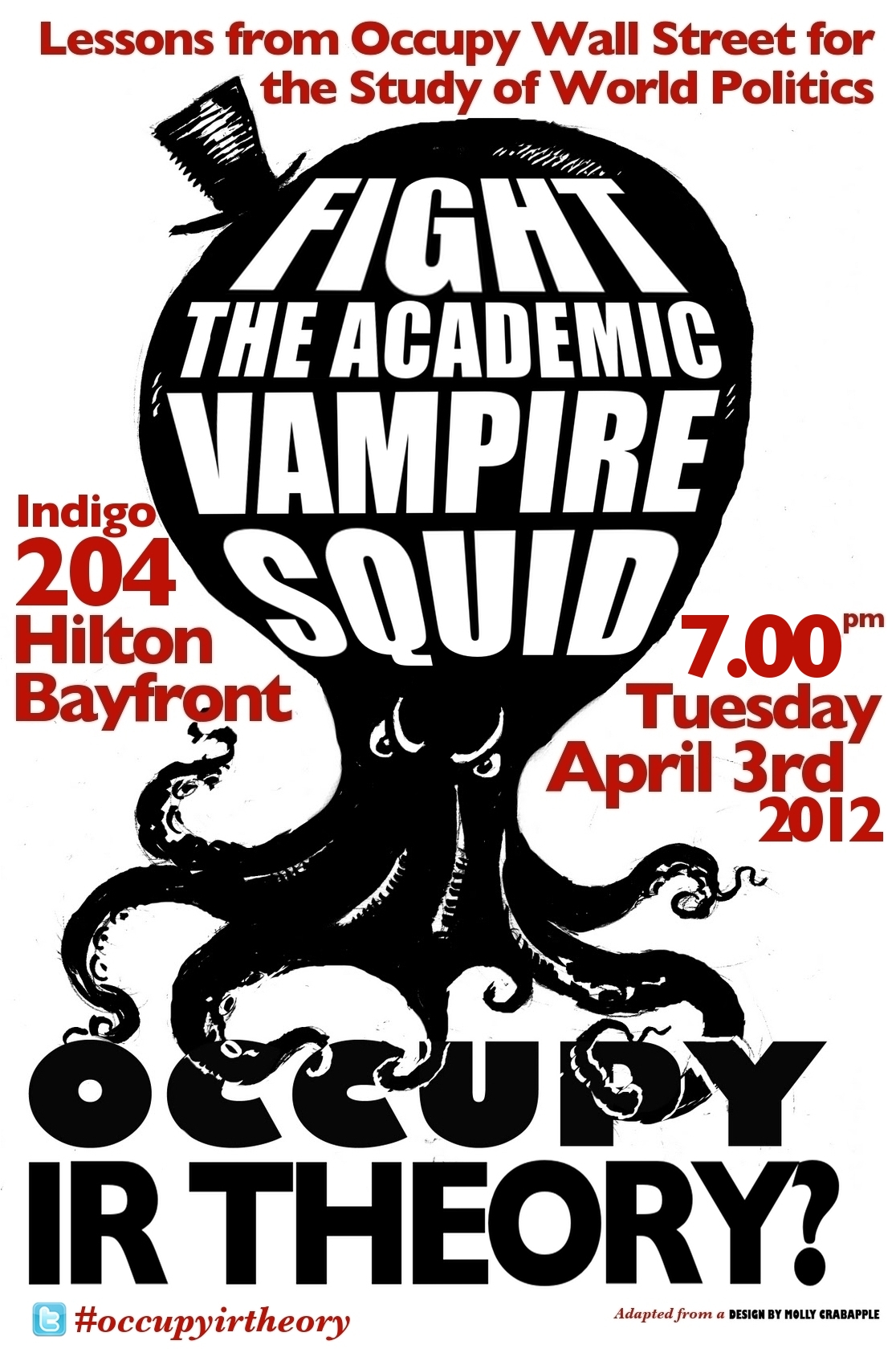
ISA 2012 is just around the corner, and it will doubtless be as hectic and awkward and joyous as ever. Robbie and I will be appearing at an event on #occupy and its relevance for IR on Tuesday at 7 in Indigo 204 at the Hilton Bayfront. We’ll be joining Lucian Ashworth, Lara Coleman, Nicholas Kiersey and Wanda Vrasti (all chaired by Jason Weidner) for what I’m sure will be an exciting roundtable discussion. More importantly, it will be brief, with most of the session given over to a General Assembly-style discussion of what IR can learn from #occupy, what #occupy might get from IR, and how we might take the spirit and organisational form into the discipline itself (or not).

The hope is that the slightly later starting time will allow people to go both to the various Section receptions and meetings (briefly) and to come to this, whilst still leaving reasonable evening time for food and the rest. Please do get involved over at Facebook (see also the #occupyirtheory group and #occupyirtheory blog) and let interested IR-types know. Readers may also be (should also be!) interested in a recent forum from the Journal of Critical Globalisation Studies on ‘Occupy IR/IPE’, featuring Nick and Wanda (as well as Colin Wight, Michael J. Shapiro, Patrick Jackson and others), which I’ve parcelled together as a single pdf for your delectation here.

Hope to see you there!