Ethical Encounters – Care in Counterinsurgency: Feminist Ethics and the Morality of ‘Winning Hearts and Minds’

Processed with VSCOcam with lv01 preset

This guest post, by Jillian Terry, is the fourth in a series of posts reflecting on contemporary global ethics that was originally organised as the Ethical Encounters in a Changing World panel for the 2015 ISA convention in New Orleans. Jillian is in the final stages of completing her PhD in International Relations at the LSE, where her research explores the relationship between feminist ethics and post-9/11 war. Recently, Jillian has published her research in the International Feminist Journal of Politics and has contributed a chapter to the edited volume Gender and Private Security in Global Politics, edited by Maya Eichler (OUP, 2015). For earlier posts, see Myriam’s here, Joe’s here, Elke’s here and Diego’s here. Kim’s discussion post can be found here.


In thinking of twenty-first century war, questions of ethics in the realm of counterinsurgency are embodied in a wide range of encounters between combatants, civilians, and counterinsurgents. In Afghanistan and Iraq, we have witnessed tactics, strategies, and mechanisms in the name of COIN operations ranging from population control and detention to targeted killings and the implementation of the Human Terrain System, resulting in a set of complex realities about what it means to ‘do’ counterinsurgency in the contemporary era. Nevertheless, much of what we talk about when we think through questions of ethics and counterinsurgency remains tied to its manifestation in formal, legal mechanisms – namely the Counterinsurgency Field Manual (FM 3-24) – and their insistence on counterinsurgency as a practice of ‘winning hearts and minds’. Like much mainstream work on the ethics of war in IR, this has resulted in ethical conversations around counterinsurgency operations that are theorized with respect to just war doctrine, applying principles of jus in bello and jus ad bellum to determine the moral status of counterinsurgency as a means of warfighting. Here, I see a vital disconnect between existing analyses of COIN and how it is actually experienced and felt by insurgents and civilian populations – experiences and encounters that are irreducible to the strict criteria of the just war framework. To bridge this disconnect, I suggest a reorienting of our ethical lens away from just war thinking and towards a feminist ethics premised on care, empathy, and relationality. Such a perspective is more attuned to considering the practical realm of counterinsurgency rather than remaining mired in abstract debates about the semantics and theory of COIN operations. Given that the practical realm is one in which the truly relational nature of counterinsurgency becomes apparent, it is logical to look towards feminist ethics for an alternative viewpoint that prioritizes the lived experiences of individuals over legalistic interpretations of counterinsurgency as it appears on paper. A feminist ethics rooted in understandings of care and relationality will allow us to move beyond the formal articulation of COIN as is found in FM 3-24 and instead think about the encounters of those affected by counterinsurgency operations in a genuine and meaningful way.
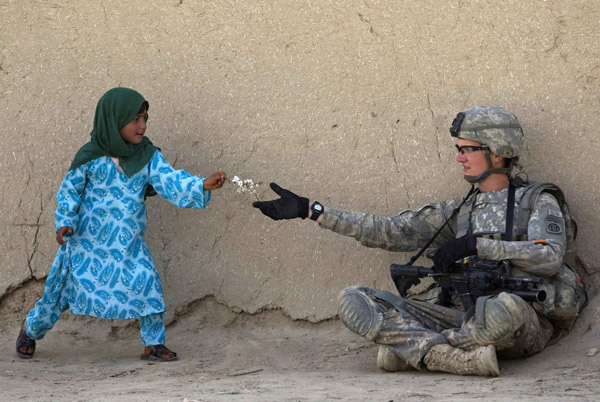

U.S. Army PFC Danny Comley during patrol in Kandahar Province, Afghanistan, February 2010.

Continue reading

Ethical Encounters – Taming of the Infinite: Applying Ethics for Political Violence – A Brief Critique

This is the third post in a series reflecting on contemporary global ethics that was originally organised as the Ethical Encounters in a Changing World panel for the 2015 ISA convention in New Orleans. Myriam’s post can be found here, Joe’s is here, Jillian’s here and Diego’s here. Kim’s discussion post is here.


The relationship between ethics and politics is complex; in theory, as in practice. Against a contemporary background where hitherto morally prohibited acts, such as assassinations by drones strikes in non-military zones, are instituted as legitimate and justifiable practices, it becomes vital to understand anew the relationship between politics, violence and ethics, and its limits, particularly when such acts are underwritten by innovative military technologies that open new horizons for ethical considerations in international politics.

Ethics, in the context of politics – including international politics – is presently predominantly conceived in terms of applied ethics and chiefly concerned with the search for an ethical theory that can be arrived at through abstraction and applied to real world ethical dilemmas. While burgeoning poststructuralist scholarship in the late 1990s sought to address ethics in terms that consider aspects of contingency, alterity and potentiality, the events unfolding in the aftermath of 9/11 appear to have given way to a more practically oriented approach to thinking about ethics in international politics, giving priority to the application of ethical principles of warring. Such practical approaches often mirror scientific processes, or algorithmic logics in trying to find ‘correct’ outcomes.

While just war traditions of ethics in war have always had a close relationship with the analytical procedures and structures of international law, the practical turn in contemporary political ethics means that concerns addressed in the international and global context are primarily framed in terms of finding and applying appropriate principles, codes and rules in trying to resolve ‘real moral problems’. Problem solving through rational procedures, and scientific rationales thus stands at the heart of practical considerations of the ethics of political violence and war. This is exemplified in the IF/THEN logic of current discourses on the ethics of war or in the structures of target selections for lethal drone strikes. Among others, Seth Lazar’s recent work on the morality of war, presented at a philosophy workshop at the LSE in 2013 for example, considers approaches to moral decision making in uncertainty in the following terms: “one plausible approach to decision-making under uncertainty is to determine the expected moral value (EV) of the outcomes available to me, and to choose the best one. So, I am permitted to ƒ if and only if EV(ƒ) ³ EV(¬ƒ)”. Similarly, Bradley Strawser’s defence of the ethical obligation to use drones as a weapon of choice relies on a selection of variables (X, Y, G) and principles (principle of unnecessary risk – PUR) that, combined, serve to confirm the hypothesis, namely that using drones is an ethical obligation. This procedural algorithmic logic speaks to a technoscientific-subjectivity with which ethical outcomes are ascertained, problems solved. Ethics becomes a technical matter that can be solved through procedures and thus has natural limits. It is only able to assess, whether an outcome was achieved through the correct logical theoretical trajectory, not through the particularities of the moment.

Stuart Kinlough/Getty Images

Stuart Kinlough/Getty Images

Continue reading

Ethical Encounters – The Special Ambiguity of Humanity

This is the second post in a series reflecting on contemporary global ethics that was originally organised as the Ethical Encounters in a Changing World panel for the 2015 ISA convention in New Orleans. Myriam Fotou’s original post can be accessed here, Elke’s is here, and Jillian’s here. Kim’s discussion post is here.


Encountering Humanity

Humanity is special. This sounds like a very conventional claim. We are used to hearing appeals to our common humanity. The appeal works on the presumption that there is something in human beings that we not only share as humans but which also calls us to respond in particular ways when we encounter each other. We are said to have human rights that exceed any of our particular belongings to states, faiths or ethnicities. We intervene to protect human beings beset by violence and catastrophe, disregarding the norms of sovereignty that prevent outside interference. We appeal to our common humanity to solicit resources for distant strangers, often depicted in their suffering as vulnerable human bodies to shake us from our everyday disregard. Humanity is appealed to as a matter of routine, but what does our humanity consist in?

Reflection on the meaning of humanity is less common than our appeals to it, yet this deeper rumination also comes with practiced ease. Knowing what our humanity is has long been a matter of divining what is distinctive about human beings and then moving to grant our distinctively human capacities an exalted status, claiming it as our essential nature. Humanity, as something to which we appeal, is conventionally a judgment on what is prized in human nature, marking out what is elevated amongst all the contradictions of our all too human nature.

Huge Manatee

Humanity then works not only as an appeal – “for the love of humanity!” – but also as a standard to which we should be held. Knowing what is properly human provides a guide to our interactions. What do we owe each other? To be treated in accordance with our essential nature. In a typically modern and Western formulation: to be treated as rational beings, to have our individual freedom respected. These sorts of claims have long echoes and many sources. They also have dissonant reverberations because the standard of humanity not only marks off the human from the animal or the divine, but also differences between those human beings recognised as fully and properly human and those denied recognition, and in their denial degraded as sub-human, primitive and savage. This exclusion from full humanity of the non-human negates the appeal and standard of humanity, opening up the non-human to forms of violence, degradation and abuse. Women, savages, barbarians, Jews, Muslims, Asians, Africans, queers, lunatics, cripples; a brutal list of exceptions to the defining standard, such that even its partial enumeration raises questions about humanity as a standard. Nearly as insidious is the way the self-appointed arbiters of humanity use such distinctions to exculpate themselves. Those who fight for humanity against savagery are always noble in their own eyes. Continue reading

Ethical Encounters – Border Ethics: Autoimmunity as Ethics of Hospitality

s200_myriam.fotouThis guest post, by Myriam Fotou, is the first in a series of posts reflecting on contemporary global ethics that was originally organised as the Ethical Encounters in a Changing World panel for the 2015 ISA convention in New Orleans. Myriam is a PhD candidate in the Department of International Relations at LSE, she is also a visiting lecturer at Royal Holloway and City University London. Joe’s post can be found here, Elke’s is here, Jillian’s here and Diego’s here. Kim’s discussion post is here.


Let us consider this negative sentence: “death has no border”
J. Derrida, Aporias

Framing the problem

In mid-January 2014, approximately five nautical miles off the coast of Turkey and near the Greek islet of Farmakonisi, eleven non-Europeans, including babies and children, were drowned. Amid adverse weather conditions, their boat had capsized during an attempt by the Greek coastguard to tow the old smuggling boat. Accounts of what happened are contradictory: survivors argue that they were being pushed back to Turkey, shouted at and threatened, and that the drowned were not inadvertently killed; Greek authorities, on the other hand, argue that they were towing the boat to Greek waters and safety, that the conditions did not allow for the people on the old, adrift vessel to be taken aboard the coastguard’s vessel, that the “illegal” immigrants coming from Asia did not know anything about the sea and navigating, how to swim or orient themselves. By gathering on one side of the boat after one of them fell overboard, they caused the vessel to capsize themselves. These contradictory stories, which although might not make much of a difference in the end result (almost half of the people on board were drowned), in essence symbolise the contradiction between the law and its application, the inherent violence in both, and in European states’ backpedalling on their hospitality obligations.

Farmakonisi

Continue reading

What We Talked About At ISA: Embracing Indecision – Free Improvisation and Ethics as Action

We, the garden of technology. We, undecidable

– John Cage, 1988

“Art is sort of an experimental station in which one tries out living”, John Cage once famously quipped. I hadn’t really given this line much thought until I watched a friend perform with his ensemble of free improvisationalists and began to understand – rather late, admittedly, – the creative interconnectivity of musical improvisation with aspects of political and ethical life. Encapsulated in Cage’s comment is the close enmeshment of creation and performance, fabrication and action, production and interaction, set against a modernist ontology of profound uncertainty, pertinent beyond disciplinary analytical divides. Simultaneously embracing and resisting the scientifically and technologically mediated quest for certainty in his time, John Cage, along with other experimental musicians and artists, perpetually sought to challenge a reliance on that which can be decided, by finding different disruptive and unfamiliar techniques.

These techniques are not merely aesthetic choices or practices, but rather, as forms of encounters, have also ethical and political relevance. Whether it is through shock, as in Marcel Duchamp’s work in art (Fountain – a urinal as art!), or experimentation in John Cage’s work in music (4’33 – silence as music!), such disruptions emanate propositions of drastic undecidability – albeit against an always specific socio-political background. Residing in these practices of radical alterity is a production of subjectivity, of a modus vivendi, and with it an ethico-political dimension. As Maurizio Lazzarato duly notes, such techniques are ethico-politico-aesthetic techniques to wrest with the nature of disciplinary and security societies. Embracing this transdisciplinary approach, I thus take the principles of free improvisation as a stimulus to rethink, in positive ways, how to deal with the modern modus of fluid ground, uncertainty and undecidability, in politics and ethics through the modes of sonic and corporeal interaction.

b4367380aba26506f571b124b88cd1febf0fc442c1fb715267614d71a7f356af

Challenging the practical turn in contemporary conceptualisations of ethics in politics was my core theme for this year’s ISA conference, so I came equipped with not one but three papers on ethics and politics. Each sought to problematize the prevalence of applied ethics in theorizing international politics more broadly and political violence specifically. The first paper develops a critique of practical ethics as the dominant way of thinking about the ethics of political violence (watch this space for more on that). The second paper considers the prevalence of ethics as a scientific-technological matter in the use of unmanned and autonomous military technology. In this third and final paper, I try to rethink ethics in trans-disciplinary ways and turn to an unlikely source: free improvisation in music. Drawing on the principles of free improvisation, I suggest, allows us to conceptualise ethics as action rather than an applied abstract concept or epithet. In other words, to overcome the shortcomings of traditional modes of theorizing ethics in political theory, I look to free improvisation in music to rethink ethics and politics in less familiar ways, through the modes of sonic and corporeal interaction. I am very much still in the process of thinking all this through, so bear that in mind if you decide to read on. Suggestions, critiques and feedback welcome!

Continue reading

What We Did At ISA 2015: Tripping Over The Color Line

To write poetry after Auschwitz is barbaric. –Adorno

Through all the sorrow of the Sorrow Songs there breathes a hope—a faith in the ultimate justice of things. The minor cadences of despair change often to triumph and calm confidence. Sometimes it is faith in life, sometimes a faith in death, sometimes assurance of boundless justice in some fair world beyond. But whichever it is, the meaning is always clear: that sometime, somewhere, men will judge men by their souls and not by their skins. Is such a hope justified? Do the Sorrow Songs sing true? –Du Bois

plantation map

On the Great River Road that runs along the Mississippi River there is a stretch called Plantation Alley between Baton Rouge and New Orleans. This section of the river had over 300 sugarcane plantations in the middle of the 19th century. Today the Great River Road is actually a complex series of small roads crossing the Mississippi again and again. Those roads are dotted with oil refineries and the occasional small town, but where the roads run along the river front they are dominated by old plantation homes. The antebellum structures attract throngs of visitors, in tour buses and rental cars, searching for an authentic Plantation Adventure and to experience true Southern Splendor. Plantations, it seems, are family friendly fun, providing a window into the rich history and culture of the South. This is an unsettling sales pitch.

While driving to Lafayette, Louisiana, we decided to stop at the Laura Plantation, where their award as “2007’s Best Louisiana Attraction” is prominently displayed. We chose the Laura Plantation because it was billed as a more serious tour, focused on the history of the plantation rather than costumed play acting and antique fetishism that is apparently rife at other plantations.  We arrived in time for the last tour of the day and drifted into the gift shop to buy tickets. We paid our money and were advised to use the toilets before we began. The shop was filled with memorabilia from the plantation itself, from Plantation Alley and the Great River Road, as well as an ambiguous but discernible thing we can call Southern Heritage. As we waited for the tour to begin, watching the other visitors and browsing the extensive collection of inessential collectibles, it was strange to see that no one displayed any signs of discomfort in this setting or with the history about which we were queuing up to learn.  Continue reading

What We Talked About At ISA2015: A Debate Around John Hobson’s ‘The Eurocentric Conception of World Politics’

Below is the text of my intervention at a roundtable organized by Alina Sajed entitled ‘Race and International Relations—A Debate Around John Hobson’s The Eurocentric Conception of World Politics‘. TDoT has hosted a symposium on the book: you can read an initial post by John, commentaries from Meera, Srdjan and Brett, and a reply from John. I’ve tried not to cover the same ground.

While race and racism have recently become topics of increasing interest in the rather parochial world of IR scholarship, few books have ranged so widely across time and thinkers as John Hobson’s The Eurocentric Conception of World Politics. This is a monumental work of scholarship that accumulates a staggering amount of evidence, were further proof necessary, of the white supremacist and/or Eurocentric foundations of IR as a discipline (I use the ‘and/or’ advisedly, because much of the debate that the book has generated and some of my own critique focuses on the complex relationship between the formations that Hobson identifies as ‘scientific racism’ and ‘Eurocentric institutionalism’, about which more in due course). So whatever my problems with the book, I want to endorse it as a deeply necessary intervention in the IR academy. Nonetheless, I find myself in sharp disagreement with some of its central claims in ways that have not been fully addressed in earlier discussions. I will focus here on two areas of disagreement: first, the book’s treatment of Marx, Lenin and Marxism in general; and second, its crucial distinction between ‘scientific racism’ and ‘Eurocentric institutionalism’.

Why focus on a critique of Marxism as Eurocentric and/or imperialist? (Again the ‘and/or’ seems necessary because Hobson’s careful mapping of European thought finds conjunctions of racism and/or Eurocentrism with both imperialist and anti-imperialist sensibilities). Partly this comes out of my own intellectual investment in denying what I believe to be the false choice that is often presented between Marxism and postcolonialism. As such, I find myself troubled as much by Marxist work that repudiates postcolonialism as I am by the opposite tendency (which I think is at work in this book). But partly this also comes out of a sense that if Marxism were in fact as Eurocentric and/or imperialist as Hobson suggests, this would leave inexplicable its enormous appeal in the Third World both in the heyday and aftermath of the great decolonization and liberation movements that it informed. More prosaically, I think Hobson’s readings of Marx and Lenin are temporally truncated and therefore somewhat misleading.

Continue reading

The Wages of Sin

Scrooge McDuck

The Times Higher reports stockholder relief. The fears of investors in pre-eminent parasites Reed Elsevier – that profits would be undermined by the move to academic open access – have been dissipated. Normal business is more-or-less resumed, thanks to the rise of hybrid publication models in the UK. That is, the combination between pay-to-publish that makes journal articles immediately available to all on the one hand and repositories for drafts and embargoed versions which preserve library subscription income on the other. In 2011, says the report [1], it looked like the push for widespread and substantial open access (rather than the soft version we’ve ended up with) might undermine the kind of market dominance that produces operating profits of 32%. Indeed, they expected Elsevier’s profit margins to fall by over a fifth in the face of full open access. But by September this year share prices were outperforming expectations.

The analysts write revealingly about the threat: “political intervention both in Europe and the US would force a shift to full Open Access journals, with negative consequences on the economics of Elsevier”. Revealing, too, on the concessions made to corporate publishers and divergent national policies. Despite more than a decade of agitation, debate, and now government mandates, “the rise of Open Access appears to inflict little or no damage on leading subscription publishers” for reasons that are obvious enough, should we care to notice them. Embargo periods and other restrictions protect profits, and so subscription levels remain high. Moreover, this manifestation of openness “may in fact be adding to profits”, because double dipping people.

The new reality is that we have two mutually reinforcing business models. Publishers can now add those Article Processing Charges (APCs) – many of which will be funded by the public purse – to their already bountiful subscription income. Unsurprising, then, that the stock performance of Reed Elsevier and Wiley continues to a grow at a neat pace. The future risk – so far as there is one – comes not from a revolution in publishing, but from library funding shortfalls caused by potential trouble in the economy at large.

Elsevier Profits 2011-2014

Source: Berstein Research, ‘Reed Elsevier: Goodbye to Berlin’, 24 September 2014

So open access is growing “in theory” but not in substance, which is to say, not in a way that realigns academic publishing. Continue reading

Four Things the Left Should Learn from Kobane

The Kurdish town of Kobanê has recently become the centre of a geopolitical conflagration that may well change the course of Middle Eastern politics. After months of silence over the threat faced by Kurds from ISIS, the world is now finally watching, even if the ‘international community’ remains conspicuously quiet. However, many Western responses, be it from scholars, journos or activists, have somewhat predictably retracted into recycled critiques of US and UK imperialism, often at the expense of missing what is truly exceptional and noteworthy in recent developments. So, in the style of contemporary leftist listicles, here are four things we can and should learn from events in and around Kobanê.

1. It’s Time to Question the West’s Fixation on ISIS

If Barack Obama, David Cameron and Recep Tayyip Erdogan are to be believed, the ‘savagery’ of ‘fundamentalism’ is the primary focus of NATO involvement in Syria. Notably, many left critics have reproduced this very same fixation on ISIS when discussing Western interests. However, for an almighty imperialist organisation supposedly hell bent on stopping ‘Islamic extremism’, NATO have been curiously ineffective. In fact, the US has been indirectly responsible for arming ISIS and altogether incompetent and/or reluctant in arming the decidedly secular Kurdish resistance. US and UK air strikes have been fleeting, and at best symbolic, making little impact on the advance of ISIS. Moreover, Turkey has repeatedly turned a blind eye to ISIS’s use of its territories and borders for training activities and supply lines, respectively. More recently, as Kobanê teetered on the edge of conquest, Turkey insisted any military assistance was dependent on the Kurdish PYD abandoning self-determination and self-governing cantons, and agreeing to Turkish buffer zone in Kurdish controlled areas in Northern Syria (which amounts to little more than a colonial land grab). Now, considering the US and UK were keen to intervene long before ISIS was seen as a threat, and considering Turkey long-standing hostility to the PKK/PYD, we should be more demanding of any analysis of intervention that begins and ends with ISIS. In short, it is becoming increasingly clear that ISIS is little more than a pretext for NATO to pursue other geopolitical aims – namely removing Assad and destroying Kurdish autonomy.

Continue reading

Dispatches from the Robot Wars; Or, What is Posthuman Security?

Audra MitchellA guest post from Audra Mitchell, who is Senior Lecturer in International Relations at the University of York. Audra is a Fellow of the Independent Social Research Foundation (2014-15) and has held or will hold visiting fellowships at the Universities of Queensland, Edinburgh and Melbourne. She is the author or editor of three books: International Intervention in a Secular Age: Re-enchanting Humanity? (Routledge, 2014); Lost in Transformation: Violent Peace and Peaceful Conflict in Northern Ireland (Palgrave, 2011) and (ed. with Oliver Richmond) Hybrid Forms of Peace: From the ‘Everyday’ to Postliberalism (Palgrave, 2011), as well as articles in Security Dialogue, Review of International Studies, MillenniumBritish Journal of Politics and International Relations, Third World Quarterly, and Alternatives, amongst others. She blogs at Worldy IR. Audra’s current research project explores how mass extinction challenges the ontological and ethical underpinnings of ‘security’.


“So when are the intergalactic robot wars coming?” This is a question I’ve been asked (more than once) by colleagues who’ve heard that I’m working on posthumanist thought and international security. The implication is that what I’m doing is a kind of science fiction. Well, there’s definitely science (including robots – see below) and a rich fictional literature to draw on, but it’s not taking place in a galaxy far, far away. It’s very much rooted in, and attuned to, this planet.

‘Posthuman security’ is an umbrella term I’m using to talk about a recent surge in thinking and writing at the nexus of posthumanist philosophy, security and ethics. It starts from the proposition that international security is not solely a matter of securing human lives and bodies. Diverse beings other than humans are implicated in the conditions of (in)security. Whether other animals, machines, networks, minerals, water, ecosystems or complex assemblages thereof, a wide range of beings other than humans shape the contexts of (in)security and the ways that we define them. This, in turn, challenges the engrained notion that the human is the ultimate referent object of security, ethics and philosophy.

Mojave Desert Ecology

Indeed, another question I get asked frequently is “are you critiquing human security?” The answer is both yes and no. The norm of human security epitomizes a humanist turn in the last two decades of international thought, also reflected in the fields of humanitarianism and norms such as Responsibility to Protect. These frameworks have carved out a space for themselves within international ethics by framing a specific image of the human individual as the focal point of security, ethics and, by extension the universe. So, of course, adopting a post-human (or more-than-human) approach to security means challenging and deconstructing these influential paradigms. But this new discourse is not simply a critique of existing frameworks. Posthuman security thinking offers a number of distinct, positive contributions to international security, ontology and ethics.

The term itself is highly contestable – and should be contested. Continue reading