
 In our second post marking the inauguration of the latest president of the United States, Andrew Hom and Cian O’Driscoll reflect on what “winning” means for Trump and his followers — semantically, operationally, ideologically. Andrew is lecturer in international relations at the University of Edinburgh and works on timing, temporality, and the politics of victory in IR theory. Cian, a specialist on victory in just war theory and international ethics, is senior lecturer in politics at the University of Glasgow. This post is based on the ESRC-funded project ‘Moral Victories: Ethics, Exit Strategies, and the Ending of Wars’ (ES/L013363/1) and an ESRC Impact Acceleration Grant (ES/M500471/1). Edit: The other two posts in this series can be found here and here.
Donald Trump has been one of the most critically scrutinized political figures in recent history. But what has so far escaped much attention is how Trump promised to ‘Make America Great Again’ by ‘winning’ on all fronts. Yet victory has long been a centrepiece of Trump’s vision for American renewal. Here is Trump on the stump in April 2016:
You’re going to be so proud of your country. […] We’re going to turn it around. We’re going to start winning again: we’re going to win at every level, we’re going to win economically […] we’re going to win militarily, we’re going to win with healthcare and for our veterans, we’re going to win with every single facet, we’re going to win so much, you may even get tired of winning, and you’ll say “please, please, it’s too much winning, we can’t take it anymore” and I’ll say “no it isn’t”, we have to keep winning, we have to win more, we’re going to win more!
This repeated themes he had been expressing since the Republican primaries, and victory resurfaced in Trump’s inaugural address: ‘America will start winning again, winning like never before.’
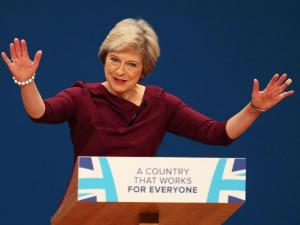 ‘commitment to the men and women who live around you’, ‘recognizing the social contract that says you train up local young people before you take on cheap labour from overseas.’ And perhaps astonishingly, for a Conservative Prime Minister, May promised to deploy the full wherewithal of the state to revitalize that elusive social contract by protecting workers’ rights and cracking down on tax evasion to build ‘an economy that works for everyone’. Picture the Brexit debate as a 2X2 matrix with ideological positions mapped along an x-axis, and Remain/Leave options mapped along a y-axis to yield four possibilities: Right Leave (Brexit), Left Leave (Lexit), Right Remain (things are great) and Left Remain (things are grim, but the alternative is worse). Having been a quiet Right Remainer in the run-up to the referendum, May has now become the Brexit Prime Minister while posing, in parts of this speech, as a Lexiter (Lexiteer?).
 Disrupting ethical theories that are rooted in abstractions and assumptions of universal moral principles is, I believe, urgently required if we are to better understand the moral responsibility we have toward our fellow human beings, particularly in environments of conflict and violence. And so for me, what resonates most strongly in Reconstructing Human Rights is the ethical project contained within the book. Like Hoover, I am not at all convinced that universalising accounts of morality can adequately address ethical problems in political contexts. And like Hoover, I am concerned with how the quest for certainty and universality shapes how we understand, see, and treat one another in social and political life. What is at stake here, in my view, is nothing less than the capacity for ethical action itself, which is at risk of being entirely subsumed by the pursuit of absolutes, leaving little room for contingency, alterity, uncertainty, or indeed anything unknown that might arise out of the specificity of any one ethical moment.
 This is the first comment, following Joe’s
 Earlier this year I visited

 The Disorder Of Things