Freeing the Pluralist Imagination, or on the wisdom of escaping Weber’s “Iron Cage”

This is the second in a series of posts by several of us at The Disorder Of Things on Patrick Thaddeus Jackson‘s The Conduct Of Inquiry in International Relations: Philosophy of Science and Its Implications for the Study of World Politics. Paul started things off with his post setting up Jackson’s methodology of politics in order to ask important questions about the politics of Jackson’s methodology. The next few weeks will see further posts, followed by a reply by Jackson himself.

Update (3 Feb): Nick’s post is now up, to learn about material monism and the philosophical power of beards read it here.

Update (17 Feb): Meera’s post is now online, in which she threatens the stability of the matrix.


A broad definition of science, by design, does not provide us with any standards for good research, or indeed any specific advice for how to go about doing research, beyond the two basic admonitions to focus on factual knowledge of the world, and to separate this activity logically and conceptually from the promulgation of normative judgments and partisan-political stances. (25)

Patrick Jackson, The Conduct of Inquiry in International Relations

My comments on Jackson’s book need to be put in a personal context. I have no interest in claiming the title of “science” for my work or “scientist” for myself. Further, I do not consider my primary vocation the production of empirical knowledge. Instead, my work is “normative” and focused, most broadly, on how we think about the ethical dimension of world politics. Finally, I do not self-identify as a participant in the discipline of “International Relations,” nor as a “political scientist;” the tradition of scholarly work identified as “International Relations” is compromised by its statist foundations and the historically positivist pretensions that motivated the move to a science of politics are unsustainable in my estimation.

This raises an obvious question: why am I commenting on a book about the conduct of scientific inquiry in International Relations (IR)?

A Personal Anecdote

While at a conference in Ljubljana, Slovenia, I had an argument with my friend, Laust Schouenborg, about the nature of social science. Sitting in a Soviet-era housing block converted into a budget hotel, watching the sun go down behind the park, I was rhetorically ejected from academia.

Our argument began when Laust, after reading Chris Brown’s International Relations Theory: New Normative Approaches, suggested (contra Brown) that because there are no standards of what constitutes a “good” normative argument, the study of ethics had no place in IR, and that scholars concerned with making arguments about how politics should be, had no place in academia.[1] The modern university is a place for scientific study and those who were not practicing science should, he claimed, be relegated to the political and cultural spheres.

This line of reasoning shocked me, but it was only the culmination of a disciplining process I experienced in my first two years as a PhD student in the International Relations Department at the LSE. Even as many members of faculty supported my work, I was constantly asked why I was studying in an IR department and some “colleagues” suggested that my research was value-less as scientific work – whatever its virtues as polemic or sermon.[2]

These experiences have left me with two abiding intellectual concerns about the conduct of social inquiry. The first is to challenge the institutional privilege bestowed upon those conducting their inquiry as “science.” On this concern, Jackson and I share considerable ground, as his critique of exclusive definitions of scientific inquiry deflates dominant pretensions and advocates for a more inclusive study of world politics. And I must give credit where it is due: Jackson doesn’t suggest that my kind be thrown from the ivory tower – just given separate offices. The second concern is deeper and more contentious: to challenge the notion that the ethical questions that interest me can and should be separated from scientific inquiry into world politics. On this point Jackson and I share less ground, and for this reason the bulk of my comments will focus on how and why Jackson separates the “scientific” and the “normative” in his pluralist approach to IR.

Aside from satisfying very personal concerns, I offer this response to Jackson’s book because his generous orientation, stated most forcefully in the concluding chapter, invites engagement. Along with analyzing Jackson’s essentially Weberian account of a pluralist science of IR, and suggesting that a fuller account of social inquiry should bring together ethical and empirical inquiry, my most substantive critique is that the pluralism Jackson defends is partial and continues to discipline the study of world politics in an unsustainable way – a critique that, if correct, undermines a central aim of his project.

Continue reading

Martin Luther King as an international thinker?

Monday 17 January marked the official US holiday honoring Martin Luther King, Jr. While watching Monday’s Democracy Now! program, featuring substantive excerpts from King’s speeches,  the clarity with which he connected the domestic fight for equality to international politics, in particular poverty and war, struck me. The international aspects of King’s thinking, I believe, are important for two reasons.

King’s Radicalism

First, it challenges the interpretation of King as an insufficiently radical leader offered by some critics, and the co-option of King’s legacy not only by “moderate” liberals but also by conservative political figures in the US. King has become a symbol in the public consciousness of a safe reformism and a favorite icon for the type of liberal who abhors radicalism above any other political sin. As Michael Eric Dyson says, “Thus King becomes a convenient icon shaped in our own distorted political images. He is fashioned to deflect our fears and fulfill our fantasies. King has been made into a metaphor of our hunger for heroes who cheer us up more than they challenge or change us.”

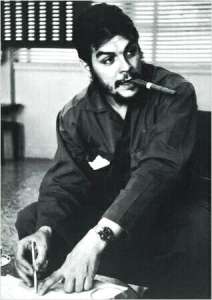
A personal anecdote to illustrate the point: a couple of years ago while handing over the editorship of Millennium to the incoming editorial team, one of the new editors commented on the large poster of Che Guevara that hangs on the Millennium office door. The Che poster, so far as I know, predates most of us currently associated with the journal, therefore I suggested it should stay. I then asked why Che should go. My colleague suggested that Che’s participation in revolutionary violence made him an inappropriate icon – in many academic disciplines this might be a rather devastating point, but International Relations is full of characters far more violent and less admirable than Comrade Che – see Paul’s post on Kissinger, for example.

When asked who might better grace the walls of the office my colleague suggested Martin King or Mohandas Gandhi (a political figure subject to a similar post-hoc liberal deification), with their key qualification as acceptable iconography being that they had not participated in political violence. While I have a great deal of sympathy for non-violence, my own introduction to both King and Gandhi came through the study of non-violence political strategy, the liberal (and I think my colleague would gladly accept that identification) embrace of King or Gandhi, paired with the repudiation of Che, is (unintentionally?) disingenuous.

It’s a disingenuous embrace because it insists that the first rule of acceptable political action is a renunciation of physical violence, while at the same time turning a blind eye to the violence institutionalized in the state through everyday police brutality and legalized/legitimized imperial warfare, as well as the structural violence inherent to global capitalism. This misses the radical content of non-violence as practiced by King and obscures the link that exists between non-violent agitation and armed resistance. The political commitments and motivations of King and Che are remarkably similar, even as their fundamental orientations (Marxism vs. Christianity) and tactics (non-violent direct action vs. guerrilla insurgency) diverged. Continue reading

Rape & Rape Prevention: A Cod-Evolutionary Perspective

Rape is an evolutionary adaptation. More than that, it now appears that anti-rape strategies are evolutionary too, which for women means increased strength at certain stages of the menstrual cycle, increased general distrust of men and hatred of black men in particular. Taking Darwin in vain, this is the argument put together by Jesse Bering at Slate.

We should probably start by getting our definitional house in order. In an admirable example of rigging the answer by misspecifiying the question Bering names rape as “the use of force, or threat of force, to achieve penile-vaginal penetration of a woman without her consent“. So men are biologically incapable of being raped, women incapable of raping, and the sexual-reproductive organs the only legible site for sexualised aggression (no anal here please!).

Hardly surprising, given this terminological firing gun, that rape emerges as a phenomena only comprehensible in procreational terms. This is a narrower agenda even than saying that it is somehow ‘evolutionary’, itself already less than saying it has something to do with ‘biology’ (the possibility of rape being about ‘sex’, socially understood, or ‘power’ stands at yet further removes).

The quality of proof offered doesn’t fare much better. Take the study on racist attitudes and menstrual cycles, results we’re at risk of ignoring with our rampant ‘political correctness’ (*yawn*). Turns out women from this sample (77 white undergraduates) scored higher on fear-of-rape metrics of black men when they were most vulnerable biologically to impregnation. Bering takes this as supporting an evolutionary adaptation against ‘out-groups’, although he concedes that ‘cultural transmission’ may play a role.

The study itself suggests something rather less conclusive. It found that implicit race bias (non-conscious stereotyped associations of the form ‘black-physical’) was much more strongly correlated with rising fertility than explicit bias. Its metrics for race bias were all clearly consistent with a sociological or interpretive account of race (which is to say that race is a social, not a biological category, and that its meaning is historically and politically determined, not the outcome of adaptive ancestral behaviour). The data is also somewhat partial, as its relation to some wider questions. There is no comment on the fact that, for example, race bias remains fairly pronounced even where there is no ‘conception risk’, nor any significant attempt to cite work on general levels of race bias in general populations as a comparator or to examine variation among degree of bias in the women studied and the possible sources for those differences.

Continue reading

LSE Occupied!

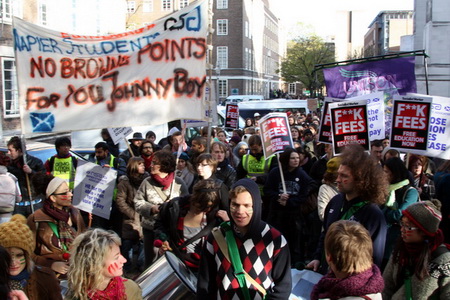
More breaking news. Today LSE students occupied in protest at education cuts, demanding that LSE management produce at least some murmurs of opposition before the Parliamentary vote next Thursday.

Follow here, with updates here. Petition of support here.

Ethics of Austerity 3: Cynicism, Sincerity and Fear

“You ain’t never been no virgin, kid, you were fucked from the start.”

-Titus Andronicus, “A Pot in Which to Piss

Police Vodafone protesters oxford street

Police protect Vodafone store from the threat of public exposure of truth.

And you have to wonder what it will take for serious people to realize that punishing the populace for the bankers’ sins is worse than a crime; it’s a mistake.

Paul Krugman

Of obedience, faith, adhesiveness;

As I stand aloof and look there is to me something profoundly

affecting in large masses of men following the lead of those who

do not believe in men.

-Walt Whitman, “Thought”

Hypothesis

The winter air has turned cold enough, has pressed in with its full weight, so that there is no more space for lies. The truth of crisis is that the powerful and the wealthy do not take responsibility, they assign it; they do not suffer their follies or their sins, they pay their penance in the currency of our lives.

We’ve spent the last few years living with the anxiety of impending doom, spurred on by hustlers of panic, addled prophets of economic Reformation, and Janus-faced managers of public interest.

Yet, despite the prolonged disaster-foreplay, the consummation of this crisis was always going to be “us against them” and never “we’re all in it together.” Continue reading

Cosmopolitan Moralism and Human Rights

Sometimes I have the impression that all intellectuals have become cosmopolitans. But there is an increasing gap between what intellectuals think and preach and what the ordinary people feel. There is a growing divergence between the demos and the elites, especially concerning the perception and the treatment that should be reserved to the “diverse”: immigrants, minorities, gays and so on are more and more perceived as a threat. When xenophobia is rising, the intellectuals have a responsibility to help to distinguish between the real and apparent reasons, even at the price to become isolated from great parts of the population.

– Daniele Archibugi

In this post I want to both feature and expand upon an upcoming special issue (Volume 12, Issue 1) of Human Rights Review, which I  guest edited with my colleague and friend Marta Iñiguez de Heredia. The special issue focuses on human rights as an ideal and practical politics, opening some initial space to consider why the interaction between moral ideals and practical politics is important, and provoking discussion of how the clear divide between them is unsustainable.

To set the stage, we find Daniele Archibugi and Seyla Benhabib discussing Cosmopolitanism at Open Democracy. For both authors the place of universal rights in cosmopolitan politics is central, but the moral principle expressed through universal human rights works in a very particular way. This approach to human rights prioritizes what, in the paper, we call the “philosopher’s” understanding of rights, which begins from rational moral principles already known before political action is taken.

Continue reading

Julian Assange and the Spectre of Rape

One step took him through the roaring waterfall
That closed like a bead-curtain, left him alone with the writhing
Of what he loved or hated.
His hands leapt out: they took vengeance for all
Denials and soft answers. There was one who said
Long since, ‘rough play will end in tears’.

Cecil Day Lewis, Sex Crime (in Joanna Bourke, Rape: A History from 1860 to Present)

And so the Julian Assange Rape Thing rambles on. For some of those keen to defend wikileaks from a legitimacy-crisis-by-proxy, the allegations have invalidated themselves in even being stated. The timing is more than suspicious, and public incompetence reveals machinations behind the scenes. It’s a classic Kompromat, a transparent stitch-up.

The standard ‘rule of law’ holding position – let due process take its course before condemnation – is strangely ineffective in this situation. The taint of sex crime is almost a performative speech act. The suggestion passes the sentence, and trimmings like ‘alleged’ only reinforce the effect, which thrives on ambiguity. All that said, there are two elements to the defences of Assange that deserve unpicking.

The first is the unforgivable recycling of rape myths. Smear is followed by counter-smear. After all, one of his accusers is a radical feminist! And we all know what that means. More than that, a lesbian! Or perhaps not. Like many a spectre of the inconstant feminine before her, she is not what she seems. Her identity, like her allegation itself, hints at a mercenary cunning.

The second, and related, problem is that of the pure non-sexuality implicitly attributed to Assange. Profiles brim with Matrix-y tropes, or paint him as the new King of the Hackerati, like Johnny Lee Miller with long hair. He moves mysteriously, a homeless pilgrim, and needs only a coffee and a laptop to wreak havoc on those stale old boys at the Pentagon. More than once he is identified as a monk, if one who self-flagellates at the altar of techno-modernity. Pristine public service. Political heroes don’t fuck, let alone rape. All those mucky fluids pull them down from their symbolic perch.

Why are these responses necessary? Clearly they are stand-ins for our feelings about wikileaks itself, and for visceral identifications with, and reactions against, the figure of the rebel. They are moves to person-alise the political. Assange is an embodiment, and the enterprise for all concerned stands and falls on the robustness or weakness of his flesh. But it is obvious that the stakes are wider than that, and that ‘the debate’ about information and truth in war can hardly be settled in the courtrooms of Sweden.

Instead of holding on to an agnostic distance from the allegations, could we not better serve both anti-rape politics and free knowledge by cutting the moral link altogether? In rushing to quash accusations and to lambaste accusers, matters on which we can’t possibly speak with authority, we only confirm their wider political power. Why should the outcome of the case affect our view on wikileaks at all? Can we really be saying that our politics is that reductionist? Or our moral sense so basic that the revelation of wrong-doing would bring the whole edifice tumbling down? Rape is quite bad enough on its own without it having to act as a keystone for just conduct in war or the rights of an informed citizenry.


UPDATE (30 Nov): The stakes in the game of embodiment have just been raised. An Interpol arrest warrant has just been issued for Assange, not on any charges of treason, breaches of secrecy, or hacking, but for ‘sex crimes’.

Ethics of Austerity 2: Interlude of Broken Glass

There’s always a surprising disconnect between experience and public reality when you attend an event that goes on to become an “event.” On such occasions, I find myself wondering how my experience can run so counter to the public narratives that emerge. Yesterday’s (10 Nov.) protest march in London is no different.

Here are some media images that reflect the protest I attended:

But the images that defined the “event” were slightly different. We’ve all seen them on the TV, in the papers, and on the web.

What I don’t want to do is engage in hand wringing over a protest hijacked by violent fringe elements, or tut at those smashing up the office building or gathered outside to watch. Instead, I want to do the opposite, I want to imagine myself as the one who failed, failed to fully grasp that it wasn’t just a sunny afternoon of political play acting. Continue reading

Inequality and the Human(e) Development Index

The UN Development Programme (UNDP) has for the last 20 years pioneered seemingly innovative approaches to development that have substantially redefined the terms on which development aid is conceived, offered and spent. The publishing of the first Human Development Report in 1990 was a bold move which made a case for measuring and judging countries’ developmental status in a way which focused on quality of life indicators as well as macro-economic statistics – an idea now which is completely mainstream and commonplace amongst donor governments and development practitioners.  It also proposed the notion of ‘human security‘ in 1994; a subversive response to the ‘securitisation’ agenda emerging in the wake of the Cold War which sought to broaden both the referent of security and the range of relevant concerns.  It was absolutely instrumental in pushing the Millennium Development Goals agenda – an incredibly ambitious and detailed set of targets for international development practice that served to underpin widespread agreement for the expansion of development funding across donor governments.

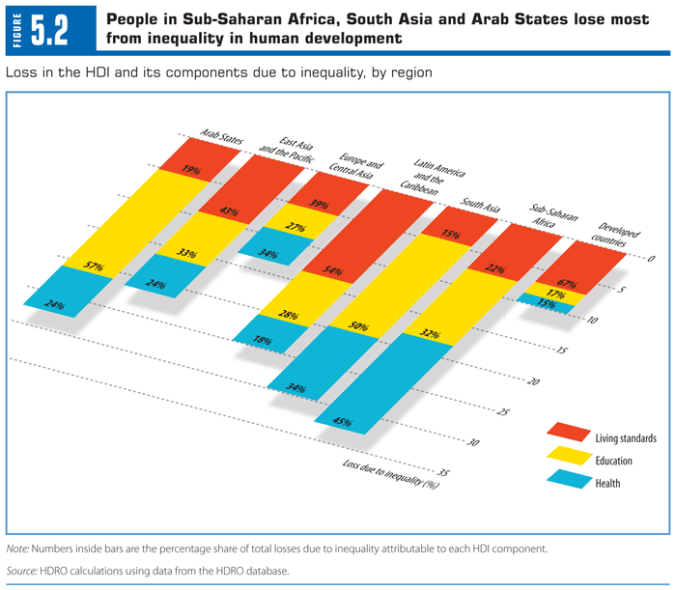
Its recent decision to measure inequality as a constituent part of development through its apparent role in determining the quality of life is, in this context, really interesting. On one level, it is indicative of the development community’s constant reflexivity – a term often used by David Williams – which recalibrates the tenor of its activities according to whatever the relevant crisis is supposed to be. Having been roundly critiqued and lambasted for the MDGs’ complicity with impoverishing neoliberal economic structures, we can read this ‘equality turn’ as the UNDP’s attempt to once more place itself on the vanguard of a more humane and responsive development agenda, moving itself away from the territory that the IFIs are starting to encroach upon.

It will be interesting to see whether and how the donors follow down this particular road. To a certain extent, the UNDP’s previous ‘innovations’ on human development, particularly with regard to adjusting for gender inequality, levels of absolute poverty and service provision, have all found various champions amongst western development agencies, all of whom have incorporated these issues seemingly deeply into their approaches to development, albeit perhaps through substantially de-radicalising the most substantive aspects of critique.

Inequality as an issue however poses a much more substantive threat to the international development agenda when pushed too far – not only does it cast doubt on the shining beaconof the self-made rich in the global South, but specifically, it starts to push against the foundational myth that ‘development abroad’ can be achieved with no corresponding change in the fortunes of ‘developed’ countries, a key threat to donor sanguinity and compliance with the UNDP’s more radical agendas. After all, if it is true within countries that vast inequalities impact on quality of life through skewing access to the goods that constitute human well-being, why would this also not be true between countries? The nonsense and yet widespread idea that some countries merely have to ‘catch up’ with others is belied by the inequality point but poses the much harder question for western countries and populaces to deal with: do I support international development enough to sacrifice any aspect of my own well-being?

As argued on an earlier post, the failure of highly-moralising development and anti-poverty agendas to deal at all with the central problem of inequality, both international and domestic, has been egregious and pervasive over the last 20 years, and looks to remain so in the future. The UNDP’s intervention is no doubt a timely one, although given the history of its more radical proposals, one which will probably be so watered down in practice as to be meaningless. Furthermore, by bringing this question within the competence of the ‘development’ policy specialists rather than engaging it as a public political question in ‘developing’ and ‘developed’ countries, the potential for getting to grips with the depth of this challenge seem remote.

What’s love of country got to do with it? responsibility in Afghanistan

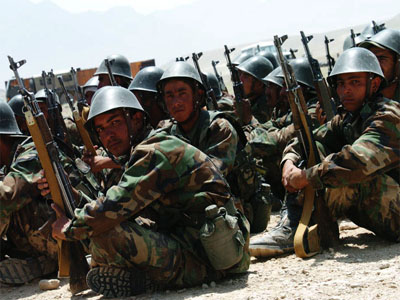
Recently, I saw an excellent documentary on the US military’s ongoing efforts to train and equip the Afghan National Army; the film, Camp Victory, Afghanistan, left me reflecting on my own thinking about this ongoing war. Despite the recent attention to the conflict, which seems to have returned to prominence, I have yet to read anything that helped clarify my thought – in particular the nagging question of what “we” owe Afghanistan.

There’s much to pick apart there: who does “we” refer to? Why would we owe Afghanistan anything? And what does it mean to talk of Afghanistan as a subject to whom we have duties? I’ll try to address these questions in working out why I’m troubled by the idea that we owe something to the people of Afghanistan.  Continue reading