Economy of Force

We return from the holidays with gusto and a book symposium on Patricia Owens’ Economy of Force: Counterinsurgency and the Historical Rise of the Social (Cambridge, 2015). Patricia is Professor of International Relations at the University of Sussex, co-editor of European Journal of International Relations, and a former fellow of the Radcliffe Institute for Advanced Study at Harvard University and of Oriel College, Oxford. Patricia’s first book was Between War and Politics: International Relations and the thought of Hannah Arendt (Oxford, 2007). Economy of Force is in the Cambridge University Press series ‘Studies in International Relations’ and is out in paperback next summer (the introduction is available in full here). The book will also be the subject of a forthcoming special section of Security Dialogue.
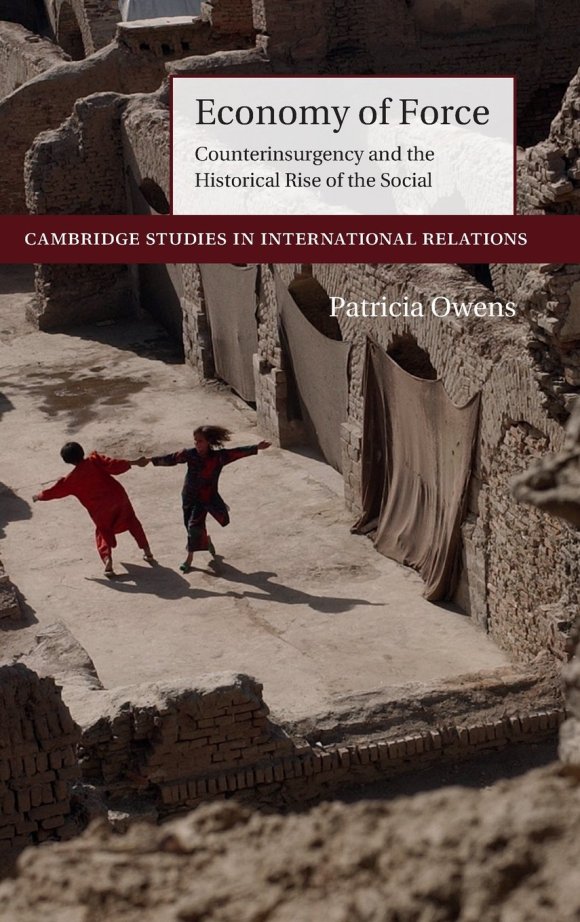

Economy of Force

Economy of Force seeks to rekindle interest in one of the oldest but neglected languages and techniques of government administration – household governance – that it uses to write a new history and theory of counterinsurgency with broad implications for social, political, and international thought. The book is a study of oikonomia in the use of force, from oikos, ancient Greek for household. But it also makes a larger claim, that household governance underlies the relatively recent rise of distinctly social forms of government and thought more broadly. Since the late eighteenth-century, modern, capitalist state and imperial administrators have drawn on and innovated different forms of household governance, scaling up and transforming the units of rule in which populations are domesticated. To really understand the significance of households-as-government we need to dispense with the relatively recent and bourgeois notion of households as houses, homes, or family-as-kin. Instead, households are best understood through the nature of the hierarchical relations between people in a particular spatial arrangement. Households are the persistent but historically variable spaces in which the life processes of members – real, vulnerable bodies needing food, water, shelter – are administered and the household itself is maintained.

There is a very long tradition of thinking of households-as-government in the history of political and economic thought and in anthropology, archeology and comparative studies of different household forms. There is also excellent and wide-ranging scholarship in literary and gender studies on practices and ideologies of domesticity (from domus, Latin for house). In drawing on and extending these and other literatures, Economy of Force suggests that there is a far deeper significance of households and forms of domesticity than captured in International Relations debates about the so-called ‘domestic analogy’. Household administration is highly portable and plays a remarkably significant role in imperial and international relations. These are grounds to make a stronger claim than one based on mere analogy. I argue that there is a domestic homology connecting different households, despite their historical and geographical variability, based on the genealogy of household governance in the history of social and political thought, but also the human experience of basic life necessities and the stubborn but contingent attempts to domesticate people through the administration and control of life needs.
Continue reading

Let’s Talk About the “Ugly Briton”: Shashi Tharoor on Winston Churchill

October is always a good time to catch up on one’s correspondence from July.  “FYI,” noted a friend though FB’s messaging system, linking to this:

The video’s title, “Dr Shashi Tharoor MP – Britain Does Owe Reparations,” sums it up.  The other videos from the same debate event are worth watching, too, but Tharoor’s is quite simply a must-see for anyone interested in the British Empire.  Indeed, you have probably seen it already.  With 3 million views, 6000+ comments plus what seem to be hundreds of reactions by all kinds of people in all kinds of media of communication, this one 15-minute video alone can legitimate Oxford Union Society claim’s that it aims “to promote debate and discussion not just in Oxford University, but across the globe.”

Why is it that Oxford Union struck social media gold with this debate but not with some others (“socialism does (not) work,” anyone)?  Even if it is safe to assume that “many” people would be familiar the reparations argument in general and even that “some” would be familiar with Britain’s reparations to the Maori, the fact is that “no one” had given a fig about the case for Indian reparations [1].  My scare quotes are meant to signal that these quantifications are relative.  It was a century ago that Dadabhai Naoroji, known to some as the Grand Old Man of India, argued that “immediate” self-government, a.k.a. swaraj, would constitute Britain’s “reparation”.  But this is precisely the point: reparations-talk becomes itself only when subjected to a sufficient degree of metropolization or mainstreaming [2].  White academics like Boris Bittker started paying attention to the legal argument for “black reparations” only in 1969, after James Forman famously stood up in a New York City church to argue that white churches owed a lot of money to a lot of people.

Continue reading

Thinking Internationally About The Arms Trade

A guest post, following our recent podcast on the arms trade and its discontents, from Anna Stavrianakis. Anna is a Senior Lecturer in International Relations at the University of Sussex. Her research focuses on the arms trade, arms transfer control and militarism.


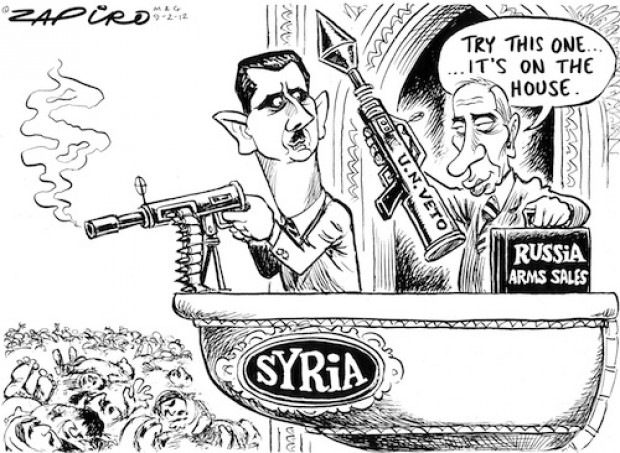
Zapiro - Russia Syria Arms Trade

September 2015, ExCel Centre, London: Stop The Arms Fair activists block the road and prevent military vehicles entering the Defence and Security Equipment International (DSEI) exhibition. They are protesting against one of the largest arms fairs in the world – sending a message to the UK government and arms companies that “inviting representatives of repressive regimes and their armed forces to hob-nob and do dodgy deals at DSEI … with representatives from the UK government and unscrupulous arms companies from around the world IS NOT OK.” Two weeks previously, Cancun, Mexico: Control Arms activists build a life-size sand sculpture of a Stormer 30 tank on Baracuda Beach, Cancun, calling on states to save lives! by ensuring the toughest possible standards at the first Conference of State Parties to the Arms Trade Treaty, the biggest game in town for contemporary international arms transfer control.

These two campaigns share the language of “dodgy deals” but are otherwise quite different visions of the arms trade and its control. The Control Arms campaign focuses on encouraging, informing and embarrassing diplomats into agreeing a multilateral treaty that enshrines higher common international standards and establishes stronger norms against arms transfers that violate human rights and international humanitarian law. The Stop The Arms Fair coalition, meanwhile, takes direct action to halt the operation of arms fairs in the UK by physically blockading the exhibition centre, in protest at the relationship between arms companies and the UK government, and the relationships between the UK government and authoritarian, repressive and war-fighting foreign governments.

I’ve written in the past about the international politics of NGO and campaign group strategy – whether reformist, insider approaches are more effective than transformist, outsider ones – in the context of debates about global civil society. Yet what continues to trouble me, intellectually and politically, is a raft of questions about the operation of the arms trade itself. Namely: where, or with whom, does political responsibility lie for the negative effects of the arms trade in a world of formally national states that are home to internationalising arms companies and operate in a multilateral system based on sovereignty? What social forces drive the arms trade, how does their power operate, what is the character of the problems they generate, and how should scholars and activists best respond? Competing understandings of the operation of the arms trade can be seen in the varied activist responses to it: is the problem one of lack of regulation, the need for improved multilateral action, improved normative standards and international law, as per the Arms Trade Treaty? Or is the problem the relationship between the state and arms capital, and government promotion of the trade, as per the anti-DSEI protests? In the case of DSEI, how are we to understand the operation of internationalising arms capital that has an intimate yet fractious relationship with national states? And in the case of the Arms Trade Treaty, how should we make sense of efforts to create a level playing field of respect for human rights and humanitarian law in the context of a vastly asymmetric and hierarchical world military order?

Thinking theoretically, I have come to see that a large part of the difficulty in answering these questions lies in the grip that methodological nationalism continues to hold on IR as a discipline. Continue reading

Capitalism: A History of Violence

Alexander Anievas and TDOT resident Kerem Nişancıoğlu introduce their new book How The West Came to Rule: The Geopolitical Origins of Capitalism.


‘For the last two decades, challenges to the inequalities and injustices of capitalism have been casually dismissed by a status quo swimming in hubris. From Margaret Thatcher’s infamous proclamation that ‘there is no alternative’ to Francis Fukuyama’s declaration of the ‘end of history’, the study and critique of capitalism has been relegated to margins of public discourse. More recently, Mark Hunter argued that any attack on capitalism is ‘an attack on human nature’, thereby reaffirming the now centuries-old conceit that capitalism is as ‘natural and organic’ as living and breathing.

However, as stock markets came crashing down in 2008, the force of history reasserted itself in a series of revolutions, square occupations, anti-austerity protests, strikes, riots, and anti-state movements taking place from London to Ferguson, Athens, Cairo, Istanbul, Rojava, Santiago and beyond. Such movements have torn at the certainties of ‘capitalist realism’ and started sporadically – if inconsistently – challenging such long-held ‘common sense’ truisms and the power structures that bolster them.

howthewest

Continue reading

What We Talked About At ISA: The Imperial Sociology of the “Tribe” in Afghanistan

As has been established, encounters between the coloniser and the colonised led to the creation of truths, myths, legends and identities in which the two were mutually implicated. These encounters have also bequeathed a particularly problematic lexicon, one whose provenance is narrowly European and one which has been kept alive especially in the discipline of International Relations, even as it is increasingly renounced by other disciplines and in the world outside the Anglophone academy. In my talk at ISA this year, I sought to problematise the concept of ‘tribe’ and show how a monolithic and unreflective body of work became the norm with reference to Afghan social organisation as exemplified by this kind of statement made by General Jim Gant in 2009:

When one says “Afghan people” what I believe they are really saying is “tribal member”. Every single Afghan is a part of a tribe and understands how the tribe operates and why. This is key for us to understand. Understanding and operating within the tribal world is the only way we can ever know who our friends and enemies are, how the Afghan people think and what is important to them. Because, above all, they are tribesmen first.[1]

By tracing the way in which the term “tribe” has been deployed in the Afghan context, the paper (based on a dissertation chapter) performs two types of intellectual labour. First, by following the evolution of a concept from its use in the early nineteenth century to the literature on Afghanistan in the twenty-first century, wherein the “tribes” seem to have acquired a newfound importance, it undertakes an intellectual history of the term. The Afghan “tribes”, taken as an object of study, follow an interesting trajectory: initially likened to Scottish clans, they were soon seen as brave and loyal men, but fundamentally different from their British interlocutors – albeit interestingly always superior to the Hindus who often provided the necessary contrast – only then to be seen as a “problem” that needed to be managed, and finally, as indispensable to a long-term “Afghan strategy”.[2] And second, the paper endeavours to describe how that intellectual history is intimately connected to the exigencies of imperialism. My argument is that the “tribe” has become a familiar and accessible idiom – another expedient shorthand – used to make sense of Afghanistan’s diverse and complex social structure, but that in the process the term has veered far from the manner in which it was originally conceived and utilised. I aim to demonstrate not only how the term has become more thoroughly racialised, but also how it now amounts to a conceptually vapid word that has paradoxically been credited with ever more importance in “understanding Afghanistan”.

It is one man’s early 19th century writing that continues to be the capstone of much of the academic work done on Afghanistan today. Continue reading

What We Talked About At ISA2015: A Debate Around John Hobson’s ‘The Eurocentric Conception of World Politics’

Below is the text of my intervention at a roundtable organized by Alina Sajed entitled ‘Race and International Relations—A Debate Around John Hobson’s The Eurocentric Conception of World Politics‘. TDoT has hosted a symposium on the book: you can read an initial post by John, commentaries from Meera, Srdjan and Brett, and a reply from John. I’ve tried not to cover the same ground.

While race and racism have recently become topics of increasing interest in the rather parochial world of IR scholarship, few books have ranged so widely across time and thinkers as John Hobson’s The Eurocentric Conception of World Politics. This is a monumental work of scholarship that accumulates a staggering amount of evidence, were further proof necessary, of the white supremacist and/or Eurocentric foundations of IR as a discipline (I use the ‘and/or’ advisedly, because much of the debate that the book has generated and some of my own critique focuses on the complex relationship between the formations that Hobson identifies as ‘scientific racism’ and ‘Eurocentric institutionalism’, about which more in due course). So whatever my problems with the book, I want to endorse it as a deeply necessary intervention in the IR academy. Nonetheless, I find myself in sharp disagreement with some of its central claims in ways that have not been fully addressed in earlier discussions. I will focus here on two areas of disagreement: first, the book’s treatment of Marx, Lenin and Marxism in general; and second, its crucial distinction between ‘scientific racism’ and ‘Eurocentric institutionalism’.

Why focus on a critique of Marxism as Eurocentric and/or imperialist? (Again the ‘and/or’ seems necessary because Hobson’s careful mapping of European thought finds conjunctions of racism and/or Eurocentrism with both imperialist and anti-imperialist sensibilities). Partly this comes out of my own intellectual investment in denying what I believe to be the false choice that is often presented between Marxism and postcolonialism. As such, I find myself troubled as much by Marxist work that repudiates postcolonialism as I am by the opposite tendency (which I think is at work in this book). But partly this also comes out of a sense that if Marxism were in fact as Eurocentric and/or imperialist as Hobson suggests, this would leave inexplicable its enormous appeal in the Third World both in the heyday and aftermath of the great decolonization and liberation movements that it informed. More prosaically, I think Hobson’s readings of Marx and Lenin are temporally truncated and therefore somewhat misleading.

Continue reading

Notes on Europe and Europeans for the Discerning Traveller

Europe has the only classical tradition that is also considered modern.

Europe claimed Greece as its ancestor. But not anymore.

Europe once turned a Black god white.

Once upon a time Europe decided that it was a family of nations. This decision is commemorated as the beginning of international law.

Because indigenous peoples were not mentioned in a very old book, Europeans wondered if these peoples were human.

Some of the Europeans who cleared lands of their indigenous peoples liked to represent themselves as indigenous princesses.

Europeans once thought that if they left Europe they would degenerate. To this day they view their cousins over the seas with suspicion.

European scientists once found a way to break up human beings into a set of quantum parts.

Europe is proud of freeing itself from metaphorical chains.

Europe got rich out of African slavery. Then it freed the slaves.

Europe was so concerned with slavery that it colonized the African continent.

In Europe you can baptises yourself so as to be born again with a humanitarian soul.

Some of Europe’s top philosophers were bigots and racists, even for their own time.

Europeans were so fascinated with primitives that they created a space in the brain called the unconscious.

Europeans say that Unconscious bias is regrettable but that it doesn’t make a person bad.

Europe prefers to narrate its eras of global war as eras of “long peace”.

Europe once had a big war with itself when some Europeans started to practice in Europe what they had been practicing in their colonies.

Algeria was a part of Europe. But Algeria was not part of the pax-Europa.

Anyone can be European so long as you tell Europeans where you come from.

Europeans can only trust women who show their whole face. Exceptions apply.

Europe never said thank you to muslim scholars.

The Mediterranean is currently the deadliest sea crossing in the world

Europeans are experts on Africa, Asia and Oceania.

Europeans prefer to learn about Africa, Asia and Oceania from other Europeans.

Europe is the only cosmopolitan that is allowed to keep its own adjective.

Europe believes that if it wasn’t written down it didn’t happen.

Europeans like to write about themselves.

Only Europeans can know Europe.

Once Europe was narcissitic, but Europeans fixed that by turning the mirror into a window onto the world.

The Global Transformation: A Response

The final post in our forum on The Global Transformation, in which Barry Buzan and George Lawson respond to the points raised by Julian Go, Jeppe Mulich and Jamie Allinson. The original post, summarising the book is available here. The book will also be discussed further at the ISA conference in New Orleans and a launch at LSE.

[Editor’s note: The authors are not responsible for the images in this post. But it’s Friday.]


Given the ‘excess’ of contemporary academic production, it is a rare treat to have colleagues engage seriously with your work. We therefore offer our heartfelt thanks to Julian Go, Jeppe Mulich and Jamie Allinson for their close reading of our book and for their thoughtful critiques of it. We offer our equally heartfelt thanks to the editors of The Disorder of Things, particularly Meera Sabaratnam, for investing a considerable amount of time in organising and publishing these commentaries.

The interventions by Go, Mulich and Allinson raise two main issues: the first relates to our use of, and contribution to, theoretical debates, particularly those around imperialism, and uneven and combined development (UCD); the second concerns the relationship between history and theory, most notably our use of macro-historical frames such as ‘modernity’. We discuss these issues in turn.

On theory

Julian Go is right that The Global Transformation ‘expressly rejects any grand theoretical narratives or systems’. He is also right that we do not use ‘categories derived from a larger and more comprehensive theoretical system’. And, however tiresome it is to keep agreeing with your critics, Go is once more right in saying that our use of uneven and combined development is not meant to correct this shortcoming – as we discuss below, we use UCD as an analytical shorthand rather than as a theoretical schema containing a range of causal claims.

Why is this the case? The first reason is strategic. At the beginning of the project, we had several choices to make: whether to pitch the book primarily to an IR audience or whether to also take some swings at cognate disciplines; whether to get drawn into internal debates associated with particular theoretical schemas or seek out a position in-between, or perhaps above, the fray; how to balance big picture and fine-grained historical analysis, and more. In each of these instances we chose the easy option – easy not in the sense of being straightforward to do, but in the sense of ‘less is more’. For example, rather than spend much time on the shortcomings of disciplinary historical sociology when it comes to its ‘occlusion of the global’, we concentrated on what historical sociology (and economic and world history) contributes to IR debates. Given that the answer to this was ‘quite a lot’, we made this our primary concern. Similarly, rather than distract ourselves – and readers – with the minutiae of debates internal to the whys and wherefores of ‘the global transformation’, we constructed a composite argument that assembled diverse storylines into a single narrative. To be clear – we are not saying that we neither built on, nor took a stand on, many of these debates, not least around the ‘internalism’ and Eurocentrism of many existing accounts. Rather, we made a deliberate decision to take an ecumenical approach, building on insights from a variety of theoretical churches rather than sticking to a single tradition.

Hindu-Jesus Continue reading

When Ernest Met Leon

This is the fourth post in our forum on Buzan and Lawson’s The Global Transformation, from our own Jamie. The opening post, responses from Julian Go and Jeppe Mulich, and the authors’ rejoinder are all live.


Imagine that you are a collier in one of the mining districts of central Scotland in 1799. You spend your days hewing minerals from the earth, as your predecessor of one century before almost certainly did. You eat a similar, limited, diet and probably return from darkened pit to tallow-lit cottage on the same route and to the same few possessions as that of one hundred years previously. Perhaps most important, as vast proportions -possibly a majority – of the rest of humanity had been and remained at the time of your birth, you are not a legally or politically autonomous individual. You are a serf of sorts: your labour if not your entire body bound to the will of another. Should you attempt to flee this master, and were not returned to him within a year and a day, any person found to be harbouring you would be liable to pay one hundred pounds compensation for your person .

Compare now the grandson or great-grandson (for by this point, and unlike the case of 1799, daughters would not be working down the pit) of this collier in 1899. It is quite possible you or your forbears would have emigrated, as one-sixth of your European contemporaries did, to lands such as Canada and Australia cleansed of their aboriginal inhabitants to enable you to flourish. Where once you were the property of a mine-lord, you are now the citizen-subject of the world’s most powerful Empress: a ‘psychological wage’ available to you should you choose to take it. Your work remains back-breaking, but aided by machinery. Most of all, you are paid for it. This wage relationship creates not just a free individual but a potentially conscious collectivity. That collectivity, in which you may recognise yourself not just as miner, Briton or Scot but as a member of something called ‘the working class’, has its own flags, buildings, trade unions and – an entity unknown to your forbear of 1799 – political parties.

Has there ever been a century in which so much changed for so many? The wager of Barry Buzan and George Lawson in their magisterial book The Global Transformation is that – with the possible hazy exception of the early holocene transition to settled agriculture – there has not. In doing so, they are revising revisionism, with great consequences not just for historical sociology but for the discipline of IR.

The view of the ‘long nineteenth century’ from the French Revolution to the Russian as a ‘great divide’ in human history has fallen into disfavour, smacking as it can of the triumphal sense of European, male, bourgeois self that characterised the century in question. The institutions and social practices heralded as novel can usually be traced back to other times and places, and the picture of shocking change within a lifetime transformed into something less immediately perceptible. To the extent that there is a popular historical consciousness, in the UK at any rate, it thrives on finding the familiar in history: the ways in which the Edwardians, or Victorians, or Tudors or Plantanagets were ‘like us’. Buzan and Lawson’s reminder of the recent nature, and the strangeness, of the past is a lapidary one.

nostalgia_press_21522u569_0

Tea-plantation workers in Tsarist-era Georgia.

Continue reading

Modernity Is Everything; Empires Are Everywhere

JMulich_squareJeppe Mulich brings us the third post in our forum on The Global Transformation by Buzan and Lawson. Jeppe is a doctoral candidate at the Department of History at New York University. He works on comparative empires, global history, and colonialism in world politics. His research on regionalism, law, and intercolonial networks in the eighteenth and nineteenth centuries has been published in the Journal of Global History and in the anthology The Uses of Space in Early Modern History (Palgrave Macmillan, 2015).

The authors’ original post, Julian’s response, Jamie’s response and the authors’ rejoinder are now live.


Let me start off by stressing that The Global Transformation is a fantastic book. Buzan and Lawson manage to pack a host of information and analysis into a relatively short and very readable book, while at the same time keeping their fundamental argument sharp and coherent. It is one of those works that leave you wondering why it has not already been written, particularly in a discipline so intent on retelling the wrong stories over and over again.[1] It is also, incidentally, a book that strongly argues in favor of the relevance of my own field, something that any aspiring scholar should welcome with open arms. With this in mind, my comments and critiques in the following piece might come off as nitpicky, but if they do this is only because I agree with so very much of Buzan and Lawson’s core argument. I am not trying to offer a counterargument or even a corrective to their account, but rather a few friendly jabs and perhaps an opening for further research into and discussion of some of the wider themes and implications of this important book.

I will primarily provide comments on the book from the perspective of a historian, with the theoretical underpinnings which that classification implies. My comments are divided into three broad sections. The first section will deal with issues of thinking in time, in particular how to date the type of global shifts that Buzan and Lawson are interested it and, related to this, how to disentangle the historical forces of change and continuity. The second section will delve more into the specific substance of the global transformation – namely the notion of modernity and the potential problems and benefits of using this nebulous concept. The third section will focus more on a particular part of the puzzle of the nineteenth century – that of colonial configurations and the multitude of state-forms emerging at this time – and consider this phenomenon vis-à-vis Buzan and Lawson’s treatment of rational state-building.

Periodization and Eurocentric Narratives

BelleyWhile Hobsbawm (1962) introduced the idea of a long nineteenth century more than half a century ago, in the first of his three books covering the period from 1789 to 1914, the past decade and a half has witnessed a resurgence of interest among historians and historical sociologists. Unlike Hobsbawm’s work, which focused almost entirely on events and developments within Europe, many of these new accounts are in various ways attempting to grapple with the inherent Eurocentrism of earlier histories. Such projects are often accomplished by telling decidedly global stories of the nineteenth century, with the most widely read example being C. A. Bayly’s The Birth of the Modern World, joined in the past year by Jürgen Osterhammel’s 1000-page behemoth The Transformation of the World.[2]

What the works of Bayly, Osterhammel, and Buzan and Lawson have in common is their focus on the transformative nature of the nineteenth century, apparent with just a cursory glance at their titles. While these authors might be interested in a certain kind of big history, their work focuses on shifts, breaks, origins, and turning points – not on continuities and long trajectories. This is in many ways true for most academic history, which often ends up as an exhausting chase to find the origins of specific phenomena or practices or, when coupled with the peculiar obsession with modernity, an endless argument over when and where the first example of a truly modern state/revolution/economy/philosophy/society/ideology/science/war should be found. Increasingly relegated to the sidelines are the crotchety old contrarians who insist that nothing much ever changed anyhow.[3] Continue reading