The Eternal Return of Benign Colonialism

One of a pair of posts we will be featuring at The Disorder this weekend on the Third World Quarterly affair. This first contribution is from Naeem Inayatullah, Professor of Politics at Ithaca College, who has visited with us before.


In “The Case for Colonialism” (2017), Bruce Gilley calls for a return to colonialism. He asserts that colonialism brought great benefits to Third World states, that these gains were squandered due to a premature granting of independence to the former colonies, and that only a re-colonization by Western states can develop lost capacities. Many scholars are outraged by Gilley’s publication. Some have called for its retraction while others demand that we ignore it altogether. I think we make a mistake in underestimating this event.

We need not express surprise by Gilley’s presentation. He is only the latest in a long line of scholars and policy makers that have made such claims for decades and for centuries.  For example, Robert Jackson’s Quasi-States (1990) makes similar arguments but without Gilley’s polemical bite. Jackson’s book itself expands on an influential article he wrote with Carl Rossberg, “Why Africa’s Weak States Persist,” (Jackson and Rossberg, 1982).  Indeed, the tone and substance of Gilley’s presentation is widespread in our time. We can find it in the work, for example, of Max Boot (2002), Robert F. Cooper (2002), Niall Ferguson (2008), Michael Ignatieff (2003), Robert Kagan (2002) and Robert D. Kaplan (2003). Some Marxists make comparable claims: Bill Warren in Imperialism, Pioneer of Capitalism (1980) argues that the Third world needs more, not less capitalism and imperialism. Imperialism, as capitalism’s pioneer first destroys and then reconfigures all other cultures. This creative destruction is the condition for moving the world to socialism and to communism. The political bent of these mostly academic writers can range from Marxist to liberal to conservative. But they all require former colonizing states to accept the responsibility of doing good for others via a benevolent imperialism/colonialism. Nor are eminent philosophers, such as Kant, Hegel, and Marx, short on praise for imperialism’s and colonialism’s value to subjected people (Blaney and Inayatullah 2010, chapters 5 and 6).

If our response is disbelief, we might wish to familiarize ourselves with the academy’s centrality in propagating a colonial praxis. Indeed, many have said that academia is an effect of empire, that King Leopold’s dream of creating universities to propagate and refine colonialism has been true for some time.

Three elements make Gilley’s article different from the usual.

Continue reading

On Uses of Intellectual History: Past and Present in the Critique of Liberalism

For the final post in our symposium on Duncan Bell’s Reordering the World, a reply from Duncan himself. Here he responds to the commentaries from Dan Gorman, Inder S. Marwah, Lucian Ashworth, Kathy Smits and Richard Devetak. You can also read Duncan’s original summary post here. 

Before turning to the substance of the comments, I’d like to reiterate my thanks to The Disorder of Things for hosting this symposium, to Nivi Manchanda for co-ordinating it, and especially to the respondents for writing such sharp and incisive responses. It has been a pleasure to read them, and I have learnt much from each one. I am delighted that Daniel, Inder, Luke, Kathy, and Richard found value in Reordering the World. But rather than dwelling on points of agreement – and I agree with almost all of what they say! – I’ll use this brief reply to sketch out some thoughts on a few of the questions they raise.

Continue reading

On Statues (III)

This is the third in a series of posts about statues. Because shit keeps happening. You can read the first and second posts in any order.

Thanks to Newsnight for the TL; DR version:


Here’s the discussion that followed:

***

One striking aspect of this conversation is the degree of anxiety about the precedent value of statue removal: as Kirsty Wark asks, ‘where do you stop?’ Donald Trump wondered the same thing in a tweet that, I suspect, he hoped would be a conversation stopper:

Continue reading

Liberalism and Empire, at the Intersection of Theory and History

This is the third post in our book forum on Duncan Bell’s Reordering the World: Essays on Liberalism and Empire. Inder S. Marwah is Assistant Professor at McMaster University’s Department of Political Science.  He is currently working on a project examining Darwin’s influence over anti-imperialist political thought, particularly in non-Western contexts, at the turn of the 20th century.

Let’s start where we can’t help but to start: with a just a little bit of light gushing.  Reordering the World is a masterful collection of essays that substantively advances the study of liberalism and empire, and for those of us interested in the subject, it would be difficult to find a more fruitful, illuminating, and accomplished piece of work.  Duncan’s expositions of conceptual formations (liberalism in particular, but not alone), of complex historical periods (the 19th century), and of the many figures he treats are, quite simply, models of scholarly rigor: philosophically-rich, historically meticulous, and best of all, persistently resistant to overextension.

Of the book’s many achievements, this one stands out: Duncan imparts a level of analytical, historical and philosophical clarity to the study of liberal imperialism, whose complexities are all too often not just papered over, but actually obscured by overgeneralization.  For all of the important strides that political theorists have in recent decades made in exposing liberalism’s imperial underbelly, they’re not without their anachronisms, confusions and absences (to which I’ll return below).  Duncan lucidly draws out the deep ambivalences within liberalism, whose contours are more often assumed than actually delineated, and gets us to see its internal rifts.  He also shines a light on the scholarship’s blindspots – in particular, its neglect of important figures marginalized by our focus on the canon, and the dearth of scholarship on settler colonialism.  His revision of Mill – a towering figure in the critical literature – is equally nuanced, complicating the often truncated characterization of his “imperial liberalism” that’s become something of a commonplace, and his exposition of lesser-known (but no less influential) figures such as Freeman, Seeley, Froude and others, are similarly illuminating.

Continue reading

All Things to All People?: Thoughts on Liberalism and Imperialism

This is the second post in our book forum on Reordering the World: Essays on Liberalism and Empire. The first post by Duncan can be read here. Dan Gorman is Associate Professor in History and Political Science at the University of Waterloo and Director of the PhD programme in Global Governance at the Balsillie School of International Affairs. He is currently working on a project which assesses the role of the UN as a venue for debates over decolonization from the end of WWII to the early 1960s.

Duncan Bell has packed a career’s worth of work on the intellectual history of Britain and its empire into the last dozen or so years.  His recent collection of essays, Reordering the World, considers the intellectual attempts by British liberal thinkers (mostly, though not entirely, Victorians) to reorder the international system through empire, and the means by which they justified and rationalized their ideas.  The essays republished in the volume have been updated to account for more recent scholarship and the evolution of Bell’s thought.  They are joined by new essays on the “dream machine” of liberal imperial thought and on the Victorian imperial publicist J.R. Seeley, whose book The Expansion of England (1883) is the exemplar of Victorian liberal imperial boosterism.  Reordering the World is not just a “scholarly greatest hits”; rather, its finely-grained and astute essays are united within a common field of interpretive focus on what Bell terms the “pathologies and potentialities of empire.” (2)

Despite imperialism’s central role in nineteenth century political discourse and world affairs, as well as its influence on the creation of the discipline of International Relations (IR), it has been conspicuously understudied by political scientists.  In a discipline that continues to position the nation-state as its theoretical alpha and omega, an examination of the constitutive role of imperial variables such as race and “civilizational” hierarchies has been left to exceptional studies by scholars such as Robert Vitalis, David Long, and Brian Schmidt whose work seeks to “desegregate” IR and reveal its imperial origins.  Yet, as Bell’s essays demonstrate, nineteenth century international relations was in many ways about imperialism, and empire remained (and, in the eyes of scholars such as Jeanne Morefield, remains) a salient category of international politics well into the twentieth century.  The “imperial turn” in historical scholarship,[1] meanwhile, has in a rich irony colonized much of the historical discipline over the past several decades.  Bell’s scholarship is so rewarding in part because he seeks to identify connections between imperialism and the disciplinary history of international relations.

Continue reading

Symposium: Reordering the World

This is a guest post from Duncan Bell who is a Reader in Political Thought and International Relations at the University of Cambridge. He is the author of numerous books, including most recently Reordering the World: Essays on Liberalism and Empire to which this symposium is dedicated. Stay tuned for more contributions on Reordering The World in the coming days.

I’d like to start by thanking The Disorder of Things for hosting this symposium, Nivi Manchanda for co-ordinating it, and the participants for generously agreeing to write commentaries.

Reordering the World is an unusual book. It was not designed as a single volume, though I hope that it works as one. It collects together a series of essays that I have written about ideologies of modern British  imperialism over the last decade or so. I added a long Introduction and Coda, as well as a substantial new framing chapter – “The Dream Machine: On Liberalism and Empire.” I faced a choice about how to deal with the bulk of the other chapters – should I rewrite them significantly or leave them largely untouched? I opted for the latter course, with one exception: I rewrote a chapter on J. R. Seeley, the historian and influential late Victorian imperial ideologue. The resulting volume presents an analysis, though far from an exhaustive one, of some key themes and trends in the history and theory of modern imperial order.

My work in the history of imperial thought has been motivated by curiosity about the ways in which historical actors made sense of their world, and a conviction that studying their ideas can shed light on significant moments and movements in the past, while also helping to inform contemporary political thinking. Reordering the World is primarily a study in (international/imperial) political thought, an intervention in a set of wide-ranging debates among political theorists, intellectual historians, and IR scholars, about how empire has been conceptualised and legitimated, though I hope that it will be of interest to at least some IR scholars who work in different areas. The volume continues, while extending, the work on imperial ideology that I started with The Idea of Greater Britain: Empire and the Future of World Order, 1860-1900 (2007), and that I am currently working on for a volume entitled provisionally Dreamworlds of Race.

Continue reading

White Innocence in the Black Mediterranean

A guest post from Ida Danewid. Ida is a PhD candidate in International Relations at the London School of Economics and Political Science. Her work focuses on decolonial theory, global ethics, and the politics of solidarity. She is the editor of Millennium: Journal of International Studies vol. 45, and the forthcoming special issue “Racialized Realities in World Politics”. This post is based on her article White Innocence in the Black Mediterranean: Hospitality and the Erasure of History which won the 2017 Edward Said Award.

On the evening of the 3rd of October 2013, an overcrowded fishing boat carrying more than 500 migrants sank off the coast of the Italian island Lampedusa. Amongst the 368 found dead was an Eritrean woman who had given birth as she drowned. The divers found her a hundred and fifty feet down in the ocean together with her newborn baby, still attached by the umbilical cord. Her name was Yohanna, the Eritrean word for “congratulations”.

Over the last few years the Mediterranean migrant crisis has provoked numerous responses and activism; ranging from Ai Wei Wei’s life vest installation to Pope Francis’s “day of tears”, from radical activist campaigns such as “The Dead Are Coming” to Jason deCaire Taylor’s undersea sculpture museum, from the silent minute in the European parliament to #AlanKurdi. Seeking to counteract the rise of populist, far right, anti-immigrant, xenophobic, and racist political parties, a variety of scholars, activists, artists, and politicians have called for empathy and solidarity with the fate of shipwrecked migrants. By recognising and publicly mourning the lives that have been lost, they seek to “humanise” those who, like Yohanna and her baby, are swallowed by the turquoise-blue waters of “Our Sea”.

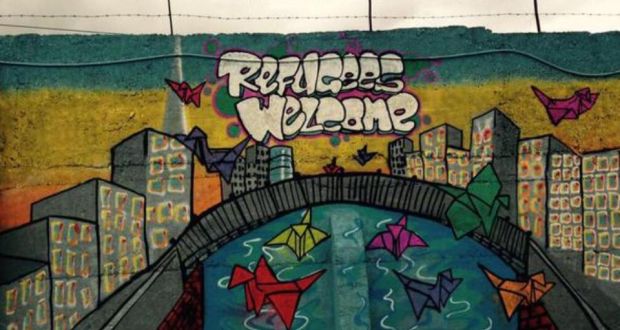
Graffiti welcoming refugees in Dublin

In international theory, these expressions of solidarity have been paralleled by a growing interest in the question of who and what counts as human. A longstanding area of concern for post- and decolonial thought, poststructuralist and feminist theorists have increasingly begun to interrogate the normative frames that cast some lives as waste, bogus, and non-human. Responding to an era shaped by the global war on terror and securitizing discourses that figure the nation-state as a body under threat, thinkers such as Judith Butler and Stephen White have argued for a new humanism, based not on the rationalist sovereign subject central to liberal political theory, but on notions of loss, grief, relationality, and bodily vulnerability. Calling for a “reconceptualization of the Left” based on precariousness as “a shared condition of human life”, Butler argues that mourning and vulnerability can serve as the new basis of political community, enabling a “we” to be formed across cultures of difference. Applied to the context of the European migrant crisis, this is an ethic of hospitality that seeks to disrupt nationalist protocols of kinship and that points towards new forms of solidarity beyond borders. As the contributors to a recent special issue on “Borders and the Politics of Mourning” make clear, grief for unknown others—for migrants—offers a radical challenge to the xenophobia and white nationalism that underwrite the necropolitical logic of the European border regime.

My research interrogates what such critical humanist interventions produce and make possible—and crucially, what they foreclose and hide from view. Building on what some activists, artists, and academics have begun to call “the Black Mediterranean”, I argue that these responses are indicative of a general problematique, endemic to both leftwing activism and academic debate, which reproduces rather than challenges the foundational assumptions of the far right. By privileging a focus on the ontological—as opposed to historical—links that bind together humankind, these ethical perspectives contribute to an ideological formation that disconnects histories that are intimately connected, and that removes from view the many afterlives of historical and ongoing colonialism. Continue reading

Militarism in the Age of Trump, Part II

Based on a paper I am co-authoring with Bryan Mabee. See Part I here.

Nation-statist militarism is the default (‘normal’) setting for militarism in international and global life.  Following Mann, this manifestation of militarism is characterized by some form of civilian control over the armed forces and a state-led economic and social mobilization of ‘destructive’ forces. (Alternative labels are ‘Westphalian militarism’ and even ‘Keynesian militarism’). In claiming the monopoly of legitimate violence, the nation-state prioritized territorial defence; planned, built and consumed from its own arsenals; and engaged in military recruitment practices that reflected and reinforced the prevailing social structures of the nation (whether professionalized or constricted).

This type subsumes what Mann refers to ‘authoritarian militarism’ and ‘liberal militarism’, his main examples coming from Europe–the absolutist polities and their twentieth century authoritarian descendants (e.g. Germany, Russia) versus the polities deriving from the constitutional regimes (e.g. Britain, France).  It even subsumes the militarisms of the post-1945 nuclear age, which include, in Mann’s terminology, sub-types like ‘deterrence-science militarism’ (‘techno-scientific militarism’) and ‘spectator sport militarism.’

Continue reading

Militarism in the Age of Trump, Part I

Part I of a post based on a paper I am co-authoring with Bryan Mabee, Senior Lecturer at Queen Mary, University of London. Bryan is the author of Understanding American Power (Palgrave, 2013), The Globalization of Security (Palgrave, 2009) and co-editor with Alejandro Colás, Mercenaries, Pirates, Bandits and Empires (Hurst/Oxford University Press, 2010).  The paper is being prepared for “Militarism and Security,” a workshop organized later this month at the School of Global Studies, University of Gothenburg by Anna Stravianakis (for her latest appearance on this blog see The Dissonance of Things No 3) & Maria Stern.

Update: Part II added on 18/03/17.

With Donald Trump as the president of the United States, militarism is once again becoming a hot topic. Trump’s appointment of right-wing generals to senior posts in both the White House and his cabinet legitimate militaristic policy discourses and positions, as do the president’s pronouncements about the need to “modernize” the country’s nuclear capability, put America’s enemies “on notice,” massively “rebuild” the military, hold “more military parades” in American cities, deploy the national guard to “restore order” (and possibly “hunt illegal immigrants”) and “streamline” U.S. defence exports.

And all of this is only the proverbial tip of the iceberg. For one thing, the Trump presidency merely empowers an already deeply militaristic and militarized American culture, one that is forever in love with guns and prisons and forever reticent to acknowledge the inherently racialized dimensions of both. For another thing, Trump’s top advisor is the “ethnonationalist” Steven Bannon, who is so influential in the White House that some describe him, tongue only halfway in cheek, as the actual president of the United States. Apparently, Bannon reasons that war between the U.S. and China is likely, given the thorny nature of international disputes in the South China Sea. One could in fact say that beneath the visible iceberg lie powerful and long-standing militarized realities—most of which have been ignored, temporized or marginalized in the earlier, ‘normal’ periods.

ABC News

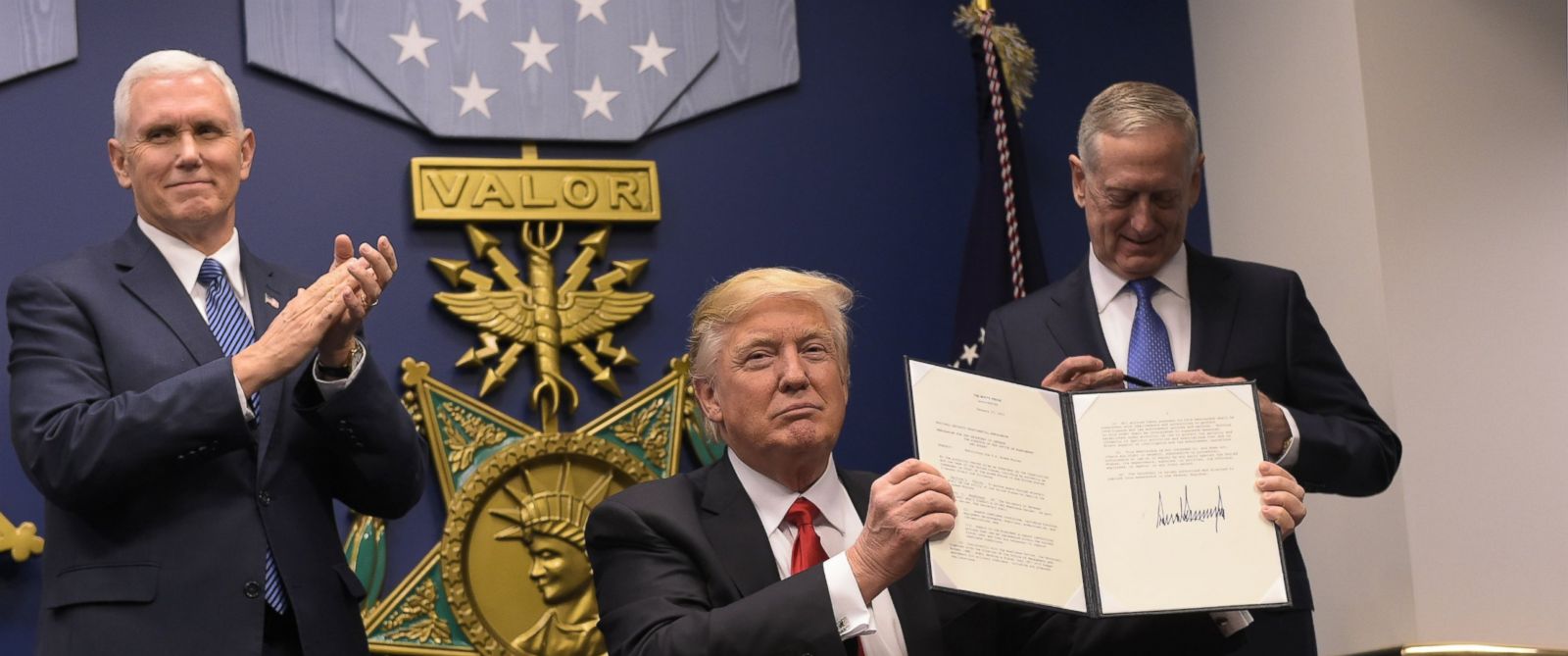
Can Critical Security Studies (CSS) help us illuminate militarism in the age of Trump? On one level, yes. Militarism is central to the field’s go-to framework on securitization—meaning, the scrutiny of the ways in which constitutional or ‘normal’ politics are transformed, via speech acts, into ‘exceptions’. The above image, Trump signing the Executive Order banning immigrants, dual nationals and US residents with citizenships from seven Muslim-majority countries from entering the country, suspend refugee admission and bar all Syrian refugees indefinitely, can be said to capture ‘exceptionalist militarism’ at work. Yet, beyond theorizing this one form of militarism, CSS has mostly been silent on the ‘classic’ concern of the literature on militarism—its sources, consequences, and the changing character.

In this two-part post we build on insights from historical sociology to develop a typology of militarism that CSS schools could consider as they try to make sense of political violence today.

Continue reading

Trump’s new empire: Thoughts on American imperialism in the age of Trump. A sneak peek from Israel/Palestine

A guest post by Hagar Kotef and Merav Amir. Hagar Kotef is a Senior Lecturer of Political Theory and Comparative Political Thought at the Department of Politics and International Relations, SOAS, The University of London. She is the author of Movement and the Ordering of Freedom (Duke University Press, 2015). Dr Merav Amir is a Lecturer (Assistant Professor) of Human Geography at the School of Natural and Built Environment, Queen’s University Belfast. Her recent publication is titled “Revisiting Politicide: State Annihilation in Israel/Palestine”, and is due to be published in Territory, Politics, Governance.

In trying to understand the horror that unfolds post Trump election, two main threads seem to dominate left discourse and blogosphere. The first rightly focuses on the horror itself, on the unprecedented coup-d′état unfolding before our eyes, on the attacks on the constitution, on fascism or other forms of totalitarianism or authoritarianism, and on brute institutionalized racism of a regime that does not even seek to pretend it adheres to the rule of law and good governance.

Credit: GPO

Credit: GPO

All this is true, and yet this narration often fails to account for three main facts. (i) Such brutal constitutional changes and violent re-demarcations of the contours of the polity are hardly unheard-of, both historically, and at this very political moment in many places across the globe. Portraying this horror as unprecedented and unique, indeed as an unbelievable horror, is a form of American exceptionalism that plays into the normalization of violence in regions that are not considered part of the ‘West’. (ii) Many of these violent regime-changes across the globe have been occurring with at least the passive, if not the very active, involvement of consecutive US administrations. Finally, (iii) such modes of foreign “interventions” (we might want to call them wars or imperialism—“neo” or just that, “imperialism”) are often what allowed the Western metropoles of the American empire to remain largely peaceful and relatively prosperous. That is, it is by externalizing its violence that the US could be “exceptional” in the meaning suggested in (i). We should therefore be careful in reproducing a pattern in which “the real crime”, as Arendt put it in regard to a previous age of totalitarianism, was when totalitarian violence moved out of Africa (at first to Asia and then to Europe) “since here [unlike in the case of “African savages who had frightened Europeans literally out of their wit”] everyone ought to have known what they were doing.”[1]

Continue reading