What We Talked About At ISA: @Hannah_Arendt – A Hypothetical Exploration of Hannah Arendt in Cybersphere

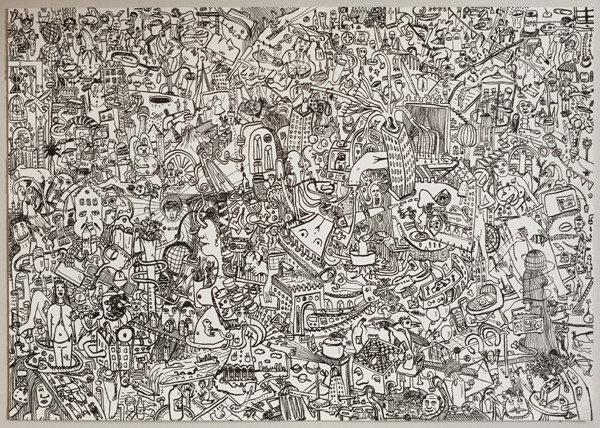
‘Social Media Drawing’ by Tjarko Van Der Pol

This year’s general conference theme for ISA in San Diego centred on ‘Power, Principles and Participation in the Global Information Age’ and, expectedly, gave rise to a proliferation of papers on the value, consequences and effectiveness of platforms such as Facebook, Twitter and other social media in the context of international relations and global politics. Having spent the past three years trying to disentangle the thoughts of one of the more intriguing political theorists on power and politics – Hannah Arendt – it has always struck me that she might have had a word or two to say about the supernova that is social networking as such. I couldn’t help picturing her vigorously engaging with a medium like Twitter, firing off Tweets to relevant interlocutors – @karlmarx no, I think that’s where you’re wrong and dangerous: #history is not ‘made’ by men and #violence not the midwife for a new society! Perhaps even: Yep: RT @karljaspers When #language is used without true significance, it loses its purpose as a means of communication and becomes an end in itself – hashtag and all. Or, on the other hand, flatly dismissing platforms such as Facebook as vanity spheres of little or no substance for political interaction. So I pitched in my paper as a playful thought experiment as to how she might have loved or loathed online social networks as viable platforms and public spheres for the creation of power and conduct of politics proper. This is a somewhat abbreviated version of the full-length paper, which can be found here.

The potency of social networking sites, as channels of communication and a medium for people from all corners of the world to meet in a virtual realm and engage with shared ideas – political or otherwise – has become indisputable. Not least since the Arab Spring uprisings of 2011, where bodies and voices were galvanized to part-take in various acts of revolt and revolution in Egypt, Tunisia, Syria and Libya, facilitated through online networks like Twitter and Facebook, have people discovered the enormous potential for a transnational coming-together in a shared cause. These networks thus appear to present themselves as a global public realm in a virtual space, transcending geographic limitations and boundaries, broadening the scope of possible political impact considerably. But with such a young medium it is perhaps wise to take a step back from the hype and ask how effective are these networks in creating actual political power? In how far can we understand the possibility to mobilize and plan in a non-spatial realm, through social networks, to constitute the generation of power and the actualization of political action? My paper sought to address these questions with an Arendtian lens – for better or for worse.
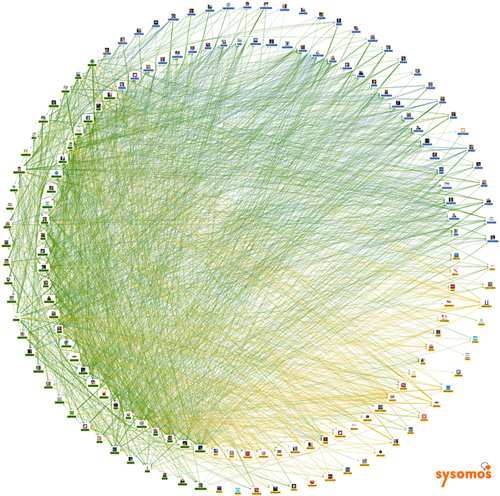
Inside the Political Twittersphere. Sysomos
Continue reading

What We Talked About at ISA 2012: A Human Right to Housing

Housing is a Human Right Exhibition, Philadelphia (original photo by Annie Seng)

I ain’t got no home. I’m just a roamin’ round, just a wandering worker, I go from town to town. And the police make it hard wherever I may go. And I ain’t got no home in this world anymore.

My brothers and my sisters they’re stranded on this road. A hot and dusty road that a million feet have trod. Rich man took my home and drove me from my door. And I ain’t got no home in this world anymore.

Was a farmin’ on the shares and always I was poor. My crops I lay into the banker’s store. My wife took down and died upon the cabin floor. And I ain’t got no home in this world anymore.

Now as I look around it’s mighty plain to see this world is such a great and funny place to be. Ah, the gamblin’ man is rich and the working man is poor. And I ain’t got no home in this world anymore.

-“I Ain’t Got No Home in this World” by Woodie Guthrie

Beginnings Are Difficult

How to start something new? This question troubles the academic as well as the activist. At the moment it troubles me both as a question of inquiry and as a meta-question of method.

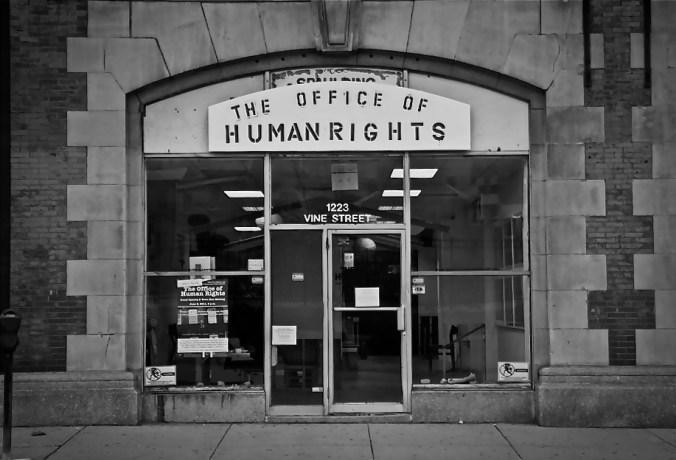
In my previous work I have argued that human rights should be judged first and foremost by the consequences they bring about. Do human rights enable new forms of politics? Do they enable politics that increase the control we have over our lives, or that reduce the suffering and humiliation we are exposed to? Or do they confine us in a liberal subjectivity that makes wider visions of justice impossible, which push us to reconcile our beautiful revolutionary dreams to the limited horizon that contemporary liberal capitalism imposes?

I have offered a qualified defense of human rights as a democratising ethos, which suggests that human rights can enable everyday people to challenge the terms of legitimate political authority, including the institutional shape of their government and the makeup of their communities. This is done by formally opening up the identity of “rights holder” to anyone, regardless of their social position. This opening, however, is only formal and in that formality human rights have an ambiguous significance. For this reason, I have argued that to think of human rights as a democratising ethos also requires that we attend to the politics of human rights. This means that ensuring that human rights support democracy and equality is a political struggle as well as an ethical vision.

Continue reading

The Anglosphere, Part Two: Of Liberal Leviathans and Global Turns

Viewed from the perspective of liberal IR, Britain’s globe-spanning empire can be described as “Liberal Internationalism 1.0.” According to G. John Ikenberry, the “liberal ascendancy” had everything to do with the “growth and sheer geopolitical heft of the world’s liberal democracies.” The British may have been the first to harmonize national interest with the stability, openness and rule-following in the international systems, but it was the Americans who “fused” them. “If the liberal order was built after World War II primarily within the West, the end of the Cold War turned that order into a sprawling global system” [1].

The question that has always fascinated me is how we got from Liberal Internationalism 1.0 to Liberal Internationalism 2.0, or how, to freely borrow from Ikenberry, power shifted between two liberal Leviathans, Britain and the U.S. What is puzzling here is the absence of the Wars of Anglophone Succession. Instead of fighting each other at least once or twice, the two empires first found ways to cooperate and coordinate their imperial activities around the globe, then engaged in what can be described as a pacted transition, even as a corporate merger. Here’s one verdict, taken from “The imperialism of decolonizationpiece by Wm Roger Louis and Ronald Robinson:

The British were welcoming the Americans back into the British family of nations and, informally at least, into the Commonwealth . . . [the post-war empire operated] as part of the Anglo- American coalition . . . like a multinational company.

Putting aside the historiography debates about its scope, timing and sequencing, this historical process was no doubt of momentous importance for the evolution of the liberal order, both in terms of the accumulation of hegemonic power, and in terms of social and institutional learning. The Anglosphere, in other words, begins here. So how do we explain it? Strategic calculus and/or a putatively liberal predilection for cooperation, compromise, and conciliation (last word Churchill’s) are only parts of this story, as Charles Kupchan notes in his How Enemies Become Friends:

British appeasement of the United States and the practice of reciprocal restraint that followed cleared the way for rapprochement. But it was the emergence of a new discourse on both sides of the Atlantic – one that propagated notions such as a “shared Anglo-Saxon race” and an “Anglo-American family” – that produced a compatible identity, consolidated stable peace, and laid the foundations for the strategic partnership that exists to this day.

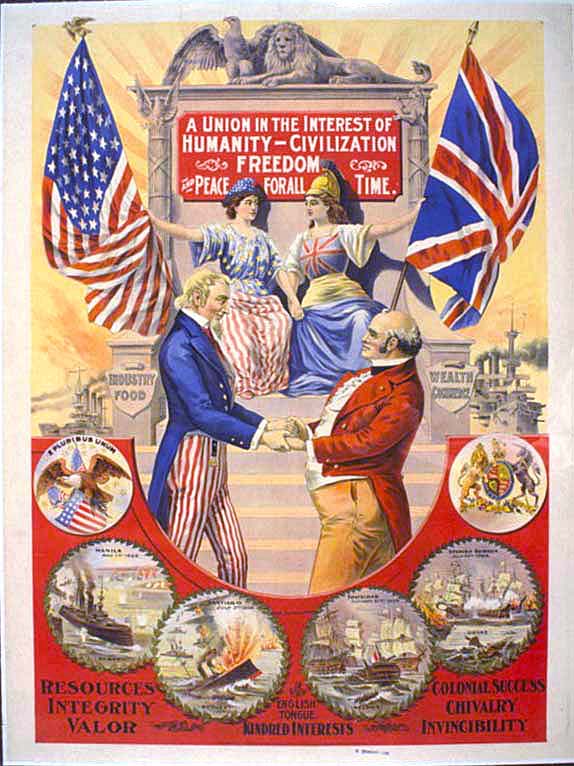
I could not agree more. Racialized identities operate as social structures of power, and this was a time when they explicitly authorized unity and superiority for Us against Them in ways that had profound consequences for the evolution of the so-called liberal international order. Anglo-Saxonism enabled the U.S. and Britain – or their elites – not only to position themselves favourably vis-à-vis each other at the turn of the twentieth century, but also with respect to the rest of the world and in a longer term. The Anglo-American rapprochement was no “global turn” of the sort that Kupchan talks about in his latest book, but it arguably comes close to it in macro-historical term. For one, the paths, pace and outcomes of the 1945-1951 international institution-building spree – that foundation of Liberal Internationalism 2.0 –followed the patterns of UK-U.S. cooperation first established during the colonial wars and near-wars in the 1890s. The much-disclaimed “special relationship” has its origins in this period – something to keep in mind next time we hear that U.S.-hugging remains in someone’s national interest, as General Sir David Richards, the head of Britain’s armed forces, argued last week.

This story I wish to tell can be expanded and contracted empirically (Anglo-Saxonism is dead today, but its effects can be found everywhere from university scholarships to contemporary military alliances) and theoretically (through, say, an account of core-periphery relations that made global capitalism possible), but the main substantive point remains the same, and that is that we cannot fully understand the “liberal ascendancy” without pausing (as Siba Grovogui might say) over the pervasiveness and power of racialized identities that connected Liberal Internationalism 1.0 and 2.0 [2]. Continue reading

The Anglosphere, Part One: What’s in a Name?

What do you get when you intersect indices that rank top two dozen nations of the world by political freedoms, GDP per capita, productivity, literacy, and patent applications in late 2000s? The answer is you get some kind of an “Anglosphere” – usually the quartet of Australia, Canada, the UK, and the U.S., but also, depending on the underlying measures and thresholds, New Zealand, Ireland, Singapore and so on.

Using data from the World Development Indicators, The Economist Intelligence Unit, and International Labour Organisation, among others sources, I’ve played this game in my research methods classes quite a bit. No methods textbook endorses such mindless empiricism, but students, from what I can tell, tend to appreciate the loose structure of the exercise. This is because the objective – familiarizing students with comparison, measurement, scaling, and so on – almost always shifts onto the “why?” questions, at which point everyone (ok, not everyone) tries to come up with his/her social scientific narrative on what makes this or that grouping “interesting,” “different,” or “special.”

Joel Kotkin, one of America’s premier demographers, and his nine collaborators have shown me how this game can be played at an infinitely more sophisticated level. Their argument – developed primarily in a collection of the Legatum Institute papers entitled “The New World Order”, but also in two shorter pieces penned by Kotkin and Shashi Parulekar at NewGeography.com and in City Journal – is that globalized economy by and large operates in and through three large “tribal groupings” or “spheres”: the Indosphere, the Sinosphere, and the Anglosphere [1]. As the authors note, their narrative can claim a formidable intellectual pedigree: “we have followed the great Arab historian Ibn Khaldun’s notion that ethnic and cultural ties are more important than geographic patterns or levels of economic development.”

Kotkin et al offer no shortage of interesting and novel observations and analytical points, but one of the project’s key punchlines is in the title of the Anglosphere section in the New World Order: “We are not dead yet.” The project’s foil, in other words, is the current wave of American declinism:

The era of unipolar domination by the United States and its key allies — which dates from the fall of the Soviet Union — has come to an end. Yet despite this, the core Anglosphere remains by far the largest cohesive economic bloc in the world. Overall it accounts for more than 18 trillion dollars, one quarter of the world’s GDP, far more than any other cohesive global grouping.

Continue reading

The Crisis of Europe and Colonial Amnesia

Recent commentary on the Eurozone crisis has started to pick up the grammar of colonial rule. The centre for Research on Finance and Money at SOAS, for example, has published an influential report wherein northern Europe (Germany especially) is framed as the core and southern Europe (especially Greece) as the periphery. Meanwhile, Ulrich Beck, European cosmopolitan par excellence, wonders whether the European Union will become “a European Empire with a German stamp”. Beck notes that Merkel’s sense of power “conforms to the imperial difference between lender and borrower countries.” At stake, agree many prominent European intellectuals in the pages of The Guardian, Eurozine and Der Spiegel, is no less than the promise of freedom and democracy immanent to the European project itself. All variously agree that, against the imperial sclerosis spread by capitalist and bureaucratic functionaries at the highest levels of governance, what is needed is a rejuvenation of meaningful democracy at a grass-roots level.

Faced with a dismantling of democracy Jürgen Habermas mounts a plea to save the old “biotope of Europe”. The constitutive components of this threatened ecosystem are freedom and democratisation, and its genesis lies in the Second World War and the fight against fascism and “internal” barbarism. The president of the European Central Bank has himself proclaimed that Europe now faces its “most difficult situation since the Second World War”. Alternatively, for many social democratic and leftist commentators, the danger of the situation lies in the loss of the “internal” struggle of labour and capital that defined the Cold War landscape. In the new context of EU institutional “empire” and its neoliberal tentacles, the defeat of labour quickens the erosion of social democracy, thus deciding the fate of the European project.

Europe, then, is perceived to be “colonizing” itself and in the process destroying freedoms and democratic structures that had been hard fought for by the general populace against political oppression and economic exploitation. But this angst-ridden imaginary of European crisis has very little to say about the substantive historical and global dimensions of European colonialism. Does cosmopolitan and social democratic angst cover these legacies and contemporary effects? In fact, in most recent treatises on the crisis the struggle for decolonization is given no integral status, even though these particular struggles were inseparable to and spanned the formative time period of the European project – the Second World War (and the Cold War). Some do mention current issues of migration and xenophobia. Nevertheless the implication, in general, is that colonial legacies are derivative of, or additional to, the core struggle for democracy and freedom in Europe. Fascism, Cold War, class struggle: yes; colonization, imperialism, decolonization and liberation struggle: not really.

Not all intellectuals suffer from this colonial amnesia. A number of scholars including Robert Young, Pal Ahluwalia, Paige Arthur and Alina Sajed have argued that in some key strands of post-War French thought, the issue of colonialism and decolonization was integral to discussions of European re-democratization and humanist concerns. This engagement reached a peak in the Algerian war of independence in the late 50s before falling into abeyance. And this was precisely the same time, we should note, as the Treaty of Rome, which bound European countries together in a tighter economic union simultaneoulsy sought to re-bind (post-)colonial African polities, peoples and resources into this union.

More generally, there has accumulated a significant amount of scholarship that reveals the colonial influences that shaped and were woven into quintessentially “European” intellectual/political movements such as Enlightenment and modernity. Continue reading

It’s Really Kicking Off In Quebec

Despite some news coverage and discussions on Twitter, we’ve seen little on the continuing educational and political crisis in Quebec. Hence, a guest post from our friend and colleague Philippe Fournier. Philippe teaches political thought and International Relations at the Université de Montréal and the Université du Québec à Montréal. He has published research on Foucault and International Relations, Governmentality in the contemporary United States and Violence and Responsibility. He is currently working on the government of security in the US and on the theoretical conflation of sovereign power and government in Foucault. His other research interests include critical cultural theory and political economy.


A little background info and some thoughts on the student crisis in Quebec, which has been going on for 101 days now and shows no signs of waning in the face of the government’s disturbing intransigence. The recent adoption of Bill 78, which circumvents the right to protest without prior notice and gives the police the right to change a demonstration’s itinerary, among other things, has shocked and angered many Quebecers and made the news worldwide. On Tuesday May 22, over 250 000 people expressed their discontent with the current government and it was quite a sight.

Ever since the ‘quiet revolution’ in the early 1960s, which saw the institution of important social provisions and the attribution of several socio-economic entitlements to the francophone majority, Quebec has been holding fast to its social-democratic heritage. Jean Charest’s liberal party, in power since 2003, is determined to fight off the modern-day antichrist of debt and rationalise state activity. The Charest government’s attack on hard fought social entitlements, including accessible post-secondary education (Quebec has the lowest tuition fees in Canada), has been going steady since 2003 but has intensified since 2008. Quebecers were told that it was no longer reasonable to expect affordable public services and that it was high time that we join the pay as you go party.

What is at play in this conflict is no less than the fate of social-democratic expectations in Quebec. These expectations are actively discouraged and discredited by the current political elite. The demands for a tuition freeze by sizeable portions of Quebec’s students are considered unreasonable in many quarters, and seen as a plane expression of bad faith and overindulgence by a majority of Canadians, seemingly stuck in a Stephen Harper induced stupor. The words ‘pragmatic’, ‘realistic’ and ‘rational’ have been duly appropriated by the partisans of deregulation, free-enterprise and individual responsibility. Any suggestions that the latter orientations are based on an ideological choice are ridiculed; they simply express a sounder and more logical way to manage society.

Up to now, there seemed to be a dour resignation to the decimation of our social programs. This young generation of Quebecers, which many had touted as completely apathetic and apolitical, has taken a resolute stand against restricting access to a public good, against the further commodification of knowledge and against the uncompromising law and order approach of an arrogant and irresponsible government. Those that have taken to the streets day after day and sacrificed their terms and put their professional lives on hold for the students that will come after them, have shown extraordinary resilience and bravery. It came as a surprise to many, because they did it on their own, with little or no help from their political science professors, who have long abandoned critical thinking for functionalist replications of reality sanctioned by government money.

Continue reading

What We Talked About At ISA: From #occupyirtheory to #OpenIR?

A write up of my comments at the #occupyirtheory event in San Diego. The event itself was both hope-filled and occasionally frustrating, not least for the small group of walk-outs, apparently ‘political’ ‘scientists’ lacking in any conception of what it actually means to engage in the political (note: this bothered me especially, but was a rather minor irritation in the grander scheme of things). Despite the late hour, there were between 40 and 60 people there throughout, and a number of very positive things have come of it. It looks like there’ll be some gathering at BISA/ISA to discuss further, and we’re pitching something for the Millennium conference on some of the themes addressed below, and there will of course be ISA 2013 too. In the meantime, there’s the Facebook group, the blog, and a mailing list. The term OpenIR is owed to Kathryn Fisher, and seems to several of us to be a better umbrella term for the many things we want to address in the discipline and the academy. I also just want to give a public shout-out to Nick, Wanda, Robbie and Meera for doing so much on this.


The #occupy practice/meme has antecedents. Physical manifestations of a ‘public’, horizontalism, prefigurative politics and more can be traced in all sorts of histories. One such lineage is the foreshadowing of Zucotti Park in recent struggles over education. Take the slogan in March 2010 over privatisation at the University of California, which was ‘STRIKE / OCCUPY / TAKEOVER’. Or Middlesex, where students resisting the dismantling of the Philosophy Department in that same year unfurled a banner during their occupation, one that proclaimed: ‘THE UNIVERSITY IS A FACTORY! STRIKE! OCCUPY!’.

I want briefly, then, to think about the space of the university in our discussions of #occupy. There have been rich and suggestive calls to re-politicise ourselves as academic-activists, to look again at our work and its claims, and to turn our abilities, such as they are, to projects of resistance and transformation. But we risk a displacement. When we talk of ‘the street’, or politics enacted in the reconfigured space of #occupy, or of the ‘real world’ that we must be relevant to, we already miss the university itself as that factory in which we labour. We are tempted by a view of ourselves as leaving ivory towers to do politics, instead of seeing those towers themselves as spaces of politics. As if our institutions and practices were not already part of the world.

Whether you see #occupy as transformational or nor, or whether you simply prefer a different vocabulary, I think a demand remains: a demand to politicise our own positionality. This politicisation can have many dimensions, but I want to suggestively highlight four, each being a sphere in which we should be diagnosing and transforming our own practices.

Continue reading

Whitewashing History


The Morning Post, 1913 – on the violence of the suffragette movement:

Early yesterday morning some women succeeded in burning a valuable house near Trowbridge. In the night of Monday to Tuesday ROUGH’S boathouse on the river at Oxford, near the Long Bridges, was seen to be on fire. It was impossible to save the building or the boats which it contained. Nailed to the bridge near was found a card with the words “Votes for women. No peace till we get the vote.” The presumption is that the boathouse was set on fire, the KING’S horse was stopped, and the Trowbridge mansion was destroyed by some of the females who are discontented with the structure of society. Whether that be the case or not – it is quite possible that the truth may not be ascertained – the action is typical of much that has happened lately and deserves thinking about. Indeed, if we are to believe the leaders of the “movement”, the purpose with which these things are done is to make men think. The question is, What are we to think? The planned and deliberate destruction of property is intelligible as an expression of anger against the owner. But as the wellbeing of society depends upon the security of persons and property against wilful attacks, such attacks are regarded as crimes, and one of the principal purpose for which society is organised is to prevent such acts and to punish those who commit them. But in the class or cases which we are considering there is not motive or animosity against the particular person whose property is destroyed. Those who do them have not the personal hatred which usually explains such doings. If this were an isolated case, if it were found that a house had been wilfully set on fire by a young lady well brought up and accustomed in other respects to behave herself well, a jury would probably come to the conclusion that she was not in her right mind, and the Court order that she should be taken care of until she was restored to complete sanity. But the present case is not isolated. There is an epidemic of the state of mind which produced it; it is but one of a large number of similar cases. This frame of mind cannot possibly be considered healthy. The acts which it produces constitute a war, not only upon society as at present constituted but upon any conceivable state of society because it is impossible to imagine any community of human beings not based upon laws for preserving the security of property as well as of life and society, the propounds of the most astounding schemes for the reconstruction of the community, have ever propounded a plan which would not guarantee the work of and man’s hands against wanton and wilful destruction. The women who go about setting fire to houses seem, therefore to have their thoughts out of gear. In most respects apparently their minds work as other people’s do, but the epidemic of arson appears to be a form of monomania. This quality of the minds concerned noes not disappear under an examination of the alleged motive. These ladies say that women ought to have the same political rights as men, and in particular the Parliamentary franchise, and they assert that women are qualified to be members of the body polite. But it is unthinkable that a person who refuses to recognise the fundamental condition upon which every society is founded can be qualified for membership in that society. The person whose mind works in that way is inaccessible to reasonable arguments.

**********

Mahatma Gandhi – on violence:

I do believe that, where there is only a choice between cowardice and violence, I would advise violence… I would rather have India resort to arms in order to defend her honour than that she should, in a cowardly manner, become or remain a helpless witness to her own dishonor.

Continue reading

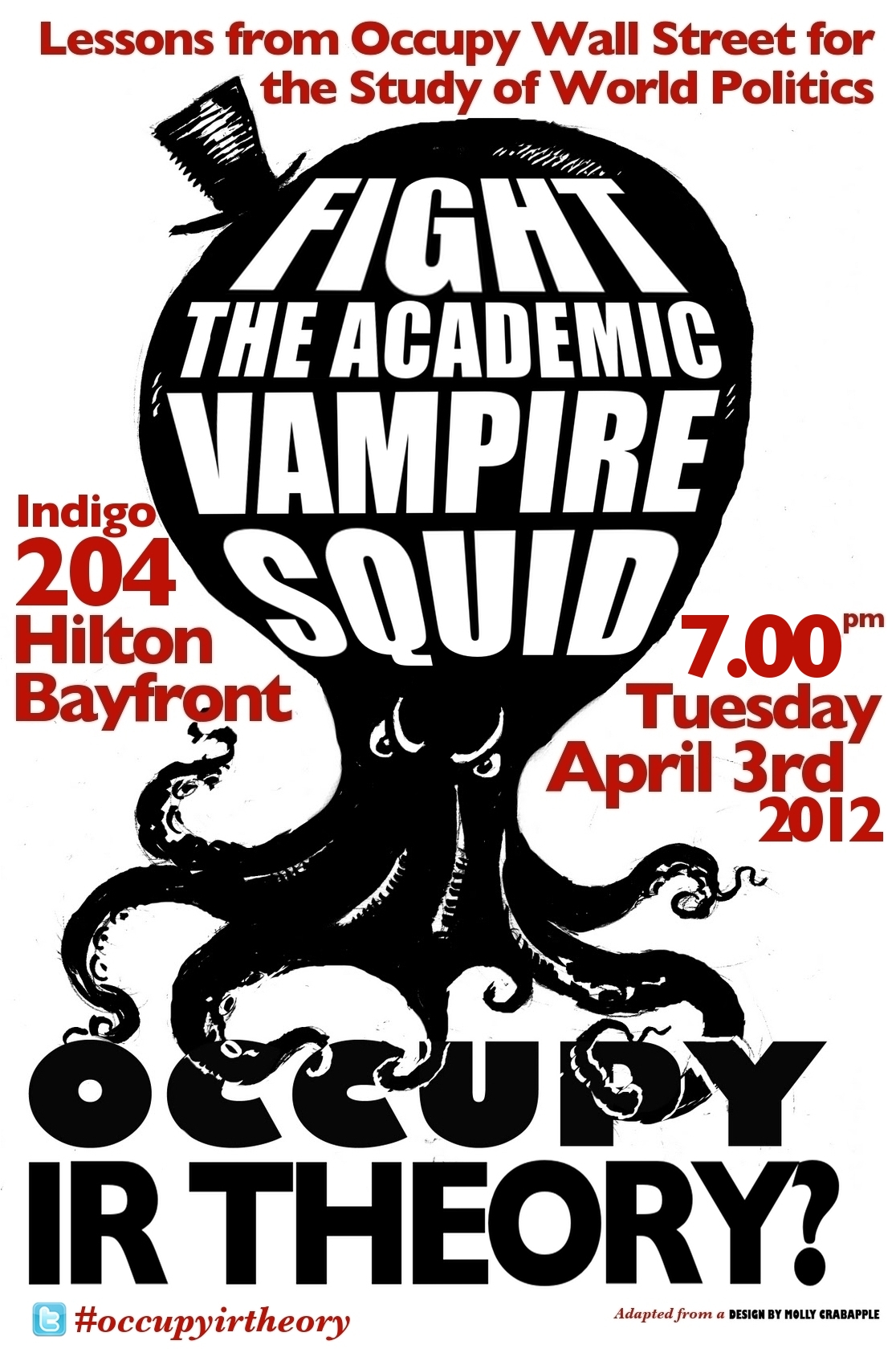
#occupyirtheory, International Studies Association (San Diego) Edition

ISA 2012 is just around the corner, and it will doubtless be as hectic and awkward and joyous as ever. Robbie and I will be appearing at an event on #occupy and its relevance for IR on Tuesday at 7 in Indigo 204 at the Hilton Bayfront. We’ll be joining Lucian Ashworth, Lara Coleman, Nicholas Kiersey and Wanda Vrasti (all chaired by Jason Weidner) for what I’m sure will be an exciting roundtable discussion. More importantly, it will be brief, with most of the session given over to a General Assembly-style discussion of what IR can learn from #occupy, what #occupy might get from IR, and how we might take the spirit and organisational form into the discipline itself (or not).

The hope is that the slightly later starting time will allow people to go both to the various Section receptions and meetings (briefly) and to come to this, whilst still leaving reasonable evening time for food and the rest. Please do get involved over at Facebook (see also the #occupyirtheory group and #occupyirtheory blog) and let interested IR-types know. Readers may also be (should also be!) interested in a recent forum from the Journal of Critical Globalisation Studies on ‘Occupy IR/IPE’, featuring Nick and Wanda (as well as Colin Wight, Michael J. Shapiro, Patrick Jackson and others), which I’ve parcelled together as a single pdf for your delectation here.

Hope to see you there!

Human Rights Contested – Part I

This post (presented in two parts) is drawn from a review article that will be forthcoming in The Journal of Intervention and Statebuilding, which looks at a recent set of critical writings on human rights in order to consider the profound limitations and evocative possibilities of the contested idea and politics of human rights.

Human Rights in a Posthuman World: Critical Essays by Upendra Baxi. Oxford: Oxford University Press, 2009.

Surrendering to Utopia: An Anthropology of Human Rights by Mark Goodale. Stanford, CA: Stanford University Press, 2009.

The Divided World: Human Rights and Its Violence by Randall Williams. Minneapolis, MN and London: University of Minnesota Press, 2010.

After Evil: A Politics of Human Rights by Robert Meister. New York, NY: Columbia University Press, 2011.

The central tension of human rights is that they propagate a universal and singular human identity in a fragmented political world. No one writing about human rights ignores this tension, but the most important question we face in judging the value of human rights is how to understand this tension and the divisions it creates. The expected divisions between good and evil, between moral universalists and dangerous relativist, between dignified interventionists and cowardly apologists, have long given shape to human rights, as both an ideal and a political project. Seeing the problems of (and for) human rights in these habituated ways has dulled our capacity for critical judgment, as few want to defend evil or violent particularisms or advocate passivity in the face of suffering. Even among serious and determined critics our inherited divisions are problematic (and increasingly over rehearsed), whether we think of human rights as the imposition of Western cultural values, or in terms of capitalist ideology serving the interests of neo-liberal elites, or as an expression of exceptional sovereign power at the domestic and global levels. The ways that these divisions deal with the tension at the heart of human rights misses the ambiguity of those rights in significant ways.

     Rather than trying to contain the tensions between singularity and pluralism, between commonality and difference, in a clear and definitive accounting, the authors of the texts reviewed here allow them to proliferate. Rather than trying to resolve the problem of human rights, they attempt to understand human rights in their indeterminate dissonance while exploring what they might become. To create and invoke the idea of humanity is not a political activity that is unique (either now or in the past) to the ‘West’. The people most dramatically injured by global capitalism sometimes fight their oppression by innovating and using the language and institutions of human rights. Political exceptions – the exclusion of outsiders, humanitarian wars and imperialist conceits – are certainly enabled by the same sovereign power that grants rights to its subjects, which is a metaphorical drama all too easily supported by human rights, but it is only a partial telling of the tale, a telling that leaves out how human rights can reshape political authority and enable struggles in unexpected ways. The work of these authors pushes us to reject the familiar divisions we use to understand the irresolvable tension at the centre of human rights and see the productive possibilities of that tension. If human rights will always be invoked in a politically divided world, and will also always create further divisions with each declaration and act that realises an ideal universalism, then our focus should be on who assumes (and who can assume) the authority to define humanity, the consequences for those subject to such power, and the ends toward which such authority is directed. Continue reading