Economy of Force: A Reply

In which Patricia Owens responds to our four commentaries (on patriarchy, colonial counterinsurgency, biopolitics and social theory) on her Economy of Force.


I’m extremely grateful to Pablo K, Elke Schwarz, Jairus Grove, and Andrew Davenport for their serious engagements with Economy of ForceAs noted in the original post, the book is a new history and theory of counterinsurgency with what I think are significant implications for social, political and international thought. It is based on a study of late-colonial British military campaigns in Malaya and Kenya; the US war on Vietnam; and US-led campaigns in Afghanistan and Iraq against the background of the high colonial wars in the American Philippines and nineteenth-century French campaigns in Tonkin, Morocco and Algeria. Probably the emblematic case for the book is Britain’s colonial state terror against Kenya’s Land and Freedom Army and civilians in the 1950s, a campaign that was closer to annihilation than ‘rehabilitation’. Although the so-called ‘hearts and minds’ campaign in Malaya is held up by generations of counterinsurgents as the model for emulation, the assault on Kikuyu civilians shows the real face of Britain’s late-colonial wars. It also points to some profound truths about the so-called ‘population-centric’ character of more recent campaigns in Afghanistan and Iraq. Though offering new readings of some better-known counterinsurgency cases, Jairus Grove suggests that this choice perpetuates an erasure of America’s ‘Indian Wars’.
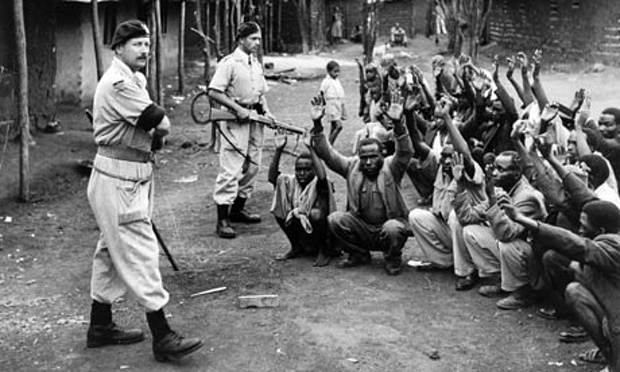
Mau-Mau

Researching Economy of Force, I certainly became aware of the general significance of these wars, including through Andrew J. Birtle’s and Laleh Khalili’s histories of counterinsurgency. However, Grove draws attention to something more relevant to Economy of Force than appreciated before: “one of the first federal bureaucracies with jurisdiction over the home and social issues”, he writes, “was created by and administered by the War Department”. Decades before the distinctly ‘social’ engineering during the Philippines campaign (1899-1902), the Bureau of Indian Affairs was administering indigenous populations on the mainland. In focusing on overseas imperial wars, Economy of Force surely neglects settler colonialism, its genocides, and how “warfare, pacification, and progressivism were an assemblage in the US context from the outset”. While the book was not centrally focussed on US state making, I’m grateful to Grove for insisting that settler colonialism is necessarily a form of counterinsurgency. To be sure, the Philippines campaign was examined not as the founding moment of American counterinsurgency, but because it was explicitly conceived by contemporaries as a form of overseas housekeeping; to problematize progressive social policy; and to challenge the effort to separate good (domestic) social engineering at home from bad social engineering (overseas). I would hesitate to wholly assimilate the Progressive Era (1890s-1920s) into earlier Indian Wars, though its ‘social reforms’ shaped indigenous administration. But these are quibbles. Grove is right that I have neglected something of significance in the ‘historical trajectory from Thanksgiving to Waziristan’. I hope to be able to rectify this in future work.

Continue reading

The Stories We Tell About Killing

The third piece in our forum on Economy of Force (following Patricia’s opening and Pablo’s piece on patriarchy), and the first contribution to The Disorder of Things from Jairus.


Narrative: The central mechanism, expressed in story form, through which ideologies are expressed and absorbed.

– Glossary, U.S. Army Field Manual 3-24

Patricia Owens Economy of Force is, to date, the most important book that has been written on counter-insurgency. To put it another way, Economy of Force is the first book written with the sobriety of distance from the necessary but often polemical responses to Human Terrain and the high-profile ‘anthropologists’ of war in Iraq and Afghanistan.

The shortcoming of these earlier responses was the tendency to treat contemporary efforts in Afghanistan and Iraq as somehow new. Lost in the flurry of shock over academic involvement in warfare was the understanding that social theory has, in some sense, always been at war. It is this last point that Owens’ book really excels at theorizing. Unlike other explorations of counter-insurgency that emphasize the ‘weaponization’ of social theory and anthropology, Owens locates counter-insurgency as an outgrowth of liberalism and its governance of the social, specifically the domestic. This difference is vitally important. In the work of Roberto Gonzalez and others, we are left with a sense that anthropology and social work could be demilitarized. However, the genealogy of ‘home economics’ given to us by Owens’ suggests that the very concept of the social is rife with the desire for order, which is often established by violent means.

HTT 12
This places the first part of Owens book alongside Michel Foucault’s three biopolitics lectures, in particular Security, Territory and Population, as well as Domenico Losurdo’s Liberalism: A Counter-History. In their own way these works attempt to reconstruct the philosophical and political history of liberalism as beginning with the violence of racial and economic ordering, rather than seeing liberalism as having fallen from grace as a result of the temptation and corrosive effects of empire. Owens, Foucault, and Losurdo all find liberalism’s logic of governance to be in the form of what Foucault famously called ‘war by other means.’ What distinguishes Owens’ work from Foucault and Losurdo is that she follows this line of logic through to the particular formation of a liberal way of war called counter-insurgency. Owens’ foregrounding of counter-insurgency is a much needed corrective to Foucault’s conclusion in Security, Territory, and Population, where he argues that external relations in the state system of Europe were characterized by balance of power politics. Entirely absent in Foucault’s development of the concept of race war in Society Must be Defended and Security, Territory, and Population is the particularities of European imperial and then colonial enterprise. This becomes even more apparent in the final lectures The Birth of Biopolitics, in which the brilliant and prescient account of the rise of neoliberalism in the U.S. leaves out entirely the anti-black racism that animated the war on the welfare state. Owens’ more internationally situated account does not ameliorate all of these shortcomings, but does put us on the road to doing so. In fact, her genealogy of the domestic is not about refining our understanding of the social in social theory, but about showing how essential and under-theorized the domestic is in the field of International Relations, which relies essentially on the difference between the foreign and domestic.

Continue reading

Economy of Force

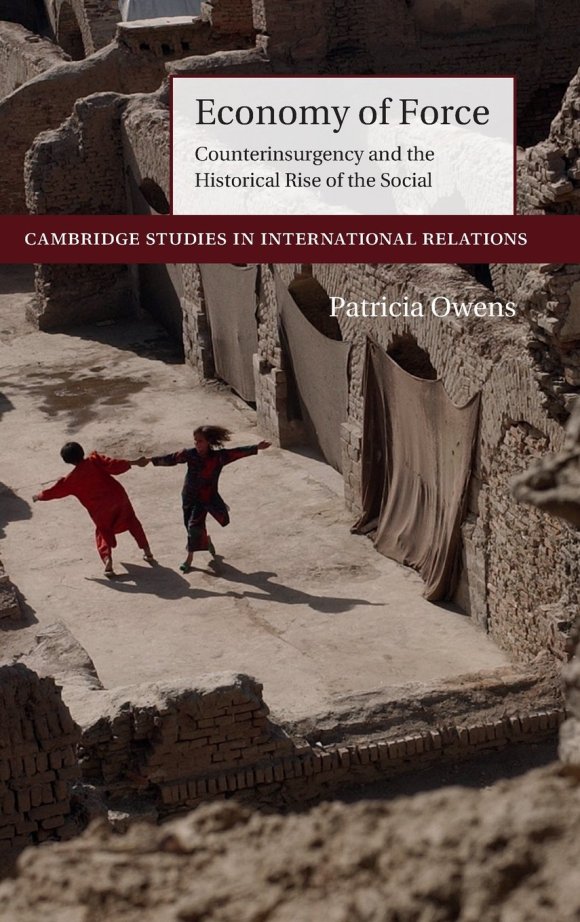
We return from the holidays with gusto and a book symposium on Patricia Owens’ Economy of Force: Counterinsurgency and the Historical Rise of the Social (Cambridge, 2015). Patricia is Professor of International Relations at the University of Sussex, co-editor of European Journal of International Relations, and a former fellow of the Radcliffe Institute for Advanced Study at Harvard University and of Oriel College, Oxford. Patricia’s first book was Between War and Politics: International Relations and the thought of Hannah Arendt (Oxford, 2007). Economy of Force is in the Cambridge University Press series ‘Studies in International Relations’ and is out in paperback next summer (the introduction is available in full here). The book will also be the subject of a forthcoming special section of Security Dialogue.


Economy of Force

Economy of Force seeks to rekindle interest in one of the oldest but neglected languages and techniques of government administration – household governance – that it uses to write a new history and theory of counterinsurgency with broad implications for social, political, and international thought. The book is a study of oikonomia in the use of force, from oikos, ancient Greek for household. But it also makes a larger claim, that household governance underlies the relatively recent rise of distinctly social forms of government and thought more broadly. Since the late eighteenth-century, modern, capitalist state and imperial administrators have drawn on and innovated different forms of household governance, scaling up and transforming the units of rule in which populations are domesticated. To really understand the significance of households-as-government we need to dispense with the relatively recent and bourgeois notion of households as houses, homes, or family-as-kin. Instead, households are best understood through the nature of the hierarchical relations between people in a particular spatial arrangement. Households are the persistent but historically variable spaces in which the life processes of members – real, vulnerable bodies needing food, water, shelter – are administered and the household itself is maintained.

There is a very long tradition of thinking of households-as-government in the history of political and economic thought and in anthropology, archeology and comparative studies of different household forms. There is also excellent and wide-ranging scholarship in literary and gender studies on practices and ideologies of domesticity (from domus, Latin for house). In drawing on and extending these and other literatures, Economy of Force suggests that there is a far deeper significance of households and forms of domesticity than captured in International Relations debates about the so-called ‘domestic analogy’. Household administration is highly portable and plays a remarkably significant role in imperial and international relations. These are grounds to make a stronger claim than one based on mere analogy. I argue that there is a domestic homology connecting different households, despite their historical and geographical variability, based on the genealogy of household governance in the history of social and political thought, but also the human experience of basic life necessities and the stubborn but contingent attempts to domesticate people through the administration and control of life needs.

Continue reading

(Why We Can’t) Let the Machines Do It: A Response to Inventing the Future

The fourth post in our (already pretty popular) forum on Nick and Alex Williams’ Inventing the Future, this time from Sophie Lewis and David M. Bell. Sophie is at the University of Manchester, writing up a PhD on surrogacy’s uneven ‘cyborg’ geography and thinking about its utopian potential. She has written about surrogates for JacobinThe New Inquiry, and The Occupied Times; currently, excerpts are included in the 2015 “Technotopia” symposium. She also writes with the Out of the Woods (anticapitalist ecology) collective. She has co-translated Bini Adamczak’s Communism For Kids and written things that appear in Mute, Open Democracy, the ‘Demanding the Future’ tumblr, and on Novara WireDavid M. Bell is a Research Associate on the ‘Imagine’ project in the Department of Geography, University of Sheffield. He is interested in the potentials and dangers of utopia(nism) within, against and beyond capital, the state and itself. He has written on the politics of musical improvisation, utopian fiction and participatory arts practice; and is currently working on two book projects: Rethinking Utopia: Place, Power, Affect, to be published by Routledge in 2016; and A Future History of Sheffield: Art Practice, Hope and the City, with Jessica Dubow and Richard Steadman-Jones.


To The Future! But Whose?

To The Future! But Whose?

1. 

Inventing the Future provides a ‘plausible programme for ‘a world free of work’. It ‘shows us how we can organise’ to ‘realise a postcapitalist world’. So state its back-cover endorsements by Mark Fisher and Paul Mason. You should never judge a book by its blurb, but these claims are not to be sniffed at: here are two prominent thinkers of the UK left positioning this book as, if not a blueprint for utopia, a blueprint for utopianism – a roadmap that doesn’t quite cover the future but certainly takes us to its outskirts. The hyperbole continues away from Verso’s official promotional campaign too: Novara Media founder Aaron Bastani has publicly suggested that Corbyn’s Shadow Cabinet receive copies of the book’s chapters as bedtime reading pamphlets. We are not so sure. There is much of value in Inventing the Future (hereafter ItF); and it certainly opens up space for thinking about what might be and how we might get there. But there are serious questions about who this future is for, whose labour (re)produces it, and who it will continue to exclude.

Before the reader is let in on how we can invent the future, however, they need to be disabused of various notions that are holding it back. These are grouped together under the rubric of ‘folk politics’ – a supposed ‘constellation of ideas and intuitions within the contemporary left that informs the common-sense ways of organising, acting and thinking politics’ (p. 10). Its key features are the privileging of ‘local particularisms’; the spatially and temporally ‘immediate’ (and ‘unmediated’); ‘resistance’; and the ‘natural’. The attitude that Srnicek and Williams (hereafter S&W) take to this assemblage is remarkably similar to Marx and Engels’ position on utopian socialism: it was necessary in that it locally kept alive the possibility of alternative ways of living while large-scale political change was impossible, but once the material conditions for totalizing political change (supposedly) arrive, revolutionaries should embrace them and move beyond their quaintly uninspiring New Lanarks, exchange banks and workers’ associations. The time! is! (was!) now! (then!).

Against ‘folk politics’, S&W believe that a return to universalism is necessary for the invention of the future. Whilst acknowledging the colonial history (p. 76) of the universal and rejecting ‘Eurocentricism’ (pp. 77-78), they nonetheless argue that abandoning this structure of thought entails ‘licensing all sorts of oppressions as simply the inevitable consequence of plural cultural forms.’ (p. 77) This seems odd given that so many Indigenous and pre-colonial practices, identities, sexualities and cosmologies with liberatory potential have been destroyed in the name of universalism; and whilst these are acknowledged with the claim that there are non-European forms of ‘reason’, ‘science’, ‘progress’ and ‘freedom’ (p. 77), we are not convinced that these decidedly European terms are the most suitable labels for them. (What does ‘progress’ mean for cultures whose temporalities are nonlinear, for example?). We are more heartened, however, by the call for a universalism that is ‘pluri-versal’ and ‘does not entail homogeneity…does not necessarily involve converting diverse things into the same kind of thing’ (here, S&W refer to capitalism’s ability to sustain and draw power from diverse forms of social organization); and which ‘must recognise the agency of those outside Europe…in building truly planetary and universal futures.’ (p. 78) Continue reading

Postcapitalist Ecology: A Comment on Inventing the Future

The third post, and second guest, in the Disorder’s forum on Nick and Alex Williams’ Inventing the Future. Joseph Kay writes on climate change and libertarian communism with the collaborative blog Out of the Woods.


Having drafted the following comment on Nick Srnicek and Alex Williams’ (henceforth S&W) Inventing the Future: Postcapitalism and a World Without Work, it reads more critically than I expected. In mitigation, I should say that I’m on-board with many of the key themes of the book. I am wholly sympathetic to anti-work politics, generally in favour of automating away toil (with qualifications which will become apparent), and agree that the replacement of global capitalism requires scalability, comfort with complexity, long-term strategy, utopian imagination, and a plurality of organisational forms and infrastructure.

The critical tenor of what follows arises less from disagreement as such, than from my focus on what appear to be the ecological silences in the text. In particular, I focus on the implied conception of nature imported through S&W’s adoption of an avowedly modern rhetoric of progress and control, and on the unmentioned premises of both the project of full automation, and their more general contention that “we are usually not better off taking the precautionary path” (p.177). My argument is not to reject a high-tech, low-work future, but to outline some of the problems to be addressed in rendering such a ‘hyperstitional’ image ecological.

Modernity and the Ideology of Nature

Early on in Inventing the Future, S&W summarise their thesis:

If complexity presently outstrips humanity’s capacities to think and control, there are two options: one is to reduce complexity down to a human scale; the other is to expand humanity’s capacities. We endorse the latter position.

Read in an ecological light, the conjunction of ‘think and control’ affords two readings. The first and obvious reading is that their argument is situated within what Neil Smith called the ideology of nature. Smith argued that the ideology of nature had two poles. The first, a modernising politico-theological argument which saw scientific progress as the means to conquer and subdue nature. Here, the imaginary is mechanical, and separation from – as dominion over – nature is understood as an emancipatory process.

Continue reading

Let’s Talk About the “Ugly Briton”: Shashi Tharoor on Winston Churchill

October is always a good time to catch up on one’s correspondence from July.  “FYI,” noted a friend though FB’s messaging system, linking to this:

The video’s title, “Dr Shashi Tharoor MP – Britain Does Owe Reparations,” sums it up.  The other videos from the same debate event are worth watching, too, but Tharoor’s is quite simply a must-see for anyone interested in the British Empire.  Indeed, you have probably seen it already.  With 3 million views, 6000+ comments plus what seem to be hundreds of reactions by all kinds of people in all kinds of media of communication, this one 15-minute video alone can legitimate Oxford Union Society claim’s that it aims “to promote debate and discussion not just in Oxford University, but across the globe.”

Why is it that Oxford Union struck social media gold with this debate but not with some others (“socialism does (not) work,” anyone)?  Even if it is safe to assume that “many” people would be familiar the reparations argument in general and even that “some” would be familiar with Britain’s reparations to the Maori, the fact is that “no one” had given a fig about the case for Indian reparations [1].  My scare quotes are meant to signal that these quantifications are relative.  It was a century ago that Dadabhai Naoroji, known to some as the Grand Old Man of India, argued that “immediate” self-government, a.k.a. swaraj, would constitute Britain’s “reparation”.  But this is precisely the point: reparations-talk becomes itself only when subjected to a sufficient degree of metropolization or mainstreaming [2].  White academics like Boris Bittker started paying attention to the legal argument for “black reparations” only in 1969, after James Forman famously stood up in a New York City church to argue that white churches owed a lot of money to a lot of people.

Continue reading

Fragments from a Critical Geography Conference: ICCG Ramallah, July 2015

A guest post from Lisa Tilley. Lisa is a GEM Doctoral Fellow at Warwick and ULB. Her research has taken place in sites of extraction (urban slums and rural settlements) in Indonesia and draws on political ecology and political economy, as well as postcolonial and decolonial thought. An earlier version of this post is also available at the wonderful new resource that is Global Social Theory.


If this farm had not been ravaged
I could have become an olive tree
or a geography teacher
or an expert of the kingdom of ants
or a guardian of echoes

– From Mahmoud Darwish’s The Dice Player (visual version here)

Writing/Speaking/Thinking the Global Palestine

The settler colonial condition can be fully understood only by those who live it. But the rest of us can at least bear witness in the place (Palestine) where it is most legible.

Since the Nakba (catastrophe) of 1948 when 800,000 Palestinians were expelled and 536 towns and villages were deleted from the map the fast and slow erasure of Palestine has continued as an active political project.[1] Zionist leader Chaim Weizmann encapsulated the unrelenting strategy of everyday dispossession in the phrase: “another goat and another acre”.[2] This has been paralleled too by fast and slow memoricide, the deleting of the artistic, historical and cultural existence of Palestine.[3] Tahrir Hamdi calls these the “two movements” of erasure, the cultural and the material.[4] Two movements working not towards the goal of Palestine no longer is but towards the goal of Palestine never was.

Doing a geography conference (ICCG) in Ramallah was therefore an organised act of defiance against Palestinian erasure (“Welcome to Palestine […] its geography lives”).[5] Continue reading

Three Theses on ISIS: The Universal, the Millenarian, and the Philistine

Nimer SultanyA warm welcome to Nimer Sultany who brings us a guest post on thinking about ISIS. Nimer is Lecturer in Public Law, School of Law, SOAS, University of London. He holds an SJD from Harvard Law School. He practiced human rights law in Israel/Palestine, and was the director of the Political Monitoring Project at Mada al-Carmel – The Arab Research Center for Applied Social Research. His recent publications include: “The State of Progressive Constitutional Theory: The Paradox of Constitutional Democracy and the Project of Political Justification” in the Harvard Civil Rights – Civil Liberties Law Review and “Religion and Constitutionalism: Lessons from American and Islamic Constitutionalism” in the Emory International Law Review.


The ruthless brutality of the Islamic State in Iraq and Syria (ISIS or ISIL) unfolds before our eyes on the screens. As commentators struggle to explain and understand it, it becomes convenient to revive old Orientalist tropes. Beyond the spectacular brutality, the reason that ISIS invites attention (both fascination and fear) is that it seems easy to fit in confrontational narratives of Islam (us v. them, anti-American, etc.). Muslims are clearly angry at something. In his infamous article “The Roots of Muslim Outrage”, Bernard Lewis simplistically explained that Muslims are envious of, and angry at, Western modernity and secularism. The U.S. magazine Newsweek illustrated this knee jerk reaction, and recourse to run of the mill thinking patterns, in a Muslim Rage cover in September 2012.

o-NEWSWEEK-MUSLIM-COVER-facebook

In his book “Covering Islam” (1981) Edward Said has effectively critiqued these binary simplifications that dominate not only journalistic discourse about “Islam”, but also expert-talk about Islam. For Said, all attempts to conceptualise other cultures are a value-laden interpretive exercise. He showed the deficiencies of orthodox writings on—and views of—Islam, and called for “antithetical knowledge” to challenge the orthodoxy’s claims of value-free objectivity.

It seems little has changed, however, since Said wrote his book in the wake of the Iranian revolution. In this brief commentary I want to examine three attempts to understand ISIS. These are long treatments in respected liberal media outlets. To use Said’s phrase, these are treatments that fit in different “communities of interpretation.” These three essays are all aware of the need to provide “context” for ISIS. However, their contextualisation differs. The success of this contextualisation in shedding a light on ISIS varies. Let me call these interpretive techniques: universalization; Millenarian confrontation; and intellectual bewilderment. These three attempts operate mostly on the ideational/ cultural domain.

Continue reading

Capitalism: A History of Violence

Alexander Anievas and TDOT resident Kerem Nişancıoğlu introduce their new book How The West Came to Rule: The Geopolitical Origins of Capitalism.


‘For the last two decades, challenges to the inequalities and injustices of capitalism have been casually dismissed by a status quo swimming in hubris. From Margaret Thatcher’s infamous proclamation that ‘there is no alternative’ to Francis Fukuyama’s declaration of the ‘end of history’, the study and critique of capitalism has been relegated to margins of public discourse. More recently, Mark Hunter argued that any attack on capitalism is ‘an attack on human nature’, thereby reaffirming the now centuries-old conceit that capitalism is as ‘natural and organic’ as living and breathing.

However, as stock markets came crashing down in 2008, the force of history reasserted itself in a series of revolutions, square occupations, anti-austerity protests, strikes, riots, and anti-state movements taking place from London to Ferguson, Athens, Cairo, Istanbul, Rojava, Santiago and beyond. Such movements have torn at the certainties of ‘capitalist realism’ and started sporadically – if inconsistently – challenging such long-held ‘common sense’ truisms and the power structures that bolster them.

howthewest

Continue reading

What We Talked About At ISA2015: A Debate Around John Hobson’s ‘The Eurocentric Conception of World Politics’

Below is the text of my intervention at a roundtable organized by Alina Sajed entitled ‘Race and International Relations—A Debate Around John Hobson’s The Eurocentric Conception of World Politics‘. TDoT has hosted a symposium on the book: you can read an initial post by John, commentaries from Meera, Srdjan and Brett, and a reply from John. I’ve tried not to cover the same ground.

While race and racism have recently become topics of increasing interest in the rather parochial world of IR scholarship, few books have ranged so widely across time and thinkers as John Hobson’s The Eurocentric Conception of World Politics. This is a monumental work of scholarship that accumulates a staggering amount of evidence, were further proof necessary, of the white supremacist and/or Eurocentric foundations of IR as a discipline (I use the ‘and/or’ advisedly, because much of the debate that the book has generated and some of my own critique focuses on the complex relationship between the formations that Hobson identifies as ‘scientific racism’ and ‘Eurocentric institutionalism’, about which more in due course). So whatever my problems with the book, I want to endorse it as a deeply necessary intervention in the IR academy. Nonetheless, I find myself in sharp disagreement with some of its central claims in ways that have not been fully addressed in earlier discussions. I will focus here on two areas of disagreement: first, the book’s treatment of Marx, Lenin and Marxism in general; and second, its crucial distinction between ‘scientific racism’ and ‘Eurocentric institutionalism’.

Why focus on a critique of Marxism as Eurocentric and/or imperialist? (Again the ‘and/or’ seems necessary because Hobson’s careful mapping of European thought finds conjunctions of racism and/or Eurocentrism with both imperialist and anti-imperialist sensibilities). Partly this comes out of my own intellectual investment in denying what I believe to be the false choice that is often presented between Marxism and postcolonialism. As such, I find myself troubled as much by Marxist work that repudiates postcolonialism as I am by the opposite tendency (which I think is at work in this book). But partly this also comes out of a sense that if Marxism were in fact as Eurocentric and/or imperialist as Hobson suggests, this would leave inexplicable its enormous appeal in the Third World both in the heyday and aftermath of the great decolonization and liberation movements that it informed. More prosaically, I think Hobson’s readings of Marx and Lenin are temporally truncated and therefore somewhat misleading.

Continue reading