The Global Transformation: A Response

The final post in our forum on The Global Transformation, in which Barry Buzan and George Lawson respond to the points raised by Julian Go, Jeppe Mulich and Jamie Allinson. The original post, summarising the book is available here. The book will also be discussed further at the ISA conference in New Orleans and a launch at LSE.

[Editor’s note: The authors are not responsible for the images in this post. But it’s Friday.]


Given the ‘excess’ of contemporary academic production, it is a rare treat to have colleagues engage seriously with your work. We therefore offer our heartfelt thanks to Julian Go, Jeppe Mulich and Jamie Allinson for their close reading of our book and for their thoughtful critiques of it. We offer our equally heartfelt thanks to the editors of The Disorder of Things, particularly Meera Sabaratnam, for investing a considerable amount of time in organising and publishing these commentaries.

The interventions by Go, Mulich and Allinson raise two main issues: the first relates to our use of, and contribution to, theoretical debates, particularly those around imperialism, and uneven and combined development (UCD); the second concerns the relationship between history and theory, most notably our use of macro-historical frames such as ‘modernity’. We discuss these issues in turn.

On theory

Julian Go is right that The Global Transformation ‘expressly rejects any grand theoretical narratives or systems’. He is also right that we do not use ‘categories derived from a larger and more comprehensive theoretical system’. And, however tiresome it is to keep agreeing with your critics, Go is once more right in saying that our use of uneven and combined development is not meant to correct this shortcoming – as we discuss below, we use UCD as an analytical shorthand rather than as a theoretical schema containing a range of causal claims.

Why is this the case? The first reason is strategic. At the beginning of the project, we had several choices to make: whether to pitch the book primarily to an IR audience or whether to also take some swings at cognate disciplines; whether to get drawn into internal debates associated with particular theoretical schemas or seek out a position in-between, or perhaps above, the fray; how to balance big picture and fine-grained historical analysis, and more. In each of these instances we chose the easy option – easy not in the sense of being straightforward to do, but in the sense of ‘less is more’. For example, rather than spend much time on the shortcomings of disciplinary historical sociology when it comes to its ‘occlusion of the global’, we concentrated on what historical sociology (and economic and world history) contributes to IR debates. Given that the answer to this was ‘quite a lot’, we made this our primary concern. Similarly, rather than distract ourselves – and readers – with the minutiae of debates internal to the whys and wherefores of ‘the global transformation’, we constructed a composite argument that assembled diverse storylines into a single narrative. To be clear – we are not saying that we neither built on, nor took a stand on, many of these debates, not least around the ‘internalism’ and Eurocentrism of many existing accounts. Rather, we made a deliberate decision to take an ecumenical approach, building on insights from a variety of theoretical churches rather than sticking to a single tradition.

Hindu-Jesus Continue reading

When Ernest Met Leon

This is the fourth post in our forum on Buzan and Lawson’s The Global Transformation, from our own Jamie. The opening post, responses from Julian Go and Jeppe Mulich, and the authors’ rejoinder are all live.


Imagine that you are a collier in one of the mining districts of central Scotland in 1799. You spend your days hewing minerals from the earth, as your predecessor of one century before almost certainly did. You eat a similar, limited, diet and probably return from darkened pit to tallow-lit cottage on the same route and to the same few possessions as that of one hundred years previously. Perhaps most important, as vast proportions -possibly a majority – of the rest of humanity had been and remained at the time of your birth, you are not a legally or politically autonomous individual. You are a serf of sorts: your labour if not your entire body bound to the will of another. Should you attempt to flee this master, and were not returned to him within a year and a day, any person found to be harbouring you would be liable to pay one hundred pounds compensation for your person .

Compare now the grandson or great-grandson (for by this point, and unlike the case of 1799, daughters would not be working down the pit) of this collier in 1899. It is quite possible you or your forbears would have emigrated, as one-sixth of your European contemporaries did, to lands such as Canada and Australia cleansed of their aboriginal inhabitants to enable you to flourish. Where once you were the property of a mine-lord, you are now the citizen-subject of the world’s most powerful Empress: a ‘psychological wage’ available to you should you choose to take it. Your work remains back-breaking, but aided by machinery. Most of all, you are paid for it. This wage relationship creates not just a free individual but a potentially conscious collectivity. That collectivity, in which you may recognise yourself not just as miner, Briton or Scot but as a member of something called ‘the working class’, has its own flags, buildings, trade unions and – an entity unknown to your forbear of 1799 – political parties.

Has there ever been a century in which so much changed for so many? The wager of Barry Buzan and George Lawson in their magisterial book The Global Transformation is that – with the possible hazy exception of the early holocene transition to settled agriculture – there has not. In doing so, they are revising revisionism, with great consequences not just for historical sociology but for the discipline of IR.

The view of the ‘long nineteenth century’ from the French Revolution to the Russian as a ‘great divide’ in human history has fallen into disfavour, smacking as it can of the triumphal sense of European, male, bourgeois self that characterised the century in question. The institutions and social practices heralded as novel can usually be traced back to other times and places, and the picture of shocking change within a lifetime transformed into something less immediately perceptible. To the extent that there is a popular historical consciousness, in the UK at any rate, it thrives on finding the familiar in history: the ways in which the Edwardians, or Victorians, or Tudors or Plantanagets were ‘like us’. Buzan and Lawson’s reminder of the recent nature, and the strangeness, of the past is a lapidary one.

nostalgia_press_21522u569_0

Tea-plantation workers in Tsarist-era Georgia.

Continue reading

Modernity Is Everything; Empires Are Everywhere

JMulich_squareJeppe Mulich brings us the third post in our forum on The Global Transformation by Buzan and Lawson. Jeppe is a doctoral candidate at the Department of History at New York University. He works on comparative empires, global history, and colonialism in world politics. His research on regionalism, law, and intercolonial networks in the eighteenth and nineteenth centuries has been published in the Journal of Global History and in the anthology The Uses of Space in Early Modern History (Palgrave Macmillan, 2015).

The authors’ original post, Julian’s response, Jamie’s response and the authors’ rejoinder are now live.


Let me start off by stressing that The Global Transformation is a fantastic book. Buzan and Lawson manage to pack a host of information and analysis into a relatively short and very readable book, while at the same time keeping their fundamental argument sharp and coherent. It is one of those works that leave you wondering why it has not already been written, particularly in a discipline so intent on retelling the wrong stories over and over again.[1] It is also, incidentally, a book that strongly argues in favor of the relevance of my own field, something that any aspiring scholar should welcome with open arms. With this in mind, my comments and critiques in the following piece might come off as nitpicky, but if they do this is only because I agree with so very much of Buzan and Lawson’s core argument. I am not trying to offer a counterargument or even a corrective to their account, but rather a few friendly jabs and perhaps an opening for further research into and discussion of some of the wider themes and implications of this important book.

I will primarily provide comments on the book from the perspective of a historian, with the theoretical underpinnings which that classification implies. My comments are divided into three broad sections. The first section will deal with issues of thinking in time, in particular how to date the type of global shifts that Buzan and Lawson are interested it and, related to this, how to disentangle the historical forces of change and continuity. The second section will delve more into the specific substance of the global transformation – namely the notion of modernity and the potential problems and benefits of using this nebulous concept. The third section will focus more on a particular part of the puzzle of the nineteenth century – that of colonial configurations and the multitude of state-forms emerging at this time – and consider this phenomenon vis-à-vis Buzan and Lawson’s treatment of rational state-building.

Periodization and Eurocentric Narratives

BelleyWhile Hobsbawm (1962) introduced the idea of a long nineteenth century more than half a century ago, in the first of his three books covering the period from 1789 to 1914, the past decade and a half has witnessed a resurgence of interest among historians and historical sociologists. Unlike Hobsbawm’s work, which focused almost entirely on events and developments within Europe, many of these new accounts are in various ways attempting to grapple with the inherent Eurocentrism of earlier histories. Such projects are often accomplished by telling decidedly global stories of the nineteenth century, with the most widely read example being C. A. Bayly’s The Birth of the Modern World, joined in the past year by Jürgen Osterhammel’s 1000-page behemoth The Transformation of the World.[2]

What the works of Bayly, Osterhammel, and Buzan and Lawson have in common is their focus on the transformative nature of the nineteenth century, apparent with just a cursory glance at their titles. While these authors might be interested in a certain kind of big history, their work focuses on shifts, breaks, origins, and turning points – not on continuities and long trajectories. This is in many ways true for most academic history, which often ends up as an exhausting chase to find the origins of specific phenomena or practices or, when coupled with the peculiar obsession with modernity, an endless argument over when and where the first example of a truly modern state/revolution/economy/philosophy/society/ideology/science/war should be found. Increasingly relegated to the sidelines are the crotchety old contrarians who insist that nothing much ever changed anyhow.[3] Continue reading

Closet Postcolonialists? On Buzan and Lawson’s Global Transformation

julianaugust13This is the second post in our symposium on The Global Transformation by Buzan and Lawson. We are delighted to welcome Julian Go, Professor of Sociology and Director of Graduate Studies at Boston University, and Editor of Political Power and Social Theory. Julian’s recent books include American Empire and the Politics of Meaning (Duke University Press, 2008) and Patterns of Empire: the British and American Empires, 1688 to Present (Cambridge University Press, 2011), both of which have won numerous prestigious awards in various disciplines. He is currently working on a manuscript provisionally entitled Postcolonial Theory and Social Thought and a volume on Global Historical Sociology co-edited with George Lawson.

Update: Jeppe’s response, Jamie’s response and the authors’ rejoinder are now also live. Original post here.


In this magisterial work, Buzan and Lawson make two overarching claims: 1. the nineteenth century saw a fundamental “global transformation” in the “international order”, creating the essential aspects of the “global modernity” we inhabit today, and 2. disciplinary IR needs to recognize this transformation and reconfigure its identity and agenda accordingly. As a historical sociologist, I feel less certain about judging the second claim but more certain about the first. Was there a fundamental transformation in the nineteenth century that has shaped our contemporary global modernity? Yes. And Buzan and Lawson painstakingly and persuasively chart this transformation like none other.

What, then, to say about this important book – a book, by the way, which every serious historical social scientist needs to read? A book which, in my estimation, belongs among the great works of historical sociology like those of Wallerstein, Tilly, and Mann? Pushed to say something critical, I will instead say something didactic. More precisely, I will comment on two things: the relative absence of theory and the remarkable presence of empire. Put differently: what is the theoretical frame or theoretical considerations mobilized in the work? And why isn’t empire the fundamental organizing analytic category? Or, put simply: are Buzan and Lawson closet postcolonialists? Continue reading

The Global Transformation: The Making of the Modern World

This guest post by Barry Buzan and George Lawson marks the beginning of a symposium on their book The Global Transformation: History, Modernity and the Making of International Relations (Cambridge University Press, 2015). Barry is a Fellow of the British Academy, Emeritus Professor in the LSE Department of International Relations and a Senior Fellow at LSE IDEAS. He was formerly Montague Burton professor in the Department of International Relations, LSE. Among his books are, with Richard Little, International Systems in World History (2000); with Ole Wæver, Regions and Powers (2003); From International to World Society? (2004); with Lene Hansen, The Evolution of International Security Studies (2009); and An Introduction to the English School of International Relations (2014). George Lawson is an Associate Professor of International Relations at LSE. His research focuses on the interface between International Relations and Historical Sociology, and on processes of radical change, most notably revolutions. He is the author of Negotiated Revolutions (2005) and the editor (with Chris Armbruster and Michael Cox) of The Global 1989 (2010).

Team BG

Update: Julian’s response, Jeppe’s response, Jamie’s response and the authors’ rejoinder are now live.


The core argument of The Global Transformation is straightforward: during the 19th century, a ‘global transformation’ remade the basic structure of international order. This transformation involved a complex configuration of industrialization, rational state-building, and ideologies of progress. What do we mean by these terms?

  • By industrialization we mean both the commercialization of agriculture and the two-stage industrial revolution, which together both shrank the planet and generated an intensely connected system of global capitalism. The extension of capitalism brought new opportunities for accumulating power, not least because of the close relationship between industrialization and dispossession. Indeed, industrialization in some places (such as Britain) was deeply interwoven with the forceful de-industrialization of others (such as India).
  • By rational state-building, we mean the process by which administrative and bureaucratic competences were accumulated and ‘caged’ within national territories. This process was not pristine. Rather, as we show in the book, processes of rational state-building and imperialism were co-implicated – most 19th century nation-states in the West were imperial nation-states, and imperialism ‘over there’ fed into rational state-building ‘at home’: the modern, professional civil service was formed in India before being exported to Britain; techniques of surveillance, such as fingerprinting and file cards, were developed in colonies and subsequently imported by the metropoles; cartographic techniques used to map colonial spaces were reimported into Europe to serve as the basis for territorial claims,. Domestically, rational states provided facilitative institutional frameworks for the development of industry, technological innovations, weaponry and science; abroad, they provided sustenance for imperial policies. Both functions were underpinned by ‘ideologies of progress’.
  • By ‘ideologies of progress’, we mean assemblages of beliefs, concepts and values that address how polities, economies and cultural orders relate to each other, how individuals and groups fit into these assemblages, and how human collectivities should be governed. In the book, we highlight the impact of four such ideologies: liberalism, socialism, nationalism and ‘scientific racism’, all of which were rooted in ideas of classification, improvement, control and progress (including ‘scientific racism’, many of whose proponents favoured a ‘forward policy’ in which European imperialism was hardened, both to safeguard white gains and to combat miscegenation with ‘backward’ peoples). Again, there was a dark side to these ideologies (and not just with ‘scientific racism’) – the promise of progress was linked closely to a ‘standard of civilization’ which served as the legitimating currency for coercive practices against ‘barbarians’ (understood as peoples with an urban ‘high culture’ – the ‘Oriental Despotisms’ of the Ottomans, Indians, Chinese, etc.) and ‘savages’ (understood as peoples without an urban ‘high culture’ – virtually everyone else). These ideas ended the long dominance of the dynastic state and defined the social framework of modernity. Nothing of comparable weight has come into being since, so these ideas, and the interplay amongst them, not only defined the dynamics of legitimacy and conflict during the 20th century, but continue to dominate the 21st

The three components of the global transformation were mutually reinforcing. Continue reading

The Chinese Logistical Sublime and Its Wasted Remains

Sent from Taipei, the last post in a container ship ethnography. The entire series can be viewed here.


“We cannot think of a time that is oceanless
Or of an ocean not littered with wastage”
– T. S. Eliot, “The Dry Salvages”

OLYMPUS DIGITAL CAMERA

An APL vessel heads out of the port of Hong Kong

On our thirteenth day at sea, after having been battered by 6 meter waves and snow, gale-force winds and storm, having watched the ship’s skeleton snake and bend with the force of rough seas from within the depths of its passageways, I woke up on a calm, quiet morning to a sea that had turned a lighter shade of blue. From my porthole, delighted, I watched as seagulls weaved in an out of the wind currents above the containers, seaweed merrily skimmed the surface of the ocean, and fishing vessels began dotting the horizon. Land was near. Less than a day later, we drew into the port of Kaohsiung, Taiwan. Terminals stretched for miles from two harbor mouths, the air a humid, sticky breeze, the pilot’s Mandarin accent sounding suddenly like home.

The transition from sea to land has been almost too quick. After days suspended over liquid blue, spent imagining the ocean from what Derek Walcott has termed the “subtle and submarine”, the looming horizon of the sedentary state with all its territorial weight seemed almost churlish. Everything since touching land has been a blur. We spent 36 hours in Kaohsiung, during which a majority of the 4000 containers on the vessel were unloaded, then surged onward to Yantian, where 16 hours in port – aided by gantry cranes larger than I have ever seen – allowed not more than a hasty trip to the city center for a dinner of mushroom and chive dumplings (desperately welcomed after a six-week parade of meat and potatoes), before we set sail again for Hong Kong. Now, after a mere 15 hours there, we are in Kaohsiung once more. Tonight we leave for Taipei with four different currencies in my pocket and my head swirling from switching back and forth between two different tongues. After 42 days at sea, in less than twelve hours I will be off the Ever Cthulhu forever, never to return.

In the meantime, I am allowing myself to be taken in by the fearsome, monstrous smoothness of the East Asian logistical sublime. I had expected the delays we experienced on the US west coast to have created a massive backlog in China, but we arrived to clear seas and empty anchorages. The Chinese ports have a clockwork, kinetic edge. The transitions are quick – almost blinding. Once the ship berths, security rolls out a portable security checkpoint on the shore below, gangs of workers appear from under the towering gantries, and a rolling stream of workers climbs up the gangway. Lashings go off, trucks and straddle cranes slide into place, the agent appears, papers and loading plans are signed, and the cargo operations begin. There are no breaks, no pauses, no delays. The entire machinery of the port, already in gear, accommodates the ship in one smooth gesture.

Continue reading

In Non-Places, No One Can Hear You Cry

Post 4 in a series of ethnographic notes sent from the Pacific Ocean. View more from the series here.


OLYMPUS DIGITAL CAMERA

Keeping watch at sunset from the bridge

The 3rd mate’s seafaring career began with a desire for basketball shoes. “When I was really young, I saw these guys coming home – seamen from my province – and they looked really amazing,” he shares one afternoon as we stare across the ocean from the bridge, where he is on watchkeeping duty for 8 hours a day. “They had these fancy dresses, basketball shoes… at that time I really liked basketball, so when I saw those brand new shoes, I said, ‘ok, I want that too’. The other men in my town, they were not the same. Even if they had a higher degree of education, they didn’t have those things the seaman were having. So I thought, why study those courses the other guys are studying when I can go with being a seaman?”

Not that his family, in particular two uncles who were seamen, approved: it would be a very hard job, they warned him, and very painful – especially if you have a family. One cousin had died on board a vessel that had sunk over the Atlantic. But the 3rd mate does what he sets his mind to, and so on he went to a Bachelor of Science in Marine Transportation – the college degree a majority of the crew holds.

“And in reality?” I venture, “Is it what you imagined?” The answer is an unequivocal no. “If I had a chance to go back, I would not be here,” he says. “Life on the sea, it’s very different from what I fancied. The stories from previous generations I’ve heard are all quite interesting: no hardships, everything’s ok. But when I got here, I found that everything is saturated. The six months on board… it’s six months of hell. I am constantly missing my loved ones. When I go home, the three months of vacation are even not completely vacations for me.”

Continue reading

Deciphering ‘The International’ in History and Theory

The final post in our symposium in our symposium on Alex Anievas’ Capital, the State, and War: Class Conflict and Geopolitics in Thirty Years’ Crisis, 1914-1945, in which Alex himself replies to his critics and interlocutors.


It brings me great pleasure to be invited to respond to such thoughtful and challenging critiques of my book Capital, the State, and War (CSW). On the (meta-)theoretical front, Mark Rupert and Kamran Matin question my use of uneven and combined development (UCD) as a transhistorical ‘general abstraction’ to be incorporated into a historical materialist framework. On the more historical/historiographical front, Campbell Craig challenges my interpretation of Woodrow Wilson’s foreign policies during and after the First World War, arguing that I rely too heavily on the extant historiographical literature, specifically N. Gordon Levin’s 1968 New Left ‘revisionist’ critique Woodrow Wilson and World Politics. Craig further criticizes my theoretical approach for being overly structuralist and consequently ‘devoid of agency or praexeology’, while pushing me to consider the relevance of UCD to contemporary world politics.

While disagreeing with some of my interlocutors interpretations of what I was trying to do in CSW, it is a breath of fresh air that they have all offered substantive engagements with my work in ways dealing with genuine theoretical disagreements; though, as I hope to demonstrate, in the case of Matin and possibly Rupert, these theoretical disagreements may be less serious than they first appear. So I would be remiss not to express my deep gratitude to Rupert, Matin and Craig for their highly stimulating critiques. In what follows, I engage with the precise standing of UCD and ‘general abstractions’ in filling out of a distinctly historical materialist theory of ‘the international’ before turning to the more specific historical-theoretical issues raised by Craig.

I. Method, Abstraction and Historicity in Marxist Theory

While being ‘largely convinced’ by the ‘relational, historical, and dialectical conceptual apparatus’ I deploy in explaining the interstate conflicts of the Thirty Years’ Crisis of 1914-1945, Rupert remains sceptical of my conceptualization of UCD as a ‘general abstraction’. He raises the question: “In a world where a great deal of epistemological and actual violence is done by universalizing abstractions, why create another as the basis for a theory whose basic impulse is de-reification, re-contextualization, and re-historicization in the interest of opening potentially emancipatory horizons?”. As such, Rupert is ‘unpersuaded’ by my argument that UCD is best understood as a transhistorical phenomenon which can be employed as a ‘general abstraction’.

Kamran Matin, by contrast, argues that I have not realized the full potentials of deploying UCD as a transhistorical abstraction, Continue reading

Capital, the State, and War: A Note on the Relation of Uneven and Combined Development to Historical Materialism

A guest post from Kamran Martin (also the author of this popular and important piece on Kobani, recently liberated from the forces of the Islamic State). It is the third and final commentary in our symposium on Alex Anievas’ Capital, the State, and War: Class Conflict and Geopolitics in Thirty Years’ Crisis, 1914-1945. Kamran is a Senior Lecturer in International Relations at the University of Sussex, and the author most recently of Recasting Iranian Modernity: International Relations and Social Change, as well as ‘Redeeming the Universal: Postcolonialism and the Inner-Life of Eurocentrism’. Kamran is also the incoming co-convenor of the BISA Historical Sociology Working Group, and is beginning work on a project tracing the international history of the Kurdish national liberation movement.


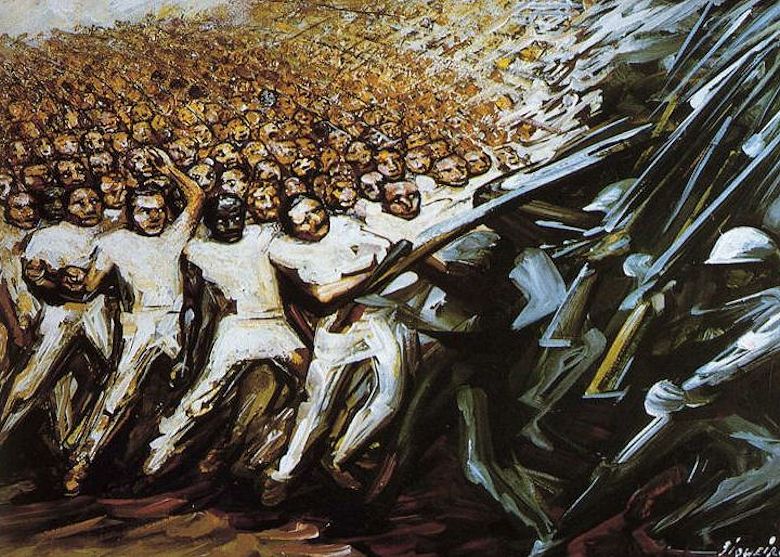
David Alfaro Siqueiros - Lucha por la Emancipacio

Over the past 10 years or so Leon Trotsky’s idea of ‘uneven and combined development’ has gained considerable traction within the fields of International Relations (IR) and historical sociology. It has been critically and productively deployed or rethought to address a diverse group of international and sociological problematics ranging from anarchy, contingency, and eurocentrism to the rise of capitalism, premodern societies, and non-western modernities. Alex Anievas’s new book Capital, the State, and War: Class Conflict and Geopolitics in the Thirty Years’ Crisis, 1914-1945 is an extremely invaluable addition to this rich and growing body of scholarship on uneven and combined development.

Through a masterful deployment of uneven and combined development, Anievas provides a compelling alternative account of the two world wars that fundamentally challenges the existing polarized ‘internalist’ and ‘externalist’ modes of explanations. Weaving social, economic, (geo)political and ideological moments of the making of the ‘Thirty Years Crisis’ into a theoretically informed, historically grounded and empirically rich account Capital, the State, and War is a tour de force for anyone interested in Marxist historiography of the World Wars and the rise and demise of the twentieth century world order.

As someone who’s also contributed to the literature on uneven and combined development I’m particularly interested in Anievas’s explicit discussion of the precise relation of the idea of uneven and combined development to historical materialism in Capital, the State, and War. Explicit interrogations of this relation have been relatively neglected in much of the publications on uneven and combined development. As a leading Marxist thinker and political activist Trotsky himself saw his idea of uneven and combined development as simply derivative of Marxist dialectics and materialist conception of history and as such did not seem to have believed that the idea had any transformative implications for materialist conceptions of history.

Continue reading

Capital, the State, and War: Reflections of a Codger

A guest post from Mark Rupert, the second reply in our symposium discussing Alex Anievas’ Capital, the State, and War: Class Conflict and Geopolitics in Thirty Years’ Crisis, 1914-1945. Mark is Professor of Political Science at Syracuse University and the author of three books: Producing Hegemony: The Politics of Mass Production and American Global Power (1995), Ideologies of Globalization: Contending Visions of a New World Order (2000) and Globalization and International Political Economy (2006, with Scott Solomon). His recent papers focus principally on the politics of the far right.


I’ve been following Alex Anievas’ project for a while. Now that it’s come to fruition in this book, I find myself both delighted and saddened. I’m delighted to see that Alex has produced such a superb book, perhaps as close as any I’ve seen to realizing the potential of an historical materialist approach to IR. I’m also saddened that the book arrives in an intellectual context – some thirty years after the project of critical IR was launched – in which critical approaches to IR-IPE have been largely neutered or marginalized, at least in the US academic community where I work. I congratulate Alex on his achievement. I thank him for all I have learned from his work. But I fear that the role of IR theory as ideology, and the sociology of knowledge so powerfully operative within the still-dominant US wing of the profession, mean that this book might have the ability to convince but it will not win (if I may appropriate and invert the courageous words of Miguel de Unamuno).

This book takes direct aim at the very foundations of IR theory, laid down in attempts to understand the great crises of the early twentieth century. Much of our intellectual discipline, as well as the 20th century world, was constructed in this epic conjuncture. Deploying a theory of uneven and combined development, Alex re-narrates it well. The intersection of various temporalities of capitalist development – the “whip of external necessity,” the “privilege of historical backwardness,” and the “contradictions of sociological amalgamation” – play crucial roles in his analyses of 1914, Wilsonian statecraft, the rise of Nazi Germany, and the so-called policy of “appeasement”. His command of the relevant bodies of scholarship is deeply impressive (the bibliography alone would make this book worth buying). And at the end of the book I find myself largely convinced that this formative era cannot be understood without a relational, historical, and dialectical conceptual apparatus such as the one Alex deploys, and that a quest for parsimonious covering laws based on hyper-abstracted “levels of analysis” is an analytical trap that has radically decontextualized and dehistoricized prevailing modes of IR scholarship.

Continue reading