Open Access: HEFCE, REF2020 and the Threat to Academic Freedom

This is the text of a document prepared by Meera and me on Article Processing Charges as currently understood and the serious risks we think they pose to academic freedom and funding, broadly understood (previous discussed by several contributors to our open access series). It is also available as a pdf, and we encourage academics to think carefully about the issues foregrounded, and to act accordingly.


Applegarth Press

Summary

  • The Government is pushing academic publishing to a ‘pay-to-say’ model in order to achieve open access to publicly funded research
  • This ‘gold’ route to open access, which levies Article Processing Charges (as proposed in the Finch Report and taken up by RCUK and HEFCE) poses a major problem for academics in the UK:
    • It threatens academic freedom through pressures on institutions to distribute scarce APC resources and to judge work by standards other than peer review
    • It threatens research funding by diverting existing funds into paying for publications (and private journal profits) rather than into research
    • It increases academic inequality both across and within institutions, by linking prestige in research and publishing to the capacity to pay APCs, rather than to academic qualities
    • It threatens academic control of research outputs by allowing for commercial uses without author consent
  • In response, academics should:
    • Practice and lobby for ‘green’ open access of all post-peer reviewed work within journals and institutions
    • Lobby against proposed restrictions on REF2020 and against compliance pressure for ‘gold’ open access
    • Demand clear policies from Universities around open access funds
    • Ensure institutional resources are not unnecessarily spent on APCs
    • Protect the integrity of scholarly journals by rejecting the pressure for ‘pay-to-say’ publishing

Open Access: Rushing Implementation

Many academics have been ardent supporters of the open access principle (that peer-reviewed academic work should be freely available and easily accessible to anyone), and were excited when the Government made steps to advance it. However, it has become clear that the implementation of this policy via REF2020 will have very serious negative consequences for all academic authors and institutions, unless authors and institutions themselves start to take action and make their voices heard. It is critical that academics understand what is happening and lobby our pro-VCs of Research, our VCs and Universities UK to defend both academic freedom and open access.

The timescale for action and decision-making is now incredibly short. Several policies, including that of the Government and of RCUK were declared immediately with the release of the Finch Report, totally accepting its views without wider consultation. HEFCE is going to open and close a very quick consultation period early in 2013 in order to issue guidance ahead of REF2020. Some universities have been given until March 2013 to determine what to do with open access funds that they were given in November. And it was only on 29 November 2012 that the first indications from HEFCE were given as to their intentions, at the Academy of Social Sciences (ACSS) conference on Implementing Finch. The timetable for finalising the details of this complex policy is thus extremely short and does not allow for adequate discussion of its serious consequences. Despite this, academics can still play an important role in resisting the threats posed.

So, What is Happening?

In summary, academic journals are being moved from a ‘pay-to-read’ model to a ‘pay-to-say’ model.
Continue reading

Open Access: Time for Action

This is the last in our recent series of posts this week on open access. Pablo covered the big questions and rationales for open access; Colin explored the potential consequences of the current policy direction; David raised serious questions about its fit for social sciences; Nivi highlighted the implications for early career academics and Nathan extended the discussion to the broader problems of academic precarity.


What do we do now? I will not labour over diagnostic points made eloquently and at length elsewhere on this blog (and also in the comments sections). In part, because there just isn’t time. At least in the UK, right now, we are facing a critical juncture where open access policy is being solidified by the Finch ‘Implementation Groups’, and solidified in the wrong direction. Indeed, there is a Academy of Social Sciences Conference in London on 29th and 30th November on the implementation of OA policy, which will likely further reinforce the direction of travel laid out by the Finch Report. Dame Janet Finch is the keynote on the first day, and the second day is ‘aimed at’ publishers, learned societies and their representatives. I am also somewhat concerned at the speed of travel on this, which suggests that Government have not taken the time to seriously reflect on it, and that most wider academic ‘stakeholders’ are being left behind on discussions and decisions which seriously affect all of our futures.

Briefly, though, my concerns around an endorsement of Article Processing Charges mirror questions raised by Colin. Having said that, I am rather more certain/pessimistic than him that these pose a very substantial threat to academic freedom and the overall integrity of the journal system. I am also concerned that they will increase the costs of research without increasing its quality, and waste a lot of academic time as Universities and Departments try to administer them (as will have to happen for most Arts/Humanities/Social Science research which is not funded by grant-money). Finally, I am highly disappointed that nowhere does the Finch Report seriously reflect on possible Government action to further protect copyright over the Version of Record.

So, what is to be done?  Continue reading

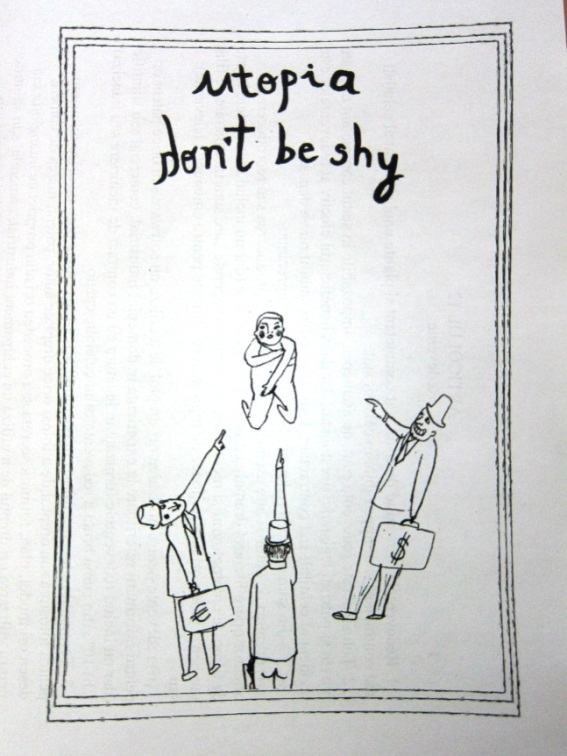
This Courage Called Utopia

(wild bells) A warm Disordered welcome to Wanda Vrasti, who previously guested on the topic of the neoliberal tourist-citizen imaginary, and now joins the collective permanently. And glad we are to have her. Her academic writings thus far include Volunteer Tourism in the Global South: Giving Back in Neoliberal Times (which came out with the Routledge Interventions series a few months ago), ‘The Strange Case of Ethnography in International Relations’ (which caused its own debate), ‘”Caring” Capitalism and the Duplicity of Critique’, and most recently ‘Universal But Not Truly “Global”: Governmentality, Economic Liberalism and the International’.


It’s often been said that this is not only a socio-economic crisis of systemic proportions, but also a crisis of the imagination. And how could this be otherwise? Decades of being told There Is No Alternative, that liberal capitalism is the only rational way of organizing society, has atrophied our ability to imagine social forms of life that defy the bottom line. Yet positive affirmations of another world do exist here and there, in neighbourhood assemblies, community organizations, art collectives and collective practices, the Occupy camps… It is only difficult to tell what exactly the notion of progress is that ties these disparate small-is-beautiful alternatives together: What type of utopias can we imagine today? And how do concrete representations or prefigurations of utopia incite transformative action?

Javier Lozano Jaén

First thing one has to notice about utopia is its paradoxical position: grave anxiety about having lost sight of utopia (see Jameson’s famous quote: “it has become easier to imagine the end of the world than the end of capitalism”) meets great scepticism about all efforts to represent utopia. The so-called “Jewish tradition of utopianism,” featuring Adorno, Bloch, and later on Jameson, for instance, welcomes utopianism as an immanent critique of the dominant order, but warns against the authoritarian tendencies inherent in concrete representations of utopia. Excessively detailed pictures of fulfilment or positive affirmations of radiance reek of “bourgeois comfort.” With one sweep, these luminaries rid utopianism of utopia, reducing it to a solipsistic exercise of wishing another world were possible without the faintest suggestion of what that world might look like.

But doing away with the positive dimension of utopia, treating utopia only as a negative impulse is to lose the specificity of utopia, namely, its distinctive affective value. The merit of concrete representations of utopia, no matter how imperfect or implausible, is to allow us to become emotionally and corporeally invested in the promise of a better future. As zones of sentience, utopias rouse the desire for another world that might seem ridiculous or illusory when set against the present, but which is indispensable for turning radical politics into something more than just a thought exercise. Even a classic like “Workers of the World Unite!” has an undeniable erotic (embodied) quality to it, which, if denied, banishes politics to the space of boredom and bureaucracy. It is one thing to tell people that another world is possible and another entirely to let them experience this, for however shortly.

Most concrete representations and prefigurations of utopia from the past half century or so have been of the anti-authoritarian sort. Continue reading

The Citadel Has Been Blown Up. Hurray! Next? A Response to Hobson

This is the second post in a symposium on John M. Hobson’s new book, The Eurocentric Conception of World Politics. The series began with a post by the author summarising the argument of the book and laying out some provocations for sympathetic readers. In the next few weeks, we will have further posts from Srjdan and Brett Bowden, followed by a reply from John.

Update: Srdjan’s post and Brett’s post are now up.


I was at an IR event last year where the speaker jovially declared that they just did not care about being, and being accused of being, Eurocentric. At the time, I found it both a little shocking and depressing that they could see fit to dispense with that fig leaf of serious acknowledgement that often accompanies discussions of Eurocentrism.  And indeed I thought, glumly, that it perhaps reflected many scholars’ underlying attitudes to the issue – a tokenistic practice of acknowledgement underpinning a wider apathy or disconnection. What only struck me later was also the possibility that the speaker also didn’t really understand the issue which was batted away so carelessly. Indeed, it is unclear that many ‘mainstream’ IR scholars truly understand the problem of Eurocentrism, given the mythologised twin deaths of colonialism and scientific racism in 1945 (or so).

Seriously?

So, Hobson is knocking at the door more loudly, with a bigger stick, and much more paperwork.  Continue reading

The End Of IR Theory As We Know It…

A guest post on the state of International Relations from Felix Berenskoetter. Felix is Lecturer in International Relations at SOAS, University of London. He holds a PhD from the LSE and works on theories and concepts in IR; politics of space and time; critical approaches to European Security, and dynamics of friendship and estrangement in transatlantic relations. Felix has published articles in various journals, is a former editor of Millennium and co-editor of Power in World Politics (Routledge, 2007). He is also co-founder and current chair of the ISA Theory Section.


In case you missed it, recent ISA and BISA conferences saw panels contemplating whether ‘IR Theory’ has come to an end. This question, posed by the editors of EJIR, was discussed by a range of distinguished scholars whose answers ranged from ‘yes’ to ‘no’, in the process reflecting on the meaning of ‘theory’ and ‘end’. While state of the art exercises can be tiring, the contributions will be worth reading when they appear in an EJIR special issue later this year.

Yet I could not help wondering what the answers would have been had the panels featured not established professors, but junior scholars at the start of their career. Indeed, would it not be more adequate to have the latter group engage this question? After all, they tend to be the ones teaching introductory IR courses, which are expected to give an overview of theoretical arguments and debates. And they enter the profession with a significant research project under their belt (the PhD), which informs their first wave of publications and likely influences future projects that will shape the field. So what does that generation think of ‘IR Theory’? What theories and what kind of theorizing is prevalent in their teaching and writing? Continue reading

Dr El-Khairy, I Presume?

We’re on a roll now. On Friday, Omar became the fourth of us to ascend the greased pole of academic accreditation since we began cultivating this little corner of the internet. Forever more to be known as Dr El-Khairy, his burgeoning cultural insurgency notwithstanding. The work in question? American Statecraft for a Global Digital Age: Warfare, Diplomacy and Culture in a Segregated World. And who said it was good enough? Faisal Devji and Eyal Weizman, actually. So there. And I have promises in writing that he will be telling us more about it all real soon.

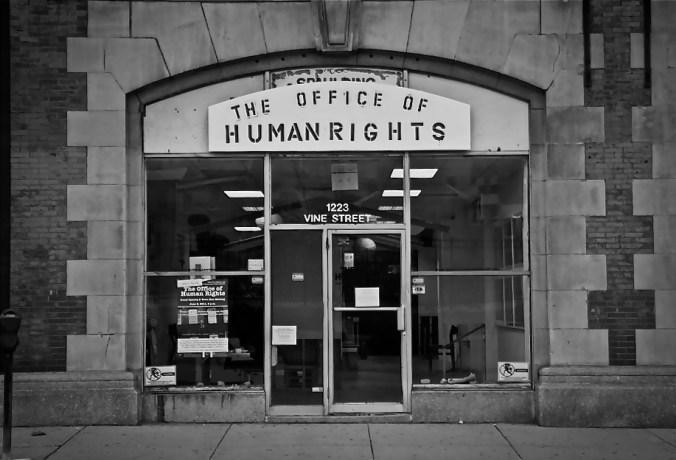
What We Talked About at ISA 2012: A Human Right to Housing

Housing is a Human Right Exhibition, Philadelphia (original photo by Annie Seng)

I ain’t got no home. I’m just a roamin’ round, just a wandering worker, I go from town to town. And the police make it hard wherever I may go. And I ain’t got no home in this world anymore.

My brothers and my sisters they’re stranded on this road. A hot and dusty road that a million feet have trod. Rich man took my home and drove me from my door. And I ain’t got no home in this world anymore.

Was a farmin’ on the shares and always I was poor. My crops I lay into the banker’s store. My wife took down and died upon the cabin floor. And I ain’t got no home in this world anymore.

Now as I look around it’s mighty plain to see this world is such a great and funny place to be. Ah, the gamblin’ man is rich and the working man is poor. And I ain’t got no home in this world anymore.

-“I Ain’t Got No Home in this World” by Woodie Guthrie

Beginnings Are Difficult

How to start something new? This question troubles the academic as well as the activist. At the moment it troubles me both as a question of inquiry and as a meta-question of method.

In my previous work I have argued that human rights should be judged first and foremost by the consequences they bring about. Do human rights enable new forms of politics? Do they enable politics that increase the control we have over our lives, or that reduce the suffering and humiliation we are exposed to? Or do they confine us in a liberal subjectivity that makes wider visions of justice impossible, which push us to reconcile our beautiful revolutionary dreams to the limited horizon that contemporary liberal capitalism imposes?

I have offered a qualified defense of human rights as a democratising ethos, which suggests that human rights can enable everyday people to challenge the terms of legitimate political authority, including the institutional shape of their government and the makeup of their communities. This is done by formally opening up the identity of “rights holder” to anyone, regardless of their social position. This opening, however, is only formal and in that formality human rights have an ambiguous significance. For this reason, I have argued that to think of human rights as a democratising ethos also requires that we attend to the politics of human rights. This means that ensuring that human rights support democracy and equality is a political struggle as well as an ethical vision.

Continue reading

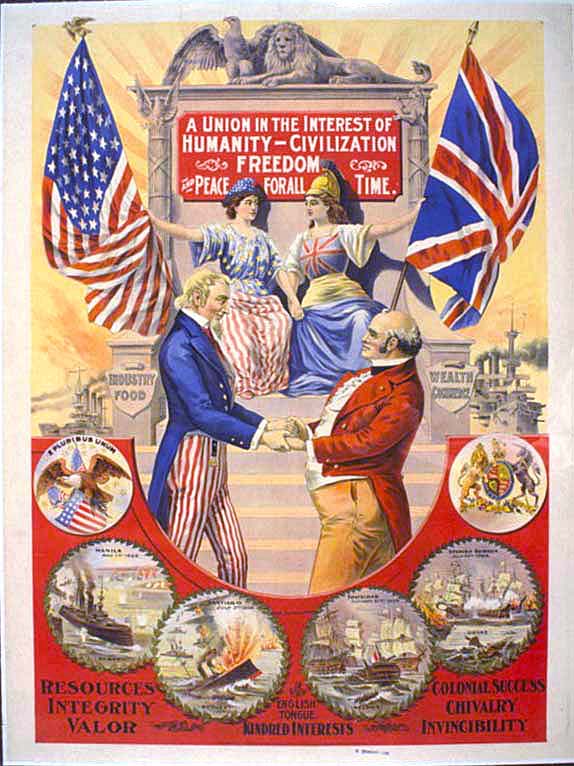
The Anglosphere, Part Two: Of Liberal Leviathans and Global Turns

Viewed from the perspective of liberal IR, Britain’s globe-spanning empire can be described as “Liberal Internationalism 1.0.” According to G. John Ikenberry, the “liberal ascendancy” had everything to do with the “growth and sheer geopolitical heft of the world’s liberal democracies.” The British may have been the first to harmonize national interest with the stability, openness and rule-following in the international systems, but it was the Americans who “fused” them. “If the liberal order was built after World War II primarily within the West, the end of the Cold War turned that order into a sprawling global system” [1].

The question that has always fascinated me is how we got from Liberal Internationalism 1.0 to Liberal Internationalism 2.0, or how, to freely borrow from Ikenberry, power shifted between two liberal Leviathans, Britain and the U.S. What is puzzling here is the absence of the Wars of Anglophone Succession. Instead of fighting each other at least once or twice, the two empires first found ways to cooperate and coordinate their imperial activities around the globe, then engaged in what can be described as a pacted transition, even as a corporate merger. Here’s one verdict, taken from “The imperialism of decolonizationpiece by Wm Roger Louis and Ronald Robinson:

The British were welcoming the Americans back into the British family of nations and, informally at least, into the Commonwealth . . . [the post-war empire operated] as part of the Anglo- American coalition . . . like a multinational company.

Putting aside the historiography debates about its scope, timing and sequencing, this historical process was no doubt of momentous importance for the evolution of the liberal order, both in terms of the accumulation of hegemonic power, and in terms of social and institutional learning. The Anglosphere, in other words, begins here. So how do we explain it? Strategic calculus and/or a putatively liberal predilection for cooperation, compromise, and conciliation (last word Churchill’s) are only parts of this story, as Charles Kupchan notes in his How Enemies Become Friends:

British appeasement of the United States and the practice of reciprocal restraint that followed cleared the way for rapprochement. But it was the emergence of a new discourse on both sides of the Atlantic – one that propagated notions such as a “shared Anglo-Saxon race” and an “Anglo-American family” – that produced a compatible identity, consolidated stable peace, and laid the foundations for the strategic partnership that exists to this day.

I could not agree more. Racialized identities operate as social structures of power, and this was a time when they explicitly authorized unity and superiority for Us against Them in ways that had profound consequences for the evolution of the so-called liberal international order. Anglo-Saxonism enabled the U.S. and Britain – or their elites – not only to position themselves favourably vis-à-vis each other at the turn of the twentieth century, but also with respect to the rest of the world and in a longer term. The Anglo-American rapprochement was no “global turn” of the sort that Kupchan talks about in his latest book, but it arguably comes close to it in macro-historical term. For one, the paths, pace and outcomes of the 1945-1951 international institution-building spree – that foundation of Liberal Internationalism 2.0 –followed the patterns of UK-U.S. cooperation first established during the colonial wars and near-wars in the 1890s. The much-disclaimed “special relationship” has its origins in this period – something to keep in mind next time we hear that U.S.-hugging remains in someone’s national interest, as General Sir David Richards, the head of Britain’s armed forces, argued last week.

This story I wish to tell can be expanded and contracted empirically (Anglo-Saxonism is dead today, but its effects can be found everywhere from university scholarships to contemporary military alliances) and theoretically (through, say, an account of core-periphery relations that made global capitalism possible), but the main substantive point remains the same, and that is that we cannot fully understand the “liberal ascendancy” without pausing (as Siba Grovogui might say) over the pervasiveness and power of racialized identities that connected Liberal Internationalism 1.0 and 2.0 [2]. Continue reading

What We Talked About At ISA 2012: How Music Brings Meaning to Politics

At this year’s ISA conference, I presented on the panel ‘The Social Technologies of Protest’, with George Lawson, Eric Selbin, Robbie Shilliam and our discussant Patrick Jackson. The full text of the draft paper is available here. Thanks go to the panel and audience for some fascinating questions and discussions.


Music is a world within itself
With a language we all understand
With an equal opportunity
For all to sing, dance and clap their hands
But just because a record has a groove
Don’t make it in the groove
But you can tell right away at letter A
When the people start to move

–          ­‘Sir Duke’, Stevie Wonder, Songs in the Key of Life (1976)

Music is an old and effective technology of politics. This was highly visible in both the recent uprisings and the attempts at counter-revolution; whilst from the beginning Tunisian activists sang their national anthem in the street in anti-regime protest, Assad blasted the Syrian anthem into the cities as a reminder of his position. Rappers and older musicians shared platforms in Tahrir Square, and DJs parodically remixed Gaddafi’s final public speeches into technotronic nonsense. Whilst not all political music is sung of course, songs and the act of singing are particularly powerful in political situations as means and symbols of mobilisation and unification.  Moreover, songs tend to linger in the brain.

But there are at least two ways of thinking about the relationship between politics and music. The question which is perhaps most often asked and answered is: how, when and where is music political? So, why did the Tunisian protesters sing the national anthem in front of the courthouse, how did music support the anti-apartheid struggle, and why did the Haitian revolutionaries sing the Marseillaise? How did the musical character of these expressions facilitate a particular kind of political act? Lots of excellent writers, both scholarly and otherwise, have turned their attentions to the nature of political music, and especially protest music, in a variety of times and places.

However, the question that I want to focus on mainly here though is slightly different: how, when and where is politics musical? This question was stimulated by the general observation that when we try to make sense of politics, we often use metaphors related to music. A common phrase is that a political statement or value ‘struck a chord’ with an audience, or that protesters are ‘banging a drum’. Politicians may or may not be ‘in tune’ with publics, and relations may be ‘harmonious’ or not. Coups will be ‘orchestrated’.

Perhaps surprisingly, in moving from vernacular to scholarly modes of understanding politics, the metaphors of music are no less important. In fact, in some cases they seem to be more important. The genre-defining work of the historical sociologist Charles Tilly in the study of contentious politics is a revealing and fascinating case in point.

Continue reading

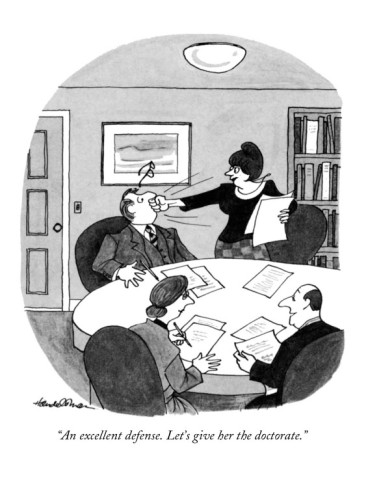
Dr Sabaratnam, I Presume?

Hot on Roberto’s heels, and the third of us to achieve doctorhood since the inception of The Disorder Of Things, our very own Meera today survived the critical questioning of Robbie Shilliam and Christopher Cramer. She is henceforth Dr Sabaratnam, certified by virtue of her thesis: Re-Thinking the Liberal Peace: Anti-Colonial Thought and Post-War Intervention in Mozambique. For the record, I’m assured that any violence inflicted was purely intellectual.