More Groundings

The final piece, and rejoinder, in The Disorder Of Things forum on The Black Pacific.


I have to say, I really didn’t know what to expect from my interlocutors. Perhaps that’s because I have little idea what kind of response to expect from the book and who its readership might be. In any case, these varied and passionate responses are a joy to engage with.

Heloise, you not only provide a lucid introduction to some of the key themes and provocations of my book; you also usefully connect its arguments to broader intellectual and political currents in the world of development, especially regarding indigenous struggles in and over the Americas. Olivia, you provide a striking engagement with the politics of intellectual investment, one that in many ways exceeds the strictures of my book to become a general mediation upon ethics and method. Ajay, you poetically and critically reflect on solidarity building across/besides territory and culture, and in so doing you begin to ask pertinent questions about “groundings” with reference to Turtle Island. Krishna, yours unfolds as a forceful defence of the urgency to focus intellectually upon the materiality of dispossession.

I’m going to engage with your response, Krishna, at some length. But firstly, I want to call attention to and amplify some of the questions that Olivia and Ajay ask.

18379_488175720248_5710406_n

Continue reading

The Black Pacific: Thinking Besides the Subaltern

The first in a forum on Robbie’s recently released The Black Pacific: Anti-Colonial Struggles and Oceanic Connections (Bloomsbury, 2015). A number of commentaries will follow in the coming week.


May 1979. A Black theatre troupe from London called Keskidee, along with a RasTafari band called Ras Messengers, land at Auckland airport, Aotearoa New Zealand. They have been invited by activists to undertake a consciousness-raising arts tour of predominantly Māori and Pasifika communities. They are driven almost immediately to the very tip of the North Island. There, at a small hamlet called Te Hāpua, Keskidee and Ras Messengers are greeted by Ngati Kuri, the local people of the land. blk1An elder introduces his guests to the significance of the place where they now stand. Cape Reinga is nearby, where departing souls leap into the waters to find their way back to Hawaiki, the sublime homeland. The elder wants to explain to the visitors that, although they hold an auspicious provenance – the Queen of England lives amongst them in London – Ngāti Kuri live at ‘the spiritual departure place throughout the world’. The elder concludes with the traditional greeting of tātou tātou – ‘everyone being one people’. Rufus Collins, director of Keskidee, then responds on behalf of the visitors:

You talked of your ancestors, how they had taken part in our meeting, and I do agree with you because if it was not for them you would not be here. You talked of our ancestors, taking part and making a meeting some place and somewhere; the ancestors are meeting because we have met. I do agree with you.

But Collins also recalls the association made betweenblk2 the visitors and English royalty, and there he begs to differ: ‘we are here despite the Queen’. Then the Ras Messengers begin the chant that reroutes their provenance from the halls of Buckingham Palace to the highlands of Ethiopia: “Rastafari come from Mount Zion.”

This meeting is emblematic of the story that I tell of The Black Pacific wherein Maori and Pasifika struggles against land dispossession, settler colonialism and racism enfold within them the struggles of African peoples against slavery, (settler) colonialism and racism. Sociologically, historically and geographically speaking, these connections between colonized and postcolonized peoples appear to be extremely thin, almost ephemeral. But those who cultivate these connections know otherwise. How do they know?

Continue reading

Arab Political Thought After 2011 (Lines of Inquiry for a Research Agenda)

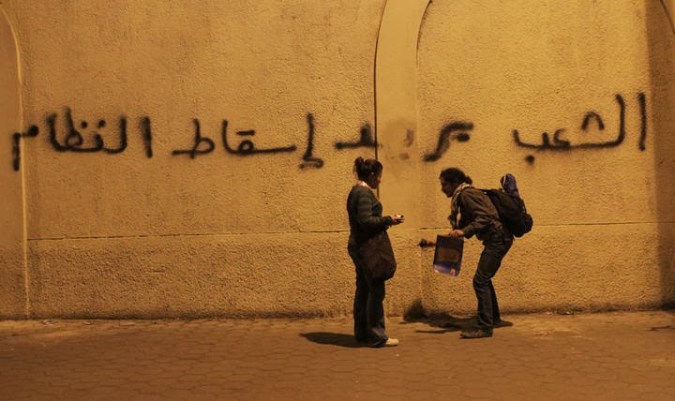
A guest post – on the eve of the 5th anniversary of the Egyptian uprising – by Michaelle Browers. Michaelle is Associate Professor of Politics and International Affairs and directs the Middle East and South Asia Studies Program at Wake Forest University. She is author of Democracy and Civil Society in Arab Political Thought: Transcultural Possibilities (Syracuse University Press, 2006) and Political Ideology in the Arab World: Accommodation and Transformation (Cambridge University Press, 2009), and has edited and contributed to (with Charles Kurzman) An Islamic Reformation? (Rowman and Littlefield, 2003). Her articles have appeared in the International Journal of Middle East Studies, Journal of Middle East Women’s Studies, Journal of Political Ideologies, Critical Review of Social and Political Philosophy, Theory and Event, and Third World Quarterly. An earlier version of this memo was prepared and presented at working group on “Re-envisioning the Arab State,” hosted by the Center for International and Regional Studies (CIRS) at the Georgetown University’s School of Foreign Service in Doha, Qatar (January 17-18, 2016).


Browers - Cairo Graffiti

The past five years has been a series of ups and downs, trading moments of great elation and hope with periods of deep disappointment for those of us who study Arab political thought and practice. We have seen declarations of Arab springs and Arab winters, and claims about the resilience, the end and again the resilience of Arab authoritarianism. We have seen people in the streets and squares of many cities call for justice, dignity, democracy, rights, revolutions – ideas that many Arab intellectuals have written about at great length and mourned for their lack – and heard commentators claim Arab intellectuals were absent from the uprisings or, as Ramzy Baroud put it, “resting, not dead.” In general, we have seen much in the way of claims of a lack of intellectual work or a lack of alternative visions to the status quo. I contend that the real lack is a full investigation of whether, in fact, such claims have merit—that is, that there is a need for research into political thought that assumes its existence rather than its absence.

But in engaging post-2011 “Arab political thought” we may need to revise some of our assumptions about what it is we seek at the outset. This intervention puts forth four subsets of questions in need of further discussion as we broach that larger question (of how we should study Arab political thought after the 2011 uprisings): one which raises an old question worth reconsidering anew, a second which suggests a different approach to our study, a third which maintains the need to look for answers in a slightly different place or with a broader lens, and a fourth which proposes one substantive line of theorizing that strikes me as politically salient after 2011. Embedded in each of these four broad question-sets are myriad avenues of research, as well as, of course, indications of some of my own convictions and commitments.

Continue reading

Twilight of the Journal Vampire Squid

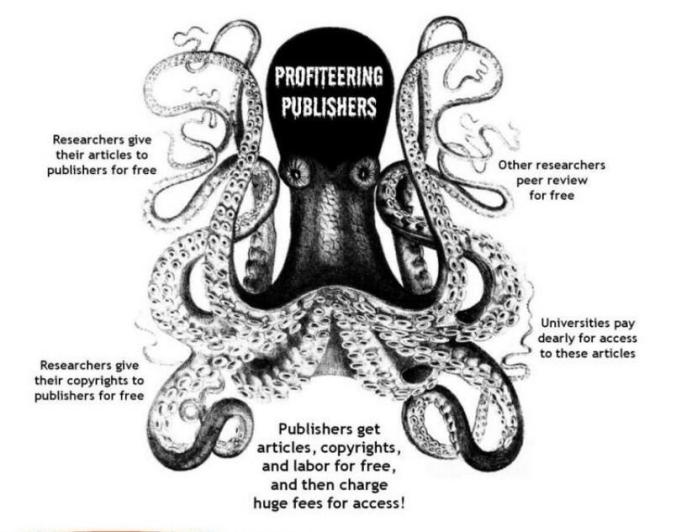
This was in someone's open access slide show someplace, but the name, and therefore the credit, escapes me.

This was in someone’s open access slide show someplace, but the name, and therefore the credit, escapes me.

I have a piece up at e-IR today returning to the question of open access. It is partly an introduction to the issues, partly a manifesto on why academics should take the digital commons more seriously. But it is mainly intended as a provocation for the discipline (proto-discipline, non-discipline, borg-discipline, what you will) of IR, and a challenge to the in my view excessive resistance to open access that characterises its upper echelons. To wit:

What is IR’s contribution to the open access movement? Almost nothing, arguable less than nothing. There is no IR equivalent of ArXiV  – the hugely successful online repository favoured by physicists and mathematicians. Nor of PLOS  – the gigantic open access mega-journal suite favoured by hard scientists, which sustains itself on low relative processing charges. Nor of Cultural Anthropology – a learned society journal gone fully open access. No experiment like the Open Library of the Humanities – a new platform-cum-mega-journal funded by a conglomerate of libraries. No appetite for something like Sociological Science – an open access journal with quick review times and low, means-tested article publishing costs. There are a handful of open access IR journals, like Ethics & Global Politics (not to be confused with Ethics & International Affairs), the Journal of Critical Globalisation Studies, and the Journal of Narrative Politics, run largely on goodwill, but they are sadly lacking a disciplinary presence. Publishing in them will not make a career, and is unlikely to impress hiring committees which have an eye to bankrupt measures of quality like the journal impact factor.

Worse still, the discipline of IR has missed opportunities to make itself more open and relevant, all the while fretting over its introversion and lack of relevance. Some of our responses to the open access movement have been sadly conservative and dismissive. New journals like the European Journal of International Security and the Journal of Global Security Studies are run on the standard closed model. Neither the leadership of the British International Studies Association nor the International Studies Association have followed the innovations carved out by colleagues in anthropology, sociology or STEM subjects. And young journals that position themselves as disrupting orthodoxy (such as Critical Studies on Security) have nevertheless emerged under the imprint of familiar publishing houses. While Editorial Boards in other disciplines are considering resignation and boycott to force change on the system, IR scholars are joining an ever-growing list of titles that promote business as usual. Closed journal publishing has become common sense: unquestioned despite its manifest failings.

Continue reading

Reinventing the Future

It is an honour to have had Inventing the Future considered in such depth and detail, and we want to begin by extending our thanks to everyone who contributed to this symposium. This response is a useful moment for us to clarify our argument, to respond to the most significant questions, to acknowledge limitations of the book, and to correct some misunderstandings. We do so in a spirit of humility, given that – as we wrote in the introductory post – we see this book as a contribution to a larger debate and hopefully the spark for reflection on what we think are important issues for the contemporary left.

Post-Work Futures

In Joseph, Sophie and David’s pieces, some fundamental questions are raised about what precisely a post-work world entails, particularly with respect to concerns around the environment, labour, social reproduction, and colonialism. Does a high-tech post-work world entail the exhaustion of resources and the decimation of the earth’s climate? Does a post-work world mean the continued oppression and subjugation of low-income countries? These are essential questions to ask. In responding to these queries, it will be useful to draw up a series of alternative possible futures indicating how a post-work project may play out. Roughly speaking, we can imagine four broad and potentially intersecting futures: a neocolonial and racist post-work world, an ecologically unsustainable post-work world, a misogynist post-work world, and a leftist post-work world.

Continue reading

Myths of Invention

The fifth commentary, and sixth post, on Nick Srnicek and Alex Williams’ Inventing the Futurefrom DoT’s own Joe Hoover. A reply from Nick and Alex will follow.


Inventing the Future begins with a lament.

Where did the future go? For most of the twentieth century, the future held sway over our dreams. On the horizons of the political left a vast assortment of emancipatory visions gathered, often springing from the conjunction of popular political power and the liberating potential of technology.

The authors resent that they have been denied a future with more promise than the present. They mourn the absence of the object of their desire, the impossibility of its fulfilment, the lives to be lived in these lost leftist utopias. This seems to be a widely felt disappointment, if we are to judge by how often the complaint has been made of late. Disappointment leads to diffuse anger, directed at the status quo on the “Left”, its lack of vision. At the root of this discontent is anger at the world itself, for all of the ways it impedes us, frustrates our hopes and gives no comfort to our dreams – it is a world in need of re-making. I do not want to suggest that because the book’s narrative is motivated by such feeling that it can be reduced to an outburst against the vagaries of existence, the work is too focused and the problem it addresses too serious for such crude criticism. Yet, this fundamental emotional resentment colours the project in an important way.

Orpheus plays his lament

The lament shapes the inquiry itself. We are wounded by the loss of our desire – a future flush with possibility – and we are angry at capitalism for stealing our future. Obviously the detail is more sophisticated than this curt summary, but a stark statement of the underlining logic reveals the essential narrative. The problem of contemporary Left politics is not the desire for a universal utopian future but rather that this future has been lost, which runs counter to important criticisms of progressive leftism (a point taken up by Aggie Hirst and Tom Houseman). Therefore, the authors’  task is to remind us why we desire the future, then to consider where to look for a new one and how to seek after it. Inventing the Future is a quest to find what was lost, so we can become whole in our desires. We may set out on such a quest with great optimism but we still carry a worrisome anger with us.

There are a great many barbarities in our world attributable, at least in part, to “capitalism” but it is not a villain stealing away with our ladylove (the difficulties of determining what capitalism is are taken up later). Our lost future is not the exceptional crime of some neoliberal conspiracy. Yes, I know the book does not say anything quite so crude. Nonetheless, the narrative structure is driven by a conflict that finds its resolution with the us (the protagonist) achieving wholeness in a future fulfilment of our desire. The authors make the caveat that contestation will not end in this postcapitalist future, but this future still holds out the promise that the conflicts of today will melt away. The world is always messy, unfinished, stubborn, cruel, confused, and, I posit, resistant to the kind of  breaks with past ways of being that are suggested here (Sophie Lewis and David Bell look at the temporalities involved in greater detail). If we lament that, we risk resentment against the world itself, against human existence and against flesh and blood people who move slowly and impede our dreams. Love of the future sits dangerously close to hatred of the present – which is not to say we should have no love of the future, but rather that we ought to be wary of too much of it.
Continue reading

(Why We Can’t) Let the Machines Do It: A Response to Inventing the Future

The fourth post in our (already pretty popular) forum on Nick and Alex Williams’ Inventing the Future, this time from Sophie Lewis and David M. Bell. Sophie is at the University of Manchester, writing up a PhD on surrogacy’s uneven ‘cyborg’ geography and thinking about its utopian potential. She has written about surrogates for JacobinThe New Inquiry, and The Occupied Times; currently, excerpts are included in the 2015 “Technotopia” symposium. She also writes with the Out of the Woods (anticapitalist ecology) collective. She has co-translated Bini Adamczak’s Communism For Kids and written things that appear in Mute, Open Democracy, the ‘Demanding the Future’ tumblr, and on Novara WireDavid M. Bell is a Research Associate on the ‘Imagine’ project in the Department of Geography, University of Sheffield. He is interested in the potentials and dangers of utopia(nism) within, against and beyond capital, the state and itself. He has written on the politics of musical improvisation, utopian fiction and participatory arts practice; and is currently working on two book projects: Rethinking Utopia: Place, Power, Affect, to be published by Routledge in 2016; and A Future History of Sheffield: Art Practice, Hope and the City, with Jessica Dubow and Richard Steadman-Jones.


To The Future! But Whose?

To The Future! But Whose?

1. 

Inventing the Future provides a ‘plausible programme for ‘a world free of work’. It ‘shows us how we can organise’ to ‘realise a postcapitalist world’. So state its back-cover endorsements by Mark Fisher and Paul Mason. You should never judge a book by its blurb, but these claims are not to be sniffed at: here are two prominent thinkers of the UK left positioning this book as, if not a blueprint for utopia, a blueprint for utopianism – a roadmap that doesn’t quite cover the future but certainly takes us to its outskirts. The hyperbole continues away from Verso’s official promotional campaign too: Novara Media founder Aaron Bastani has publicly suggested that Corbyn’s Shadow Cabinet receive copies of the book’s chapters as bedtime reading pamphlets. We are not so sure. There is much of value in Inventing the Future (hereafter ItF); and it certainly opens up space for thinking about what might be and how we might get there. But there are serious questions about who this future is for, whose labour (re)produces it, and who it will continue to exclude.

Before the reader is let in on how we can invent the future, however, they need to be disabused of various notions that are holding it back. These are grouped together under the rubric of ‘folk politics’ – a supposed ‘constellation of ideas and intuitions within the contemporary left that informs the common-sense ways of organising, acting and thinking politics’ (p. 10). Its key features are the privileging of ‘local particularisms’; the spatially and temporally ‘immediate’ (and ‘unmediated’); ‘resistance’; and the ‘natural’. The attitude that Srnicek and Williams (hereafter S&W) take to this assemblage is remarkably similar to Marx and Engels’ position on utopian socialism: it was necessary in that it locally kept alive the possibility of alternative ways of living while large-scale political change was impossible, but once the material conditions for totalizing political change (supposedly) arrive, revolutionaries should embrace them and move beyond their quaintly uninspiring New Lanarks, exchange banks and workers’ associations. The time! is! (was!) now! (then!).

Against ‘folk politics’, S&W believe that a return to universalism is necessary for the invention of the future. Whilst acknowledging the colonial history (p. 76) of the universal and rejecting ‘Eurocentricism’ (pp. 77-78), they nonetheless argue that abandoning this structure of thought entails ‘licensing all sorts of oppressions as simply the inevitable consequence of plural cultural forms.’ (p. 77) This seems odd given that so many Indigenous and pre-colonial practices, identities, sexualities and cosmologies with liberatory potential have been destroyed in the name of universalism; and whilst these are acknowledged with the claim that there are non-European forms of ‘reason’, ‘science’, ‘progress’ and ‘freedom’ (p. 77), we are not convinced that these decidedly European terms are the most suitable labels for them. (What does ‘progress’ mean for cultures whose temporalities are nonlinear, for example?). We are more heartened, however, by the call for a universalism that is ‘pluri-versal’ and ‘does not entail homogeneity…does not necessarily involve converting diverse things into the same kind of thing’ (here, S&W refer to capitalism’s ability to sustain and draw power from diverse forms of social organization); and which ‘must recognise the agency of those outside Europe…in building truly planetary and universal futures.’ (p. 78) Continue reading

The Dissonance Of Things #4: Leftist Foreign Policy After Corbyn

The fourth of our monthly podcasts, turning our attention with ever greater political precision to Corbynmania, Jacorbynism, #JezWeCan, or however you prefer to characterise the arrival of Jeremy Corbyn as Leader of the UK Labour Party. Since before his victory, Corbyn has been stalked by, and occasionally celebrated for, his views on international politics, from the crisis in Ukraine and associated Great Power rivalries to his views on Hamas and from the (non-)renewal of Trident to the UK’s future role in NATO. David Cameron, for one, has attempted to securitise Corbyn, repeatedly arguing that “the Labour Party is now a threat to our national security, our economic security and your family’s security”.

And so we ask: what is a leftist foreign policy? Is such a thing even possible? Should the left, in whatever form, be seeking to capture, remake or resist foreign policy? What do the wishlist strands of a left foreign policy look like? Lee, Meera and I are herded into some kind of order by Kerem, and joined by Chris Emery of the University of Plymouth. author of US Policy in Iran: The Cold War Dynamics of Engagement and Strategic Alliance 1978-81 and this post on the history of covert action in Iran.

As ever, consume, cogitate, argue, and share, share, share. Past and future casts are available on soundcloud.

Further resources, including articles discussed in the podcast:

The Corbyn After-Effect

Corbyn LOL

Win he did. And how. Although the petty vindictiveness of the #LabourPurge was real, it wasn’t enough to materially affect the result, and has arguably strengthened Jeremy Corbyn’s mandate. Even as dodgy expulsions and dodgier retentions sour the taste, nobody can claim that the Labour elite were too lax in their efforts to hobble him. For those who have felt blackmailed and maligned by New Labour and its outriders this past decade or two, the moment of joyful disbelief is to be relished. A social democrat as leader of the Labour Party! What a notion. Negative solidarity is giving way to a new structure of feeling, not just resisting but asserting positively the horizon of a more egalitarian, less parochial politics. It was fitting that Corbyn’s ascent took place on the same day as the major London march in defence of refugees, and that he moved amongst us.

The euphoria won’t last, is indeed already muted, tempting us to get our disappointment in early. Continue reading

The Corbyn Effect

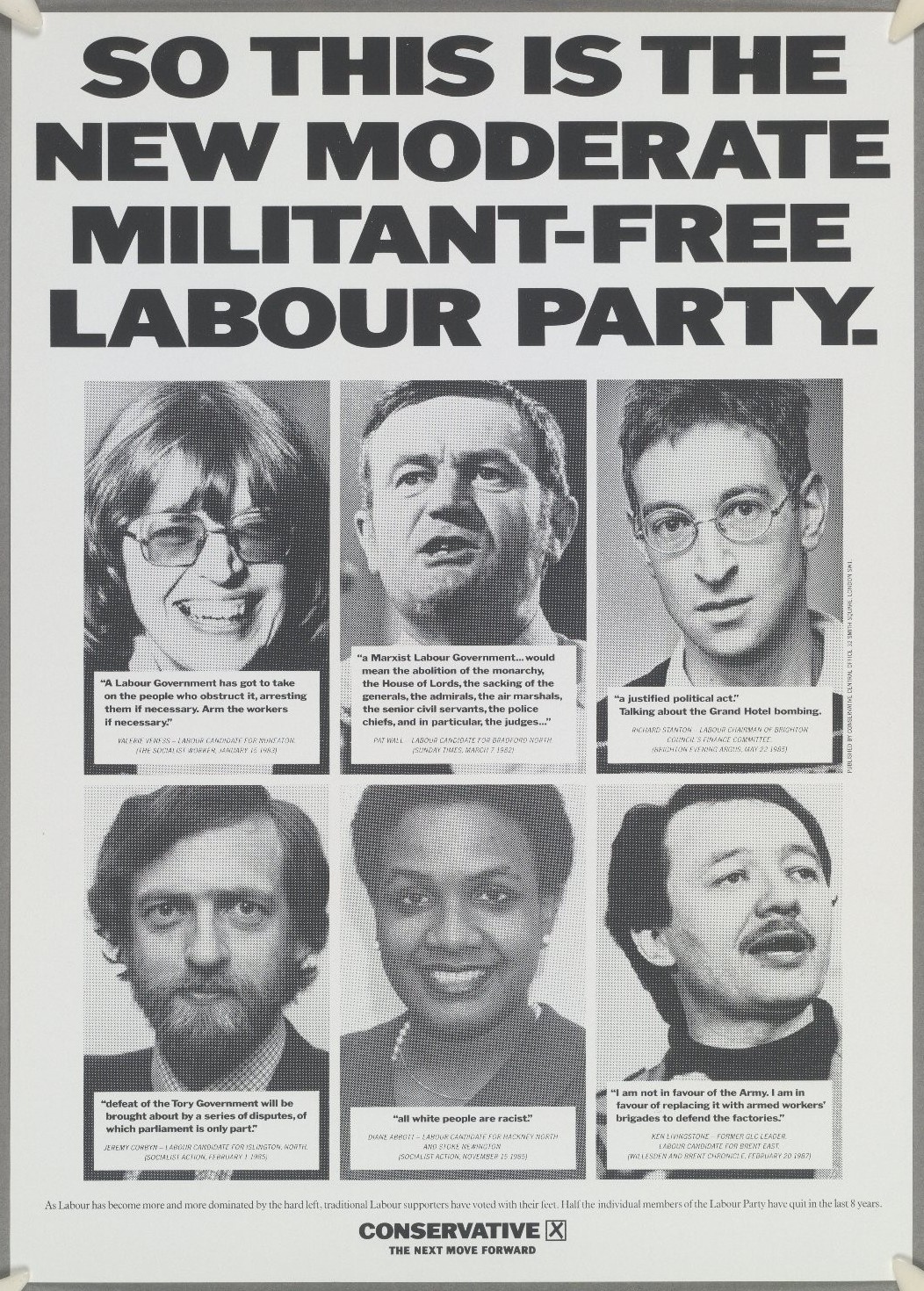
Moderate Militant-Free Labour Conservative Poster

In the last days, the Labour mainstream has not so much fallen as fully leapt into a fit of apoplexy. The cause an opinion poll – by no means solid, by no means a guarantee of future stock value – placing Jeremy Corbyn as the likely winner of the party’s leadership contest. Labour MPs, some now publicly flagellating themselves, nominated Corbyn for a ‘balanced debate’, but apparently couldn’t countenance that it might actually lead anyone to, you know, debate. Corbyn’s moment of popularity is thus sketched as, among other things, “the emotional spasm…an apocalyptic tendency”. John McTernan – a prime mover in the utter implosion of Labour in Scotland – was invited to hold forth on national TV as an oracle nevertheless, where he showed off his great talent in persuasion by calling Labour supporters “morons”. John Rentoul, that other great passé hack, thought recognising the left-wing appeal of the SNP as a factor in Labour’s defeat was like believing in space lizard conspiracy theories.

There was an equal portion of patronising bullshit to go with the name-calling. “Do some research” before you dare to a preference, chided Anne Perkins. Don’t be a “petulant child”, admonished Chuka Umunna. Sunny Hundal came at logic with customary cack-handedness, transforming the clear articulation of principles into a pathology. These are some of the same people who bemoan the detachment of politicians from real people, the decline in party membership, and so on, only to rise up as vengeful furies when a candidate dares to stir energies. All down to an unsavoury populism, natch. This, says Helen Lewis, is ‘purity leftism’, nothing like the necessary compromises of opposition, where you have to be bold enough to endorse 2% defence spending (something “the public” indeed likes, although hardly top of their polled priorities). Blair, of course, can only relate in the terms of triangulation, regurgitating the 1990s whilst pretending to the terrain of the future.

It doesn’t matter that Corbyn’s record is one of social democracy (remember that?). It doesn’t matter that there are trends in his favour. It doesn’t matter that his economic policies are comparatively bold and redistributive. It doesn’t even matter that many of Corbyn’s policies are popular. One line of Blair’s intervention was widely cited: “I wouldn’t want to win on an old fashioned leftist platform”. Few completed the quote: “…even if it was the route to victory“. This is not political argument, nor even Machiavellian electoral planning, but the tantrum-jitters of the self-appointed aristocracy. Having passed out lectures on loyalty and collective responsibility on Monday during the second reading of the Welfare Bill, the dauphins were by Thursday pre-declaring a coup should Corbyn win and practically spitting on their own activists besides. They saw no contradiction. Labour’s experts advocate not political communication but political manipulation, impersonating the enemy to take their place in our collective consciousness.

And so it will go on if any of the appeasement candidates win. Continue reading