Between Fetishization and Thrift? A Response to Dave Eden’s Autonomy: Capitalism, Class and Politics.

Nick faceAhoi, Disorders! We’re thrilled to host a guest post by Nicholas J. Kiersey, Assistant Professor at Ohio University, indefatigable student of Foucault, Italian Autonomism and Deleuze and Guattari, plus a die-hard fan of Battlestar Galactica. Nick is the author of papers on governmentality in Global Society, the biopolitics of the war on terror in New Political Science, everyday neoliberalism in the Journal of Critical Globalisation Studies, and is due to be published on the occupy movement and affective labour in the financial crisis in Global Discourse and Global Society respectively. Oh, and he’s also Irish. That’s also important. Below is Nick’s review of Dave Eden’s new book on Autonomist thought, which one can only hope has not gone entirely unnoticed because it’s one of the finest on the subject!

All quotes in the below are to Eden’s text, unless otherwise stated.


Eden Autonomy

No doubt, a return to the commodity is a risky venture. As Dave Eden puts it in his exceptional new book, certain framings of the power of the commodity can lead to an embrace of austerity, a “romanticization of poverty” or, worse, “a reactionary anti-capitalism”. Nevertheless, he asserts, a return to the commodity may ultimately be required. Currently popular framings of social movements, such as those of Hardt and Negri, he notes (citing Franco Berardi), offer very bright and “jolly” interpretations of the possibilities of the age, pretty much ignoring the need for a critique of the commodity form altogether. As such, they appear to have little sense of what it is that keeps capitalism going, or what it is that might finally send it on its way! However, while Eden wishes to convince us that we cannot do without the critique of the commodity, it is unclear if he ultimately achieves this goal. For his argument stands or falls on his ability to convince us that it is possible both to embrace this critique and remain faithful to an internal theory of capitalist power. This is a difficult circle to square and, by the end of the book, Eden seems to have done little to address it – an irony given that this is actually one of the areas where the targets of his critique are especially strong.

At the heart of Eden’s explanation of Autonomism, its virtues and its flaws, is the “Copernican inversion” of Marxism in which Mario Tronti asserts that the true dynamic force behind capitalism’s development is the workers rather than capital. Starting from this core observation, Eden proceeds to offer a survey and critque of Tronti’s heirs, particularly Antonio Negri. For Negri, the current order in world power is defined most completely by the antagonism between ‘Empire’ and the ‘multitude,’ where the latter term endeavors to expand the definition of the proletariat in order to capture not only the vitality of “labour as a whole” but to encompass the full diversity of the identities which compose it, and Empire is the power which dominates the multitude. Breaking with traditional Marxism, however, Empire is not capitalism. Rather, it is a multi-valent regime which proscribes democracy in order to bolster a global order of things which is capitalist, statist, racist, and gendered, among other things. Challenging this power, however, the Multitude realises the creative possibilities of today’s intellectual and affectively efficacious labour, and incorporates them in its struggle for self-actualisation.

Continue reading

A Crisis of Immediacy

I wonder if other writers feel as though they are throwing words by the hopeful fistful into a void, into the place where an audience might be. This hoped-for-reader is on my mind because I feel I should apologise for having taken so long to think these thoughts and align them so that I can throw them into that void.

There is no reason for apologies, however, because my hoped-for-reader doesn’t know that my current thoughts are inspired by a planned but only partly written series of posts from two-and-a-half years ago. Yet I feel I am writing an overdue assignment on the last day of class.

My thoughts are not timely. I worry this means they are no good. This is a strange feeling, to worry not that the words that carry our thoughts are inadequate but rather that they have gestated too long, such that tossing them into the void ceases to be a hopeful act of communication and becomes rather like dropping a crumpled page into the nearest bin.

Artwork from wraphome.org

Artwork from wraphome.org

Those many months past I wanted to write more about the economic crisis, about the disaster in the making that was “austerity”. In particular I wanted to consider what virtues might help us to navigate what seemed an all-encompassing crisis. But the moment has passed, surely. Right? There’s talk now of recovery even in Britain and signs of changing attitudes in Europe. Continue reading

Struggling with Precarity: From More and Better Jobs to Less and Lesser Work

Once a French neologism, precarity is now a household name describing in equal measure the fate of low-wage, part-time holders of bullshit jobs, seasonal and migrant workers, creative entrepreneurs of the self, “graduates with no future,” foreclosed homeowners, debtors and increasingly even segments of the salaried bourgeoisie. At its most basic, a term for the economic uncertainty and existential angst associated with the dissolution of fixed employment, precarity also suggests the disintegration of stable societal bonds, occupational identities, social protections and a sense of entitlement and belonging characteristic of the old proletariat. In short, then, precarity is the experiential dimension of the crisis of the society of work dating back to the 70s and 80s.

Diego Rivera Detroit Industry Mural 1923

Increasingly advanced production methods, introduced since the 70s to tame shop-floor insubordination as well as reap the untapped potentials of global competition, have caused a decline in growth rates, which no amount of privatization, financialization and austerity measures has been able to make up for since. Andrew Kliman and others have argued that it is this real crisis in capitalist productivity that lies at the heart of the current slump, and not simply unrestrained financial gluttony, as the more short-termist analysis offer. As capitalist production develops, machines replace people and the rate of profitability, which is given by the human labor theory of value, drops, causing sluggish investment and slow growth. This is essentially Marx’s theory of economy crisis, aka the tendency of the profit rate to fall, but also a story we should know by now from Autonomist accounts about the transition from Fordism to post-Fordism (Hardt and Negri) or from profit extraction to rent-becoming-profit (Christian Marazzi), and from David Harvey’s accumulation by dispossession.

If we shift the scale of our focus from capital to labor, though, we see that the crisis of capitalist productivity is, in fact, a crisis of work or a crisis of a society built around work as the only legitimate point of access for income, status and citizenship rights. Again, Marx is instructive here: “Capital itself is the moving contradiction, [in] that it presses to reduce labour time to a minimum, while it posits labour time, on the other side, as sole measure and source of wealth.” Socially necessary labor is reduced to a minimum (through things like automation, outsourcing, and financialization) at the same time that human participation in paid work continues to remain our only measure and source of wealth. Work doesn’t disappear as a result. It becomes fragmented, devalued, and wasteful, ceasing to provide a social identity or a collective language of experience.

Image

Precarity is a word for our time. It describes the slow disintegration of the historic bond between capitalism, democracy and the welfare state. But it also entails a rallying cry to reverse this situation. Continue reading

The Pay Strike And Its Discontents

Breaking Bad Pay Teachers More Money

The ballots are out, the wheels are in motion. Union members have until Thursday 10 October to vote on strike action over the latest derisory pay offer of 1% (if you haven’t received a ballot, go here). The justness of the cause seems clear enough. Since 2009, every pay award has been several percentage points below inflation, leading to a consistent real terms drop in pay. And some of those paltry increases were only attained after negotiations. Yet, despite the protests from above (and excepting a brief dip in student numbers), British higher education is in fine financial health. The overall wage bill is decreasing at the same time that surpluses are growing. And for “growing” read “more than doubling”, from £488 million in 2007/8 to £1.1 billion in 2011/2012. Managers are reaping their rewards accordingly, and a significant portion of Vice-Chancellors are seeing their pay go up by 10-20%. At Sussex, for example, Michael Farthing is now paid £280,000 (including pensions contributions), as compared to £178,000 in 2007 (that’ll be a 57% increase then).

And yet there is a foreboding. Fear is a factor, nondescript anxiety another. Perhaps an awkward sense that any level of action is somehow at odds with the academic code.

Articulated objections come in two stripes. First, the we-haven’t-got-it-so-bad defence. Beyond the usual ‘all in it together’ austerity ideology, there are pay increments (which most permanent academic staff get automatically). Real wages aren’t declining so hard if you move up a pay step each year. This is on its own a pretty restricted ambition, since it amounts to a kind of career “progression” that leaves you standing still. It is also, for all the talk of solidarity with lower-paid workers, a selfish analysis.

In the last 5 years, the pay for new lecturers and tutors has dropped 13% in real terms. Following the USS pension saga, they (we) have each had tens of thousands of pounds taken from them over the course of their careers, while staff that retained their old rights are paying more every month into a scheme that was, let us recall, nowhere near crisis. There are fewer scholarships and research grants than before, and an increase in teaching-heavy posts. Consumer-driven logics are set to make that worse. On the horizon, just over there, is a US-style expansion based on precarity, a prestige elite, and debt bubbles. Some at the top are already breaking from the national pay spine, inaugurating a two-tier system. Consider this trend alongside the state of university finances. What is it to look at this and say things aren’t so bad? I put it to you that such a position is detached, complacent, and irresponsible.

Second, there is the strikes-change-nothing complaint. This has better justification. Local actions over the last years have not reversed policies. Pensions were stripped down anyway. And there is something peculiar, isn’t there, about the idea of day-long walkouts and picket lines in a sector so based on relatively scattered student-teacher interactions. There is no machinery to fall silent, no buzzing shop floors to stand empty. Just a day of saved wages for management and probably a whole stack of reorganised lectures, academics not really being the types to withhold knowledge (or, rather, unwilling to see knowledge as labour). There is a sense that the old tactics are dead, and should be left in their graves.

On the one hand, this is an argument for more radical action. If employers can handle strike days, we need more. Or, alternatively, forms of action that do not fetishise the picket line. Something that will make VCs pay attention, like a marking boycott or withholding final grades. In a customer-orientated culture this is the pressure point, especially if action begins to alter the results of the National Student Survey, that Big Other of the academic scene (what do students really want?). The complaint goes up that the national union lacks the imagination to instigate these actions, and that we should therefore turn to more vibrant kinds of opposition. But new forms of resistance nevertheless confront established modes of punishment. When full pay is withheld day on day, when even partial performance leads to the forfeit of full wages, how quickly will we really buckle? We know something has to break the pattern, but we’re not sure we’re capable of it, or that the sacrifice is worth it. In other words, we find ourselves a little too close to text-book academic bitching: something more fundamental needs doing, but we’re not likely to be the ones to do it.

On the other hand, the fear and the paralysis can be found closer to home. Complaints about the union form do not produce their alternative ex nihilo. There are possible replacements, but no actually-existing ones. Nor does the appetite for creating one seem to exist. And for good reason. The paradoxical character of academic subjectivity is both to consider ourselves in a position of real epistemic and social privilege and to be so despondent about our influence on things as to merely absorb the changes thrust upon us (working conditions, impact agendas, research restrictions). The legal protections of strike action have no parallel, truncated as they are. Creative alternatives have raised energy, and served as political classrooms in their own right, but they haven’t actually stymied ‘reforms’ (whether on fees, outsourcing or investment portfolios). And, strange as it may sound, universities are probably happier taking draconian action against their workers than their students. A faculty occupation, if we could even imagine such a thing, would not end well.

None of that is to say that we (there’s that intangible collective again) should walk zombie-like to the picket. Fersure, let the rejuvenation of academic democracy proceed apace. In the meantime, we have to ask ourselves seriously what the consequence is of another pliant year. There are murmurings that a failure to win this ballot will endanger collective bargaining itself. If we cannot muster the resolve to deliver a strong yes on action short of a strike, and a strong yes on strike – if we cannot even deliver a serious turnout – that’s probably as much as we deserve.

The Student Movement in Quebec: Of Small Victories and Big Disappointments

A guest post by Philippe Fournier, following up on his analysis of the Quebec student movement in May last year. Philippe is Postdoctoral Fellow at the Canada Research Chair in Globalisation, Citizenship and Democracy (Chaire MDC) at Université du Québec à Montréal’s Sociology Department, and works primarily on Michel Foucault in global politics.


A Quebec student march route

A Quebec student march route

Quebec’s protracted student crisis, which laid heavy on voters’ minds, has been fixed, at least for now. In early September, the Parti Québécois (PQ) was ushered in as a minority government. The PQ campaigned on a tuition freeze, higher taxes for society’s upper echelons and a fairly ambitious environmental agenda. These aspirations notwithstanding, popular discontent with the Liberal’s handling of the student crisis, widespread accusations of corruption (see the ongoing Commission Charbonneau) and a collective displeasure with Premier Jean Charest’s smug ways, all contributed to the previous government’s demise. All things considered, the Liberals did very well, taking 31% of the vote. The PQ took a mere 32%, hardly a glowing endorsement from the general public. Most analysts believe that it was also a clear message to the incoming rulers that Quebecers had no interest in one of the more fundamental objectives of the PQ’s platform, that is sovereignty.

There are several dimensions and consequences to the PQ’s election, most of which provide an example of things-that-are or of things-that-will-be in western countries facing economic woe.

Students and Protests

The majority of students see the electoral results as a victory and feel vindicated for their continued efforts. A minority of students, many of whom are affiliated or sympathetic to the now recently defunct CLASSE (now the ASSÉ), which was set up especially for the strike, are less enthused and sense that this is only a reprieve in the long and arduous fight for free education.

The PQ has called for a summit on higher education, which will take place sometime in February and is meant to involve a wide-ranging consultation between state officials, student representatives, chancellors and business leaders. The likely outcome will be an indexation of tuition fees to the cost of living and new innovative means to cut costs in University management. Opposition parties are already accusing the PQ of having bowed down to the vociferous demands of ‘the street’ and have warned that this blank cheque would have consequences on the allocation of funds to other social programs. The ASSÉ is predictably sceptical of such proceedings and is not yet sure whether it will participate. After being told by the government that they had to cut a further 120 million before the negotiations even started, University chancellors are ticked off.

Insofar as the student crisis was widely heralded as a social movement and not just a sectorial claim, it is important to assess its overall effect on Quebec’s current political landscape. Continue reading

The Best Things In Life Are Free?: Open Access Publishing and Academic Precarity

The fifth post this week on open access and its impact on IR (amongst other social sciences) from previous guest poster Nathan Coombs (follow the blue underlines for the first, second, thirdfourth and sixth posts). Nathan is completing a PhD in politics and philosophy in the Department of Politics and International Relations, Royal Holloway, University of London. He is co-founder and co-editor of the transdisciplinary, open-access journal, the Journal of Critical Globalisation Studies. He has a book forthcoming in 2013: The British Ideology. Images by Pablo.


When my colleagues and I established the open-access journal, the Journal of Critical Globalisation Studies in 2009, to us open-access publishing meant placing an academic journal online which would be free for both our contributors and our readers. We took inspiration from open-access journals in critical philosophy such as Parrhesia and Cosmos and History, the efforts of the Open Humanities Press, and the Australian book publisher Re.Press, who make PDFs of their releases available online simultaneously with their distribution to bookstores.

Since this time, however, the term open-access seems to have become increasingly polyvalent. As discussed in contributions to this series of reflections by Pablo, Colin Wight and David Mainwaring, open-access publishing is now endorsed by government and publishers. Yet the price of this move into the mainstream has unfortunately been a watering down of the term. In the ‘gold’ open-access publishing scheme proposed by the Finch report, for instance, universal access to academic publications is secured, but only by preserving the existing journal subscription system and by introducing Article Processing Charges (APCs) for authors.

Whether these pseudo open-access schemes will prove to be unstable transitional forms or lasting models only time will tell. In any event, for my contribution I want to focus on open-access in its fully fledged form: ‘full open-access’ we will call it. The model of full open-access, as operated by the JCGS, does not permit any persistent role for the private (profit motivated) sector within academic journal publishing. Full open-access journals are housed on independent or University affiliated websites, freely available to everyone in the world within an internet connection, and provide a free anonymous peer-review service for contributors.

Let us imagine a world where academic journal publishing turned over completely to this approach. Journal subscription fees would be swept away. Academics would take control over their publishing arrangements. The profits of corporate publishers would dwindle to zero. An enticing scenario for anyone exasperated with the current status quo.

As with all things that sound too good to be true, though, caution is required. Continue reading

Death To Open Access! Long Live Open Access!

A few weeks ago at the Millennium conference, some of us got together to talk about open access and the political economy of knowledge (re)production in our little corner of academia (“us” being Colin Wight, David Mainwaring, Nivi Manchanda, Nathan Coombs, Meera and me). Over the remainder of this week, we’ll be posting those reflections here for your delectation because, some discussion notwithstanding, labourers in today’s university-factories need to get talking about these things, and fast.


Open Access appears to be here. The Finch Report has recommended it, the Government has endorsed it, and there even seem to be some monies newly available for it. The battle is won, and the age of unfettered academic-public intercourse is upon us. Well, not quite. Finch’s preference for Gold Open Access, in which journals continue to receive revenues and make profits and in which academics (or their institutions) pay a fee of several thousand pounds per article for the pleasure (the so called Article Processing Charge (APC) system, which will receive greater attention in later posts), is deeply problematic (well-reasoned explanations for why available from Stevan Harnad and Peter Coles (Telescoper), with more qualified views, even cautious support, from Stephen Curry and Repository Man). Also, the monies aren’t new, and have instead been extracted from existing research budgets (and what a complete and utter surprise that is).

This is all cause for serious concern, and relates closely to the kinds of arguments that are developed and deployed in favour of Open Access (or, to be more provincial about it, Open IR). There are three kinds of arguments for opening up the journal system, arguments from access, ethics and cost, and we are in danger of letting the first overwhelm the different, and better, cases made in the name of the second and third.

The first set of arguments has to do with the problem of access: that the journal system is broken because it creates barriers to the circulation of academic knowledge. The journal as usually conceived was an ingenious and appropriate method for collating and distributing knowledge in the 18th century, but is now redundant. And yet journals – with their pay walls – remain the only (or at least the principal) vector for success or employment in academic life. This is doubly problematic since the various metrics that journal comparisons and prestige enable themselves then become vectors of discipline and control, even in the face of the many, many reasoned objections to such measures.

Continue reading

The Crisis of Europe and Colonial Amnesia

Recent commentary on the Eurozone crisis has started to pick up the grammar of colonial rule. The centre for Research on Finance and Money at SOAS, for example, has published an influential report wherein northern Europe (Germany especially) is framed as the core and southern Europe (especially Greece) as the periphery. Meanwhile, Ulrich Beck, European cosmopolitan par excellence, wonders whether the European Union will become “a European Empire with a German stamp”. Beck notes that Merkel’s sense of power “conforms to the imperial difference between lender and borrower countries.” At stake, agree many prominent European intellectuals in the pages of The Guardian, Eurozine and Der Spiegel, is no less than the promise of freedom and democracy immanent to the European project itself. All variously agree that, against the imperial sclerosis spread by capitalist and bureaucratic functionaries at the highest levels of governance, what is needed is a rejuvenation of meaningful democracy at a grass-roots level.

Faced with a dismantling of democracy Jürgen Habermas mounts a plea to save the old “biotope of Europe”. The constitutive components of this threatened ecosystem are freedom and democratisation, and its genesis lies in the Second World War and the fight against fascism and “internal” barbarism. The president of the European Central Bank has himself proclaimed that Europe now faces its “most difficult situation since the Second World War”. Alternatively, for many social democratic and leftist commentators, the danger of the situation lies in the loss of the “internal” struggle of labour and capital that defined the Cold War landscape. In the new context of EU institutional “empire” and its neoliberal tentacles, the defeat of labour quickens the erosion of social democracy, thus deciding the fate of the European project.

Europe, then, is perceived to be “colonizing” itself and in the process destroying freedoms and democratic structures that had been hard fought for by the general populace against political oppression and economic exploitation. But this angst-ridden imaginary of European crisis has very little to say about the substantive historical and global dimensions of European colonialism. Does cosmopolitan and social democratic angst cover these legacies and contemporary effects? In fact, in most recent treatises on the crisis the struggle for decolonization is given no integral status, even though these particular struggles were inseparable to and spanned the formative time period of the European project – the Second World War (and the Cold War). Some do mention current issues of migration and xenophobia. Nevertheless the implication, in general, is that colonial legacies are derivative of, or additional to, the core struggle for democracy and freedom in Europe. Fascism, Cold War, class struggle: yes; colonization, imperialism, decolonization and liberation struggle: not really.

Not all intellectuals suffer from this colonial amnesia. A number of scholars including Robert Young, Pal Ahluwalia, Paige Arthur and Alina Sajed have argued that in some key strands of post-War French thought, the issue of colonialism and decolonization was integral to discussions of European re-democratization and humanist concerns. This engagement reached a peak in the Algerian war of independence in the late 50s before falling into abeyance. And this was precisely the same time, we should note, as the Treaty of Rome, which bound European countries together in a tighter economic union simultaneoulsy sought to re-bind (post-)colonial African polities, peoples and resources into this union.

More generally, there has accumulated a significant amount of scholarship that reveals the colonial influences that shaped and were woven into quintessentially “European” intellectual/political movements such as Enlightenment and modernity. Continue reading

It’s Really Kicking Off In Quebec

Despite some news coverage and discussions on Twitter, we’ve seen little on the continuing educational and political crisis in Quebec. Hence, a guest post from our friend and colleague Philippe Fournier. Philippe teaches political thought and International Relations at the Université de Montréal and the Université du Québec à Montréal. He has published research on Foucault and International Relations, Governmentality in the contemporary United States and Violence and Responsibility. He is currently working on the government of security in the US and on the theoretical conflation of sovereign power and government in Foucault. His other research interests include critical cultural theory and political economy.


A little background info and some thoughts on the student crisis in Quebec, which has been going on for 101 days now and shows no signs of waning in the face of the government’s disturbing intransigence. The recent adoption of Bill 78, which circumvents the right to protest without prior notice and gives the police the right to change a demonstration’s itinerary, among other things, has shocked and angered many Quebecers and made the news worldwide. On Tuesday May 22, over 250 000 people expressed their discontent with the current government and it was quite a sight.

Ever since the ‘quiet revolution’ in the early 1960s, which saw the institution of important social provisions and the attribution of several socio-economic entitlements to the francophone majority, Quebec has been holding fast to its social-democratic heritage. Jean Charest’s liberal party, in power since 2003, is determined to fight off the modern-day antichrist of debt and rationalise state activity. The Charest government’s attack on hard fought social entitlements, including accessible post-secondary education (Quebec has the lowest tuition fees in Canada), has been going steady since 2003 but has intensified since 2008. Quebecers were told that it was no longer reasonable to expect affordable public services and that it was high time that we join the pay as you go party.

What is at play in this conflict is no less than the fate of social-democratic expectations in Quebec. These expectations are actively discouraged and discredited by the current political elite. The demands for a tuition freeze by sizeable portions of Quebec’s students are considered unreasonable in many quarters, and seen as a plane expression of bad faith and overindulgence by a majority of Canadians, seemingly stuck in a Stephen Harper induced stupor. The words ‘pragmatic’, ‘realistic’ and ‘rational’ have been duly appropriated by the partisans of deregulation, free-enterprise and individual responsibility. Any suggestions that the latter orientations are based on an ideological choice are ridiculed; they simply express a sounder and more logical way to manage society.

Up to now, there seemed to be a dour resignation to the decimation of our social programs. This young generation of Quebecers, which many had touted as completely apathetic and apolitical, has taken a resolute stand against restricting access to a public good, against the further commodification of knowledge and against the uncompromising law and order approach of an arrogant and irresponsible government. Those that have taken to the streets day after day and sacrificed their terms and put their professional lives on hold for the students that will come after them, have shown extraordinary resilience and bravery. It came as a surprise to many, because they did it on their own, with little or no help from their political science professors, who have long abandoned critical thinking for functionalist replications of reality sanctioned by government money.

Continue reading

The Irruption of the Event

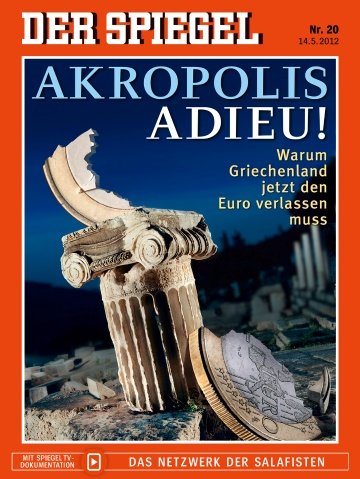
As the inevitable Greek exit from the eurozone seemingly approaches, it’s worth comparing current statements about Greece to how the financial press and regulators considered Lehman Brothers the week before its collapse set the global markets into panic mode. (See below for a selection of illuminating comments from officials about Lehman Brothers pre-collapse and about Greece pre-exit.) Reading these misplaced predictions, one thing becomes clear: the contemporary financial system is far too complex and opaque for anyone to determine the precise consequences of a Greek exit. Add into that the unpredictable nature of crisis politics (e.g. today sees rumors of Greek governing coalitions flying all over the place), and one has a system that quickly surpasses our capacities for forecasting. In this regard it’s interesting to read reports about the current Greek exit fears versus the reports in February when it also looked like Greece might leave (prior to the second of ECB’s long-term refinancing operations (LTROs) that managed to calm markets for a short while). In the earlier reports many commentators considered that French and German banks had largely separated themselves from Greek exposure, while the initial LTRO had purportedly given the financial system the flexibility it needed to survive any temporary disruption. Intriguingly, today’s fears about Greece, after the failure of the LTROs to significantly improve the situation and combined with fears over Spain’s banking system, are much more apocalyptic than in February.

The unfortunate truth is that while a Greek exit will be devastating to the Greek people (of this everyone is confident), it is still a better option than the continued austerity regime. Even the most optimistic IMF estimates of Greece’s economy under the austerity regime only see them returning to 120% debt-to-GDP ratio by 2020 – i.e. the same level that so worries commentators about Italy today. What is being asked of Greece is a state of permanent austerity and permanent social chaos. 

Milos Bicanski/Getty Images

September 9, 2008 – http://www.nytimes.com/2008/09/10/business/10place.html?pagewanted=all

Unlike Bear Stearns, which effectively collapsed when customers fled for the exits and the firm could not finance itself, Lehman Brothers has more sources of long-term financing and like other broker-dealers, access to emergency financing from the Federal Reserve. Mr. Fuld said that the existence of that lending facility should take any question of Lehman facing a liquidity crisis “off the table.

September 12, 2008 – http://www.ft.com/intl/cms/s/0/b3506214-80d5-11dd-82dd-000077b07658.html#axzz1mXeJ33ET

While the crisis at Bear stunned the markets, other financial institutions have had six months to prepare for the possible failure of Lehman. In the Bear crisis, the risks were extreme in part because they were unknown and unmanaged. The New York Fed has conducted extensive stress tests in order to attempt to evaluate the impact of a Lehman failure on markets such as the CDS market and it believes the systemic risk is quantifiable and lower than the risk that was posed by the imminent collapse of Bear back in March. Regulators have also evaluated the risk mitigation strategies put in place by other banks and the authorities believe them to be robust. That suggests the risk that a Lehman collapse could trigger a domino effect of failures at other financial institutions ought not to be great.

September 14, 2008 – http://www.ft.com/intl/cms/s/0/f3586ede-80ca-11dd-82dd-000077b07658.html#axzz1mXeJ33ET

Mr Paulson believes that the systemic risks associated with the potential failure of Lehman have been reduced because the market has had time to prepare for its possible demise, and a new Fed funding facility would assist an orderly unwinding of its positions.

February 15, 2012 – http://blogs.channel4.com/faisal-islam-on-economics/eurozone-reaches-its-lehman-moment-as-germany-insults-greece/16278

All the while, the chatter in euro policy circles, as I wrote on Monday, is that the Greek rot will not infect the rest of the euro area. A default could be managed. Even the odd French bank has managed to dispose of much of its exposure. We’ve had months to prepare. And, so the Lehman moment comes full circle. Three and a half years ago we were told exactly the same by Hank Paulson and co re Lehmans: The system, we were told, was strong enough. Finns, Dutch and some Germans increasingly think the same about a Greek default.