This Courage Called Utopia

(wild bells) A warm Disordered welcome to Wanda Vrasti, who previously guested on the topic of the neoliberal tourist-citizen imaginary, and now joins the collective permanently. And glad we are to have her. Her academic writings thus far include Volunteer Tourism in the Global South: Giving Back in Neoliberal Times (which came out with the Routledge Interventions series a few months ago), ‘The Strange Case of Ethnography in International Relations’ (which caused its own debate), ‘”Caring” Capitalism and the Duplicity of Critique’, and most recently ‘Universal But Not Truly “Global”: Governmentality, Economic Liberalism and the International’.


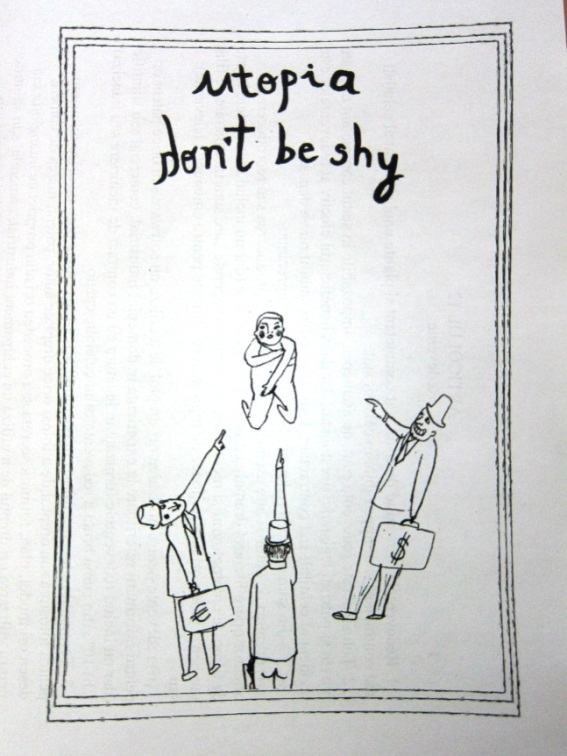
It’s often been said that this is not only a socio-economic crisis of systemic proportions, but also a crisis of the imagination. And how could this be otherwise? Decades of being told There Is No Alternative, that liberal capitalism is the only rational way of organizing society, has atrophied our ability to imagine social forms of life that defy the bottom line. Yet positive affirmations of another world do exist here and there, in neighbourhood assemblies, community organizations, art collectives and collective practices, the Occupy camps… It is only difficult to tell what exactly the notion of progress is that ties these disparate small-is-beautiful alternatives together: What type of utopias can we imagine today? And how do concrete representations or prefigurations of utopia incite transformative action?
Javier Lozano Jaén

First thing one has to notice about utopia is its paradoxical position: grave anxiety about having lost sight of utopia (see Jameson’s famous quote: “it has become easier to imagine the end of the world than the end of capitalism”) meets great scepticism about all efforts to represent utopia. The so-called “Jewish tradition of utopianism,” featuring Adorno, Bloch, and later on Jameson, for instance, welcomes utopianism as an immanent critique of the dominant order, but warns against the authoritarian tendencies inherent in concrete representations of utopia. Excessively detailed pictures of fulfilment or positive affirmations of radiance reek of “bourgeois comfort.” With one sweep, these luminaries rid utopianism of utopia, reducing it to a solipsistic exercise of wishing another world were possible without the faintest suggestion of what that world might look like.

But doing away with the positive dimension of utopia, treating utopia only as a negative impulse is to lose the specificity of utopia, namely, its distinctive affective value. The merit of concrete representations of utopia, no matter how imperfect or implausible, is to allow us to become emotionally and corporeally invested in the promise of a better future. As zones of sentience, utopias rouse the desire for another world that might seem ridiculous or illusory when set against the present, but which is indispensable for turning radical politics into something more than just a thought exercise. Even a classic like “Workers of the World Unite!” has an undeniable erotic (embodied) quality to it, which, if denied, banishes politics to the space of boredom and bureaucracy. It is one thing to tell people that another world is possible and another entirely to let them experience this, for however shortly.

Most concrete representations and prefigurations of utopia from the past half century or so have been of the anti-authoritarian sort. Continue reading

Female Terrain Systems: Engagement Officers, Militarism, and Lady Flows

One of the more interesting interventions made at Friday’s Gender, Militarism and Violence roundtable came from Vron Ware on the topic of a photo exhibit about the British Army’s Female Engagement Officers. The exhibit is funded by the Poppy Appeal, which was itself subject to some debate as a sentimental memorialism allocating funds in the service of a imperial-nostalgic self-image. The pictures, collected by a female former RAF Sergeant, are presumably understood by military and civilian leaders to be a significant public relations resource in illustrating the flexibility, equity and decentness of Anglo-American-Western ‘involvement’ in Afghanistan. Manifestations of cultural sensitivity, postfeminist integration and armies as state-building reconciliation services. And yet someone decided, both on the Army website and Twitter account, that the best image to lead with was that of knickers on a washing line. A puerile social media engagement.

The rest of the images, and the media coverage of them, focus heavily on assorted ‘personal’ issues experienced by the women. Gaze on their beauty products! See how they control their lustrous hair! Peak in on their need for mementos of home! Marks of difference indeed, although none of the coverage I have seen broaches the possibility that men too might stash deodorant in their tents, or manage their body hair to maintain professional standards, or display reminders of loved ones waiting at home. Instead, as any gender-sensitive observer might expect, the specially femininity of these troops displaces all other dimensions of war/peace/development/security (an impression encouraged by some of the subjects themselves). The BBC even recently juxtaposed the death of a female army medic with an image of another woman coming out of the shower tent. A soft voyeurism on military women as leaky bodies and as somehow out of place. But not just that. The juvenilia comes packaged together with the idea of the Female Engagement Officers as crucial to a kind of military effectiveness:

Captain Crossly told the London Evening Standard that one of the highlights of the tour was ‘seeing the absolute fascination of women in the compound when I removed my helmet and protective glasses to speak to them in their own language’.

She added: ‘Women are known throughout the world to bring people together, to focus on family and community. Just by being female, even in military uniform, you are seen to promote such things and are therefore more accepted.’

Lieutenant French said: ‘The photographs demonstrate the more feminine traits of female soldiers can be used as a strength on operations.’

Continue reading

Fratriarchy, Homoeroticism and Military Culture

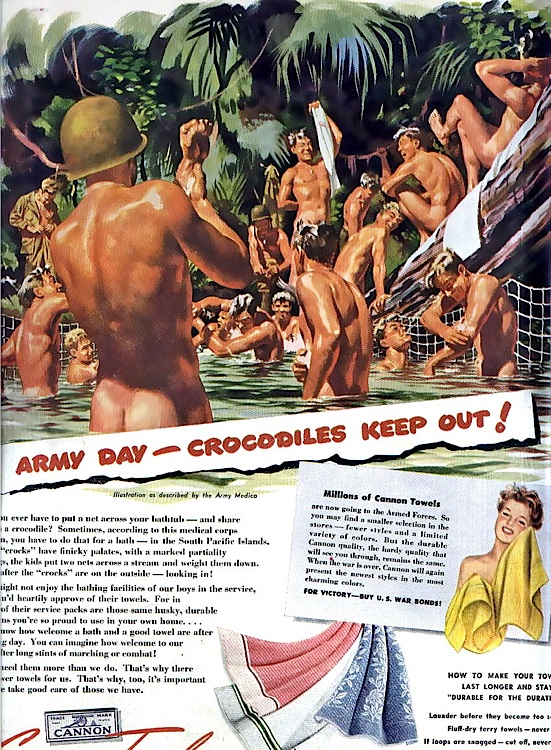
The ever-excellent Sociological Images offers up this 1940s advert, and others like it, as an example of how images previously taken to be innocent consumer bait for stereotypical homemakers now appear to us as dripping with homoeroticism. They may have added too that this half-ironic, half-nostalgic distance is what endears us to such images, which we then enjoy as vintage objects, for all that we know about the true historical context in which they were produced.

One common idea, which relates nicely to military bathing aesthetics (cannon towels? really?) is that many bonding behaviours in nominally heterosexual, male-dominated groups are in fact homosexual, but in a disavowed or repressed way. The scrum, the shared shower, the bunk-beds, the exclusion of women not only from the fields of play and war, but also from the various celebrations and carnivals that follow, all seem to indicate a desire for intimacy that cannot be named as such.

In the excellent Bring Me Men (which deserves its own dedicated review), Aaron Belkin identifies a more complex relation. In becoming military men, there is a need not only to disavow femininity, but also to become intimate with the ‘unmasculine’ and the ‘queer’. Rather than identifying a direct alignment of the masculine with the military, or seeing gender norms as accidental in their intersection with the military, there is instead a constitutive tension between the masculine and the unmasculine (or, we might say, between the strongly heteronormative and the homosexual). Basic training relies on a traumatic ambiguity, continually casting initiates as by turns masculine and unmasculine, so that no soldier can ever be sure that they were sufficiently on the ‘right side’ of the line. As one Marine put it: “The opposite of feminine? No. To me, what is masculine? I don’t know. [pause] And I’ve worked so hard at being it”. The continual ambiguity – what Belkin calls discipline as collapse – interacts with surveillance and punishment to produce the soldier-subject.

More brutally: Continue reading

Navigating Neoliberalism: Political Aesthetics in an Age of Crisis

For those who are interested, here’s a copy of the talk I gave last weekend on the technological sublime, machine perception, and cybernetic economies. Held in the beautiful Treignac area at The Matter of Contradiction: Ungrounding the Object event, it was a lot of fun and filled with some fascinating discussions. Many thanks to the Treignac Projet for inviting me and organizing the event. Check out more of their work here.

The Olympic Semiosphere

The chafing constraints of a thesis prevent any original reflection on our hallowed Olympic moment (not least because Rahul has already said so much, and so well). There was little to better Iain Sinclair’s apt diagnosis of “a wonderful national hallucination: a beautiful conjuring between William Borroughs and Charles Satchi…the combination of paranoia and advertising run wild” (a clip worth watching for Jon Snow’s outraged ignorance at the origins of the Olympic Flame [clue: Nazis]). Reports had filtered through that the economic miracle was not as originally billed, with talk of Central London’s ‘ghost town’, stimulating a description elsewhere of the Olympics as an “economic bomb deployed against world cities”. And now there is the most welcome return of K-Punk. At length:

Welcome to the Hunger Games. The function of the Hunger Games is to suppress antagonism, via spectacle and terror. In the same way, London – 2012 preceded and accompanied by the authoritarian lockdown and militarisation of the city – are being held up as the antidote to all discontent. The feelgood Olympics, we are being assured, will do everything from making good the damage done by last year’s riots to seeing off the “threat” of Scottish independence. Any disquiet about London 2012 is being repositioned as “griping” or “cynicism”. Such “whinging”, it is claimed, assumed its proper place of marginality as the vast majority enjoy the Games, and LOCOG is vindicated…

…But once the Olympic floodlights are turned off, most will switch back from an attitude of mild interest to indifference towards even the most dramatic Olympic sports, never mind those many Olympic sports which plainly have limited specator appeal. This isn’t the point though: disquiet about London 2012 was never necessarily based in any hostility towards the sports. Enjoyment of the sport and loathing for LOCOG and the IOC are perfectly compatible.

Cynicism is just about the only rational response to the doublethink of the McDonalds and Coca Cola sponsorship (one of the most prominent things you see as you pass the Olympic site on the train line up from Liverpool Street is the McDonalds logo). As Paolo Virno argues, cynicism is now an attitude that is simply a requirement for late capitalist subjectivity, a way of navigating a world governed by rules that are groundless and arbitrary. But as Virno also argues, “It is no accident … that the most brazen cynicism is accompanied by unrestrained sentimentalism.” Once the Games started, cynicism could be replaced by a managed sentimentality.

Affective exploitation is crucial to late capitalism. The BBC’s own Caesar Flickerman (the interviewer who extracts maximum sentimental affect from the Hunger Games contestants before they face their deaths in the arena) is the creepily tactile trackside interviewer Phil Jones. Jones’s “interviews” with exhausted athletes, are surely as ritualised as any Chinese state broadcast. Emote. Emote again. Emote differently. Praise the crowd.

And, just in case you somehow missed it, the irrepressible CassetteBoy:

How Many Buddhists Are There in Northern Ireland?

Danny Boyle’s Olympics opening extravaganza was many things, but one thing it was not was a history lesson. If you were looking for any acknowledgement of the place of empire in the British national narrative, you would have had to concentrate quite ferociously during the hauntingly beautiful Abide With Me section, sung by Emeli Sandé, to see Akram Khan’s dance troupe mime the whipping of slaves (1:21:04 into the BBC’s coverage of the event). It’s possible that I simply imagined this because I was looking so hard. Anachronistically, moments before, Empire Windrush had arrived on stage, without context, like a Caribbean cruise ship blown off course (Columbus revenge). Two moments that you would have missed if you’d blinked, leaving you mystified about how the opening ceremony, Team GB, and indeed Britain itself had become such a multiracial spectacle.

In the reams of mostly laudatory commentary that has followed the ceremony, some have suggested that it might not have been appropriate to stage imperial conquest and plunder on an occasion that was meant to welcome the world to London. The insinuation that opening ceremonies should be mind-numbingly ‘fun’ is belied precisely by what made this one meaningful. Boyle deserves credit for trying to do history—any history at all, however potted—and indeed what makes his exclusions telling and problematic was precisely the emotional depth and maturity with which he was able to stage historical trauma (the Industrial Revolution, the World Wars, 7/7) and individual vulnerability (children in hospital, the references to children’s literature evoking the darkness of growing up) without detracting from the spirit of celebration. Yet some traumas are clearly easier to commemorate, some dead easier to remember, than others. Boyle’s history was curiously blinkered, resolutely domestic, almost wilfully blind to anything that happened outside this ‘green and pleasant land’. (An alternative potted history entitled ‘How to Keep Your Land Green and Pleasant’ might read ‘Step 1: export surplus population, preferably of the lower orders, preferably to places quite far away; Step 2: export dirty industries; Step 3: repeat step 2 for as long as you are able to.) The problem may have begun with the title—Isles of Wonder—that foreshadowed the geographically circumscribed view of history with which we were presented. Indeed the extraordinary, infuriating and continuing dilemma of British identity is that only the cultural right does geographical justice to Britain’s role in forging the modern world, albeit in registers of racism and supremacism. If Boyle’s historical imagination is anything to go by, the left, it would seem, prefers amnesia.

Continue reading

Dr El-Khairy, I Presume?

We’re on a roll now. On Friday, Omar became the fourth of us to ascend the greased pole of academic accreditation since we began cultivating this little corner of the internet. Forever more to be known as Dr El-Khairy, his burgeoning cultural insurgency notwithstanding. The work in question? American Statecraft for a Global Digital Age: Warfare, Diplomacy and Culture in a Segregated World. And who said it was good enough? Faisal Devji and Eyal Weizman, actually. So there. And I have promises in writing that he will be telling us more about it all real soon.

Friday is for Beautiful Revolutionary Dreams and Pragmatist Notes

Imagination is the chief instrument of the good. It is more or less a commonplace to say that a person’s ideas and treatment of his fellows are dependent upon his power to put himself imaginatively in their place. But the primacy of the imagination extends far beyond the scope of direct personal relationships. Except where “ideal” is used in conventional deference or as a name for a sentimental reverie, the ideal factors in every moral outlook and human loyalty are imaginative. The historic alliance of religion and art has its roots in this common quality. Hence it is that art is more moral than moralities. For the latter either are, or tend to become, consecrations of the established order. The moral prophets of humanity have always been poets even though they spoke in free verse or by parable. Uniformly, however, their vision of possibilities has soon been converted into a proclamation of facts that already exist and hardened into semi-political institutions. Their imaginative presentation of ideals that should command thought and desire have been treated as rules of policy. Art has been the means of keeping alive the sense of purposes that outrun evidence and of meanings that transcend indurated habit.

-John Dewey, Art as Experience

What We Talked About At ISA 2012: How Music Brings Meaning to Politics

At this year’s ISA conference, I presented on the panel ‘The Social Technologies of Protest’, with George Lawson, Eric Selbin, Robbie Shilliam and our discussant Patrick Jackson. The full text of the draft paper is available here. Thanks go to the panel and audience for some fascinating questions and discussions.


Music is a world within itself
With a language we all understand
With an equal opportunity
For all to sing, dance and clap their hands
But just because a record has a groove
Don’t make it in the groove
But you can tell right away at letter A
When the people start to move

–          ­‘Sir Duke’, Stevie Wonder, Songs in the Key of Life (1976)

Music is an old and effective technology of politics. This was highly visible in both the recent uprisings and the attempts at counter-revolution; whilst from the beginning Tunisian activists sang their national anthem in the street in anti-regime protest, Assad blasted the Syrian anthem into the cities as a reminder of his position. Rappers and older musicians shared platforms in Tahrir Square, and DJs parodically remixed Gaddafi’s final public speeches into technotronic nonsense. Whilst not all political music is sung of course, songs and the act of singing are particularly powerful in political situations as means and symbols of mobilisation and unification.  Moreover, songs tend to linger in the brain.

But there are at least two ways of thinking about the relationship between politics and music. The question which is perhaps most often asked and answered is: how, when and where is music political? So, why did the Tunisian protesters sing the national anthem in front of the courthouse, how did music support the anti-apartheid struggle, and why did the Haitian revolutionaries sing the Marseillaise? How did the musical character of these expressions facilitate a particular kind of political act? Lots of excellent writers, both scholarly and otherwise, have turned their attentions to the nature of political music, and especially protest music, in a variety of times and places.

However, the question that I want to focus on mainly here though is slightly different: how, when and where is politics musical? This question was stimulated by the general observation that when we try to make sense of politics, we often use metaphors related to music. A common phrase is that a political statement or value ‘struck a chord’ with an audience, or that protesters are ‘banging a drum’. Politicians may or may not be ‘in tune’ with publics, and relations may be ‘harmonious’ or not. Coups will be ‘orchestrated’.

Perhaps surprisingly, in moving from vernacular to scholarly modes of understanding politics, the metaphors of music are no less important. In fact, in some cases they seem to be more important. The genre-defining work of the historical sociologist Charles Tilly in the study of contentious politics is a revealing and fascinating case in point.

Continue reading

‘Our Retrospective Abhorrence’; Or, ‘Jerry Building’ (1994)

Jonathan Meades‘ incisive, irreverent, sweeping, often hilarious and somehow majestic account of the forms of Nazism (architectural, political, libidinal), criminally unavailable on DVD. Presented here in full lo-fi glory. One of the best docu-arguments ever committed to celluloid. You’re very welcome.