Critique In Hysterical Times

This is a slightly edited version of an essay that was published in The Black Book of FYTA, ed. Athanasios Anagnostopoulos & FYTA (Athens: Nefeli, 2017), 34-40, a collection marking the fifth anniversary of the conceptual audiotextual performance duo FYTA. It was written in February 2017 and revised in April. Think of it as bits of the year gone by. Thanks to FYTA for the invitation to write this, and to Jordan Osserman for useful chats.

In their performance/situation entitled ‘nEUROlogy’, presented at Geneva’s Bâtiment d’Art Contemporain in October 2015, FYTA attempted a far-right medico-theological resuscitation of the European project. The performance was staged in a confined room that FYTA describe as ‘something between the basement of a cult and Clockwork Orange’s reform clinic’—perhaps as apt a description as any of the contemporary European Union as seen from the perspective of its more disgruntled members. In Part I of this triptych, entitled ‘Eden’, FYTA assume the role of the high priests of the European right. Dressed in the red robes of cardinals, they stand before the altar of ‘Europe’, performing the rituals and incantations on which its very sustenance seems to depend. The soundscape of the performance in this segment is revealing in the way FYTA give voice to the utterly banal sentiments of xenophobic nationalists (‘Our environment is our home, our blood is what connects us to the soil, earth is our blood; when we defend our land we defend our blood’) against a disorienting musical backdrop of what sounds like Mongolian throat singing—as if to draw attention to the naturalisation of the arbitrary that is constitutive of all nationalisms. In Part II (‘The Garden’), Europe lies prostrate on a stretcher, covered by her flag. She might be dead, although the beep of machinery suggests life support. Here FYTA appear in the garb of medics who, even as they mill around the patient to no great effect, intone ‘we must remain free’. On the wall hangs a sign that reads ‘Rester Frei!’, the unfamiliar linguistic mashup seeming to gesture at the discontents of Franco-German alliance (or maybe this is just how the Swiss speak). Who killed Europe? On this question the cardinals are unambiguous: barbarians, cultural relativism, immigrants (‘how many people can you fit in the smallest of all continents!’), Islam. On the ground lies a pile of blood spattered posters—mass-produced, as if for a large protest—that read ‘Je suis Voltaire’. Beethoven’s ‘Ode to Joy’, the Anthem of Europe, ushers in Part III (‘Hell’). One thinks of the orchestra of the Titanic playing music to calm the passengers as the ship sinks.
Continue reading

On Statues (III)

This is the third in a series of posts about statues. Because shit keeps happening. You can read the first and second posts in any order.

Thanks to Newsnight for the TL; DR version:


Here’s the discussion that followed:

***

One striking aspect of this conversation is the degree of anxiety about the precedent value of statue removal: as Kirsty Wark asks, ‘where do you stop?’ Donald Trump wondered the same thing in a tweet that, I suspect, he hoped would be a conversation stopper:

Continue reading

On Statues

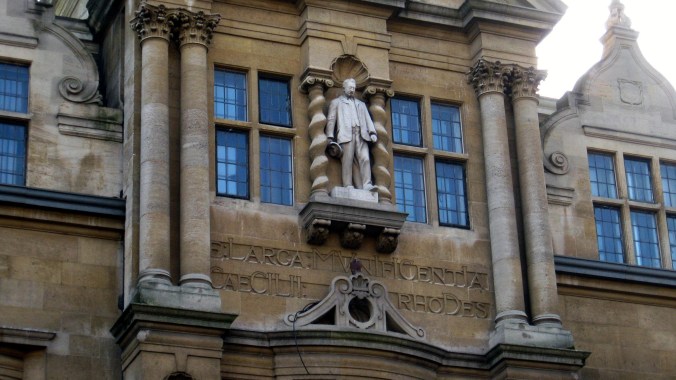
Even commentators sympathetic to the aims of Rhodes Must Fall in Oxford (RMFO) have been at pains to point out that the removal of the statue of Cecil Rhodes on the facade of Oriel College is not the most significant element of the campaign’s platform. Amia Srinivasan observes that ‘Neither the Cape Town nor the Oxford campaign has ever been just about statues.’ Amit Chaudhuri laments that ‘it would be…sad if Rhodes Must Fall in Oxford became identified with the statue in Oriel College alone’ because its ambition beyond the removal of the statue, namely that of decolonising education, is more significant. David Olusoga worries that by building their manifestos around calls for the taking down of statues, the more complex and worthy ideas around decolonisation raised by these campaigns have been ‘distorted into a simple right-wrong, yes-no statue debate’. I don’t disagree (much) with these views and indeed, if you want a right-wrong, yes-no answer, this essay will disappoint. But they beg the question of what statues mean and why we keep putting them up if they are so easily relegated to an epiphenomenal register of political discourse.

It’s worth remembering that RMFO itself has never downplayed the significance of the statue in the way that some of those writing in solidarity with it have done. It describes its mission as that of decolonising ‘the institutional structures and physical space in Oxford and beyond’ (emphasis mine) and lists as its first aim the intention to tackle ‘the plague of colonial iconography (in the form of statues, plaques and paintings) that seeks to whitewash and distort history’. In addition, it aims to reform the Eurocentric curricula to which university students continue to be subject and to address the under-representation and lack of welfare provision for black and minority ethnic staff and students at Oxford. One way to think about the place of the statue in this debate is to see it as a means to an end: as Srinivasan rightly notes, ‘complaints of structural racism and calls for curriculum reform don’t draw public attention like the toppling of a statue, and the RMF leaders know this.’ But while clarifying that its campaign is indeed ‘about more than a statue’, RMFO nonetheless insists that

statues and symbols matter; they are a means through which communities express their values. The normalised glorification of a man who for so many is a symbol of their historical oppression is a tacit admission that – as it stands – Oxford does not consider their history to be important. This is incompatible with a community that posits itself as progressive, enlightened and intellectually honest.

Without wanting to suggest that the success of RMFO should be judged by whether the statue falls or endures (it shouldn’t), I want to think with RMFO about what the expressive function of statues entails. Writing in a very different context, Judith Butler has famously worried that the relegation of injustices to the realm of the ‘merely cultural’ effectively downgrades the urgency with which they demand redress. For ‘merely cultural’ read ‘merely symbolic’, and the risk of disappearance of the demand for iconographic decolonisation (exactly what Oriel College might wish for) becomes obvious: if RMFO is about more than ‘just’ a statue and if we all agree that the statue is ‘merely symbolic’, then we might as well get beyond, behind, and beneath the symbol to address its putative ‘real’ while leaving the symbol itself intact. Meanwhile the possibility that the ‘merely symbolic’ has material consequences remains unexplored.

rhodes oxford

***

Continue reading

Love, Discomfort and the Language of the Tribe

This is the third post in our forum on Megan’s new book. We are delighted to welcome Dunja Fehimovic, a doctoral student at the University of Cambridge working on the relationship of film to national identity in Cuba in the 21st century. Dunja is author of a number of investigations of those themes in Journal of Latin American Cultural Studies and Bulletin of Latin American Research, as well as forthcoming in Cuban Cinema Inside Out and The Routledge Companion to World Cinema.


When From Cuba with Love arrived in the post, my first thought was, ‘What a beautiful book.’ It was the kind of book that drew me in – the kind of book, in fact, that might catch the eye of anyone browsing the shelves of their local bookshop. Its cover illustration reminded me of the endlessly-proliferating coffee table books about Cuba, including one I myself own about pre-Revolutionary Cuban advertising and design. It appealed to the vague, pervasive nostalgia for the ‘good old days’, roughly associated with the 1930-50s, that seems to be doing the rounds of late – all cupcakes, vintage posters, Cath Kidston and red lipstick.

From Cuba - Red Cover

But like the señorita in the picture, whose skirt is slashed to show a titillating amount of thigh, this had added appeal. The added sex appeal of Cuba, that is. As reactions to my topic of study have confirmed over time, Cuba is a sexy subject. Sex in Cuba is a very sexy subject. Daigle’s book, then, immediately evokes all of the stereotypical, exotic or erotic associations that we reveal or conceal through our reactions to Cuba as a place and subject of study. From its front cover onwards, it triggered uncomfortable reflections on my own contradictory, complex fascination with the country – a fascination that evolved, tellingly, from a love of salsa music and dancing through to a touristic experience during my undergraduate years and to the present day, as I move towards the completion of my thesis on contemporary Cuban cinema and national identity. In her introduction, Daigle warns that this is not a comfort text. True enough.

When I started reading From Cuba with Love, I got in touch with Megan to say that I had a feeling that this was going to be one of those books I wish I had written. And at certain points, I felt as though I had. The atmosphere and situations she so eloquently describes, particularly in the introduction and conclusion, were all too familiar to me as someone who has also spent time doing research in Cuba. I, too, lived near the Callejón de Hamel, and spent many afternoons pushing through the crowds, fascinated and frustrated in almost equal measure. As the rumba music picks up, Megan tells us, ‘the divide between dancers and onlookers blurs’. Crucially, though, the divide between foreigners and Cubans never does. I’ve never been sure how much of this is caused by my own self-consciousness, and how much is ‘objectively’ evident in the behaviour of people around me. Most likely it’s another case of the chicken and the egg, a self-perpetuating cycle of self-alienation and othering from both sides.

Continue reading

Out of Place: Space/Time and Quantum (In)security

A demon lives behind my left eye. As a migraine sufferer, I have developed a very personal relationship with my pain and its perceived causes. On a bad day, with a crippling sensitivity to light, nausea, and the feeling that the blood flowing to my brain has slowed to a crawl and is the poisoned consistency of pancake batter, I feel the presence of this demon keenly.

On the first day of the Q2 Symposium, however, which I was delighted to attend recently, the demon was in a tricksy mood, rather than out for blood: this was a vestibular migraine. The symptoms of this particular neurological condition are dizziness, loss of balance, and sensitivity to motion. Basically, when the demon manifests in this way, I feel constantly as though I am falling: falling over, falling out of place. The Q Symposium, hosted by James Der Derian and the marvellous team at the University of Sydney’s Centre for International Security Studies,  was intended, over the course of two days and a series of presentations, interventions, and media engagements,  to unsettle, to make participants think differently about space/time and security, thinking through quantum rather than classical theory, but I do not think that this is what the organisers had in mind.

photo of cabins and corridors at Q Station, SydneyAt the Q Station, located in Sydney where the Q Symposium was held, my pain and my present aligned: I felt out of place, I felt I was falling out of place. I did not expect to like the Q Station. It is the former quarantine station used by the colonial administration to isolate immigrants they suspected of carrying infectious diseases. Its location, on the North Head of Sydney and now within the Sydney Harbour National Park, was chosen for strategic reasons – it is secluded, easy to manage, a passageway point on the journey through to the inner harbour – but it has a much longer historical relationship with healing and disease. The North Head is a site of Aboriginal cultural significance; the space was used by the spiritual leaders (koradgee) of the Guringai peoples for healing and burial ceremonies.

Continue reading

What We Talked About At ISA: Embracing Indecision – Free Improvisation and Ethics as Action

We, the garden of technology. We, undecidable

– John Cage, 1988

“Art is sort of an experimental station in which one tries out living”, John Cage once famously quipped. I hadn’t really given this line much thought until I watched a friend perform with his ensemble of free improvisationalists and began to understand – rather late, admittedly, – the creative interconnectivity of musical improvisation with aspects of political and ethical life. Encapsulated in Cage’s comment is the close enmeshment of creation and performance, fabrication and action, production and interaction, set against a modernist ontology of profound uncertainty, pertinent beyond disciplinary analytical divides. Simultaneously embracing and resisting the scientifically and technologically mediated quest for certainty in his time, John Cage, along with other experimental musicians and artists, perpetually sought to challenge a reliance on that which can be decided, by finding different disruptive and unfamiliar techniques.

These techniques are not merely aesthetic choices or practices, but rather, as forms of encounters, have also ethical and political relevance. Whether it is through shock, as in Marcel Duchamp’s work in art (Fountain – a urinal as art!), or experimentation in John Cage’s work in music (4’33 – silence as music!), such disruptions emanate propositions of drastic undecidability – albeit against an always specific socio-political background. Residing in these practices of radical alterity is a production of subjectivity, of a modus vivendi, and with it an ethico-political dimension. As Maurizio Lazzarato duly notes, such techniques are ethico-politico-aesthetic techniques to wrest with the nature of disciplinary and security societies. Embracing this transdisciplinary approach, I thus take the principles of free improvisation as a stimulus to rethink, in positive ways, how to deal with the modern modus of fluid ground, uncertainty and undecidability, in politics and ethics through the modes of sonic and corporeal interaction.

b4367380aba26506f571b124b88cd1febf0fc442c1fb715267614d71a7f356af

Challenging the practical turn in contemporary conceptualisations of ethics in politics was my core theme for this year’s ISA conference, so I came equipped with not one but three papers on ethics and politics. Each sought to problematize the prevalence of applied ethics in theorizing international politics more broadly and political violence specifically. The first paper develops a critique of practical ethics as the dominant way of thinking about the ethics of political violence (watch this space for more on that). The second paper considers the prevalence of ethics as a scientific-technological matter in the use of unmanned and autonomous military technology. In this third and final paper, I try to rethink ethics in trans-disciplinary ways and turn to an unlikely source: free improvisation in music. Drawing on the principles of free improvisation, I suggest, allows us to conceptualise ethics as action rather than an applied abstract concept or epithet. In other words, to overcome the shortcomings of traditional modes of theorizing ethics in political theory, I look to free improvisation in music to rethink ethics and politics in less familiar ways, through the modes of sonic and corporeal interaction. I am very much still in the process of thinking all this through, so bear that in mind if you decide to read on. Suggestions, critiques and feedback welcome!

Continue reading

What We Made At ISA: Art as Subject, Art as Method

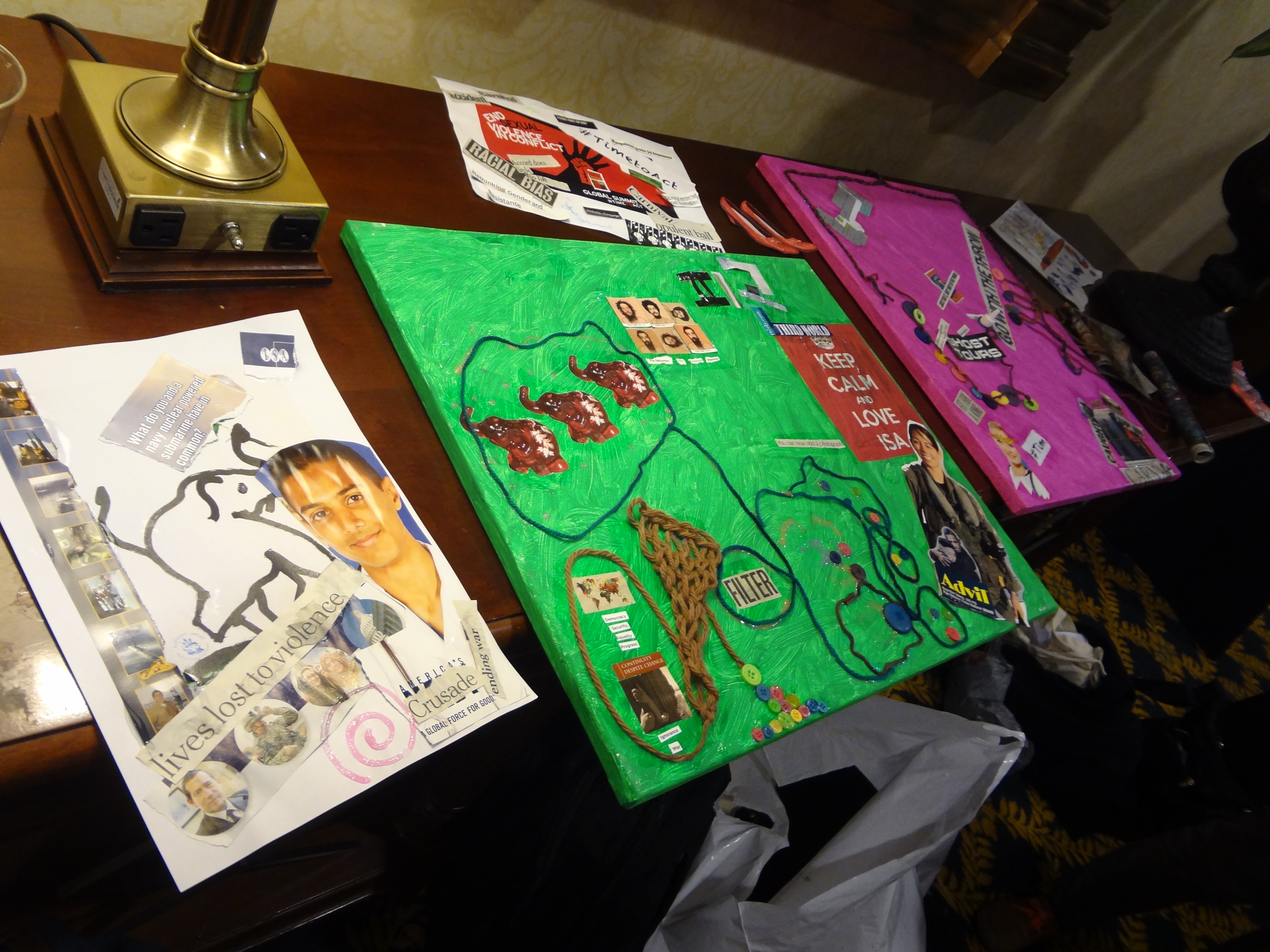
Our panel at ISA 2015 began with a comment made in a panel at ISA 2014 in Toronto: “I knit in panels. And this is the first conference I’ve ever attended where I’m the only knitter.” The speaker was Kate Daley, knitting in hand, and the conversations that followed eventually became “Art as Subject, Art as Method”, an innovative panel at this year’s conference in New Orleans.

The role of art in international politics has largely been ignored, a fact which Christine Sylvester has highlighted repeatedly [1]. In our panel, we wanted to combine study of art with the practice of art. Shifting the focus from what we make to the act of making itself, we asked what an engagement with the material, visual, sensory, and creative elements of art and craft could bring to the study of politics, employing not just colour and texture, but also interaction and sensory experience as tools.

DSC04796

Continue reading

What We Talked About At ISA: Political Speech in Fantastical Worlds

Game of Thrones - Race as a Floating Signifier

Four years ago, I tried to capture a discomfit with the new embrace of the pop-cultural within IR. The focus then was on the way putatively mainstream categories were put to use in the interpretation of science and speculative fiction. This year at ISA (see passim), I extended and nuanced that view, to account both for the great rise in pedagogical uses for the pop-cultural, and to push more forcefully at ‘critical’ approaches to the same.[1]

Like others, I am hostile to the success of zombies (or, to be frank, Dan Drezner’s version of zombies) as a useful way to stimulate reflection on world politics in all its variety. For zombie-IR, elements of the speculative and the fantastical are recruited to make sense of world politics not because they trouble or undermine or reimagine it, but because they replicate it in a way that is taken to be more easily digestible than speaking directly of world politics itself. Such simplification has come under challenge (here, here, and here, for example) and so cannot be said to characterise all approaches to the speculative. But the trend – what I term the speculative as descriptive analogy – certainly appears to be the most popular one. Let us call this Drezner’s Law: the more directly an ‘analysis’ of pop culture reflects dominant categories and concerns, the more broadly that analysis will be consumed.

Despite a single footnote on the zombie as metaphor, and a small gesture towards them as expressions of capitalist consumerism, the main accomplishment of Theories of International Politics and Zombies is to reify monolithic theories, which are taken to be no less than ‘paradigms’. In a feat of definitional feat, those dominant ‘paradigms’ (Realism, Liberalism, Constructivism, Neo-Conservatism, Role Theory) in turn hold the key truths to world politics “whether researchers admit it or not” (really?). It seems churlish to deny the usefulness of pedagogical lubricant, but it also becomes hard to avoid the sense of scholars bored to tears by the delivery of paint-by-number theory courses and the yearly task of boiling down paradigms and lineages into the simplest distinctions (Realists think states matter, liberals are interested in cooperation, constructivists believe in, well, social construction). Articulating these ideas through a new universe alleviates the boredom, however fleetingly, and raises a wry smile at the comparisons. The popular appeal of shows like Battlestar Galactica or Game of Thrones also makes it possible to generate interest in more complex themes through blog and social media ‘outreach’, as if mobilising cultural artefacts to recruit students or prove that scholars are somehow ‘in touch’. The human face of political science.

Continue reading

The Politics of Modi’s Vegetarianism

A guest post by Amit Julka and Medha.

AmitJulkaAmit is a PhD student at the Department of Political Science at the National University of Singapore (NUS), and he is working on India’s engagement with Afghanistan from the perspective of Indian identity formation. Previously he worked as a media specialist with the US Embassy in New Delhi and at the Institute for Defence Studies and Analyses (IDSA), New Delhi. He holds an M.A. in South Asian Area studies from SOAS, and is a computer engineer by training.

MedhaMedha is a research fellow/doctoral student at the German Institute for Global and Area Studies (GIGA), Hamburg.  Her research focus is on the role of Islam in India’s identity and foreign policy. She previously worked at the IDSA, and also as a journalist in India, Germany, the Netherlands and Canada. She holds an M.A. in Media Studies, jointly from Aarhus and Swansea Universities.


Among the many anodyne reports from the South Asian Association for Regional Cooperation (SAARC) summit held in Kathmandu recently, there was a curious piece of news: an article about how the Indian Prime Minister was being served ‘simple vegetarian fare with less spices and oil’ while his Pakistani counterpart was enjoying ‘halal meat dishes’ during their respective stays in Nepal. The next day, on social media, India’s Ministry of External Affairs posted a photograph of a menu with the caption ‘All Vegetarian Fare. For those asking here is what the SAARC leaders are having at the Retreat.’

Twitter_Screenshot

While it may be routine for the media to report about the dishes served during meetings and summits, this emphasis on Modi’s vegetarianism—and his apparent success in making sure all the leaders consume vegetarian food, at least at the Retreat—is particularly noteworthy. Especially when the fact that Modi was fasting for Navratri during his visit to the US was also equally publicised. Was this an attempt at burnishing Modi’s image as the Hindu Hriday Samrat within India as well as the increasingly vocal Indian or more precisely, the Hindu community abroad?

Continue reading

The War Rages On: Women in the British Military and the De-Politicisation of War in ‘Our Girl’ (2014)

A guest post on military gender in popular culture from Harriet Gray. Harriet is a PhD student in the Gender Institute at the London School of Economics, working on intimate partner abuse in the British military. She has also written on female combat roles in the American military, consent, and celebrity intimate partner violence, and can also be found on Twitter.


their war her battle

The five part BBC drama series Our Girl (and the 90 minute TV film which preceded it) centres around the experiences of Private Molly Dawes, a young medic serving in the British Army. Molly is assigned to a unit referred to as ‘2 Section’ as a combat casualty replacement, and with them deploys to Afghanistan. Her colleague in 2 Section, Private Dillon “Smurf” Smith, and their leader Captain Charles James, an experienced officer on his fourth tour of Afghanistan, form the two other principle characters in the series.

Our Girl was broadcast at a time when women’s roles in the British armed forces are once again under review. At present, women – who make up 10% of British regular military personnel – are able to serve in most roles in the British military with the exception of ‘combat roles’, defined as “ground combat units where the primary role is to close with and kill the enemy”. Previous reviews of the ban in 2002 and 2010 have concluded that while many women may well possess the physical and psychological capacities to serve in any military role, the impact of women’s presence on unit cohesion and therefore on combat effectiveness cannot be fully understood without taking the risk of sending mixed combat teams into battle; a risk which the MOD and the armed forces were not at the time of these reviews prepared to take. That is, women’s continued exclusion from combat roles was justified not on the basis of what women were capable of doing, but, as I have argued elsewhere, of who (what?) they are.

The current review, ordered by (then) Defence Secretary Phillip Hammond in the spring of 2014 and due to conclude by the end of the year, will once again prioritise the delivery of operational effectiveness in deciding whether women will be admitted to combat roles, but it is widely expected that this time, the ban will be lifted, in particular because the review has been brought forward to report earlier than the 2018 deadline required under EU equality laws, and following the lifting of a similar ban in the US armed forces in early 2013. While women are soon likely to be able to serve in all roles in the British armed forces, however, this is unlikely to mean that the masculinised culture and male domination within the British military itself will be undermined any time soon; it is likely that it will continue to be the case that, as Victoria Basham puts it, “it is gender-conforming for men to want to join the military or engage in paramilitary activities, but gender-nonconforming for women”.

As Cynthia Enloe also suggests, the definition as ‘combat’ of the roles from which women are excluded has long been largely ideological as opposed to practical – and Molly’s experience in the series reflects this. While as a medic, she is not in a combat role – indeed, as could be considered gender-conforming for a woman since her primary purpose is to preserve life rather than to end it – she is certainly not portrayed as a “beautiful soul” and her role requires her to be very much in the thick of the action. She is shown on patrol with her section, firing her weapon, and being on the receiving end of gunfire with the men alongside her, although she, unlike her comrades, shows some anguish and regret at her own perpetration of violence. While Molly’s role is not a combat role, then, her experiences with 2 Section illustrate many of the well-hashed arguments both for and against the growing presence of women in Western militaries.

Continue reading