The Politics of the UK HE Marking Boycott, Part II

Given the level of interest in my previous post (over 2,400 views in the last 10 days), I thought I would provide an analysis of UCU’s counter-proposals on USS and of the ongoing contestation of the leadership’s strategy in the current industrial action. In brief, UCU is offering to sacrifice the final salary scheme and give employers much of what they want, in exchange for a modestly improved career-average scheme. Conservatives within the union are also moving to rescind the industrial action before it has even properly started.

UCU’s Counter-Proposals

UCU’s response to UUK’s proposals, and its counter-proposals, were initially buried in a circular to branches posted on UCU’s website, before being circulated to members on Friday, only after they had been put to employers’ representatives in writing and at the USS Joint Negotiating Committee on Thursday. UCU’s critique of UUK’s proposals is excessively technical, but it does provide this helpful chart of pre-1992 universities’ incomes and costs since 2008/9.

Pre-1992 HEIs Financial Indicators (2008/9 =100). Source: HESA

Pre-1992 HEIs Financial Indicators (2008/9 =100). Source: HESA

The remarkable highlights are that income is up 27.7%; on average, the surplus of income over expenditure is £14.2m per annum, of which £11.2m is retained in reserves, which have consequently increased by 62.5%, leading to a net rise in the universities’ assets of 39.8%. Meanwhile, because of the massive real-terms pay cuts inflicted by employers, staff costs as a proportion of income are 3.7 percentage points lower. Put bluntly: just like major corporations, universities are hoarding cash; they can afford to improve their workers’ pay and conditions, but choose not to do so. There is no crisis in the affordability of pay or pensions in pre-1992 universities.

Continue reading

The Politics of the UK HE Marking Boycott

Academics in pre-1992 universities who are members of the University and College Union (UCU) will tomorrow be commencing a marking boycott in response to a planned attack by employers on our USS pension scheme.

By any reasonable measure, and despite losses suffered during the global financial crisis (GFC), USS is in good financial health, persistently taking in much more in contributions than it pays out to retirees. However, the arbitrary valuation method favoured by the UK Pensions Regulator – which has an interest in a highly conservative approach, to avoid employers running schemes down then leaving the regulator to carry the can – perversely shows the scheme in deficit. The ridiculous nature of the assumptions behind this valuation have been well explained elsewhere, as has the mendacity of Universities UK, the employers’ association, in using data misleadingly. Put simply, the claim that USS is unsustainable is based on the scenario of all contributing universities simultaneously ceasing to pay into the scheme, e.g. as a result of bankruptcy. By any reasonable measure, the scheme is not in serious difficulty in the short to medium term. Nonetheless, the employers have seized on the valuation to demand radical changes to USS, which will result in a cut in pensions of up to 27%. This follows changes imposed by the employers in 2011, which closed the final salary scheme to new entrants, put new staff onto a vastly inferior ‘career average’ scheme (which was even worse than the Teachers Pension Scheme (TPS), which is used in secondary, further and post-1992 higher education institutions), and shifted the burden of contributions from the employers to employees. It also follows years of minimal or zero pay increases, such that in the years since 2009, real pay has fallen by about 13% nationally and 17% in London.

Given this context, it is obvious that employers are seizing the opportunity of the perverse USS valuation to further cut staff costs. Insofar as the scheme faces difficulties because of the GFC, this represents yet another shunting of the costs inflicted by hyper-capitalism onto workers. And insofar as universities are trying to cut staff costs because of vast reductions in the public subsidy to higher education, it represents yet another indirect effect of austerity, which is again about socialising the costs of bailing out Britain’s financial institutions.

At stake in this industrial action is not just the fate of our pensions, but of our trade union. The marking boycott is just the latest in a recurrent spate of industrial action over pay and conditions, including on pensions in 2011 and pay in 2013/14. This time around, 78% voted for strike action and 87% for action short of a strike, on a 45% turnout – the highest since UCU’s formation in 2006, though still disappointingly low, given the stakes. However, each period of industrial strife was  botched by UCU’s national leadership, leaving the union progressively weaker. The earlier action on pensions was lost: despite some minor concessions from employers, they successfully rammed through changes to USS. The UCU Left grouping rightly warned that accepting this would only encourage the employers to come back for more later – as they are now doing. On pay, UCU itself declared that the principle of national collective bargaining – the union’s main raison d’etre – was at risk: UCU’s rejection of miserly annual pay offers had repeatedly been ignored, and employers were increasingly departing from the national pay scale and trying to tempt UCU branches into local-level settlements.

Yet, a comprehensive strategy on escalating industrial action, democratically determined by the union’s Higher Education conference, was simply ignored by the leadership. Continue reading

International Relations is Not an American Discipline (Well, Maybe It Is, A Little)

Helen TurtonA guest post on the state of the discipline by Helen Louise Turton. Helen is a University Teacher in International Relations and Security Studies at the University of Sheffield. She received her PhD from Exeter in 2013 for a dissertation on ‘The Sociology of a Diverse Discipline’, and next year Routledge will publish her International Relations and American Dominance: A Diverse Discipline. She also has work on marginality and hegemony in IR forthcoming in the Journal of International Relations and Development (with Lucas Freire) and is beginning a larger project on ‘Rereading European IR Theory’ (with Knud Erik Jørgensen and Felix Rösch). Helen is also the co-convenor of the BISA Working Group on IR as a Social Science. If you wish to join the working group please follow the link.


Gary Hilliard

It has been said on more than one occasion that International Relations is an American dominated discipline, or that the US IR community is hegemonic. In fact, one could even go so far as to say that the disciplinary image of IR being dominated by the US has become a disciplinary truism, with many academics reproducing this characterisation time and time again. The TRIP survey that has just been sent to academics in 33 different countries even poses the question “Please indicate the extent to which you agree or disagree with the statement: The discipline of international relations is an American dominated discipline” to ascertain the degree to which IR scholars around the globe feel dominated by the US. Furthermore, other empirical surveys of the discipline have sought to demonstrate the seeming continued disciplinary dominance of the American academy, pointing to the different ways in which the US is able to exercise its disciplinary hegemony.

In my new book International Relations and American Dominance I challenge the claim that IR is an American dominated discipline because the underlying question is itself deeply problematic. Asking whether IR is dominated by the US presupposes a yes or no answer. We are therefore presented with an either or option which overlooks the possibility that the discipline may be dominated by the US in some ways but not in others. This then leads us to unpack what it means to be dominant. When scholars claim that IR is an American dominated discipline we first need to assess how they understand disciplinary dynamics and relationships of dominance. Are dominance claims being made because it is perceived that American methods populate the discipline? Or do certain American theories dominate global IR? Perhaps the US is stated to be dominant because it is American IR scholars who are in positions of power? Maybe scholars have argued that IR is dominated by the US because there are more American IR scholars than those from other national IR communities? Or does the discipline subscribe to an American agenda and American understanding of what ‘international relations’ is?

The reality is that all these grounds have been used to state that the US IR community is hegemonic. Academics have implicitly drawn on different understandings of dominance and explicitly drawn attention to the different implications of US dominance, but often this is done without first clarifying what is meant or implied by American disciplinary dominance. Often scholars are speaking about one form of dominance on one page of a text, and then refer to a different understanding on another page. What this means is that the word dominance when in the context of claims stating ‘IR is an American dominated discipline’ or ‘IR is no longer an American enterprise’ is used in many different ways, taking on many different forms and measured in numerous modes despite the fact that it is presented as ‘one size fits all’ form of dominance. What this means is that although certain scholars may agree that the US is dominant they may be talking at cross-purposes about how and why America dominates. Whilst there may be agreement in one sense, there will be different answers to the crucial questions of how and why America allegedly became and remains disciplinarily dominant.

Continue reading

The Wages of Sin

Scrooge McDuck

The Times Higher reports stockholder relief. The fears of investors in pre-eminent parasites Reed Elsevier – that profits would be undermined by the move to academic open access – have been dissipated. Normal business is more-or-less resumed, thanks to the rise of hybrid publication models in the UK. That is, the combination between pay-to-publish that makes journal articles immediately available to all on the one hand and repositories for drafts and embargoed versions which preserve library subscription income on the other. In 2011, says the report [1], it looked like the push for widespread and substantial open access (rather than the soft version we’ve ended up with) might undermine the kind of market dominance that produces operating profits of 32%. Indeed, they expected Elsevier’s profit margins to fall by over a fifth in the face of full open access. But by September this year share prices were outperforming expectations.

The analysts write revealingly about the threat: “political intervention both in Europe and the US would force a shift to full Open Access journals, with negative consequences on the economics of Elsevier”. Revealing, too, on the concessions made to corporate publishers and divergent national policies. Despite more than a decade of agitation, debate, and now government mandates, “the rise of Open Access appears to inflict little or no damage on leading subscription publishers” for reasons that are obvious enough, should we care to notice them. Embargo periods and other restrictions protect profits, and so subscription levels remain high. Moreover, this manifestation of openness “may in fact be adding to profits”, because double dipping people.

The new reality is that we have two mutually reinforcing business models. Publishers can now add those Article Processing Charges (APCs) – many of which will be funded by the public purse – to their already bountiful subscription income. Unsurprising, then, that the stock performance of Reed Elsevier and Wiley continues to a grow at a neat pace. The future risk – so far as there is one – comes not from a revolution in publishing, but from library funding shortfalls caused by potential trouble in the economy at large.

Elsevier Profits 2011-2014

Source: Berstein Research, ‘Reed Elsevier: Goodbye to Berlin’, 24 September 2014

So open access is growing “in theory” but not in substance, which is to say, not in a way that realigns academic publishing. Continue reading

New World Disorders

UPDATE (9 October): And now welcoming Jairus Grove!


Old But Not Wise

We are almost four years old. Four! And like any unnatural creature, we require the lifeblood of others to survive. And the odd bit of cosmetics for our decaying visage. Thus there is a new look, and a joyous bundle of new residents to introduce. Those that have visited with us before are already featured on that there sidebar, and will be joined by the rest as posts tumble forth.

Please be upstanding in your welcome for the following chumrades:

  • Charmaine Chua is a Ph.D. Candidate at the University of Minnesota, where she toils over critical political economy, postcolonial theory, logistics, and the international division of labor. In the next year, she will be conducting field research with activists and maritime workers in Long Beach, Singapore, and on a 90,000 ton container ship traveling from Los Angeles to Taiwan. She plans to climb containers for sport in between interviews.
  • Jairus Victor Grove teaches the future at the University of Hawai’i at Manoa. Receiving his PhD from John Hopkins, his work has since encompassed cybernetics, drone war, materialism (the new kind), improvised explosive devices, and ecology, all by way of political theory. There are ways to leverage contemporary technologies in order to hear his voice and see his face.
  • Laleh Khalili teaches and researches Middle East politics at the School of Oriental and African Studies. Her latest book is Time In The Shadows: Confinement in Counterinsurgencies, which last year also happened to win both the Susan Strange best book prize from BISA and the International Political Sociology best book prize at ISA. You can also follow her intellectual adventures in the politics of transport infrastructure at The Gamming.

Black Academia in Britain

The last few years have witnessed a growing concern with the challenges that peoples of African heritage – who I will define in this blog as Black peoples – face working and studying in the UK higher education system. Issues of the relative absence of Black people in influential positions have taken centre stage, alongside the direct and indirect discrimination that both black students and staff might confront. These are long standing issues. Indeed, for a number of years now, some British Black academics have made careers in North America more easily than in their domicile country. 

These challenges have been met by various recent initiatives, for example, a concerted effort to formally institute a British Black Studies, and the creation of a network of Black British Academics. To repeat, concerns as to the presence and experience of Black people in British academia are by no means new. But these concerns have been re-engaged with in a new context marked by austerity, the growing internationalisation of universities, and the radical changes to the public university system in Britain implemented by the coalition government who  are turning “multiversities” into “monoversities” organized singularly along the lines of commercial logic and interest.

Having been involved in a small way in recent re-engagements with the place and standing of Black academics and staff in UK academia I thought I would take stock and look at a few recent statistical and qualitative studies that appraise the state of Black academia in Britain, from both an academic and student standpoint.

Before I start, though, I want to say a few words about the internal composition of Black peoples in the UK. According to the 2011 Census, Black people now compose 3.3% of the population. However, the pronounced immigration over the last twenty or so years of peoples from the African continent has significantly shifted the demographics and dynamics of the Black population itself. Whereas, in the 1950s to 80s, Black Britain referred primarily to the “historical” African Diaspora – mainly those from an African-Caribbean background – it now predominantly refers to a new Diaspora with a continental background.

Continue reading

Metrics: An Addendum on RAE / REF

Not everything that counts can be counted, and not everything that can be counted counts...

We have had overwhelming support from a wide range of academics for our paper on why metrics are inappropriate for assessing research quality (200+ as of June 22nd). However, some have also posed interesting follow-up questions on the blog and by email which are worth addressing in more depth. These are more REF-specific on the whole and relate to the relationship between the flaws in the current system and the flaws in the proposed system. In my view the latter still greatly outweigh the former but it is useful to reflect on them both.

Current REF assessment processes are unaccountable and subjective; aren’t metrics a more transparent, public and objective way of assessing research?

The current REF involves, as the poser of the question pointed out, small groups of people deliberating behind closed doors and destroying all evidence of their deliberations. The point about the non-transparency and unaccountability of this process is an important one to keep in mind.

The question is then posed, are metrics more transparent, public and objective? On a surface level, metrics are more ‘transparent’ because they are literally visible (public) and given a number, making them easily rankable. But what they represent, as we argued in our paper, is fundamentally non-transparent given the wide variety of reasons there might be for citing work, and more besides those we cited. In fact, it is the very simulation of transparency in the use of a numerical marker that becomes threatening to the act of actually reading work for assessment purposes. Continue reading

Why Metrics Cannot Measure Research Quality: A Response to the HEFCE Consultation

Pacioli Euclid Measurement

Update 24th June: 7,500+ views, 100s of shares, 200+ signatories! And a new post with some responses to further issues raised.

The Higher Education Funding Council for England are reviewing the idea of using metrics (or citation counts) in research assessment. We think using metrics to measure research quality is a terrible idea, and we’ll be sending the response to them below explaining why. The deadline for receiving responses is 12pm on Monday 30th June (to metrics@hefce.ac.uk). If you want to add an endorsement to this paper to be added to what we send to HEFCE, please write your name, role and institutional affiliation below in the comments, or email either ms140[at]soas.ac.uk or p.c.kirby[at]sussex.ac.uk before Saturday 28th June. If you want to write your own response, please feel free to borrow as you like from the ideas below, or append the PDF version of our paper available here.


Response to the Independent Review of the Role of Metrics in Research Assessment
June 2014

Authored by:
Dr Meera Sabaratnam, Lecturer in International Relations, SOAS, University of London
Dr Paul Kirby, Lecturer in International Security, University of Sussex

Summary

Whilst metrics may capture some partial dimensions of research ‘impact’, they cannot be used as any kind of proxy for measuring research ‘quality’. Not only is there no logical connection between citation counts and the quality of academic research, but the adoption of such a system could systematically discriminate against less established scholars and against work by women and ethnic minorities. Moreover, as we know, citation counts are highly vulnerable to gaming and manipulation. The overall effects of using citations as a substantive proxy for either ‘impact’ or ‘quality’ could be extremely deleterious to the standing and quality of UK academic research as a whole.

Why metrics? Why now? Continue reading

The Onuf Principles

Nicholas Onuf recently gave an interview over at e-IR. Several people of our acquaintance shared the tail-end of that, in which he is prompted to dispense career advice. Although opinions are indeed like assholes, these are good enough to elevate far above the gutter.


Original image by Stéphanie Saramago

Original image by Stéphanie Saramago

1. Preparing at length for classes does not make you a better teacher. Insofar as it dampens spontaneity, students will think you are boring; this will undercut the self-confidence you thought your lengthy preparations had purchased for you. And, of course, it steals valuable time from your scholarship.

2. Writing is a craft; writing well takes most of us a great deal of work. The usual practice is to think of a problem or issue, formulate a project, do ‘research,’ and then write it up. Bad idea. Keep writing at every stage, even if, in the end, you throw out most of what you have written. Writing makes the problem clearer, points up what more you need to do in the way of research, and, most of all, keeps your writing skills well-honed.

3. Don’t send sloppy, badly crafted papers out for review. As a frequent referee, I see them all too often. Many referees will punish you, not always consciously, for doing so, even if they think you are on to something. Once you think you have a well-crafted piece of work, do send it out, because most referees and editors take their duties seriously and will give you valuable feedback.

4. Be cautious about taking on collaborative projects. We all know that scholarship is a lonely occupation. Collaboration reduces the loneliness quotient and can result in better work than any of the collaborators could have produced on their own. It can also result in a piece of work that no one is entirely happy with. Sometimes collaboration causes damaging tension and bad feelings because of temperamental differences, greater or lesser commitment to the project, and perceived inequities in the distribution of work. All that said, collaborating with my brother on two book projects was hugely rewarding. That it might have been hugely risky never occurred to us.

5. Be even more cautious in participating in symposium projects. Their thematic foci may not match your interests very well; they tend to be superficially refereed and thus are not taken seriously; they also tend to disappear quickly from view. There are exceptions—symposia that mark major developments in the field—but you’ll have a pretty good idea if a particular symposium project has that potential. As a senior scholar, I contribute to symposia because it is fun to do projects with friends and I can afford the luxury. Most of all, avoid editing symposium volumes. This involves collaboration under the most difficult conditions. It is extraordinarily time consuming. Wrangling recalcitrant contributors is too often a thankless and disheartening responsibility.

6. Do not take on too many projects at one time. You will spread yourself too thin, miss deadlines, and make it all the more likely that you will succumb to the 90% rule—you run out of steam when any given project is 90% done and only needs some fine-tuning to be sent off. You will end up with a drawer full of nearly done projects that you have progressively lost interest in and will therefore never finish.

7. Dissertations are apprentice projects, immediately recognisable as such. Turning a dissertation into a book is probably the smart thing to do, but it will often take longer than writing the dissertation did. For most of us, it takes five years to write a good book; World of Our Making took me ten years. Whether you have that much time, institutionally speaking, is another matter.

8. Read every day. When I get up in the morning (early) and get my coffee, I read for 45 minutes. In my case, it has always been something that I do not have to read for whatever I am doing at the time. While this has broadened me immeasurably, for many scholars, a fixed time for reading is an opportunity — perhaps the only opportunity — to keep up on the literature in the field.

9. Whether to jump on a trend in the field’s scholarship, try anticipating a trend, come late to a trend but treat it critically, jump around from thing to thing, or plug away at something few others seem to be interested in is a tricky question, having much to do with temperament. It requires you to ask yourself how ambitious you are, how much you need validation from others, how long you can stayed focused on one thing, et cetera.

10. On the assumption that you are smarter than most people (or you would not be a scholar), seek out people whom you know to be smarter than you in various obvious ways. On the one hand, the more of these people you know, the less intimidating you will find them, and the more you will learn from them. On the other hand, knowing really smart people will remind you of your own limitations and help you be less arrogant. Arrogance is, of course, a constant hazard in our line of work.

Open Access, Institutionalised?: Or, Another Reason Why International Relations Is Failing As An Intellectual Project

Soc Sci Tweet

The American Sociological Association (ASA) has announced that it will launch an (as-yet unnamed) open access general sociology journal as soon as possible (this year, maybe next). Its proposed features are a mix of traditional and new: there will be start-up cash and a stipend for Editors, peer-review is to be on the standard, appropriately ‘prestigious’ model (but expedited and light on style corrections), a traditional publisher (SAGE) is involved, authors will retain copyright, there will be no hard copies and therefore no limit on how much can be published in any given time period, all articles (accepted or not) will be subject to a $25 processing fee, and a variable tariff of Article Processing Charges (APCs) will be implemented, from free for scholars from “non-competitive” countries to $100-150 for students and $700 for non-members (for the first 12 months, APCs can also be waived, no questions asked).

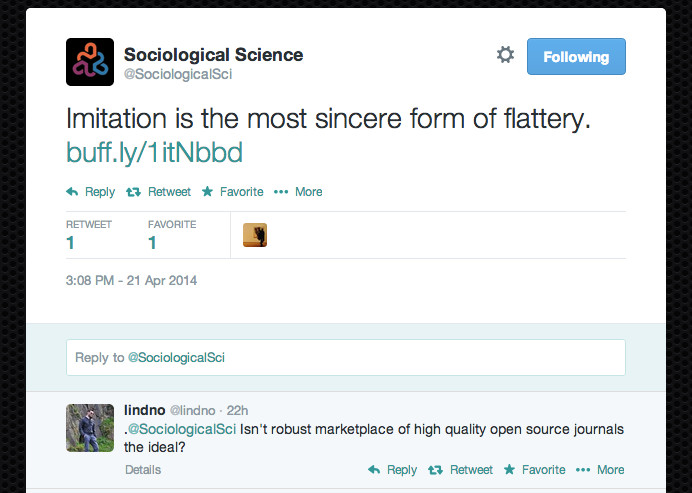
The editors at Sociological Science (one of whom we interviewed last month) have noticed that this borrows heavily from their own initiative. Sniping aside, this is surely all to the good. An indication that major academic institutions are, at last, taking open access seriously. Not quite overhauling their systems, but adopting publishing platforms considerably more reasonable than the $3,000 APCs and business-as-usual structure previously threatened. This is an important point, since it supports the claim of some OA advocates that APCs may be financially better for the academy than historical subscription rates (I leave exacting comparisons of costs and the burden of double-dipping during any transition to one side). The problem has always been that the prestige economy (and therefore the social reproduction of universities) is not venue-blind. Low cost APCs in marginal journals are therefore of little help for those still seeking the (shrinking) securities of a formal academic post. But when the reputational power of learned societies is applied, it becomes much easier to envision a world of reputable (and hopefully high quality) open access journals charging APCs at a lower net cost than we currently pay through library subscription models.

The ASA is a powerhouse in these terms, and enjoys more market influence than the International Studies Association (boasting 13,000 members to our 7,000). It is all but inevitable that the mainstreaming of open access in this way will put the squeeze on the smaller open access journals, very many of which are labours of love, and some of which seem to actively treasure their reputation as insurgents or irrelevancies. If we want more material (and particularly the kind of material that carries value in an academic market) to be open access, imitation is the right kind of problem to have. Cultural Anthropology is another example of that shift (we got the gossip from them too last year), funding an open access conversion through the largest section of the 12,000 member American Anthropological Association.

Journal Profits

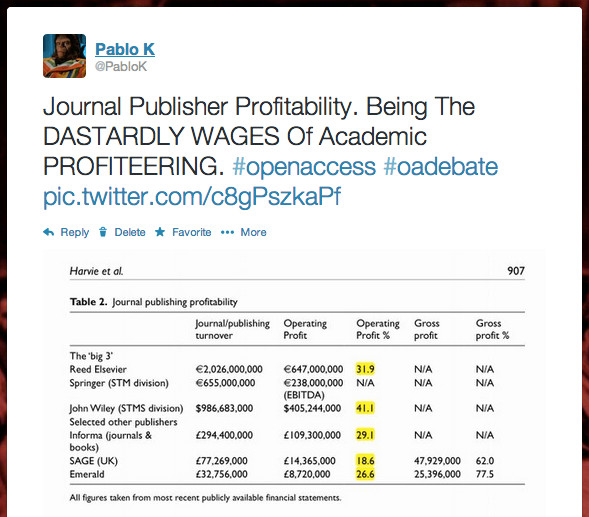
Profitability data from Harvie et al., 2012.

And yet this scenario is once again an embarrassing one for International Relations, which otherwise likes to imagine itself the most engaged and relevant of disciplines (state power! trade rounds! war and peace!). Continue reading