Out of Place: Space/Time and Quantum (In)security

A demon lives behind my left eye. As a migraine sufferer, I have developed a very personal relationship with my pain and its perceived causes. On a bad day, with a crippling sensitivity to light, nausea, and the feeling that the blood flowing to my brain has slowed to a crawl and is the poisoned consistency of pancake batter, I feel the presence of this demon keenly.

On the first day of the Q2 Symposium, however, which I was delighted to attend recently, the demon was in a tricksy mood, rather than out for blood: this was a vestibular migraine. The symptoms of this particular neurological condition are dizziness, loss of balance, and sensitivity to motion. Basically, when the demon manifests in this way, I feel constantly as though I am falling: falling over, falling out of place. The Q Symposium, hosted by James Der Derian and the marvellous team at the University of Sydney’s Centre for International Security Studies,  was intended, over the course of two days and a series of presentations, interventions, and media engagements,  to unsettle, to make participants think differently about space/time and security, thinking through quantum rather than classical theory, but I do not think that this is what the organisers had in mind.

photo of cabins and corridors at Q Station, SydneyAt the Q Station, located in Sydney where the Q Symposium was held, my pain and my present aligned: I felt out of place, I felt I was falling out of place. I did not expect to like the Q Station. It is the former quarantine station used by the colonial administration to isolate immigrants they suspected of carrying infectious diseases. Its location, on the North Head of Sydney and now within the Sydney Harbour National Park, was chosen for strategic reasons – it is secluded, easy to manage, a passageway point on the journey through to the inner harbour – but it has a much longer historical relationship with healing and disease. The North Head is a site of Aboriginal cultural significance; the space was used by the spiritual leaders (koradgee) of the Guringai peoples for healing and burial ceremonies.

Continue reading

More Notes for Discerning Travellers

A little while ago I wrote a blog, Notes on Europe and Europeans for the Discerning Traveller. It was a fictional travel guide, but with all points speaking to historical realities.

What is it about a certain “European” sensibility? Not all people who live in European countries have it, of course, but this sensibility seems to define in the main what it means to be essentially “European”). I want to ask: what is it about a sensibility that can never, ever, look at itself, for itself, and in relation to what it does to others?

We all know that the European enlightenment was supposed to be built upon the pillars of self-reflection and accountability in thought and politics. It is funny, then, that the “European” so rarely seemed to be able to hold him/herself to reflexive account especially over European colonial pasts.

It continues.

I swear, if I believed in such a cosmology called “Modernity” I’d be calling the “European” a backward, traditional native ensconced in his/her own culture, taking his/her particulars for mystical universals, and unable to look at him/herself in the mirror to start the process of socialization and “childhood development”.

But I don’t believe. So I’ll just have to call this sensibility by more mundane descriptions, such as un-reflexive, un-accountable, un-relational.

Example (twitter response to my Travel Notes blog): Continue reading

Size Matters: Reflecting on Perspective, Positionality and Critique After #ISA2015

… so I tweeted on the last day of the 56th Annual Convention of the International Studies Association. I was exhausted by that point, numbed and overwhelmed at the sheer volume of thoughts I had asked my poor brain to process over the previous four days. I was ready to crawl into bed and sleep for a week, but I still had to get home, back to Sydney from whence I came, which I duly did, over the course of the next 37 hours.

I stared blindly out of the aeroplane window as we circled around Sydney, thinking about nothing much at all, noticing the Opera House and the Sydney Harbour Bridge and how tiny they looked, how much like models, how insignificant. And in the taxi on the way home (and yes, I am acknowledging my privilege as I write this, that is kind of the point of this blog, I think…), I asked the driver to please take the bridge, not the tunnel. There is something about the view from the Eastern Distributor, which brackets Circular Quay with the Harbour Bridge on one side and the Opera House on the other, that feels to me like coming home.

photo of sydney opera house

Sydney Opera House. Photo by LJS.

As we drove, and the iconic structures came into view, I thought, somewhat mindlessly, how much bigger they seemed close up. Like I said, I was exhausted, not able to conjure much more than this rather banal observation. Objects in the rear view mirror may be closer than they appear, but objects on the ground, when you’re close up, feel much more significant. Continue reading

Open Letter In Support of Surrey Politics Department

Last week, members of the Politics Department at the University of Surrey were told by their managers that they would be effectively closed down in the summer, with a reduction of 14 staff to five teaching-only posts, and no guarantee of employment for anyone presently in the Department. The Department had been ranked 6th in Politics in this year’s Guardian Subject League Table, 4th in the NSS 2014 with an overall satisfaction rate of 97%, and 17th in the Complete University Guide 2014. Thanks to a rapid reaction and online campaign immediately following this, as well as discussions with the Political Studies Association over the last week this decision appears to be under review. The initial proposal however remains on the table at the time of writing.  To follow unfolding events, please go to the Facebook page set up by a support group, and follow the Twitter account @surreypolgrads. Many are using the hashtag #savesurreypolitics.

The below is an open letter originating from members of the Department of Politics and International Studies at SOAS, University of London.

Update 26th March: following much enthusiasm, the open letter is now available for all to sign and we have edited according. Please respond in the comments section with your name, role and institution where relevant, and do forward to colleagues.

Continue reading

What We Made At ISA: Art as Subject, Art as Method

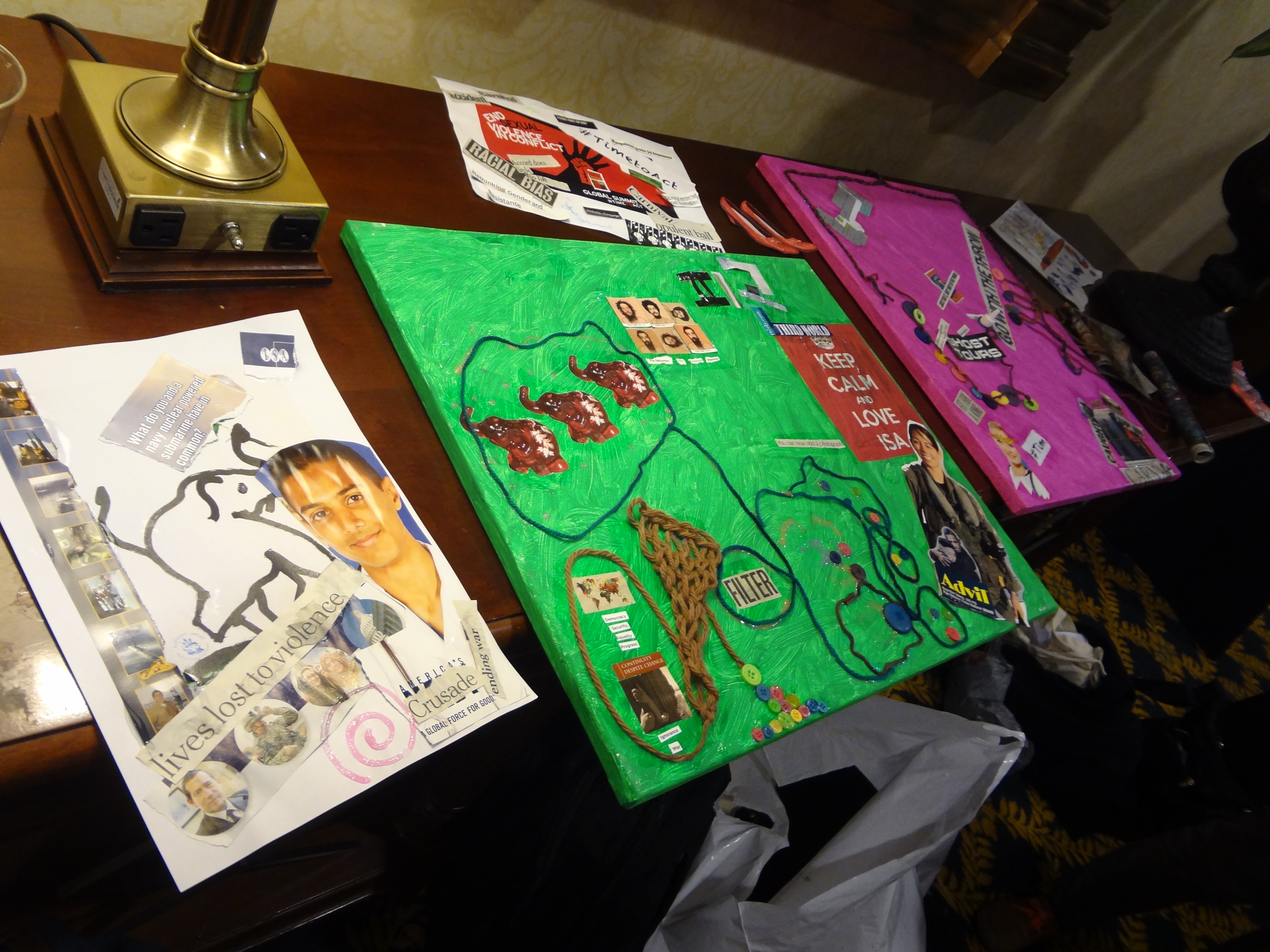
Our panel at ISA 2015 began with a comment made in a panel at ISA 2014 in Toronto: “I knit in panels. And this is the first conference I’ve ever attended where I’m the only knitter.” The speaker was Kate Daley, knitting in hand, and the conversations that followed eventually became “Art as Subject, Art as Method”, an innovative panel at this year’s conference in New Orleans.

The role of art in international politics has largely been ignored, a fact which Christine Sylvester has highlighted repeatedly [1]. In our panel, we wanted to combine study of art with the practice of art. Shifting the focus from what we make to the act of making itself, we asked what an engagement with the material, visual, sensory, and creative elements of art and craft could bring to the study of politics, employing not just colour and texture, but also interaction and sensory experience as tools.

DSC04796

Continue reading

What We Talked About At ISA2015: A Debate Around John Hobson’s ‘The Eurocentric Conception of World Politics’

Below is the text of my intervention at a roundtable organized by Alina Sajed entitled ‘Race and International Relations—A Debate Around John Hobson’s The Eurocentric Conception of World Politics‘. TDoT has hosted a symposium on the book: you can read an initial post by John, commentaries from Meera, Srdjan and Brett, and a reply from John. I’ve tried not to cover the same ground.

While race and racism have recently become topics of increasing interest in the rather parochial world of IR scholarship, few books have ranged so widely across time and thinkers as John Hobson’s The Eurocentric Conception of World Politics. This is a monumental work of scholarship that accumulates a staggering amount of evidence, were further proof necessary, of the white supremacist and/or Eurocentric foundations of IR as a discipline (I use the ‘and/or’ advisedly, because much of the debate that the book has generated and some of my own critique focuses on the complex relationship between the formations that Hobson identifies as ‘scientific racism’ and ‘Eurocentric institutionalism’, about which more in due course). So whatever my problems with the book, I want to endorse it as a deeply necessary intervention in the IR academy. Nonetheless, I find myself in sharp disagreement with some of its central claims in ways that have not been fully addressed in earlier discussions. I will focus here on two areas of disagreement: first, the book’s treatment of Marx, Lenin and Marxism in general; and second, its crucial distinction between ‘scientific racism’ and ‘Eurocentric institutionalism’.

Why focus on a critique of Marxism as Eurocentric and/or imperialist? (Again the ‘and/or’ seems necessary because Hobson’s careful mapping of European thought finds conjunctions of racism and/or Eurocentrism with both imperialist and anti-imperialist sensibilities). Partly this comes out of my own intellectual investment in denying what I believe to be the false choice that is often presented between Marxism and postcolonialism. As such, I find myself troubled as much by Marxist work that repudiates postcolonialism as I am by the opposite tendency (which I think is at work in this book). But partly this also comes out of a sense that if Marxism were in fact as Eurocentric and/or imperialist as Hobson suggests, this would leave inexplicable its enormous appeal in the Third World both in the heyday and aftermath of the great decolonization and liberation movements that it informed. More prosaically, I think Hobson’s readings of Marx and Lenin are temporally truncated and therefore somewhat misleading.

Continue reading

Why Tell Stories – Or Rather, Why I Tell Stories

This post has been slowly taking shape in my head since last year’s ISA in Toronto.  A year late, I know, but maybe now it can act as some kind of refresher as we head into this year’s festivities.  (In fact, as I write these words with a cup of tea in front of me, I’m watching the last of the sunrise over Faubourg-Marigny.)

Last year, as there has been for a few years now, there was a roundtable that consisted of people telling stories – personal stories, political stories, literary stories. The room was packed, as it always is for the storytelling roundtable. People stood leaning against the walls, cross-legged on the floor, and sometimes two to a seat. The air was warm and still. The stories were touching, wryly acerbic, and occasionally silly. One storyteller, though, both caught and divided the audience’s attention. She told a powerful story of victimisation in multiple voices, drawn from our own ranks at the ISA, and laid bare the systemic problem of sexism and sexual harassment in the academy. It was the sort of story that had half the audience stunned into silence and the other half nodding in knowing agreement.

In the wake of that story, the discussion took on a life of its own, with a number of audience members calling for solidarity, empathy, and action. Others were shocked and claimed no knowledge that such a world existed under their very noses. Still others shrugged it off, saying that the story lacked an understanding of the complicity of its own narrator (or rather, its narrators) – that it was a kind of call, but one that should not be answered. Sitting in the audience, I said nothing, watched and listened as the tension in the room crested and abated.

Two years earlier, in a similar conference room in San Diego, I had told a story of my own. I hadn’t planned to tell that particular story – in fact, I’d decided months earlier to present a piece I had written for my doctoral thesis that had gotten a warm reception in other settings, which has since appeared here in another form. That was someone else’s story, from my fieldwork in Cuba. But, about two weeks before the start of the ISA, a story of my own came to me all at once and I wrote it in less than an hour. I brought both with me to the roundtable and sat them on the table in front of me, in case I lost the nerve to tell my own story, but somehow I managed it, shaking hands and all.

Continue reading

Reading across the ‘Colour Line’: Texts, Traditions, and Academic Solidarity

ShowFullImageA guest post by Prof Gurminder K Bhambra, University of Warwick

Four incidents in the last week have caused me to check the calendar and confirm that I hadn’t accidentally time-travelled back a generation. Debates on which I had believed there to have been some (positive) movement over the last couple of decades seem to have made such little impact on many colleagues that it was as if the earlier debates had never happened. I outline the first three incidents briefly before going on to discuss the fourth in greater detail; I do so in order to reflect on their implications and consequences for academic work and engagement.

**********************************

bebop-2014-flyer-names-low-resA community statement was circulated by colleagues in Germany protesting against the development of an academic programme of Black Studies that did not include Black scholars or thinkers or engage with Black scholarship. It seems astonishing, in 2015, to have to rehearse the arguments, again, about why setting up a programme addressing the distinct experiences of a particular group of people and not including people – academics, activists, and others – who have had such experiences and have produced scholarship articulating that experience is problematic. Just so that people don’t misunderstand me here: I am NOT saying that only people with the experience can ever study or talk about such experiences. However, I am saying that to set up a programme for study without the participation of people whose experiences and writing are putatively central to it is problematic. There has been so much discussion on this topic that to repeat the mistakes of earlier times seems deliberately willful and it is this willfulness that requires to be addressed.

Since starting to write this piece, the director of the programme has disbanded it, apparently temporarily, in favour of an open debate about how to move forward in light of the criticisms being raised. Instead of disbanding, why not restructure on the basis of the criticisms and by taking them into account? They are not new.

**********************************

europeislamSecondly, the professional association that I consider to be my academic ‘home’ has advertised its forthcoming annual conference theme as ‘Fragmented Societies: Migrating Peoples’. As another colleague suggested, why not just call it ‘Migrating Peoples Fragmenting Societies’ and do away with the niceties and apparent distance created through the use of the colon. Thus far, there has been no response from the professional association to the suggestion that the wording of the conference theme be changed to avoid it sounding like a UKIP-sponsored conference.

**********************************

The third incident involves the setting up of expert panels at an international conference where all the experts chosen are from north America. There is not a single all-male panel; but all the panelists on all four panels are white. When concern about this was expressed on social media, one response was:

“Moronic tokenism, mk 2. Not satisfied with gender equality on panels at XXX? Rant about people’s skin colour instead”

Continue reading

The Politics of the UK HE Marking Boycott – Part IV: The Betrayal

The farce of UCU’s “resistance” to universities’ attack on employees’ pensions is now reaching its inevitable climax (see Part I, Part II and Part III for background). Readers may recall that the crisis has been provoked by the employers’ association, UUK, seeking to impose dramatic cuts on the basis of a supposed massive deficit in the USS pension scheme – a position exposed as spurious by many academic statisticians and UCU’s actuaries. In previous posts, I have been savagely critical of UCU’s response. In summary, I argued:

the UCU leadership is using the membership as a stage army while seeking to mediate between an increasingly angry membership and the employers. It initiated the marking boycott without first consulting its members on what an acceptable negotiating outcome would be, rushed out its proposals in secret and put them to the employers without first seeking members’ approval, and now seeks to lock down the parameters of the debate by ending the industrial action, closeting its negotiators with UUK’s in the JNC, and presenting a fait accompli in January in the same manner as the pay settlement, with demoralised and confused members left with little alternative but to endorse the outcome.

Predictably, this outcome is now unfolding. Following UCU-UUK talks, the UCU’s Higher Education Committee (HEC) has decided to put a “revised offer” from the employers to the membership via an e-ballot. This offer involves virtually no improvement on UUK’s initial position.

Continue reading

Dr Manchanda, I Presume?

A Doctor of Philosophy was made this day. Our own Nivi, for her thesis on Imagining Afghanistan: The History and Politics of Imperial Knowledge Production, received from the University of Cambridge. An analysis ranging from the imagined border to the constructed tribe, from gender to sexuality and back again, from the post-colonial to the homonationalist, and from the 19th century to present. Duly tested and found more than able by Dr Sharath Srinivasan and Professor Jutta Weldes. Granted without corrections. From this point forth, Dr Manchanda.

LOL Edward Said Eurocentrism