Speaker Vulnerability and The Patriarchal University: A Response and Tribute to Pamela Sue Anderson

Lara ColemanLara Montesinos Coleman is Senior Lecturer in International Relations and International Development at the University of Sussex. This article was originally written for the alumni magazine of Regent’s Park College, Oxford, where Anderson was based before her death and where the author read Philosophy and Theology, and has been featured on the Women in Parentheses blog.


I never quite crossed paths with Pamela Sue Anderson. She returned to Oxford in 2001 to take up a post at my former college the year after I finished my undergraduate studies. In February 2017, we were both invited to speak at a British Academy conference on Vulnerability and The Politics of Care. Anderson’s paper was read by a friend, just weeks before her death.

All of us spoke about vulnerability, but Anderson’s contribution stood out in that she addressed our own vulnerability as speakers. She began by recounting an occasion, earlier in her career, when her audience was unable to receive her as an expert on feminist philosophy. The story stayed with many of us, because it reflected the painful, hidden histories of speakers who do not conform to preconceptions of how a ‘knower’ ought to look, be or think. These stories, if they are told at all, are normally the topic of hushed and anxious conversations, where the speaker’s close friends and colleagues express outrage and reassurance. Anderson, however, put her vulnerability on display.

Her story was about a talk at Durham on feminist philosophy. Before she arrived, the posters announcing the event had been defaced with the image of another Pamela Anderson: the Playboy model and actress who rose to fame in the 1990s. Anderson’s talk was particularly well attended – by mostly male students and philosophers drawn to it by interest in the other Pamela. From the outset, Anderson was not quite believed to be a philosopher because of her name. However, she was also accused by a prominent male philosopher of ‘disappointing’ her audience because of the content of what she said: her account of epistemology was deemed to lack the ‘particularity, concreteness and relationality required for women, and so, for “feminism”’.[1]

Of course, even the most privileged and celebrated speakers can feel vulnerable when addressing an audience. We all depend upon our audiences to hear us and to recognise us as ‘knowers’ and we all run the risk of being silenced when this recognition is absent. Some of us, however, have a greater material and social exposure to being silenced or dismissed. If we are not embodied or do not perform in a way that fits with stereotypes of the philosopher (male, white, well-spoken and able bodied), then we are often not recognisable as ‘a knower who is trustworthy’.[2] The ‘joke’ of ‘Pamela Anderson’ speaking on philosophy is instructive. It relies upon stereotypes that cannot coincide: a ‘model’ is ruled out in advance as a potential ‘philosopher’.

How do we respond when an audience is unable to recognise us as a knower? Continue reading
Beyond the ‘Case for Colonialism’: Rethinking Academic Practices and Dissent

This is the second in this weekend’s pair of posts on L’affaire TWQ. The author is Swati Parashar from the School of Global Studies, University of Gothenburg, Sweden, who has Disordered previously. An abridged version of this essay appeared in the Indian Express on 30 September 2017.


It is arguable that we are living in an era of anti-intellectualism, with little respect for scholarly debates and academic endeavours. Despite the odds, several academics have been at the forefront of resistance against undemocratic forces; from participating in the widely attended public lectures on ‘nationalism’ at the Jawaharlal Nehru University in Delhi in support of students charged with sedition, protesting against Trump’s policies in the US, to raising voices against state oppression in Turkey. Many academics in the critical tradition visualise an equitable world and contribute to insightful research and progressive activism. Hence, when a leading academic journal, intuitively named the Third World Quarterly (TWQ), founded to encourage anti colonial critiques and voices from the Global South, turns around to advocate for a return to colonialism and its benefits, it requires a serious public debate. It is time to hold the mirror to ourselves and reflect on our own academic practices.

TWQ was established in the 1970s, an era when being referred to as ‘Third World’ was a badge of defiance or honour rather than a slur. The term is now back in circulation within critical/postcolonial scholarship and has an analytical and political purchase. The journal averred to promote “an open-minded and sympathetic search for establishing an international order based on justice”. The main financial patron of this academic venture was the Bank of Credit and Commerce International, which gained notoriety in 1990s with allegations of money laundering and other financial irregularities. However, the journal recovered from this scandalous association and went on to become one of the premier academic avenues for critical development discourse and postcolonial and decolonial perspectives on global politics. Academics, especially from the Global South, take pride in publishing in this journal.

The most recent issue of the journal carried an article by Bruce Gilley, a professor of Political Science in the US, titled “The case for colonialism”, which not only glorifies the earlier colonial rule but also advocates for the recolonization of certain ex-colonies. The publication of this article led to widespread furore in the global academic community, with angry petitions demanding the retraction of the published article. The statement by the editor-in-chief that the article was a ‘Viewpoint’ published to generate debate and had undergone double blind peer review, was endorsed later by the Taylor and Francis Group. It has now come to light that the editor-in-chief chose to publish the piece with major revisions, after 2 reviewers’ recommendations varied from rejection to minor revisions. As a protest against the publication,15 of the 34-member editorial board have resigned, stating in their letter that they had not been consulted about the publication of this article, and that even after requests, the reviews were not made available to them. Continue reading

The Eternal Return of Benign Colonialism

One of a pair of posts we will be featuring at The Disorder this weekend on the Third World Quarterly affair. This first contribution is from Naeem Inayatullah, Professor of Politics at Ithaca College, who has visited with us before.


In “The Case for Colonialism” (2017), Bruce Gilley calls for a return to colonialism. He asserts that colonialism brought great benefits to Third World states, that these gains were squandered due to a premature granting of independence to the former colonies, and that only a re-colonization by Western states can develop lost capacities. Many scholars are outraged by Gilley’s publication. Some have called for its retraction while others demand that we ignore it altogether. I think we make a mistake in underestimating this event.

We need not express surprise by Gilley’s presentation. He is only the latest in a long line of scholars and policy makers that have made such claims for decades and for centuries.  For example, Robert Jackson’s Quasi-States (1990) makes similar arguments but without Gilley’s polemical bite. Jackson’s book itself expands on an influential article he wrote with Carl Rossberg, “Why Africa’s Weak States Persist,” (Jackson and Rossberg, 1982).  Indeed, the tone and substance of Gilley’s presentation is widespread in our time. We can find it in the work, for example, of Max Boot (2002), Robert F. Cooper (2002), Niall Ferguson (2008), Michael Ignatieff (2003), Robert Kagan (2002) and Robert D. Kaplan (2003). Some Marxists make comparable claims: Bill Warren in Imperialism, Pioneer of Capitalism (1980) argues that the Third world needs more, not less capitalism and imperialism. Imperialism, as capitalism’s pioneer first destroys and then reconfigures all other cultures. This creative destruction is the condition for moving the world to socialism and to communism. The political bent of these mostly academic writers can range from Marxist to liberal to conservative. But they all require former colonizing states to accept the responsibility of doing good for others via a benevolent imperialism/colonialism. Nor are eminent philosophers, such as Kant, Hegel, and Marx, short on praise for imperialism’s and colonialism’s value to subjected people (Blaney and Inayatullah 2010, chapters 5 and 6).

If our response is disbelief, we might wish to familiarize ourselves with the academy’s centrality in propagating a colonial praxis. Indeed, many have said that academia is an effect of empire, that King Leopold’s dream of creating universities to propagate and refine colonialism has been true for some time.

Three elements make Gilley’s article different from the usual.

Continue reading

The Limits of Semantic Ambiguity: A response to Steve Fuller

‘Your beliefs become your thoughts,
Your thoughts become your words,
Your words become your actions,
Your actions become your habits,
Your habits become your values,
Your values become your destiny’

Mahatma Gandhi

I was at a seminar once, presenting an early version of some research on popular culture and world politics. During the question & answer period, a colleague – a distinguished scholar in literary studies and creative writing – asserted, quite forcefully, that I should reconsider my use of the concept of narrative. It didn’t belong in my scholarship, he argued, it was a concept with a history and a trajectory and its home was in literature not International Relations, the oddly ill-disciplined discipline in which I have found myself. My colleague raised his voice during this exchange, became somewhat upset. His emotional register, his irrational response to my naïve and perhaps clumsy use of a concept he had spent decades working on: he behaved like a woman.

Academics in general are such emotional creatures. We might speak, in fact, of ‘academic feminisation’. They’re so invested in their work, and the good ones are so committed to their students: they nurture, they foster talent and possibility, they provide guidance and professional socialisation. They act like women. They respond irrationally to criticisms of work, or the complaint that a concept is being misappropriated; or they focus on some perceived ‘injustice’ rather than take an argument at face value and use logic to refute it. Hysterical responses are not uncommon…

… It is clear, I hope, that the above paragraphs are deliberately ridiculous. In no scholarly outlet, one would hope, would such a flagrantly reductive and offensive set of gender stereotypes find a platform. And yet Steve Fuller was able to publish an article recently on the multi-author blog Sociological Imagination that used flagrantly reductive and offensive stereotypes about autism to support an argument about ‘semantic ambiguity’ in sociology. I want to respond here to both Fuller’s blog post, and his defence of said post – both in the comments and on Twitter – in which he essentially ‘doubles down’ on his original position. Continue reading

Right-Wing Populism, Anti-Genderism, And Real US Americans In The Age Of Trump

This is a guest post from Cynthia Weber, who is a Professor of International Relations at the University of Sussex. Cindy is the author, most recently, of Queer International Relations: Sovereignty, Sexuality and the Will to Power which was the subject of a symposium hosted by The Disorder of Things. 

The US satirical website The Onion recently ran a fake testimonial video featuring a remorseful Donald Trump supporter. The 2-minute clip is entitled ‘Trump Voter Feels Betrayed By President After Reading 800 Pages of Queer Feminist Theory’. The video features the character ‘Mike Bridger, Former Trump Supporter’, a middle-aged, working class, cishet white male from a small steel town in Pennsylvania. The balding Mike is shot in documentary talking-head style. Mike sits facing the camera, both so that his truthfulness can be evaluated by viewers and so that what US Americans will recognize as his iconic working-class garb is fully in view – dark tan zip-up jacket, olive-green button-down shirt open at the collar, white t-shirt visible underneath. Accompanied by slow music which sets a troubled, post-catastrophe tone, Mike tells his story.

‘I voted for Donald Trump,’ Mike tells us. ‘I voted for Trump because I thought he’d create a better America for everyone. But after reading 800 or so pages on queer feminist theory, I realize now just how much I’ve been duped.’

Continue reading

The HE Bill: The Final Ditch

Before parliament is prorogued on 3 May, ahead of the 8 June general election, the British government is hoping to ram through its disastrous Higher Education and Research Bill (HERB) in the so-called “wash up” period.

I have written here several times on this Bill, the most notorious aspects of which are the introduction of a “teaching excellence framework” (TEF), which would be linked to future fee increases, and the accelerated marketisation of HE, which will threaten both the quality of education and the financial sustainability of many departments and even whole universities.

While the government refused all amendments proposed by the Labour party in Commons committee (Labour’s team, led by Gordon Marsden MP, has been excellent on this issue throughout), it suffered heavy defeats in the Lords, where many significant amendments were introduced. These temper or even sabotage some of the worst aspects of the Bill, notably by severing the link between the TEF and fees; subjecting TEF to rigorous statistical scrutiny and rejecting crude rankings (gold, silver and bronze); and creating tougher tests before private providers can attain university title. The Lords even introduced two completely new, progressive amendments. The first restores the block-registration of students on the electoral roll, which was terminated under the 2014 Individual Electoral Registration protocol, leading to 920,000 people dropping off the roll, many of them students. Even more significantly, the second amendment removes overseas students from immigration statistics. This is important not only to stop the repeated crackdowns on overseas students, but also heads off a potential link between TEF scores and the right to recruit overseas. The move to reclassify foreign students has widespread public support, and has even attracted support from Tory rebels, so might have a good chance of overturning Theresa May’s fanatical and irrational intransigence on this issue.

For a full summary of the amendments and why they are important, see the briefing I have produced for the Convention for Higher Education.

For a template letter you can send to your MP, click here. It will take you less than five minutes.

This really is the final ditch. Please contact your MP, and ask as many people as you can do to the same.


In defence of the apparently indefensible (or, French ‘intellectuals’ did not ruin the West and can we please stop postie-bashing because it’s not actually terribly helpful thank you)

Note: I decided to write this post because I got tired of trying to explain my position on discourse, reality, truth, and why Foucault is not to blame for the rolling shit-show that is US politics right now on Twitter in 140 characters. And then my 800 word blog post turned into a 4000 word essay. Sorry about that. Tl; dr version: truth is a social construct but that doesn’t mean anything goes. But the long version contains turtles and an Adam Savage gif, so do please read on…

 Let me get a couple of things straight before I begin. First, I am not A Philosopher. I am not (often) a thinker of profound and important thoughts (not nearly often enough, anyway), nor do I consider the work that I do to be in the realm of philosophy, or even ‘grand theory’. I am not A Theorist either; I am, at most, a theorist with a lower-case ‘t’. I theorise, a bit, about the nature of the things that interest me and the relationships between them. It helps me make sense of the world and that’s about as far as it goes. So I am probably woefully underqualified to write this post. But here I am, because being woefully underqualified to write about postmodernism[i], and truth, and facts, and the world in general, doesn’t seem to stop a whole bunch of other people doing it and if they’re having their fun I want some. (Plus, the way you get qualified to write about Stuff is to write about it, amirite?)

Second, I have (quite unfairly, I admit), used bits of Helen Pluckrose’s recent essay on ‘How French “intellectuals” ruined the West: Postmodernism and its impact, explained’ as a sort of intellectual sparring-partner in this post, just because it offers such a full account of the charges laid at the door of postmodernism, and how this intellectual movement has affected truth, and facts, and the world in general. It’s unfair because Pluckrose’s essay is just the latest in a line of similar types of argument, and I could just as easily have chosen to respond to any of those. But I chose this essay because I am lazy and it popped up on my Twitter feed on Saturday morning and when I read it I thought: No. No more. No longer. For this, I cannot stand. So, again, here I am, to address what I see as the four key points of argument she presents in an effort to discuss the things I want to discuss about postmodernism, and truth, and facts, and so on.

1. ‘the roots of postmodernism are inherently political and revolutionary, albeit in a destructive or, as they would term it, deconstructive way’

So there are some issues here. Continue reading

The Higher Education and Research Bill

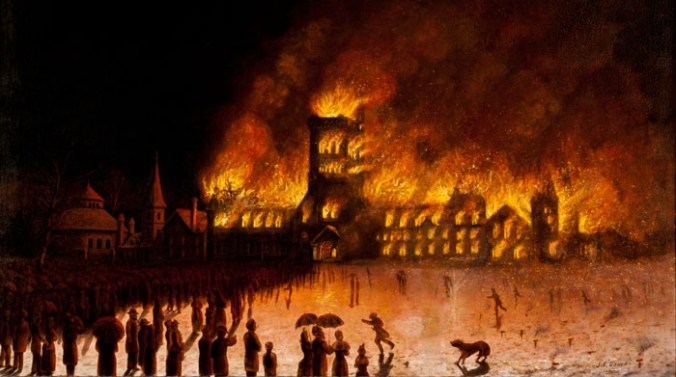
The third and final reading of the UK’s HE Bill has been scheduled for next Monday, 21 November. If it passes the Commons and then the Lords, it will become law. Thanks in part to the turmoil around Brexit, this Bill has flown under the radar for virtually everyone, perhaps even most students and academics. But the consequences, if it passes, will be disastrous. Many academics seem to think it is just yet another piece of regulatory dross, yet another bureaucratic millstone to add to the many around their necks – and thus barely worth registering a protest about. The reality is actually very different. As I’ve warned on this blog before, the Bill will have a drastic impact on the economy of UK HE, and on the education we provide. Last-ditch resistance is urgently needed.

university-college-fire-john-edwin-usher

Continue reading

White World Order, Black Power Politics: The Author’s Response

Bob’s response to Naeem, NiviSrdjan, and Meera completes our symposium on White World Order, Black Power Politics.


Four critical IR theorists have taken time away from other tasks to read my book carefully, generously, and thoughtfully. What a gift. The brevity of this response will appear stingy by comparison, but I don’t mean it to be. Rather, I am typing with my wrist in a splint, and it hurts, while I am also due to leave in the morning for a two-week vacation. Perhaps there will be another chance to show my gratitude. Many of the questions that Nivi, Naeem, Srdjan, and Meera raise have to do either with the book’s and my relationship to theory or with the limitations of my research strategy, as I anticipated and sought, self-servingly, to head off.

Continue reading

What is This Thing Called IR? A View from Howard U

This is the fourth post in our symposium on Vitalis’ White World Order, Black Power Politics. Naeem’s post is here, and Nivi’s is here. Further responses, including from the author are to follow…


IMG_7430

It was a party for DAAD-funded scholars from all over Germany and our hosts at the Martin Luther University of Halle-Wittenberg invited to us a historical costume play.  It was childish, and therefore well-suited for us international Stipendiat/inn/en, many of whom still struggled with basic German: some students and faculty dressed up as famous scholars from various periods in the university’s 500-year history and said a few things about themselves.  I have now forgotten all of the names but one: Anton Wilhelm Amo. A West African slave of a German duke who in 1734 successfully defended a dissertation in Halle’s philosophy department. The (black) guy who played Amo spoke loudly and clearly, but I recall turning to the (black) DAADer sitting next to me, a fellow poli sci student from France: “1734?” “That’s what I heard, too”, she said, “1734.”

Since this was in the era of the (dial-up) Internet, a few days later I was able to learn more about this Amo fellow, including the details eluded in the university play. Vitalis’ latest book, White World Order, Black Power Politics: The Birth of American International Relations (Cornell, 2015) is a powerful reminder of another lesson I learned then: that work by non-white scholars tends to be “denied”–that is, ignored, temporized, ornamentalized and outright purged [1]. How many students of international law or of the German Enlightenment today know anything about Amo’s “On the Right of Moors in Europe” (1729)?  Not many given that the essay has been lost to history, probably because its copies were deemed unworthy of those meticulously maintained rare book collections.  And this is a huge loss given the relevance of historical “rights of Moors” debates for the constitution of “Europe.”

IMG_7431

Continue reading