Comprador Intellectuals in the Education Crisis

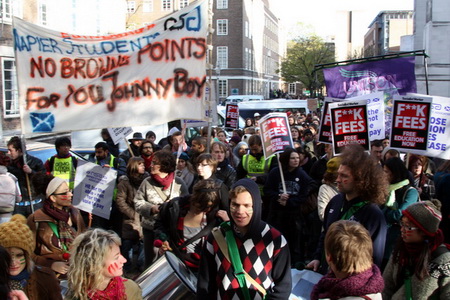
It certainly feels as if things are moving quickly in the fight over the thorough-going recomposition of UK higher education. The scale of occupation and student-led resistance has caught many by surprise. The interpretive battle over ‘violence’ may have performed familiar rituals, but the frequency and militancy of what is going on is new and invigorating. The number of occupations is now considerable, and the leadership of the NUS has been forced into support for tactics and strategy they had previously treated as marginalia. How different it looked in the immediate aftermath of the 10 November actions. The early denunciations of militant protest then seemed to foreshadow the enactment of a reformist middle ground. Aaron Porter gave at least one speech in which he appeared to accept that fees were going to be introduced as planned, and sought to move his energies into getting as much included in the £9,000 fee as possible. He mooted such bold objectives as an end to printing costs and a new universities watchdog to ensure value for money. As if to say, ‘we’ve made our point, now let’s go home’.

Last week’s much smaller protest, and its predictable, petty, kettle, seems to have made all the difference. More walk-outs are planned for today, and doubtless more occupations will follow. This has spooked Clegg to new levels of hysteria, warning that opposition to the cuts will themselves scare off the young, and the poor, and those without sufficient sense to make some back-of-the-envelope calculations as to their eventual debt burden. Obviously, this is true in a rather degraded sense of the word, since without sustained action directed at the proposals, many would not realise the scale of changes until they had already been passed. Verily, ignorance is bliss. Meanwhile, ermine-cloaked colleagues in the blue corner are reduced to crying traitor while the imperatives of civic order require ever more draconian shows of strength.

But where are the academics? Continue reading
Cosmopolitan Moralism and Human Rights

Sometimes I have the impression that all intellectuals have become cosmopolitans. But there is an increasing gap between what intellectuals think and preach and what the ordinary people feel. There is a growing divergence between the demos and the elites, especially concerning the perception and the treatment that should be reserved to the “diverse”: immigrants, minorities, gays and so on are more and more perceived as a threat. When xenophobia is rising, the intellectuals have a responsibility to help to distinguish between the real and apparent reasons, even at the price to become isolated from great parts of the population.

– Daniele Archibugi

In this post I want to both feature and expand upon an upcoming special issue (Volume 12, Issue 1) of Human Rights Review, which I  guest edited with my colleague and friend Marta Iñiguez de Heredia. The special issue focuses on human rights as an ideal and practical politics, opening some initial space to consider why the interaction between moral ideals and practical politics is important, and provoking discussion of how the clear divide between them is unsustainable.

To set the stage, we find Daniele Archibugi and Seyla Benhabib discussing Cosmopolitanism at Open Democracy. For both authors the place of universal rights in cosmopolitan politics is central, but the moral principle expressed through universal human rights works in a very particular way. This approach to human rights prioritizes what, in the paper, we call the “philosopher’s” understanding of rights, which begins from rational moral principles already known before political action is taken.

Continue reading

‘Immediate Commodifiability’; Or, A Virtual Teach-In on Austerity in Education

As a public service, some of the best of recent (and older) diagnosis and critique, largely an extension of work already done over at Infinite ThØught:

It is fascinating, and very revealing, to see how Browne’s unreal confidence in the rationality of subjective consumer choice is matched by his lack of belief in reasoned argument and judgment. The sentence that immediately follows the vacuous one about students’ ‘wants’ reads: ‘We have looked carefully at the scope to distribute funding by some objective metric of quality; but there is no robust way to do this and we doubt whether the choices of a central funding body should be put before those of students.’ It is, first of all, striking that the only alternative envisaged to the random play of subjective consumer choice is an ‘objective metric of quality’, i.e. some purely quantitative indicator. And second, it is no less striking that instead of allowing that an informed judgment might be based on reasons, arguments and evidence, there are simply the ‘choices’ made by two groups, treated as though they are just two equivalent expressions of subjective preference. We can have the money for a national system of higher education distributed either in accordance with the tastes of 18-year-olds or in accordance with the tastes of a group of older people in London: there’s no other way to do it.

Stefan Collini, Browne’s Gamble

György Lukács used to say that the objective unity of the capitalist order was never so apparent as in a phase of crisis. Then, the relative autonomy of expansionary times, which were so often asserted as the reality of social relations, would be abruptly suspended. The power of discretion would flow back to the centre, to the strategic politics of the state and to those prepared to launch a fundamental challenge to it.

What is objectionable is the ascendency of quantification, the emergence of quantifiability as a qualifying condition of relevance and admissibility. A species of transcendental reductionism. We need look no further than the familiar, degraded world of academic research. Scientific and scholarly projects, we all know, do well in these times to internalise the definitions, the priorities and the timescales of the REF as a main condition of finding institutional support. Reputation – the regard of one’s peers and serious audiences – is a frothy measure of achievement if it cannot be captured in scores and tables…League tables generally do not only reduce particular and distinct activity to a single numerical scale. As numerical procedures, they offer perverse compensation by generating distinctions where none can credibly be thought to exist in reality. 10 or 15 institutions differ within the space of 1%. But the visual code of the table – equal spacing in the plane of the vertical – renders such trivia grave and lapidary, carves them in stone…These processes of quantification and financialisation are effecting a progressive abstraction of university functions, in which exchange value is the homogeneous substance of working life. Now the labour of perfecting and defending these processes calls for an equally abstract organisational stratum of leader-managers, in a classic process of bureaucratisation.

Francis Mulhern, Humanities and University Corporatism

Wendy Brown, Why Privatisation Is About More Than Who Pays

Continue reading

International Relations versus Punk Rock

Today I was re-reading a piece by Kevin Dunn, “Never mind the bollocks: the punk rock politics of global communication,” and it lead me to wonder how far one’s route into the study of world politics affects how one perceives the “object” of inquiry. Dunn starts out by stating:

I am increasingly concerned about the ways that International Relations (IR) as a discipline seems unable to communicate to everyday citizens about issues of tremendous importance. I am repeatedly struck by our inability to speak to the people whose lives are affected daily by the issues we are supposed to be studying. More importantly, I am struck by how irrelevant we and our work can seem to the world’s population.

In 2003, I grappled quite openly and vocally with this alienation. The annual International Studies Association (ISA) Conference was being held in Portland, Oregon that year. Throughout the hallowed halls of the soul-numbing conference hotel, the discipline of IR was displaying its strengths and weaknesses. The US and its ‘ coalition of the willing’ were on the verge of invading Iraq. But within the ISA, there was little attempt to grapple with what this meant. My few attempts to stage some form of protest and intellectual outrage proved heart-warming but ineffectual. Then, at the end of the week, I went to a punk club a few blocks from the hotel to see a Joe Strummer tribute show. Joe Strummer, the frontman for the Clash, had died suddenly a few months before, and now over twenty bands from all over the region were coming together to play a benefit show. Each band performed two or three Clash songs; one band getting up after the other, sharing amps and a drum set. On stage, the bands were using the songs to make sense of the dangerous world we all found ourselves in. The in-between song banter reflected this – comments about President George W. Bush, remarks about American fascism, concerns about the impending war on Iraq, and pleas to register to vote. The kids in the club were using the Clash and punk rock, much as I did years before, to help them understand the world they were inheriting. While the discipline of IR pontificated down the street to itself about world affairs, I swirled in the mosh pit wondering: what relevance did I and the ISA have to these kids? Sadly, it seemed to me that we as a discipline were doing a poor job communicating with most of the people outside that conference hotel.

Leaving aside Dunn’s very interesting analysis of punk rock’s role as a form of counter-hegemonic global communication and subversive political message, the opening lines resonated in a profound way for me, as I share Dunn’s experience of punk music providing a frame for engaging with world politics. This leads me to the question: how does our route into the study of world politics affect our work? Continue reading

Zero-Level Protest, the Student Movement and the Spectacle of Politics

I agree with Joe.

The fall-out from Wednesday’s fees protest has congealed into some familiar oppositions. On the one side, we have disavowal. The violent minority, undermining the broad case against cuts, inarticulate in their regression to a juvenile acting-out. On the other side, affirmation. The real vandals are Clegg and Cameron, the insurgents were the epiphenomenal expression of legitimate mass anger, and broken glass is the not-that-unfortunate substratum of all great political movements.

These are not morally equivalent narratives. The case for the disavowers is built on a palpable desire to appeal to bureaucratic reasonableness, and to present the case in terms sympathetic to the cadences and tones of power, as if the problem was one of flawed communication. More ‘rational debate’ please! More damagingly, the internal disciplining necessary to any movement conceived of as a Party is already under way. Bad protester, good protester. Wayward foot-soldier, clear-sighted leader. There was a serious message, and the hijackers lost it.

This is nonsense. That the march was larger than expected would have made news, barely. But the aerial shots of Westminster, and the collections of amusing signs and fancy dress, would have concurred fully with the established parameters, the well-worn rituals, of polite English disagreement. There would have been patronising cod-support about how polite the young are these days and Mock-The-Week non-jokes about the difference between Parisian insurrectionists and London shufflers. In such symbolic space, and especially on The Right, the trope of the feckless student is impermeable to disproof. This is the mistake of those scrambling for respectability. No amount of denouncing The Crazed Vandals Of Millbank will make the cause of education palatable (although those heading up the NUS will ascend, like those before them, into the lower ranks of party politics).

Slavoj Žižek put the appropriate response nicely:

“You could have delivered the same message without violence”. Fuck them, of course you can deliver the message. But nobody would hear the message. This is what they like, that 100 people gather and write a message and then you don’t even get the bottom note [in the day’s paper]…You have to break some windows to get the message through.

This is true enough, but should already alert us to some dangers, and to the necessity of overcoming the choice between affirmation and disavowal. Continue reading

Ethics of Austerity 2: Interlude of Broken Glass

There’s always a surprising disconnect between experience and public reality when you attend an event that goes on to become an “event.” On such occasions, I find myself wondering how my experience can run so counter to the public narratives that emerge. Yesterday’s (10 Nov.) protest march in London is no different.

Here are some media images that reflect the protest I attended:

But the images that defined the “event” were slightly different. We’ve all seen them on the TV, in the papers, and on the web.

What I don’t want to do is engage in hand wringing over a protest hijacked by violent fringe elements, or tut at those smashing up the office building or gathered outside to watch. Instead, I want to do the opposite, I want to imagine myself as the one who failed, failed to fully grasp that it wasn’t just a sunny afternoon of political play acting. Continue reading

Beware the Academic Troll-Master!

But I see motivating students, passing on enthusiasm, as the first and most important task of a teacher. (Which isn’t to say that one has to blindly encourage everything a student says or writes; far from it.) That’s why I would say that one of the most despicable figures in the academic bestiary is the Troll-Master: the figure who feeds on the crushed enthusiasm of belittled students. The easiest way to win a cheap kind of respect is by adopting a nothing-can-impress-me hyper-critical stance, doused in cool weltweltschmerz, finding fault everywhere, handing out praise and encouragement only very rarely; it’s a transparent tactic, but one that works surprisingly well, and not only on jejune students, but also on very accomplished people, even those who have written a number of books. Often, the Troll-Master’s own intellectual project will be mediocre and/or suspended – it’s clear that all their libidinal energy is tied up in enslaving students into neurotic servitude. Troll-Masters can permanently insinuate themselves into students’ heads, but usually their power depends upon the hothouse claustrophobia of the university department – they are village despots, whose charismatic tyranny seldom works outside their own turf. If they have a long-term effect, it is only to produce more grey vampires.

K-Punk, ‘Break Through in Grey Lair’

One temptation is the patronizing attempt to over-identify with the imperative “not to learn” supposedly possessed by students. We could call this the “slacker” temptation – of course all students want to do is smoke dope and play Playstation! This model of teaching presupposes two intellectual classes: those who (contingently) want to learn (the lecturer him- or herself) and those who do not (most students, and by extension, most everybody). This approach is a kind of mastery, disavowed in this case and all the more pernicious for it – I know enough to tell you that you do not need to know. It is the supercilious attitude of the newspaper columnist who chucks in references to Marx, postmodernism, etc. before airily informing the less-informed reader that he or she doesn’t need to bother finding out anything about them for him- or herself. Equality of intelligence is here smothered by the laziness, not of the students, but of the teacher, who churns out information without really believing that the audience will be interested in receiving it. As Rancière puts it, “explication is the work of laziness”. The fear masked here, both by assuming student apathy and by preserving the knowledge you yourself possess, is the idea that actually there is nothing “special” about your capacity to learn…

…We must acknowledge a changed landscape: not exclusion, straightforwardly, but a peculiar form of staggered expansion. The supposedly elite institutions are still there at the top, the old-boys and girls networks still churning out elite fodder for the same kinds of jobs – politics, diplomacy, high-end culture industry work, etc. At the same time, the expansion of higher education and the re-branding of ex-Polytechnics as universities in the UK has created a situation in which no one need be excluded. It is no longer a question of keeping them out, but of ensuring they go where they are supposed to. A further change comes at the economic level. As noted, fees have created a kind of split-subject of the university: the “client” who pays for a service and yet is still a subject “supposed to be criticized” or even failed. Endless feedback forms, along the lines of customer satisfaction surveys, entail that students are supposed to know how well that which they don’t yet know is being conveyed.

Nina Power, ‘Axiomatic Equality: Rancière and the Politics of Contemporary Education’

The University, Limited.

The double assault of the Browne Report and Wednesday’s Comprehensive Spending Review have understandably led to despair and anger among academics in the humanities and social sciences. The reasons are manifold: the apparent belief by Cable and Willetts that only science matters, an insidious privatisation of public institutions, further debt for those least able to pay, massive cuts in teaching budgets, and education as a source of funds for bank bail-outs, not to mention rank hypocrisy from men educated for free and now pulling up the ladder while telling the rest of us that their schemes are not only fair, but progressive too.

This knot of anxiety deserves some dissection. The necessity, in the midst of a storm, for calm and sober reflection. Such is my rhetorical mode today. The main strand of existing critique centres on the implications for inequality. Higher fees, under such an account, can only increase the unwillingness of the poorest to attend universities, and so transform them into bastions of privilege.

But this isn’t quite right. Continue reading