#occupyirtheory, International Studies Association (San Diego) Edition

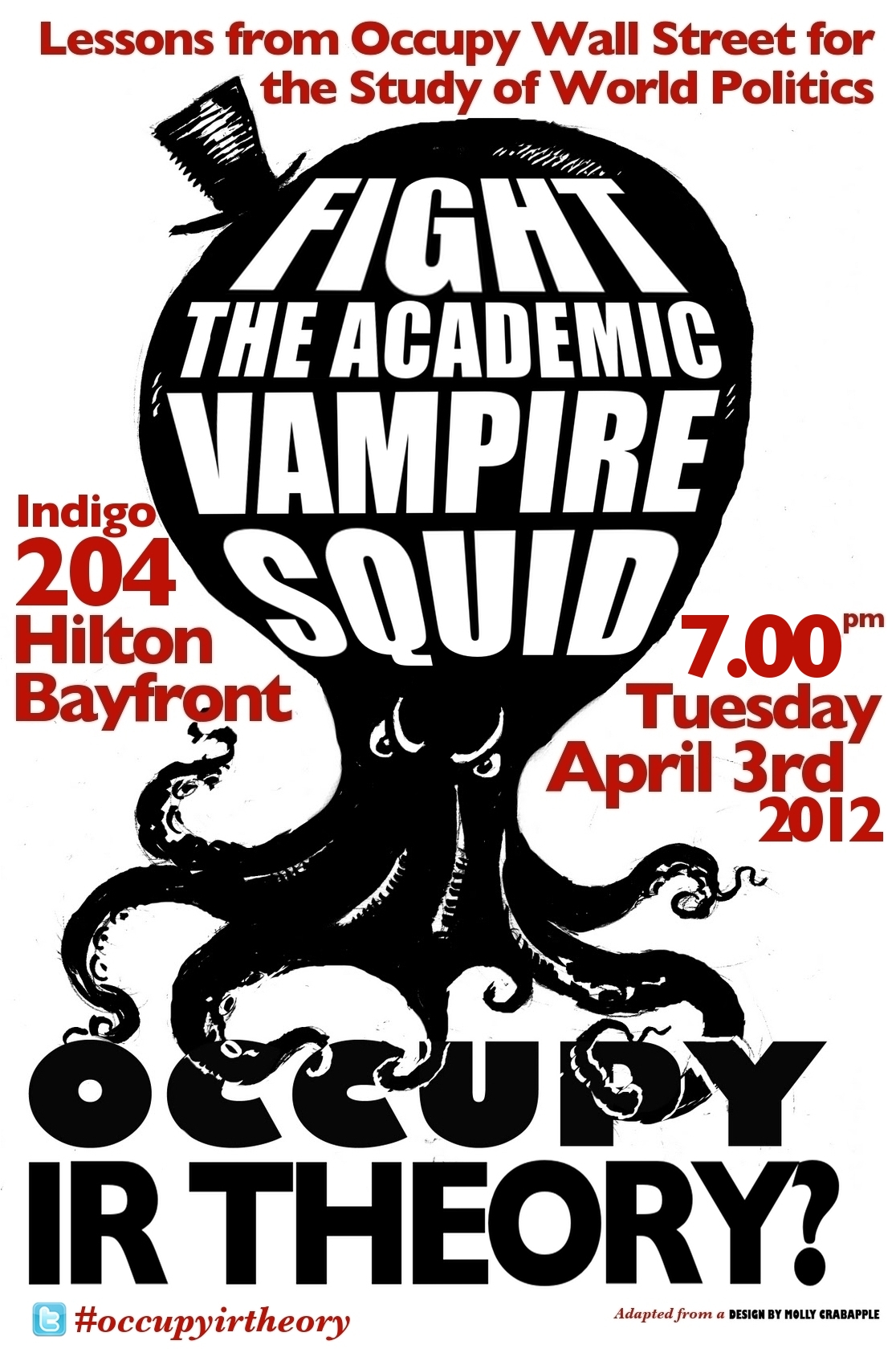
ISA 2012 is just around the corner, and it will doubtless be as hectic and awkward and joyous as ever. Robbie and I will be appearing at an event on #occupy and its relevance for IR on Tuesday at 7 in Indigo 204 at the Hilton Bayfront. We’ll be joining Lucian Ashworth, Lara Coleman, Nicholas Kiersey and Wanda Vrasti (all chaired by Jason Weidner) for what I’m sure will be an exciting roundtable discussion. More importantly, it will be brief, with most of the session given over to a General Assembly-style discussion of what IR can learn from #occupy, what #occupy might get from IR, and how we might take the spirit and organisational form into the discipline itself (or not).

The hope is that the slightly later starting time will allow people to go both to the various Section receptions and meetings (briefly) and to come to this, whilst still leaving reasonable evening time for food and the rest. Please do get involved over at Facebook (see also the #occupyirtheory group and #occupyirtheory blog) and let interested IR-types know. Readers may also be (should also be!) interested in a recent forum from the Journal of Critical Globalisation Studies on ‘Occupy IR/IPE’, featuring Nick and Wanda (as well as Colin Wight, Michael J. Shapiro, Patrick Jackson and others), which I’ve parcelled together as a single pdf for your delectation here.

Hope to see you there!

#Kony2012 from Advocacy to Militarisation

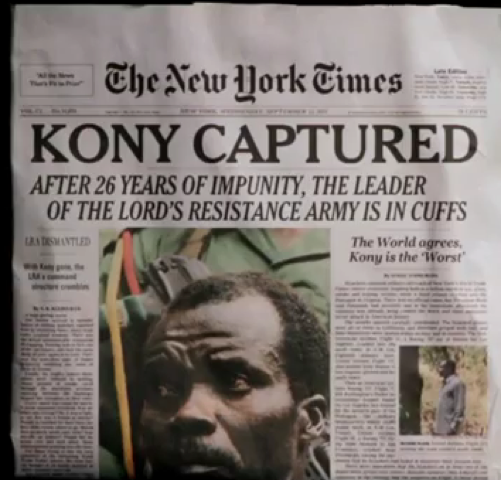
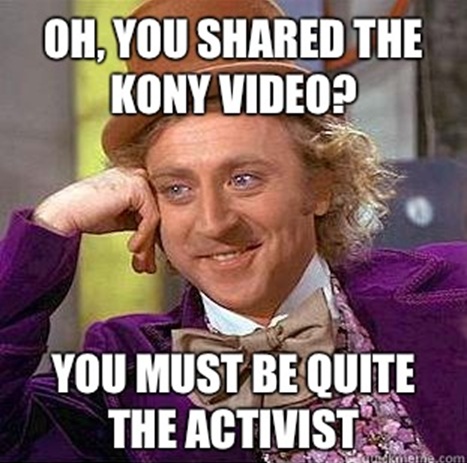
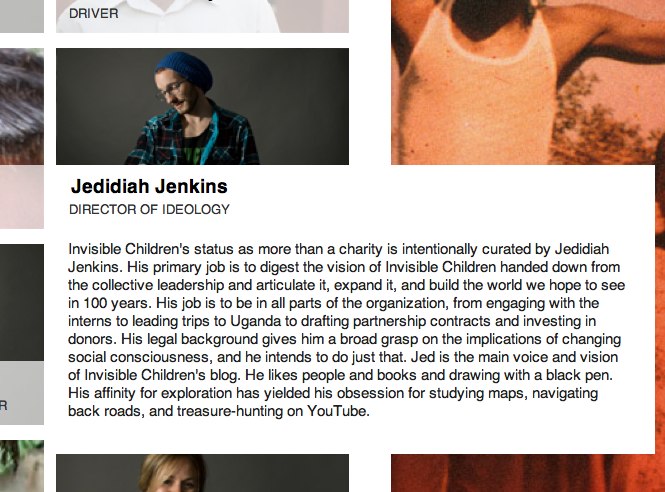
Although the attention spike and mainstream media attention on #Kony2012 has receded, not least thanks to Jason ‘Radical’ Russell’s own brush with infamy, the implications of muscular-liberalism-as-social-media-experiment continue to unfold. My feed at least continues to be peppered with anger towards Invisible Children from informed activists and scholars (although Norbert Mao, for one, takes a much more positive view and Jason Stearns makes a few qualifications of the anti-case worth reading). On Saturday, CEO Ben Keesey and ‘Director of Ideas Development’ Jedidiah Jenkins (formerly ‘Director of Ideology’: yes, really) released a short teaser video promising a sequel to #Kony2012 and declaring that the campaign was “working”. Staying stubbornly loyal to the understanding of foreign policy decision-making expressed in the original narrative, this was said to be because the people at the top were now being forced to respond to an issue they previously hadn’t cared about/known about, all thanks to the public pressure of predominantly young activist-citizens. The major consequence of this pressure being the introduction on March 12 of a Resolution in the US House of Representatives, sponsored by Jim McGovern (a Democrat) and Ed Royce (a Republican), to end Kony’s atrocities and bring justice to Norther Uganda. There’s now a Senate version of the Resolution too, taken by Keesey and Jenkins to dispel those loose accusations of ‘slacktivism’ against Invisible Children and its supporters.

But what does the Resolution actually ask for? Having reaffirmed previous declarations, it:

…calls on the Secretary of State and heads of other government agencies to undertake diplomatic efforts with partner nations focused on—
(A) expanding the number of capable regional military forces deployed to protect civilians and pursue LRA commanders; (B) enhancing cooperation and cross-border coordination among regional governments; and (C) promoting increased contributions from European and other donor nations for regional security efforts.

Now that’s a rather curious formulation of “diplomatic efforts”. Nowhere in the text is there any mention of the human rights records of the Ugandan or DRC armies, nor any suggestion that they are anything but (albeit junior) ‘partners’ in this military endeavour. The preamble makes repeated mention of ‘help’ to regional governments, and one line of text hints at problems (to “address shortcomings in current efforts”), but it is clear that these are deficiencies of coordination and military effectiveness, not of human rights concerns. The claims previously made in defence of the campaign (“we do not defend any of the abuses perpetrated by the Ugandan government or by the Ugandan army”) have rather evaporated in the transition to a formal Resolution, and Keesey and Jenkins make no complaint of that elision. Although recently rather keen to harness #Kony2012’s popularity, Human Rights Watch and others have long catalogued systematic abuses by the UPDF which match the Lord’s Resistance Army closely for brutality. The record of the FARDC (the army of the Democratic Republic of Congo) is worse still. Exact and proportional figures are hard to pinpoint, but there is no question that they are major (and quite possibly the main) perpetrators of rape, terrorism and atrocity in Eastern DRC.

All of this sets a brutal precedent. The vagueness of the call for action and policy detail, lost amongst the emotion ratcheting of being a ‘doer’ rather than a ‘sayer’, opened the door to any number of Liberal Saviour Hawk Military Industrial fantasies (to adapt Teju Cole). This is what groups like the Association of Concerned Africa Scholars warned of, a not-so-creeping militarisation of East and Central Africa. As apparently obvious as stopping Kony’s evil in a hail of righteous bullets cycles seems to Russell and Co., the cycle of insurgency and counter-insurgency tends to be draped at each stage in stark aggressions, with those regional military partners enacting their own ‘invisible’ massacres as they go.

Conspiratorial ideas of Invisible Children as a front for the US government aside, there is clearly a whole set of non-humanitarian interests at play here. I doubt there is any real appetite, and certainly very little capacity, in policy circles for any kind of escalation of direct US military involvement in the area, but then ‘support’ and ‘advice’ for regional allies and proxies has more traditionally been the mark of foreign policy. What those exponential click counts will translate into in policy terms thus remains open, but the signs aren’t great.

Dr Sabaratnam, I Presume?

Hot on Roberto’s heels, and the third of us to achieve doctorhood since the inception of The Disorder Of Things, our very own Meera today survived the critical questioning of Robbie Shilliam and Christopher Cramer. She is henceforth Dr Sabaratnam, certified by virtue of her thesis: Re-Thinking the Liberal Peace: Anti-Colonial Thought and Post-War Intervention in Mozambique. For the record, I’m assured that any violence inflicted was purely intellectual.

Call for Contributions: The Global Political Economy of the 1%

Tim Di Muzio (Wollongong) is putting together an edited volume on The Global Political Economy of the 1% which Disordered readers might be interested in contributing to. The full call is here. Abstracts of 250 words or less are due by 30 April 2012 with first full drafts by 1 November 2012. Tim can be emailed with submissions or for more details here.

While the internationalized Occupy Wall Street movement faces many strategic and organizational challenges, one of its major accomplishments has been its ability to draw global attention to the massive disparity of income, wealth and privilege held by 1% of the population. Such attention comes amidst a relatively synchronized global financial crisis, a mounting first world debt crisis in parts of Europe and the United States and the intensification of neoliberal policies. While political science and sociological study has shed light on elites and the wealthy in the past, with some recent popular exceptions, there has been a dearth of research on the culture, politics, built environments and psychology of the global rich in the new gilded age.

To redress this gap in the literature, this edited volume calls for a more focused and engaged study on what could be called the global political economy of the 1%. Such a project could help shed light on the massive chasm between this elite class of wealth holders and the rest of the global working class – the majority of whom subsist on less than US$2 a day and increasingly live in informal settlements as the dialectic of dispossession and urbanization continues its historical dance. Of course, it should be emphasized that a global political economy of the 1% does not preclude (and nor should it) the unavoidable social relations between the 1% and the 99%. However, recent literature has already enriched our understanding of how poverty, unprotected workers, and the everyday life practices of the seemingly mundane impact upon the wider global political economy. So a keen, yet nonrestrictive, focus on the political economy of 1% and the global income/wealth hierarchy is welcome.

All abstracts will be accepted and reviewed with sincerity. Selections for inclusion in the volume will be evaluated on the basis of original content, coherence and consistency with the general theme as well as the necessity of creating coherent sub-themes. Sub-themes are suggested here to organize research questions but are not necessarily the themes of the volume (contingent upon contributions).

Topics and questions that could be addressed in such a volume include but are not limited to the following: The Usual Suspects: Identifying the 1%The Social Reproduction of the 1%; Culture, Consumption and the 1%; and Power, Resistance and the 1%.

“Can I Tell You The Bad Guy’s Name?”: A Virtual Read-In and Comment On #Kony2012 and Badvocacy

UPDATE (10 March): Material is coming thick and fast on #Kony2012, so I’m adding three recent interventions. The first is from Ismael Beah, he of child soldier fame, on CNN (apologies for the awful interviewer).

The second is from Adam Branch (who just has a book out on Uganda, war and intervention) on the wrongness, and also the irrelevance to Northern Ugandans, of Invisible Children:

My frustration with the group has largely reflected the concerns expressed so eloquently by those individuals who have been willing to bring the fury of Invisible Children’s true believers down upon themselves in order to point out what is wrong with this group’s approach: the warmongering, the self-indulgence, the commercialization, the reductive and one-sided story it tells, its portrayal of Africans as helpless children in need of rescue by white Americans, and the fact that civilians in Uganda and Central Africa may have to pay a steep price in their own lives so that a lot of young Americans can feel good about themselves, and a few can make good money. This, of course, is sickening, and I think that Kony 2012 is a case of Invisible Children having finally gone too far. They are now facing a backlash from people of conscience who refuse to abandon their capacity to think for themselves.

The third, from Teddy Ruge, beautiful in its rage:

This IC campaign is a perfect example of how fund-sucking NGO’s survive. “Raising awareness” (as vapid an exercise as it is) on the level that IC does, costs money. Loads and loads of money. Someone has to pay for the executive staff, fancy offices, and well, that 30-minute grand-savior, self-crowning exercise in ego stroking—in HD—wasn’t free. In all this kerfuffle, I am afraid everyone is missing the true aim of IC’s brilliant marketing strategy. They are not selling justice, democracy, or restoration of anyone’s dignity. This is a self-aware machine that must continually find a reason to be relevant. They are, in actuality, selling themselves as the issue, as the subject, as the panacea for everything that ails me as the agency-devoid African. All I have to do is show up in my broken English, look pathetic and wanting. You, my dear social media savvy click-activist, will shed a tear, exhaust Facebook’s like button, mobilize your cadre of equally ill-uninformed netizens to throw money at the problem.

Cause, you know, that works so well in the first world.


Glenna Gordon‘s 2008 image of the Invisible Children founders in cod-Rambo pose with the Sudan People’s Liberation Army now defines the #Kony2012 backlash. Jason ‘Radical’ Russell – he who speaks excitedly of ‘war rooms’ – and his compatriots have thus far notched up 12 million-odd Vimeo hits and over 32 million YouTube hits with their 30-minute hymn to awareness, social media, atrocity prevention and youth power. A simulacrum of solidarity now not quite besieged, but at least peppered, by an array of critiques and counter-points, almost always from scholars and activists with their own well-established records of engagement and internationalism.

That backlash is now, predictably enough, giving rise to a counter-backlash from newly enlivened global citizens, and the predominant form taken by this response is itself instructive. Comment threads on posts like Mark’s consistently reveal a nascent activist consciousness which is hugely fragile, but also aggressive. Although many presumably did not know of Joseph Kony until this week (and in this minimal sense, #Kony2012 clearly ‘worked’), they are now so outraged at even the hint of complexity or counter-point that they denounce others as self-promoters, ignorami (ignoramuses?), complacent and/or complicit (by some unspecified metric) in human suffering. The juxtaposition is telling: the fresh anger and one-dimensional vigour of discovering atrocity and of being “empowered” (however vaguely) to end it is simply too appealing to withstand reasoned discussion. And so newly-minted ‘doers’ find themselves in the position of having to attack those old established ‘cynics’, Ugandans and Uganda hands among them, in whose very name they “won’t stop”. Say, at what point exactly did common humanity come to mean lecturing Ugandans that they were “ungrateful” and “negative” for pointing out that Museveni is not so nice either?

But what has been the content of this unbearable counter-critique? Continue reading

Dr Roccu, I Presume?

The second of us to achieve doctorhood since the inception of The Disorder Of Things, our very own Roberto this afternoon survived interrogation by Charles Tripp and Toby Dodge to become a fully certified Doctor of Philosophy in International Relations. His thesis being entitled Gramsci in Cairo: Neoliberal Authoritarianism, Passive Revolution and Failed Hegemony in Mubarak’s Egypt, 1991-2010. Timely and on trend, awarded sans corrections.

How is Rape a Weapon of War?

This post summarises a piece for the European Journal of International Relations just published online. An inconsequentially different pre-publication version is also available for anyone unable to breach the pay wall.

UPDATE (8 March): Sage have kindly made the full EJIR paper open access until early April, so you can now get it directly that way too.


I’m sure you have reasons
A rational defence
Weapons and motives
Bloody fingerprints
But I can’t help thinking
It’s still all disease.

Fugazi, ‘Argument’ (2001)

‘Weapon of War’ could be many explanations and I’m not sure of any of them.

UNHCR official, Goma, Democratic Republic of Congo, June 2010

1. War Rape in the Feminist Imaginary

Rape is a weapon of war. Such is the refrain of practically all contemporary academic research, political advocacy and media reporting on wartime sexual violence. Once considered firmly outside the remit of foreign policy, rape is today labelled as a ‘tactic of war’ by US Secretaries of State who pledge to eradicate it and acknowledged as a war crime and constituent act of genocide at the highest levels of international law and global governance, a development which for some amounts to the ‘international criminalization of rape’. This idea of rape as a weapon of war has a distinctly feminist heritage. Opposed to the historical placement of gendered violence within the hidden realm of the private, feminist scholarship was the first to draw out the connections between sexual violence and the history of war, just as feminists fought to make rape in times of nominal peace a matter for public concern. Feminist academics have, then, pioneered a view of sexual violence as a form of social power characterised by the operations and dynamics of gender. Sexual violence under feminist inquiry is thus politicised, and forced into the public sphere.

But the consensus that rape is a weapon of war obscures important, and frequently unacknowledged, differences in our ways of understanding and explaining it. Continue reading

Academia in the Age of Digital Reproduction; Or, the Journal System, Redeemed

It took at least 200 years for the novel to emerge as an expressive form after the invention of the printing press.

So said Bob Stein in an interesting roundtable on the digital university from back in April 2010. His point being that the radical transformations in human knowledge and communication practices wrought by the internet remain in their infancy. Our learning curves may be steeper but we haven’t yet begun to grapple with what the collapsing of old forms of social space means. We tweak and vary the models that we’re used to, but are generally cloistered in the paradigms of print.

When it comes to the university, and to the journal system, this has a particular resonance. Academics find themselves in a strange and contradictory position. They are highly valued for their research outputs in the sense that this is what determines their reputation and secures their jobs (although this is increasingly the value of the faux-market and the half-assed quality metric). This academic authority, won by publications, is also, to some extent, what makes students want to work with them and what makes them attractive as experts for government, media and civil society. They are also highly valued in a straight-forward economic sense by private publishing houses, who generate profit from the ability to sell on the product of their labour (books and articles) at virtually no direct remuneration, either for the authors or for those peer reviewers who guarantee a work’s intellectual quality. And yet all (OK, most) also agree that virtually nobody reads this work and that peer review is hugely time-consuming, despite being very complicated in its effects. When conjoined with the mass noise of information overload and the extension and commercialisation of higher education over the last decades, our practices of research, dissemination and quality control begin to take on a ludicrous hue. As Clifford Lynch nicely puts it, “peer review is becoming a bottomless pit for human effort”.

This is an attempt to explore in more detail what the potentialities and limits are for academic journals in the age of digital reproduction. Once we bracket out the sedimented control of current publishers, and think of the liveliness of intellectual exchange encountered through blogs and other social media, a certain hope bubbles up. Why not see opportunity here? Perhaps the time is indeed ripe for the rebirth of the university press, as Martin Weller argues:

the almost wholesale shift to online journals has now seen a realignment with university skills and functions. We do run websites and universities are the places people look to for information (or better, they do it through syndicated repositories). The experience the higher education sector has built up through OER, software development and website maintenance, now aligns nicely with the skills we’ve always had of editing, reviewing, writing and managing journals. Universities are the ideal place now for journals to reside.

Continue reading

Real Men Don’t Rape: A Postscript

Apropos our earlier look at the rhetoric of anti-rape advocacy, Sarah again pointed me in an interesting direction. This time to Vancouver, where a familiar campaign was launched last year. Echoing a similar phraseology (We Are Man; My Strength Is Not For Hurting; Real Men Know The Difference), this one says: Don’t Be That Guy. As is the vogue, the focus is principally on intoxication, nights out and not taking advantage, accompanied by cod-parental instruction: Just because you help her home, doesn’t mean you get to help yourself; and Just because she isn’t saying no doesn’t mean she’s saying yes; and Just because she’s drinking doesn’t mean she wants sex.

What’s interesting is that this exercise in ‘behavioural marketing’ is now seen as a success, and being given significant credit for an apparent 10% drop in rape rates since 2010. To wit:

The reversal in the trend related to sexual assaults reflected the impact of the new education program, better training for police officers and more effective investigation and enforcement, [Deputy Chief LePard] said.

The exact causal balance here is unclear, and there are no firmer details on this gendered accounting for us to work with. There still seem to be some good reasons for scepticism, but if anyone does know of more comprehensive studies on the impact of men-focused campaigns, do share. Particularly interested to hear of any research into the effects of similar behavioural marketing as part of mass anti-rape efforts in the midst of militarised-humanitarian intervention, whether in Congo or elsewhere.

‘You, Decorous Bureaucrats Of Angelic Leagues’: A Brief Review of ‘I Melt The Glass With My Forehead’ (2012)

I’ve just seen Martin McQuillan and Joanna Callaghan‘s ‘I Melt The Glass With My Forehead’: A Film About £9,000 Tuition Fees, How We Got Them, and What To Do About It.[1] It does pretty much what it says on the tin, charting the issues talking-heads style. Readers not already deeply involved in the UK higher education system and its various problems will find it particularly enlightening, and the parade of would-be-Ministers making promises soon to be broken is worth the anger-energy alone.

Two things struck me. The first was LSE Public Policy Professor Nick Barr, who, despite making a lonely case for some of the fee changes, nevertheless foregrounded a few crucial issues. Most obviously neglected by higher education activists, there’s the importance of pre-university education, which remains much more important in determining entry, ‘success’ and social mobility than any fee/loan/tax increase. Moreover, as we’ve seen before, there’s the uncomfortable truth that the Browne proposals were more redistributive than the old system, although the Government’s decision to cap fees removed this potential. Linking these dimensions is the fundamental tension of contemporary higher education, which is of matching mass participation with high quality. On Barr’s account, this cannot happen from general taxation alone without something giving. Of course, this only remains a challenge of public policy under certain comparatively narrow parameters, and, as Howard Hotson reminds us, the system being ‘reformed’ for its own good was actually the best in the world when viewed as the combination of overall quality and parity across institutions (and if you haven’t yet read Hotson on the Ivy League, do).

Second, and relatedly, the focus of our reflections seems already to have congealed around fees, and fees alone. Even on the narrow topic of student finances, the question of living costs is almost totally absent. A few voices from another age mention it, but there seems no place in our moral calculus for considering the differential between those who must support themselves and those who have the supporting done for them. But there’s also something evidently arbitrary in discussing fees without a whisper about the REF, or the impact agenda, or the generalised role of the university as a producer of public goods (and I don’t just mean Ancient Norse) in an age of austere retrenchment. Notwithstanding the manifold critiques of Browne and Willetts (charlatanism being primary among them, at least for McQuillan and Callaghan), all this misses the critical perspective provided by Andrew McGettigan, placing the fees SNAFU within a wider ecology of political economy and long-term transformation. We learn just this week of the next stage of this process at London Met, where all in-house admin is being offered for private bidding and where 229 ‘posts’ (read: jobs) are to be abolished across seven faculties (this coming after the closure of 70% of undergraduate courses).

This all matters because the public discussion of the future university is increasing, even amidst our wholesale crisis of economy. In typical academic style, it’s coming too late for the bait-and-switch, but if the renewal of energy around the idea of a public university is to mean anything, it cannot be a mere retreat. Barr’s argument that teaching grant must be restored in the next Parliament seems both commonsensical and strangely unimaginable, but there are other stagnant pits of the old to avoid alongside the risks of the new.


[1] The title is borrowed from a banner at an anti-fees demo, quoting a 1915 poem by Vladimir Mayakovsky mentioned by Dan Hancox in the film. I borrowed ‘You, Decorous Bureaucrats Of Angelic Leagues’ from the same place. It seemed somehow more appropriate.