The Global Colonial 1914-18: A mini-series

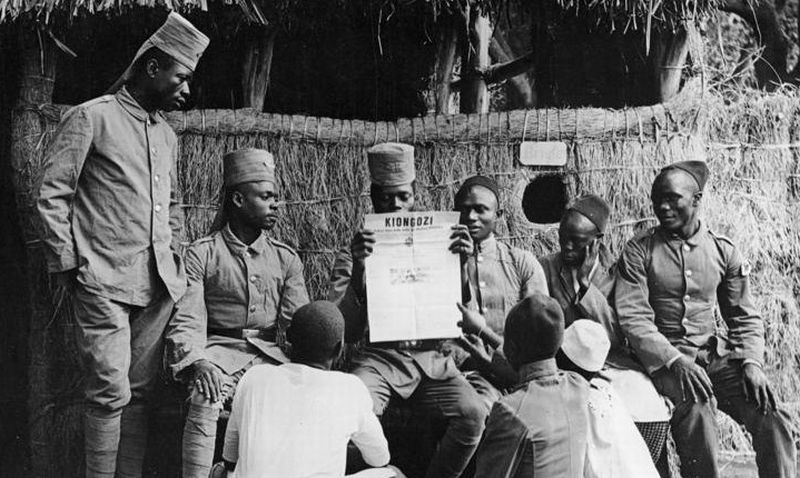
Askaris fighting for Germany listen to the news.

Askaris fighting for Germany listen to the news.

The Disorder of Things hosts a short series of posts connected to the event ‘The Global Colonial 1914-18‘, held at SOAS on 18th September 2014, and co-organised by the Colonial / Postcolonial / De-colonial Working Group of the British International Studies Association.

Our first post is by Lucian M. Ashworth, who discusses the breakdown of the colonial armed peace, as viewed by contemporary observers.

Our second post is by Dušan I. Bjelić, who offers a racial genealogy of the Great War.

Our third post is by Meera Sabaratnam, who suggests a contrapuntal reading of the war based in colonised Mozambique.

Our fourth and final post contains a transcript and video of the public roundtable which took place at the end of the day, featuring Hakim Adi, Catriona Pennell, Parmjit Singh, Martin Spafford and Charles Tripp, in which the colonial dimensions of the war are discussed, as well as their implications for teaching and commemorating the period today.

This post serves as a permanent link for the series.
 

Metrics: An Addendum on RAE / REF

Not everything that counts can be counted, and not everything that can be counted counts...

We have had overwhelming support from a wide range of academics for our paper on why metrics are inappropriate for assessing research quality (200+ as of June 22nd). However, some have also posed interesting follow-up questions on the blog and by email which are worth addressing in more depth. These are more REF-specific on the whole and relate to the relationship between the flaws in the current system and the flaws in the proposed system. In my view the latter still greatly outweigh the former but it is useful to reflect on them both.

Current REF assessment processes are unaccountable and subjective; aren’t metrics a more transparent, public and objective way of assessing research?

The current REF involves, as the poser of the question pointed out, small groups of people deliberating behind closed doors and destroying all evidence of their deliberations. The point about the non-transparency and unaccountability of this process is an important one to keep in mind.

The question is then posed, are metrics more transparent, public and objective? On a surface level, metrics are more ‘transparent’ because they are literally visible (public) and given a number, making them easily rankable. But what they represent, as we argued in our paper, is fundamentally non-transparent given the wide variety of reasons there might be for citing work, and more besides those we cited. In fact, it is the very simulation of transparency in the use of a numerical marker that becomes threatening to the act of actually reading work for assessment purposes. Continue reading

Why Metrics Cannot Measure Research Quality: A Response to the HEFCE Consultation

Pacioli Euclid Measurement

Update 24th June: 7,500+ views, 100s of shares, 200+ signatories! And a new post with some responses to further issues raised.

The Higher Education Funding Council for England are reviewing the idea of using metrics (or citation counts) in research assessment. We think using metrics to measure research quality is a terrible idea, and we’ll be sending the response to them below explaining why. The deadline for receiving responses is 12pm on Monday 30th June (to metrics@hefce.ac.uk). If you want to add an endorsement to this paper to be added to what we send to HEFCE, please write your name, role and institutional affiliation below in the comments, or email either ms140[at]soas.ac.uk or p.c.kirby[at]sussex.ac.uk before Saturday 28th June. If you want to write your own response, please feel free to borrow as you like from the ideas below, or append the PDF version of our paper available here.


Response to the Independent Review of the Role of Metrics in Research Assessment
June 2014

Authored by:
Dr Meera Sabaratnam, Lecturer in International Relations, SOAS, University of London
Dr Paul Kirby, Lecturer in International Security, University of Sussex

Summary

Whilst metrics may capture some partial dimensions of research ‘impact’, they cannot be used as any kind of proxy for measuring research ‘quality’. Not only is there no logical connection between citation counts and the quality of academic research, but the adoption of such a system could systematically discriminate against less established scholars and against work by women and ethnic minorities. Moreover, as we know, citation counts are highly vulnerable to gaming and manipulation. The overall effects of using citations as a substantive proxy for either ‘impact’ or ‘quality’ could be extremely deleterious to the standing and quality of UK academic research as a whole.

Why metrics? Why now? Continue reading

What We Talked About At ISA: Rhythm, Time and History

With thanks to Elisabetta Brighi and Xavier Guillaume for putting together the Rhythms of the International roundtable and their inspiring contributions, to Robbie Shilliam for his song, and Kyle Grayson for his spirited and thoughtful engagement. And by no means least, to the pleasingly sizeable and lively crowd who gave the last panel of the last day such a buzz.

Below is a write-up of my contribution to the roundtable, in which I reflected on the relationship of rhythm and history, and drew out some of the potential disruptions that a different rhythmic sensibility might have on our conception of history.


What is rhythm?

To my shame, colleagues, and partly out of curiosity, I looked it up in the dictionary. Shame, because if you are looking something up in a dictionary before giving a talk on it, you probably shouldn’t be giving a talk on it. Curiosity, because I wanted to know how they would define ‘rhythm’ in words rather than in noises.

The dictionary answers were not particularly edifying. One definition spoke of ‘repeated, regular beats’, another of a ‘regulated succession’ of beats. Thud, thud, thud. Boom, boom, boom. Boom, thud, boom, thud. These definitions felt flat, and rather forbidding. But I suppose this is because they were the generic definitions of all kinds of ‘rhythm’, and not just the samba playing in my head.

Using some thinking developed earlier in some work on music and politics, I started again, with a different question:

What is the relationship of rhythm and time?

This yielded a much more direct answer: it is the production of rhythm that makes time itself knowable. In the making of music, rhythm generates movement and flow, and makes it possible for sounds to synchronise and arrange themselves. Continue reading

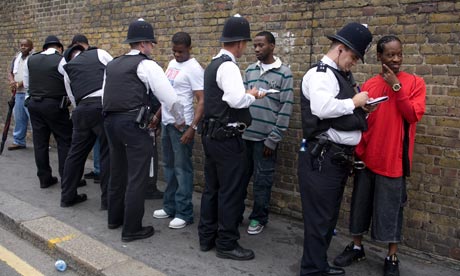
Stop and Search: Race and the Politics of Suspicion

banksy-searchStop and search at Notting Hill carnival

BETWEEN me and the other world there is ever an unasked question: unasked by some through feelings of delicacy; by others through the difficulty of rightly framing it. All, nevertheless, flutter round it. They approach me in a half-hesitant sort of way, eye me curiously or compassionately, and then, instead of saying directly, How does it feel to be a problem? they say, I know an excellent colored man in my town; or, I fought at Mechanicsville; or, Do not these Southern outrages make your blood boil? At these I smile, or am interested, or reduce the boiling to a simmer, as the occasion may require. To the real question, How does it feel to be a problem? I answer seldom a word.

– W. E. B. Du Bois, The Souls of Black Folk, (1905)

Video from excellent activist group Stop-Watch.

The political pause over Stop and Search

The riots of 2011, and the research that was conducted afterwards, have had multiple political effects. Of these, one of the most important has been a clearer public exposure of the deep animosities generated by police use of stop and search powers against young people and especially those of black and Asian backgrounds. Whilst the idea that stop and search causes animosity is not news to anyone interested in British race relations or human rights, it has unusually become the focus of increasing political attention. For many years the Independent Police Complaints Commission has warned that the use of stop and search powers may be being exercised in a discriminatory and unaccountable way, and the Equalities and Human Rights Commission have been investigating police forces on this front.  Yet it was only following the riots that the Metropolitan Police Commissioner Sir Bernard Hogan-Howe began a large overhaul of the use of the power in London in 2012. Following this, parliamentary briefings were issued which pointed to the broader ineffectiveness and abuse of the powers, and the Home Office has launched a consultation into the use of stop and search. In launching this consultation, equality-sceptic Home Secretary Theresa May acknowledged, in very measly terms, the discriminatory ways in which these powers had been exercised:

The official statistics show that, if someone is from a black or minority ethnic background, they are up to seven times more likely to be stopped and searched by the police than if they are white. Now we should not rush to conclusions about those statistics, but everybody involved in policing has a duty to make sure that nobody is ever stopped just on the basis of their skin colour or ethnicity. The law is clear that in normal circumstances, stop and search should only ever be used where there is a reasonable suspicion of criminality—and that is how it should be. I am sure we have all been told stories by constituents and members of the public about what it is like to be a young, law-abiding black man who has been stopped and searched by the police on more than one occasion. If anybody thinks it is sustainable to allow that to continue, with all its consequences for public confidence in the police, they need to think again.

House of Commons Debate, 2 July 2013 Continue reading

Getting Somewhere: HEFCE Proposals on Open Access for a Post-2014 Research Excellence Framework

zimbabwe-press

This week, the UK’s Higher Education Funding Council for England (HEFCE) published their formal proposals for including an open access requirement in any post-2014 Research Excellence Framework (REF). Responses to this will be accepted until 30th October 2013. These proposals follow a pre-consultation letter and set of responses which were submitted earlier in the year (link to University of Cambridge response).

Following up our concerns about the policy raised over the last few months (here and here, further posts here) the present iteration represents a decent outcome on some of the details, not least because it defers quite a few of them. That these issues have been deferred does not mean that they do not matter; rather it means that the battles on them will be fought elsewhere – with universities, with journal boards, with learned societies, with publishers and their lawyers and so on. Moreover, there is no cause for complacency around the broader political economy of scholarly publishing, which remains wasteful, restrictive and inequitable on many fronts. And of course, the pernicious REF exercise itself, which this government signalled it would review, must be itself vigorously contested (more on this to come).

The Requirements

The proposals are to require that any REF-submitted journal article or conference proceeding published after 2016 must be made available in the final post-peer reviewed version from an institutional repository at the point of acceptance (or publication). This in line with the previous agenda of RCUK and others, and maintains journal exclusivity by accepting substantial embargo times on truly open (read: public) viewing of these deposited versions. So a paper “immediately” placed in an institutional repository may still not be viewable for up to 24 months in the Arts, Humanities and Social Sciences (recall that this length of permissible embargo was extended in the face of publisher lobbying), although it may be possible to request papers directly from the author on an individual basis. This version of mandated open access is applicable only if the address line of the author is a UK HEI at the time of publication, and cases for exceptions can be made. HEFCE’s assessment that this should be broadly achievable under current provisions is reasonable, and represents a good path for opening up access to research under present conditions. From the perspective of maximising green OA, Stevan Harnad’s response is as ever highly incisive. Below are some reflections on the present state of play.

What Has Been Won and Deferred

First, the old green/gold battle is now (nearly) over, and with it the concerns that academics would routinely pay exorbitant author fees to have their research published. Continue reading

Dr Kirby, I Presume?

*drum roll, bugles, parades, silly hats*

In spite of his generous blogging output, our own Pablo K has also conspired to write, and now successfully defend, a doctoral thesis on Rethinking War/Rape: Feminism, Critical Explanation and the Study of Wartime Sexual Violence, with Special Reference to the Eastern Democratic of Congo. Interrogators-in-chief were Maria Stern and Mark Hoffman. Congratulations, Dr Kirby. We’d tell you to write about it, but we probably don’t need to.

phd072011s

Open Access: News and Reflections from the ACSS Conference

Last week, the first big public event discussing the Open Access policy announced in July was held at the Royal Statistical Society by the Academy of Social Sciences. If you are interested, many of the presentations from the event are already available online, with more write-ups to follow, as well as a promised YouTube video of the entire event. The programme promised and delivered a good range of speakers, and not least Dame Janet Finch herself.  I went along for the first day, thinking that this might be an open space to learn about the issues and have discussions about the policy, involving a wide range of affected parties.

Janet Finch

I did learn a lot, although what I mainly learned was that no one was really prepared to take any real responsibility for a policy to which a lot of eminent and well-informed people had very serious objections. Finch insisted that she had to stick to a brief which did not involve ‘destabilising’ the publishing system. No one was there to answer from either BIS or RCUK, who both adopted the policy immediately upon the publication of the report in July. HEFCE, who have not formally announced a position yet, however indicated at the conference that they are very likely to adopt the RCUK model for REF2020. Continue reading

Open Access: Time for Action

This is the last in our recent series of posts this week on open access. Pablo covered the big questions and rationales for open access; Colin explored the potential consequences of the current policy direction; David raised serious questions about its fit for social sciences; Nivi highlighted the implications for early career academics and Nathan extended the discussion to the broader problems of academic precarity.


What do we do now? I will not labour over diagnostic points made eloquently and at length elsewhere on this blog (and also in the comments sections). In part, because there just isn’t time. At least in the UK, right now, we are facing a critical juncture where open access policy is being solidified by the Finch ‘Implementation Groups’, and solidified in the wrong direction. Indeed, there is a Academy of Social Sciences Conference in London on 29th and 30th November on the implementation of OA policy, which will likely further reinforce the direction of travel laid out by the Finch Report. Dame Janet Finch is the keynote on the first day, and the second day is ‘aimed at’ publishers, learned societies and their representatives. I am also somewhat concerned at the speed of travel on this, which suggests that Government have not taken the time to seriously reflect on it, and that most wider academic ‘stakeholders’ are being left behind on discussions and decisions which seriously affect all of our futures.

Briefly, though, my concerns around an endorsement of Article Processing Charges mirror questions raised by Colin. Having said that, I am rather more certain/pessimistic than him that these pose a very substantial threat to academic freedom and the overall integrity of the journal system. I am also concerned that they will increase the costs of research without increasing its quality, and waste a lot of academic time as Universities and Departments try to administer them (as will have to happen for most Arts/Humanities/Social Science research which is not funded by grant-money). Finally, I am highly disappointed that nowhere does the Finch Report seriously reflect on possible Government action to further protect copyright over the Version of Record.

So, what is to be done?  Continue reading

Pre-Election Facebook Rants, #652

Posted without comment; thanks James Sadri.

<rant> What I used to dislike about the Iranian elections is what I dislike about all national elections today: they’re all fake. There is a choice but it’s not a meaningful one. With the Iranian elections the argument would be: Ahmadinejad or Karroubi/Mousavi, it doesn’t matter, the real power is with Khamenei the Supreme Leader. So you can elect the Iranian President but you can’t elect the Supreme Leader. Well that’s the situation we’ve all got today, even in the US. There is a Supreme Leader casting a long shadow over every national ‘democratic’ process. You can vote for Obama/Romney, Cameron/Brown/Clegg – whoever – but those are all fake choices, where you’re always choosing between the lesser of two evils, never for the world you really want. You can’t vote to stop 20,000 kids dying today because of lack of access to clean water. You can’t vote to stop all war. You can’t vote for people to have the same freedom of movement regardless of where they’re born. You can’t vote to stop extreme disparities of wealth. You can’t vote to stop climate change. That’s because if you do any of these things at the national level you’re shooting yourself in the foot. Increase labour protection or environmental regulation and the factories and cash will go to our enemies. Increase foreign ‘aid’ and it means less for our struggling people. Try to cap carbon emissions and you’re killing business competitiveness. Our Supreme Leader is national competition. We sacrifice the societies we really want to build – peaceful, harmonious, more equal ones – for violent dysfunctional ones that are hopefully slightly richer than those across the map lines. Nobody seems to question the race to the bottom – we seem only to be focused on being the fastest zombies. The world has globalised yet our politics remains pitifully – pathetically – parochial. So while I’ll be hoping that Romney doesn’t win tomorrow, I’m going to remember that there’s a Supreme Leader out there who’s pissing on all your national elections. And he doesn’t have a beard. </rant>