Roots, Radicals, Rockers and Reggae by Stiff Little Fingers
And lest we forget the roots, here’s the original:
And lest we forget the roots, here’s the original:
Men cannot live without seeking to describe and explain the universe to themselves. The models they use in doing this must deeply affect their lives, not least when they are unconscious; much of the misery and frustration of men is due to the mechanical or unconscious, as well as deliberate, application of models where they do not work… The goal of philosophy is always the same, to assist men to understand themselves and thus operate in the open, and not wildly, in the dark.
-Isaiah Berlin, The Purpose of Philosophy
Last month I presented two papers on human rights at the ISA conference in Montreal (both are available in draft form from the ISA website, here and here, please do not cite, but comments are welcome). Attempting to offer a summary of those papers, however, has made clear to me that they are importantly connected and perhaps incomplete as separate papers – hence the “should” in the title. Together, the papers offer a pluralistic and agonistic reconstruction of human rights as a political concept and an ethical ideal. I’ll try to offer a shorter version of the argument that connects these two papers here, though broken into three (relatively) short posts. My reconstruction begins (Part 1) with a theoretical analysis of human rights, which forms the basis for an argument (Part 2) about how we should understand the history of human rights and, finally, (Part 3) leads to a defence of a democratising reconstruction of human rights.
The Nature of Human Rights Claims
Human rights, I argue, are of central importance for contemporary political theory because they respond to the basic question of legitimate authority, which is most simply the question of what justifies the coercive power of political authority. Traditionally, the question of legitimate authority addressed to the modern state and it is from this line of thinking that we inherent the rights discourse – in which authority is rendered legitimate by protecting the rights of individual members of the political community, which is a group importantly distinct from those actually subject to the coercive power of the state.
The details of this can be filled-in in many ways, but the logic of rights is central to modern political thought. These political rights, and the institutions of governance they support, in turn, are justified by an appeal to moral rights. The moral appeal is central to the rights tradition as it is the absolute and certain quality of moral principles that justify the limitations imposed upon political authority and the powers granted to political authority to exclude, harm and constrain. Human rights emerge from this modern rights tradition, but the conditions and consequence of their emergence are complex. Continue reading
Building on my post responding to Patrick Jackson’s The Conduct of Inquiry in International Relations, I wanted to highlight a book on methodologies in political theory that I’ve been working my way through.
In my post I suggested that “normative” theorists would object to Jackson’s characterization of their work as essentially the same as political activism or religious speculation – which I stand by.
I struggle to think of an approach to ethical theory whose adherents don’t aspire to be systematic, accountable, and oriented toward discovering or producing practical ethical knowledge. While the meaning of these terms and the methods by which one pursues these aims would obviously differ from those used in strictly empirical investigations, Jackson’s broad practical definition of science raises the possibility that those of us concerned to make ethical evaluations maybe be entitled to declare: “we are scientists!”
I came across a chapter by Daniel McDermott in Political Theory: Methods and Approaches (edited by David Leopold and Marc Stears) that illustrates my point extremely well. In the chapter, “Analytical Political Philosophy,” McDermott says the following:
Analytical political philosophy is a complement to social science. Whereas social scientists aim to determine the empirical facts about human behaviour and institutions, political philosophers aim to determine what ought to be done in light of that information… There are a number of different ways to characterize it, but probably the best is that analytical political philosophy is an approach to gaining knowledge that falls into the same broad category as science.
McDermott goes on to draw parallels between the natural and social sciences and analytical political philosophy, which he admits depends upon the reality of moral facts. He avoids the controversies surrounding this issue by distinguishing metaethics from political philosophy, drawing a further comparison between science.
This leads to a deeper, and more interesting, version of the objection to the political philosopher’s project: there simply are no moral facts, ever. The theories political philosophers develop really are theories about nothing, like those medieval theologians developed about the number of angels that could fit on the head of a pin. This is a genuine worry, but it is the kind of metaethical worry that is none of the political philosopher’s business. In philosophy, as in most intellectual endeavours, progress depends in part upon a successful division of labour. All of biology, for example, is ultimately physics, but that does not mean biologists should become physicists. Nor would they allow worries about the origins of the universe to distract them from their projects… My claim is that political philosophers should set aside worries about whether there are moral facts is controversial… Continue reading
Because of the politics of becoming, gaps and fissures open up periodically between positional sovereignty as the highest authority to interpret the law and sovereignty as the effective power to decide what it will be. These two dimensions of sovereignty often shade into one another. But the discrepancy sometimes becomes a fissure that is too dramatic to ignore
William E. Connolly, Pluralism
As the recent protests kicked-off in Egypt two weeks ago, I was working on a thesis chapter about the history of the Universal Declaration of Human Rights (UDHR). In particular, I was looking at the drafting process and the intellectual debates that defined the famous human rights document. A key figure in that debate was the Lebanese representative, Charles Habib Malik, and I thought it worth pausing to remember an important figure in the contemporary human rights movement, who did much to develop human rights both intellectually and politically.

Malik defined himself as Lebanese, Christian and Arab – identities that importantly influenced his thinking and defense of human rights as a moral and political project. Despite claims that he was “Westernized” and that he was clearly a strong opponent of international communism, Malik was not a conventional Western liberal. In particular, he clearly saw himself as a fundamentally religious thinker whose political project was not only the defense of individual rights but ensuring the equal standing of Arab countries in world politics, which went together with a more general concern for securing the independence of colonized peoples and the protection of small states from great powers.
Independence springs from the Arab sense of the difference from others, a sense that has been sharpened in recent centuries by the relative isolation of the Arabs from the rest of the world. Unity takes on many modalities: from the mild form of general community and consultation enshrined in the Arab League to the extreme form of complete political unification desired by certain nationalist movements, particularly in Iraq and Syria. But regardless of its modality, every Arab feels an immediate mystical unity with every other Arab.
Lack of love. Strategy, commerce, exploitation, securing an imperial route: these were why the West for the most part came to the Near East, not because it loved us. Add to this the immense racial arrogance of modern Europe. The West has not been true to itself, and therefore it could not have been true to us.
(Charles Malik, “The Near East: The Search for Truth,” Foreign Affairs, 30, 1952)
He asks some important questions about US conceptions of “Arab Anger”, the lack of solidarity with a people fighting an oppressive regime and the myopic US-centric narratives that have dominated the news.

Update (19/05/11): A revised and expanded version of this post has been published in The Journal of Critical Globalisation Studies (Volume 4), which you can access for free here.
I’ve hesitated to comment on events unfolding in Egypt (and in the wider region, from Tunisia to Yemen). Not only do I lack any special knowledge of events but many others have said all that I would say with greater skill and clarity. Yet, a sense of solidarity with protesters and my frustration with the commentary on events leads me to offer a few thoughts on the ambiguous role that appeals to “realism” are playing in the response to the actions of the protestors and the government in Egypt.
As the protestors and Mubarak’s goons wait it out in Tahrir Square, the rebellion against the president has entered a key phase. Will the threat of continued violence give Mubarak the space he needs to solidify his power till next year, and in the process avoid the thorough changes the Egyptian people are demanding? As protestors face violence, exhaustion and deprivation the prospect of compromise must seem more desirable than before. The time seems ripe for expressions of support from key states and leaders. The protestors need our support; it’s much easier for Mubarak to play for time from the presidential palace than for protesters in the streets, but the men and women able to make a difference do not use their voices to share in democracy’s street-choir. And these moral midgets are attended to by their Lilliputian advisors, who counsel patience, restrain and reform that preserves stability.
Barak Obama has clearly mastered the dark art of evasive support, leaving no doubt that he’s all for Egyptian democracy that doesn’t change too much, too fast, and, most importantly, doesn’t compromise the key strategic interests of the US.
The administration’s restraint is also driven by the fact that, for the United States, dealing with an Egypt without Mr. Mubarak would be difficult at best, and downright scary at worst. For 30 years, his government has been a pillar of American foreign policy in a volatile region, not least because of Egypt’s peace treaty with Israel. American officials fear that a new government — particularly one dominated by the Muslim Brotherhood or other Islamist groups — may not honor the treaty signed in 1979 by Mr. Mubarak’s predecessor, Anwar el-Sadat. (NY Times)
Predictably, Joe Biden made the point with less tact, but perhaps more truth, when he expressed his insensibility to the crimes of Mubarak against his own people.
Asked if he would characterize Mubarak as a dictator Biden responded: “Mubarak has been an ally of ours in a number of things. And he’s been very responsible on, relative to geopolitical interest in the region, the Middle East peace efforts; the actions Egypt has taken relative to normalizing relationship with – with Israel. … I would not refer to him as a dictator.”
This is the second in a series of posts by several of us at The Disorder Of Things on Patrick Thaddeus Jackson‘s The Conduct Of Inquiry in International Relations: Philosophy of Science and Its Implications for the Study of World Politics. Paul started things off with his post setting up Jackson’s methodology of politics in order to ask important questions about the politics of Jackson’s methodology. The next few weeks will see further posts, followed by a reply by Jackson himself.
Update (3 Feb): Nick’s post is now up, to learn about material monism and the philosophical power of beards read it here.
Update (17 Feb): Meera’s post is now online, in which she threatens the stability of the matrix.
A broad definition of science, by design, does not provide us with any standards for good research, or indeed any specific advice for how to go about doing research, beyond the two basic admonitions to focus on factual knowledge of the world, and to separate this activity logically and conceptually from the promulgation of normative judgments and partisan-political stances. (25)
Patrick Jackson, The Conduct of Inquiry in International Relations

My comments on Jackson’s book need to be put in a personal context. I have no interest in claiming the title of “science” for my work or “scientist” for myself. Further, I do not consider my primary vocation the production of empirical knowledge. Instead, my work is “normative” and focused, most broadly, on how we think about the ethical dimension of world politics. Finally, I do not self-identify as a participant in the discipline of “International Relations,” nor as a “political scientist;” the tradition of scholarly work identified as “International Relations” is compromised by its statist foundations and the historically positivist pretensions that motivated the move to a science of politics are unsustainable in my estimation.
This raises an obvious question: why am I commenting on a book about the conduct of scientific inquiry in International Relations (IR)?
A Personal Anecdote

While at a conference in Ljubljana, Slovenia, I had an argument with my friend, Laust Schouenborg, about the nature of social science. Sitting in a Soviet-era housing block converted into a budget hotel, watching the sun go down behind the park, I was rhetorically ejected from academia.
Our argument began when Laust, after reading Chris Brown’s International Relations Theory: New Normative Approaches, suggested (contra Brown) that because there are no standards of what constitutes a “good” normative argument, the study of ethics had no place in IR, and that scholars concerned with making arguments about how politics should be, had no place in academia.[1] The modern university is a place for scientific study and those who were not practicing science should, he claimed, be relegated to the political and cultural spheres.
This line of reasoning shocked me, but it was only the culmination of a disciplining process I experienced in my first two years as a PhD student in the International Relations Department at the LSE. Even as many members of faculty supported my work, I was constantly asked why I was studying in an IR department and some “colleagues” suggested that my research was value-less as scientific work – whatever its virtues as polemic or sermon.[2]
These experiences have left me with two abiding intellectual concerns about the conduct of social inquiry. The first is to challenge the institutional privilege bestowed upon those conducting their inquiry as “science.” On this concern, Jackson and I share considerable ground, as his critique of exclusive definitions of scientific inquiry deflates dominant pretensions and advocates for a more inclusive study of world politics. And I must give credit where it is due: Jackson doesn’t suggest that my kind be thrown from the ivory tower – just given separate offices. The second concern is deeper and more contentious: to challenge the notion that the ethical questions that interest me can and should be separated from scientific inquiry into world politics. On this point Jackson and I share less ground, and for this reason the bulk of my comments will focus on how and why Jackson separates the “scientific” and the “normative” in his pluralist approach to IR.
Aside from satisfying very personal concerns, I offer this response to Jackson’s book because his generous orientation, stated most forcefully in the concluding chapter, invites engagement. Along with analyzing Jackson’s essentially Weberian account of a pluralist science of IR, and suggesting that a fuller account of social inquiry should bring together ethical and empirical inquiry, my most substantive critique is that the pluralism Jackson defends is partial and continues to discipline the study of world politics in an unsustainable way – a critique that, if correct, undermines a central aim of his project.

Monday 17 January marked the official US holiday honoring Martin Luther King, Jr. While watching Monday’s Democracy Now! program, featuring substantive excerpts from King’s speeches, the clarity with which he connected the domestic fight for equality to international politics, in particular poverty and war, struck me. The international aspects of King’s thinking, I believe, are important for two reasons.
First, it challenges the interpretation of King as an insufficiently radical leader offered by some critics, and the co-option of King’s legacy not only by “moderate” liberals but also by conservative political figures in the US. King has become a symbol in the public consciousness of a safe reformism and a favorite icon for the type of liberal who abhors radicalism above any other political sin. As Michael Eric Dyson says, “Thus King becomes a convenient icon shaped in our own distorted political images. He is fashioned to deflect our fears and fulfill our fantasies. King has been made into a metaphor of our hunger for heroes who cheer us up more than they challenge or change us.”
A personal anecdote to illustrate the point: a couple of years ago while handing over the editorship of Millennium to the incoming editorial team, one of the new editors commented on the large poster of Che Guevara that hangs on the Millennium office door. The Che poster, so far as I know, predates most of us currently associated with the journal, therefore I suggested it should stay. I then asked why Che should go. My colleague suggested that Che’s participation in revolutionary violence made him an inappropriate icon – in many academic disciplines this might be a rather devastating point, but International Relations is full of characters far more violent and less admirable than Comrade Che – see Paul’s post on Kissinger, for example.
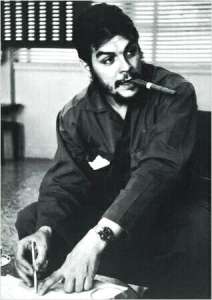
When asked who might better grace the walls of the office my colleague suggested Martin King or Mohandas Gandhi (a political figure subject to a similar post-hoc liberal deification), with their key qualification as acceptable iconography being that they had not participated in political violence. While I have a great deal of sympathy for non-violence, my own introduction to both King and Gandhi came through the study of non-violence political strategy, the liberal (and I think my colleague would gladly accept that identification) embrace of King or Gandhi, paired with the repudiation of Che, is (unintentionally?) disingenuous.
It’s a disingenuous embrace because it insists that the first rule of acceptable political action is a renunciation of physical violence, while at the same time turning a blind eye to the violence institutionalized in the state through everyday police brutality and legalized/legitimized imperial warfare, as well as the structural violence inherent to global capitalism. This misses the radical content of non-violence as practiced by King and obscures the link that exists between non-violent agitation and armed resistance. The political commitments and motivations of King and Che are remarkably similar, even as their fundamental orientations (Marxism vs. Christianity) and tactics (non-violent direct action vs. guerrilla insurgency) diverged. Continue reading

I’ve just returned from the “motherland” and bring tidings from a strange and far away place: Austerity, USA.
Gin and Tacos gave me a special gift just in time for Christmas. It seems the matriculating class of House Republicans have big plans for the country. The austerity fear mongering has reached new heights of hyperbolic cynicism as Republicans try to make it possible for states to declare bankruptcy. You can find details, with extra rage, here. The key points are that bankruptcy proceedings would allow states to renege on contracts with public sector unions and contract out public services, walk away from public sector pension obligations, and sell off public land, parks and buildings. A refutation of this obviously stupid and destructive policy, with the appropriate amount of anger and vulgarity, can also be found on Gin and Tacos, here. Finally, here’s the plan from the ideologues themselves, in case you thought we were making this shit up.
As if that were not enough to get the blood boiling, the incoming House Republicans have re-written the rules for the federal budget. The new rules will alter the current pay as you go scheme, which requires offsetting entitlement increases or tax cuts with tax increases or benefit cuts – which they did before in 2000, before the Democrats reinstate the rule in 2006. Geniuses that they are, the incoming Republican majority plans to eliminate the necessity of offsetting tax cuts – details here, and the actual new rules here. For the time being it seems that, at least in the US House of Representatives, we’ll be pretending that tax cuts do not cost money and are an effective way to cut the deficit and boost economic growth, all evidence to the contrary. When I add this to the pre-Christmas compromise on the Bush Tax Cuts, which not only extended an expensive and unwarranted tax cut to the wealthiest 2% of US taxpayers but also added an extra cut to inheritance tax as well, there is enough bad news here to push any angry leftist from thundering rage to child-like weeping. Continue reading


 The Disorder Of Things