Deciphering ‘The International’ in History and Theory

The final post in our symposium in our symposium on Alex Anievas’ Capital, the State, and War: Class Conflict and Geopolitics in Thirty Years’ Crisis, 1914-1945, in which Alex himself replies to his critics and interlocutors.


It brings me great pleasure to be invited to respond to such thoughtful and challenging critiques of my book Capital, the State, and War (CSW). On the (meta-)theoretical front, Mark Rupert and Kamran Matin question my use of uneven and combined development (UCD) as a transhistorical ‘general abstraction’ to be incorporated into a historical materialist framework. On the more historical/historiographical front, Campbell Craig challenges my interpretation of Woodrow Wilson’s foreign policies during and after the First World War, arguing that I rely too heavily on the extant historiographical literature, specifically N. Gordon Levin’s 1968 New Left ‘revisionist’ critique Woodrow Wilson and World Politics. Craig further criticizes my theoretical approach for being overly structuralist and consequently ‘devoid of agency or praexeology’, while pushing me to consider the relevance of UCD to contemporary world politics.

While disagreeing with some of my interlocutors interpretations of what I was trying to do in CSW, it is a breath of fresh air that they have all offered substantive engagements with my work in ways dealing with genuine theoretical disagreements; though, as I hope to demonstrate, in the case of Matin and possibly Rupert, these theoretical disagreements may be less serious than they first appear. So I would be remiss not to express my deep gratitude to Rupert, Matin and Craig for their highly stimulating critiques. In what follows, I engage with the precise standing of UCD and ‘general abstractions’ in filling out of a distinctly historical materialist theory of ‘the international’ before turning to the more specific historical-theoretical issues raised by Craig.

I. Method, Abstraction and Historicity in Marxist Theory

While being ‘largely convinced’ by the ‘relational, historical, and dialectical conceptual apparatus’ I deploy in explaining the interstate conflicts of the Thirty Years’ Crisis of 1914-1945, Rupert remains sceptical of my conceptualization of UCD as a ‘general abstraction’. He raises the question: “In a world where a great deal of epistemological and actual violence is done by universalizing abstractions, why create another as the basis for a theory whose basic impulse is de-reification, re-contextualization, and re-historicization in the interest of opening potentially emancipatory horizons?”. As such, Rupert is ‘unpersuaded’ by my argument that UCD is best understood as a transhistorical phenomenon which can be employed as a ‘general abstraction’.

Kamran Matin, by contrast, argues that I have not realized the full potentials of deploying UCD as a transhistorical abstraction, Continue reading
Capital, the State, and War: A Note on the Relation of Uneven and Combined Development to Historical Materialism

A guest post from Kamran Martin (also the author of this popular and important piece on Kobani, recently liberated from the forces of the Islamic State). It is the third and final commentary in our symposium on Alex Anievas’ Capital, the State, and War: Class Conflict and Geopolitics in Thirty Years’ Crisis, 1914-1945. Kamran is a Senior Lecturer in International Relations at the University of Sussex, and the author most recently of Recasting Iranian Modernity: International Relations and Social Change, as well as ‘Redeeming the Universal: Postcolonialism and the Inner-Life of Eurocentrism’. Kamran is also the incoming co-convenor of the BISA Historical Sociology Working Group, and is beginning work on a project tracing the international history of the Kurdish national liberation movement.

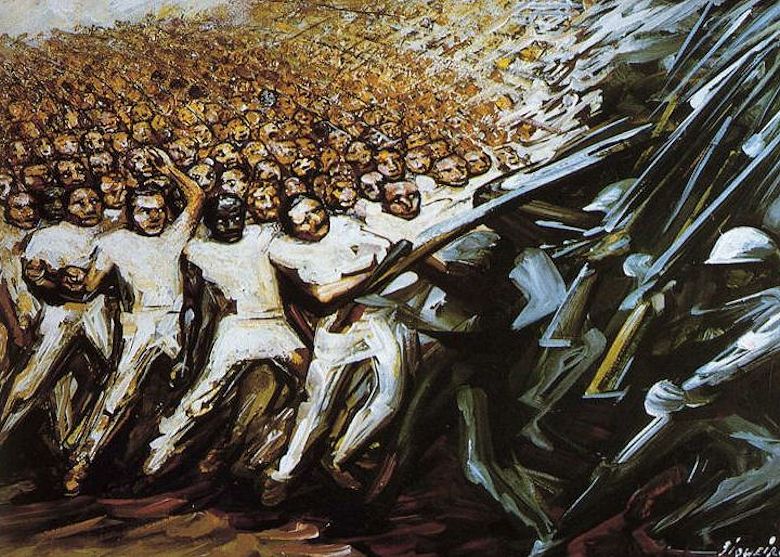
David Alfaro Siqueiros - Lucha por la Emancipacio

Over the past 10 years or so Leon Trotsky’s idea of ‘uneven and combined development’ has gained considerable traction within the fields of International Relations (IR) and historical sociology. It has been critically and productively deployed or rethought to address a diverse group of international and sociological problematics ranging from anarchy, contingency, and eurocentrism to the rise of capitalism, premodern societies, and non-western modernities. Alex Anievas’s new book Capital, the State, and War: Class Conflict and Geopolitics in the Thirty Years’ Crisis, 1914-1945 is an extremely invaluable addition to this rich and growing body of scholarship on uneven and combined development.

Through a masterful deployment of uneven and combined development, Anievas provides a compelling alternative account of the two world wars that fundamentally challenges the existing polarized ‘internalist’ and ‘externalist’ modes of explanations. Weaving social, economic, (geo)political and ideological moments of the making of the ‘Thirty Years Crisis’ into a theoretically informed, historically grounded and empirically rich account Capital, the State, and War is a tour de force for anyone interested in Marxist historiography of the World Wars and the rise and demise of the twentieth century world order.

As someone who’s also contributed to the literature on uneven and combined development I’m particularly interested in Anievas’s explicit discussion of the precise relation of the idea of uneven and combined development to historical materialism in Capital, the State, and War. Explicit interrogations of this relation have been relatively neglected in much of the publications on uneven and combined development. As a leading Marxist thinker and political activist Trotsky himself saw his idea of uneven and combined development as simply derivative of Marxist dialectics and materialist conception of history and as such did not seem to have believed that the idea had any transformative implications for materialist conceptions of history.

Continue reading

Capital, the State, and War: Reflections of a Codger

A guest post from Mark Rupert, the second reply in our symposium discussing Alex Anievas’ Capital, the State, and War: Class Conflict and Geopolitics in Thirty Years’ Crisis, 1914-1945. Mark is Professor of Political Science at Syracuse University and the author of three books: Producing Hegemony: The Politics of Mass Production and American Global Power (1995), Ideologies of Globalization: Contending Visions of a New World Order (2000) and Globalization and International Political Economy (2006, with Scott Solomon). His recent papers focus principally on the politics of the far right.


I’ve been following Alex Anievas’ project for a while. Now that it’s come to fruition in this book, I find myself both delighted and saddened. I’m delighted to see that Alex has produced such a superb book, perhaps as close as any I’ve seen to realizing the potential of an historical materialist approach to IR. I’m also saddened that the book arrives in an intellectual context – some thirty years after the project of critical IR was launched – in which critical approaches to IR-IPE have been largely neutered or marginalized, at least in the US academic community where I work. I congratulate Alex on his achievement. I thank him for all I have learned from his work. But I fear that the role of IR theory as ideology, and the sociology of knowledge so powerfully operative within the still-dominant US wing of the profession, mean that this book might have the ability to convince but it will not win (if I may appropriate and invert the courageous words of Miguel de Unamuno).

This book takes direct aim at the very foundations of IR theory, laid down in attempts to understand the great crises of the early twentieth century. Much of our intellectual discipline, as well as the 20th century world, was constructed in this epic conjuncture. Deploying a theory of uneven and combined development, Alex re-narrates it well. The intersection of various temporalities of capitalist development – the “whip of external necessity,” the “privilege of historical backwardness,” and the “contradictions of sociological amalgamation” – play crucial roles in his analyses of 1914, Wilsonian statecraft, the rise of Nazi Germany, and the so-called policy of “appeasement”. His command of the relevant bodies of scholarship is deeply impressive (the bibliography alone would make this book worth buying). And at the end of the book I find myself largely convinced that this formative era cannot be understood without a relational, historical, and dialectical conceptual apparatus such as the one Alex deploys, and that a quest for parsimonious covering laws based on hyper-abstracted “levels of analysis” is an analytical trap that has radically decontextualized and dehistoricized prevailing modes of IR scholarship.

Continue reading

Capital, the State and War: The Risks of Method

CraigA forum contribution from Campbell Craig, the first in our series responding to Alex Anievas’ new book, Capital, the State and War. Campbell is Professor in International Politics at Aberystwyth University, and the author of several books, including Glimmer of a New Leviathan: Total War in the thought of Niebuhr, Morgenthau and Waltz (2003), The Atomic Bomb and the Origins of the Cold War (2008, with Sergey Radchenko), and more recently America’s Cold War: the Politics of Insecurity (2012, with Fredrik Logevall). Campbell’s work has appeared in World Politics, Ethics & International Affairs and the Review of International Studies. He is also currently finishing an article on the nuclear revolution and neo-Trotskyism.


Woodrow Wilson 17c Stamp

In 1959 Kenneth Waltz published Man, the State and War, a study of three different levels of analysing international relations and their attempts to answer the question why war recurs. Waltz tackled his subject by demonstrating how the two most common levels of analysis – human nature, and regime type – ran into insuperable logical obstacles, and especially the problem of reductionism that social theorists such as Durkheim and Lakatos identified. His solution was to posit a third level – anarchy, or, as his title suggested, war – that could explain the recurrence of war without succumbing to the reductionist fallacy. The result was a study that has shaped the field of modern international relations more than any other single volume.

Anievas, as the title suggests, seeks to build upon Waltz’s ambition in his new book. He argues that the Marxian theory of uneven and combined development (UCD), a concept invented by Trotsky which explains international conflict by pointing to the uneven economic competition among more and less developed states whose economies are intertwined, can be used to theorise contemporary IR. This is a project being undertaken by other scholars, most notably Justin Rosenberg, but Anievas’s book is the most ambitious and thorough attempt yet to deploy Trotsky’s idea in a systematic way. However, Anievas’s method is quite different from the one used by Waltz (and Rosenberg). Rather than developing a logical or epistemological case for UCD, Anievas tries to use it as a means of shaping a detailed historical explanation of the two world wars of the twentieth century. What he is trying to do, as far as I can see, is to use UCD as a tool to explain and revise a key historical problem, as theorists in other schools of IR have done, rather than put forward an abstract case for the theory in the first place—a necessary move, for Anievas, because extant work on UCD suffers from “unsustainably high levels of analytical abstraction” (57). He concludes that the pressures of UCD upon capitalist states (particularly Germany, Great Britain, and the US) effectively explain the two world wars, and that they paved the way for a ‘proto-Cold War’ between the West and the USSR that began basically with the formation of the Soviet state in 1917.

In many ways the book is an impressive work. The narrative chapters on German, British, and American foreign relations are rich with historical detail and focused, often polemical argumentation. The engagement with competing theories is intensive and Anievas’s mastery of the debates among the neo-Marxian left is evident. Yet I was in the end not convinced by some of the main historical claims of the book nor by the method Anievas has deployed. In the spirit of Anievas’s blend of historical and theoretical inquiry, I will now present two critiques of the work from the respective points of view of the historian and the IR theorist.

Continue reading

Capital, The State and War: Rethinking the Geopolitics of Capitalist Modernity in the Era of the Two World Wars

A guest post from Alex Anievas to inaugurate a brief symposium on his book anievasCapital, the State, and War: Class Conflict and Geopolitics in Thirty Years’ Crisis, 1914-1945 (Michigan University Press, 2014), which will unfold over the next few days. Alex is a Leverhume Early Career Researcher at the Department of Politics and International Studies at the University of Cambridge. He is editor or co-editor of numerous books (including Race and Racism in International Relations and The Longue Durée of the Far-Right, both of which have previously previewed at The Disorder). His work has also appeared in the European Journal of International Relations, the Cambridge Review of International Affairs, Millennium and the Review of International Studies.


The manuscript that would become Capital, the State, and War: Class Conflicts and Geopolitics in the Thirty Years’ Crisis, 1914-1945 developed, like so many first books, out of my PhD thesis[1] In its final form, Capital, the State, and War endeavours to offer nothing less than a systematic and radical reinterpretation and historical sociological reconceptualisation of some of the main geopolitical and socioeconomic fault-lines of the 1914-1945 period. It does so through the theoretical prism of uneven and combined development, demonstrating in the process the various problems with extant historiographical interpretations and IR theorisations of this crucial epoch in the development and remaking of modern world politics. But given the rather substantial differences between what I had originally envisioned the PhD thesis to be and what it became, it’s worth briefly discussing the origins of the project and how it changed in the process of researching and writing it.

I. Origins

My PhD project was originally conceived as an intervention into the contemporary debates on the ‘resurgence’ of US imperialism in the wake of the wars in Afghanistan and Iraq – very much a radicalising moment in my own intellectual and political trajectory – and the concomitant return to Marxist theories of imperialism and empire. My aim then was to essentially rethink and ‘update’ the classical Marxist theories of imperialism and, in particular, Lenin and Bukharin’s theory of inter-imperial rivalry which, whatever its faults, still captured an essential aspect of contemporary imperialism. I was then heavily influenced by a number recent Marxist works on imperialism, particularly David Harvey’s 2003 The New Imperialism (along with his earlier, more theoretically sophisticated The Limits to Capital) and Alex Callinicos’ The New Mandarins of American Power.

Both studies, in their different ways, sought to retain the fundamental insights of the classical Marxist theories of imperialism (e.g. the persistence of historically-differentiated forms of inter-imperial rivalries rooted within the inherently competitive dynamics of capital accumulation), whilst dispensing with their more economically determinist and instrumentalist features. They did so, in particular, by reconceptualising imperialism as the intersection of two analytically distinct, but historically interconnected, ‘capitalist’ and ‘territorial’ logics of economic and geopolitical competition. While critical of certain aspects of this kind of approach – particularly, Harvey and Callinicos’ relatively undigested incorporation of a ‘proto-realist’ conception of ‘the international’ – my initial thought was that, if rooted in a stronger conception of the spatio-temporal dynamics of capitalist development and expansion that produced the somewhat porous but nonetheless identifiable ‘territorial logic of power’ – regionality – inherently arising out of the processes of capital accumulation in space and time, this perspective could provide a more adequate historical materialist theory of geopolitics.[2] At this stage in the development of the project, this is how I originally envisaged the role of Trotsky’s concept of ‘uneven and combined development’ – a kind of supplementary theory that could be employed in capturing the spatio-temporal dynamics of capitalist development in reconstructing a modified Marxist theory of imperialism. Add in a more attentive focus to the relations between capitalists and state managers and the role of ideology in structuring foreign policymaking processes and I thought this would do.

Continue reading

Why Torture When Torture Does Not Work? Orientalism, Anti-Blackness and the Persistence of White Terror

A guest post from Melanie Richter-Montpetit, responding to the disclosure of the Senate Torture Report in December. Melanie is currently lecturer in international security at the University of Sussex, having recently gained her PhD from York University in Toronto. Her work on issues of subjectivity, belonging and political violence has also been published in Security Dialogue and the International Feminist Journal of Politics.


a land on which no slave can breathe.

– Frederick Douglass (1846)[i]

I had to leave; I needed to be in a place where I could breathe and not feel someone’s hand on my throat.

– James Baldwin (1977)[ii]

I can’t breathe.

– Eric Garner (2014)

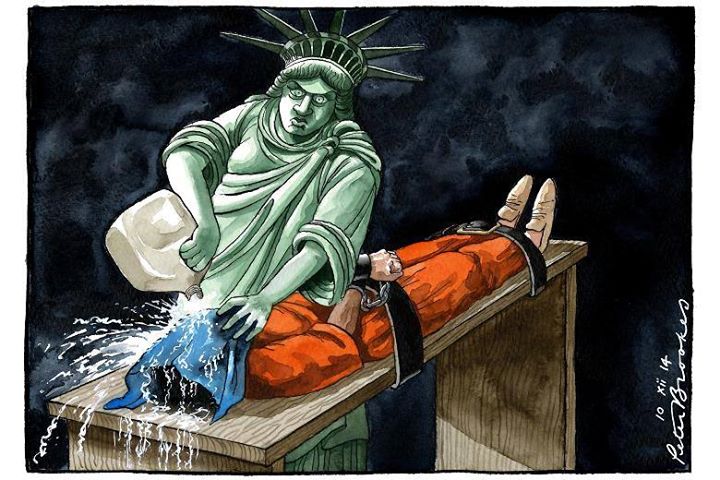
 America Waterboards

No, bin Laden was not found because of CIA torture.[iii] In fact, the US Senate’s official investigation into the CIA’s post-9/11 Detention and Interrogation program concludes that torture yielded not a single documented case of “actionable intelligence.” If anything, the Senate Torture Report[iv] – based on the review of more than six million pages of CIA material, including operational cables, intelligence reports, internal memoranda and emails, briefing materials, interview transcripts, contracts, and other records – shows that the administration of torture has led to blowbacks due to false intelligence and disrupted relationships with prisoners who cooperated. What went “wrong”? How is it possible that despite the enormous efforts and resources invested in the CIA-led global torture regime, including the careful guidance and support by psychologists[v] and medical doctors, that the post-9/11 detention and interrogation program failed to produce a single case of actionable data? Well, contrary to the commonsense understanding of torture as a form of information-gathering, confessions made under the influence of torture produce notoriously unreliable data, and the overwhelming majority of interrogation experts and studies oppose the collection of intelligence via the use of torture. This is because most people are willing to say anything to stop the pain or to avoid getting killed and/or are simply unable to remember accurate information owing to exhaustion and trauma.[vi]

So if torture is known not work, how come, then, that in the wake of 9/11 the U.S. at the highest levels of government ran the risk of setting up a torture regime in violation of international and domestic law? Why alienate international support and exacerbate resentments against “America” with the public display of controversial incarceration practices, as in Guantánamo Bay, instead of simply relying on the existing system of secret renditions? Furthermore, in the words of a former head of interrogations at Guantánamo Bay, most of the tortured and indefinitely detained are “Mickey Mouse” prisoners,[vii] reportedly known not to be involved in or not to have any information on criminal or terrorist activity against the U.S. and its allies. Drawing on previously published work, I will explore this puzzle by addressing two key questions: What is the value of these carceral practices when they do not produce actionable intelligence? And, what are some of the affective and material economies involved in making these absurd and seemingly counterproductive carceral practices possible and desirable as technologies of security in the post-9/11 Counterterrorism efforts?

Against the exceptionalism[viii] of conceiving of these violences as “cruel and unusual,” “abuse” or “human rights violations”[ix] that indicate a return to “medieval” methods of punishment, the post-9/11 US torture regime speaks to the constitutive role of certain racial-sexual violences in the production of the US social formation. Contrary to understandings of 9/11 and the authorization of the torture regime as a watershed moment in U.S. history “destroying the soul of America,”[x] the carceral security or pacification practices documented in the Senate Torture Report and their underpinning racial-sexual grammars of legitimate violence and suffering have played a fundamental role in the making of the US state and nation since the early days of settlement.[xi] The CIA Detention and Interrogation program[xii] targeting Muslimified subjects and populations was not only shaped by the gendered racial-sexual grammars of Orientalism, but – as has been less explored in IR[xiii]is informed also by grammars of anti-Blackness, the capture and enslavement of Africans and the concomitant production of the figure of the Black body as the site of enslaveability and openness to gratuitous violence.[xiv]

Continue reading

#BlackLivesMatter, The New Black Liberation Movement

Maia PalA guest post from Maïa Pal, recently returned from San Francisco. Maïa is currently a Lecturer in International Relations at Oxford Brookes University. Her main research is on the historical sociology of extraterritorial jurisdiction and Marxist theories of international law. She also researches UK student occupations as counter-conduct in the context of a political economy of higher education, and has blogged on student protests in the UK and Québec. And you can follow her on Twitter too.


Photo by Amanda Arkansassy Harris

Photo by Amanda Arkansassy Harris

After all, if someone is lost, and that person is not someone, then what and where is the loss, and how does mourning take place?

10 years after Judith Butler asked this question in her work Precarious Life, San Francisco organisers Thea Matthews, aged 27 and Etecia Brown, aged 24, gave me some answers.[1] ‘Leaderful’, ‘sustainable’, ‘multidimensional’: “BlackLivesMatter is more than a hashtag, logo or slogan, it’s a lifestyle.” Their demands against police brutality are practical, short-term and realistic. The demands consist of ensuring enforcement, transparency, mental health awareness in training, demilitarisation, two-way accountability, and community work. ‘Police should be like fire-fighters, heroes with red trucks!’, we chuckled.

Some of these demands are already being implemented; in Portland, New York, Richmond. As public policy solutions they could be quickly put in place. Nevertheless, it is absolutely clear that such goals, however important and at the core of the movement, barely scratch the surface of the problem. BlackLivesMatter activists want to achieve long-lasting institutional change and an end to the more covert social, political and economic subjugation of black people. They explicitly revive the terms of colonisation and slavery because these do not belong to the past; an experience both organisers have observed and lived through personally. Without equal access to education, jobs, and political representation; with lower life expectancy, socially and in front of a police gun; with mental health conditions, fear and loss of hope in their humanity, black people are still in chains.

The point here is not to engage a discussion on the history and intricate forms of these processes of exploitation, white supremacy and patriarchy. Although necessary and important, this piece discusses instead resistance to these processes, and specifically to what these organisers aptly described as ‘psychological warfare’. This resistance means healing people who are suffering, have lost all power and hope for resisting, and building communities that care for each other beyond the myths of freedom, property and consumerism.

Continue reading

Between Innocence and Deconstruction: Rethinking Political Solidarity

The third and final post in our short resilience and solidarity forum, this time from Chris Rossdale. Chris lectures in International Relations at Royal Holloway, University of London. His research focuses on anti-militarist social movements and radical political theory. He has also recently edited a special issue of Globalizations on radical political subjectivities, his own contribution exploring the relationship between Emma Goldman and Friedrich Nietzsche through the concept of dance. He can be reached by email thusly.


The ethos of solidarity remains one of the left’s most powerful and enduring ideas, a clarion call for collective struggle in the face of international borders and neoliberal individualism. At the time of writing, my social media feeds are awash with calls for solidarity with Ferguson; thousands also turned out to a solidarity protest at the US embassy. Last week I attended a solidarity fundraiser for the Kurdish Red Crescent, took part in an action organised to coincide with UN International Day of Solidarity with the Palestinian People, and circulated a petition in solidarity with students who experienced police violence at the University of Warwick. Rarely a day passes at present without some fresh discussion about the particular politics involved in different forms of solidarity with those suffering from the outbreak of Ebola. Across different modes, the practice of solidarity is a part of our everyday political conduct.

Rossdale_pic1

Protestors march after gathering outside the American Embassy in London November 26, 2014, to show solidarity with the family of black teenager Michael Brown who was shot and killed by a police officer in August in Missouri. REUTERS/Paul Hackett

On the one hand, this is clearly a good thing, enabling common political, financial and emotional resources to be shared in important and useful ways. Distance, whether spatial or cultural, can be an alienating force, and practices of solidarity can serve as a powerful redress to such alienation, asserting collectivity and community in the face of division. In this piece, however, my intention is to outline a critique of much of what passes for solidarity, and suggest that more radical or deconstructive understandings are needed if we wish to produce more substantive challenges to political domination.

The particular practices of solidarity I have in mind are those which occur in those contexts (which are many) in which the imbalance of power directly privileges, at least in some forms, one party over another – whether this is in the context of cis-male solidarity in feminist projects, citizen solidarity in migrant and refugee struggles, or, the particular case study I discuss below, Jewish-Israeli solidarity with Palestinians. Continue reading

Governing Through Resilience: Implications for Solidarity and Political Action

The second guest post in our solidarity and resilience forum, this time from Tudor Vilcan. Tudor is a doctoral candidate at the University of Southampton. He seeks to critically investigate how discourses of resilience are put to use as ways to govern society. He is also interested in complexity theories, new materialism and critiques of neoliberalism.


This contribution represents a sum of reflections about solidarity and political action in the context of resilience policies based on a presentation given at the Political Action, Resilience and Solidarity Workshop organized at King’s College London in September 2014. I suggest that there is room to think about political action and solidarity in the context of resilience policies. Political action and solidarity are developed through encouraging individuals and communities to take ownership of their own risk management and build generic adaptive capacities. I argue that the meaning of political action and solidarity is changed in this context, as it provides a localized social engagement that at the same time evacuates political concerns from consideration. For resilience policies to succeed in properly connecting with individuals and communities, they need to find a level of engagement that is not just social, but also political.

Vilcan_pic1

Resilience has become an important idea, especially in the last few years. It has been developed and applied in the context of the environment, threats and hazards, development or thinking about change. More importantly, it has started to make its way into policy making, becoming one way in which society can be governed. At its core, resilience proposes to be a property or capacity of groups, communities or societies to cope with disruptions and still maintain their basic functions.

There is an acute absence of contributions that seek to draw links between resilience on one side and political action and solidarity on the other. This might be because we are told that resilience is about the strengthening of society as a whole to better tolerate shocks and rebuild if necessary. It appears to go beyond concerns with formal politics and deliver a model for governing society that is more appropriate to the interdependent and complex world in which we are living. Such a model emphasizes the need for connections, diversity, broadened participation or devolved governance. It signals a move away from the centralized approaches to policy making to emphasize that society must be seen as a large array of networks, systems and critical infrastructures whose disruption or failure can have catastrophic domino effects. When resilience is conceptualized in such way, political action and solidarity can be seen to represent atavisms of a time when static, concrete political and social categories were popular. In today’s complex and fluid world, they don’t appear to have the same purchase.

Continue reading

Why We’re Not Ditching Resilience Yet…

A guest post in our resilience and solidarity symposium from Rhys Kelly and Ute Kelly. Rhys is a Lecturer in Conflict Resolution at the Division of Peace Studies, University of Bradford. His work currently focuses on the pressing challenges posed by ecological crises (including climate change) and resource depletion (including ‘peak oil’). Retaining a long-standing interest in (peace) education, Rhys’ work is now broadly concerned with investigating what kinds of individual and social learning are needed and possible in the context of increasing global insecurity, which might support just and peaceful transitions to more resilient, ‘sustainable’ communities. Ute is a Lecturer in Peace Studies at the University of Bradford. Her current research interests arise from the intersection of two areas that she has been interested in – the theory and practice of participatory engagement processes (particularly dialogue and deliberation), and the emerging interdisciplinary field of social-ecological resilience. Ute is interested in exploring the communicative and collaborative dimensions of resilience, the relationships between people and the places in which they find themselves, and approaches to enhancing resilience at different levels and in a range of contexts. She also teaches a module on ‘Peace, Ecology and Resilience’ within the BA in Peace Studies, encouraging students to explore the meanings, uses and limitations of ‘resilience’. Rhys and Ute are jointly engaged in exploring the meanings of ‘resilience’ on the ground, particularly for people who have been trying to engage with the converging ecological, economic and energy crises facing us today. Relevant recent joint publications include ‘An Education in Homecoming: Peace Education as the pursuit of Appropriate Knowledge’Journal of Peace Education (2013); and ‘Towards Peaceful Adaptation? Reflections on the purpose, scope, and practice of peace studies in the 21st Century’, Peace Studies Journal (2013).


Those who responded:
engaged with resilience,
thoughtfully active.

‘I want you’, she said,
‘to ditch ‘resilience’ now’.
How, then, to resist?

Part of a sequence of haikus about ‘10 days in September 14’ for a collective zine, these two fragments are an attempt to convey Ute’s experience of the workshop on ‘Political Action, Solidarity and Resilience’. The first tried to describe the people who responded to a survey we had created to gather reflections on ‘resilience’.[i] The responses to our survey were thoughtful and reflective, and most came from people who are critical of the status quo and trying to respond to a set of crises that includes climate change and the degradation of ecosystems, energy depletion, austerity, conflict, inequality and injustice. Interestingly, many of our respondents appreciated the opportunity to reflect on their own understandings of ‘resilience’, on the contexts in which they had seen the concept appear, and on its strengths and limitations.

Kelly_pic1

The second haiku poses a question that emerged from some of the discussions at the workshop itself – in particular, a tendency on the part of some of the contributors to dismiss the idea that ‘resilience’ might be a helpful concept, to conflate a focus on ‘resilience’ with neoliberal agendas, and/or to construct ‘resilience’ and ‘resistance’ as mutually exclusive concepts.

Such a construction, we feel, is too narrow, too caught up in looking at how ‘resilience’ has been used in some (not all) academic and policy discourses, and too dismissive of genuine attempts to grapple with ‘the fragility of things’, with a real sense of converging crises. Continue reading