Solidarity with Academics for Peace: An Open Letter

Academic freedom and freedom for political dissent is under serious threat in Turkey. Following the publication of a statement signed by Turkish and Kurdish academics, condemning Turkish state violence against Kurds, 1,128 of the original signatories have been subjected to sustained attacks and threats from the Turkish state and fascist groups.

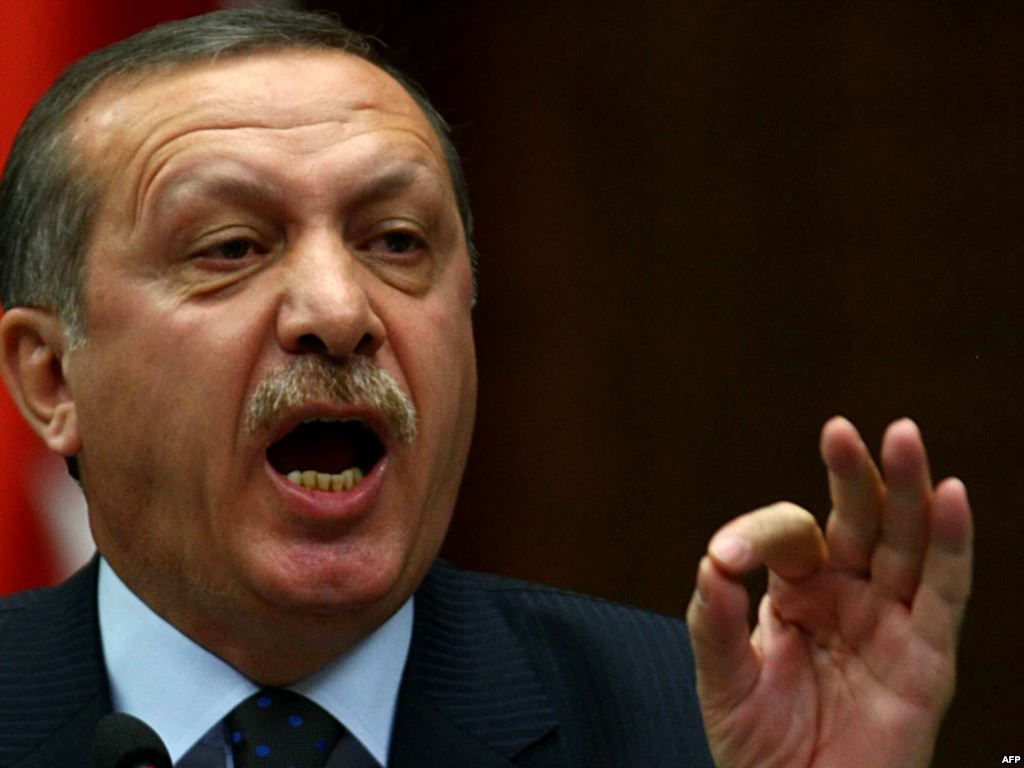
Erdogan

The Disorder of Things is proud to publish the following letter, signed by 1,211 academics, offering international support of those facing persecution in Turkey. This letter follows multiple statements criticising the Turkish state from research bodies and associations including, within the field of International Relations, ISA, EISA and BISA.

This is one of many such letters of international support for academics in Turkey. A comprehensive collection can be found here.

Continue reading

Arab Political Thought After 2011 (Lines of Inquiry for a Research Agenda)

A guest post – on the eve of the 5th anniversary of the Egyptian uprising – by Michaelle Browers. Michaelle is Associate Professor of Politics and International Affairs and directs the Middle East and South Asia Studies Program at Wake Forest University. She is author of Democracy and Civil Society in Arab Political Thought: Transcultural Possibilities (Syracuse University Press, 2006) and Political Ideology in the Arab World: Accommodation and Transformation (Cambridge University Press, 2009), and has edited and contributed to (with Charles Kurzman) An Islamic Reformation? (Rowman and Littlefield, 2003). Her articles have appeared in the International Journal of Middle East Studies, Journal of Middle East Women’s Studies, Journal of Political Ideologies, Critical Review of Social and Political Philosophy, Theory and Event, and Third World Quarterly. An earlier version of this memo was prepared and presented at working group on “Re-envisioning the Arab State,” hosted by the Center for International and Regional Studies (CIRS) at the Georgetown University’s School of Foreign Service in Doha, Qatar (January 17-18, 2016).


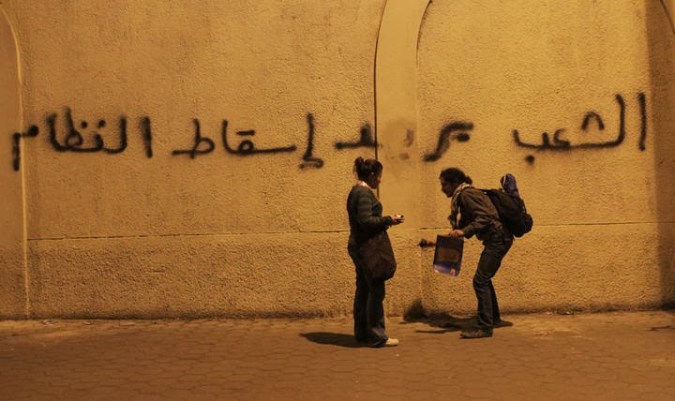
Browers - Cairo Graffiti

The past five years has been a series of ups and downs, trading moments of great elation and hope with periods of deep disappointment for those of us who study Arab political thought and practice. We have seen declarations of Arab springs and Arab winters, and claims about the resilience, the end and again the resilience of Arab authoritarianism. We have seen people in the streets and squares of many cities call for justice, dignity, democracy, rights, revolutions – ideas that many Arab intellectuals have written about at great length and mourned for their lack – and heard commentators claim Arab intellectuals were absent from the uprisings or, as Ramzy Baroud put it, “resting, not dead.” In general, we have seen much in the way of claims of a lack of intellectual work or a lack of alternative visions to the status quo. I contend that the real lack is a full investigation of whether, in fact, such claims have merit—that is, that there is a need for research into political thought that assumes its existence rather than its absence.

But in engaging post-2011 “Arab political thought” we may need to revise some of our assumptions about what it is we seek at the outset. This intervention puts forth four subsets of questions in need of further discussion as we broach that larger question (of how we should study Arab political thought after the 2011 uprisings): one which raises an old question worth reconsidering anew, a second which suggests a different approach to our study, a third which maintains the need to look for answers in a slightly different place or with a broader lens, and a fourth which proposes one substantive line of theorizing that strikes me as politically salient after 2011. Embedded in each of these four broad question-sets are myriad avenues of research, as well as, of course, indications of some of my own convictions and commitments.

Continue reading

The Weight of a Man’s Shoe

The third and final piece in a short series on naming and disciplinary representation. Marysia Zalewski is Professor in the School of Social Science at the University of Aberdeen, where she was previously Head of School and Director of Research. Marysia is the author of many text, most recently Feminist International Relations: Exquisite Corpse (Routledge, 2013), and before that Feminism After Postmodernism: Theorising Through Practice (Routledge, 2000) and (edited with Jane Parpart) The “Man” Question in International Relations (Westview, 1998) and Re-thinking the Man Question: Sex, Gender and Violence in International Relations (Zed Press, 2008).


I don’t usually work with definitions of feminism as they so often wrap feminism up too tightly. But this one offers a lot of openings: ‘Feminist theory is one of the ways in which feminism tries to challenge misogyny’s history and refuse its inheritance’ (Morris 1987: 176). I know misogyny isn’t a very comfortable word and not used much contemporarily, but there is something about the idea of challenging work (thinking, ideas, beliefs) which nurture misogyny and its close relations (e.g. sexism), and perhaps more, refusing its inheritance, the trails of which we so consistently witness personally, intellectually, emotionally and politically.

Refusing damaging historical, philosophical and disciplinary inheritances is something that was at the heart of the disquiet at an event planned for the EISA conference in Sicily in September 2015. What was planned was the naming of some of the panel rooms (attaching name plates to doors) after scholars deemed fundamentally important to the founding of the discipline: 18 names in total. All white, all men, all dead. The absence of women in such a list proffers symbolic injury of course; as delegates trooped in and out of panel rooms, constantly being reminded, if subtly, like a ‘casual reminder’ (el Malik, 2015) that the ‘world of international studies’ still belongs to (white) men, even the dead ones. And it’s not as if the spectre of ‘all white/male line-ups’ hadn’t been of serious concern in the year previous to the EISA conference in two of the other professional organisations associated with academic theorising of the international. This was detailed in a letter prepared to send to the EISA organising committee by a group of students and scholars to protest the planned ‘naming event’:

  • The February 2015 International Studies Association annual convention was criticised for the almost complete absence of non-white scholars, and the scarcity of female scholars in its Sapphire Series meant to showcase contemporary International Relations.
  • The April 2015 Political Studies Association annual conference starred an all-male keynote speaker line-up. The Association has since decided to ensure their 2016 conference would have an all-female keynote speaker line-up.

It seems it is still far too easy to readily remember and showcase the already and always remembered, revered and honoured, as Saara Särmä’s ‘All-Male Panels’ tumblr strikingly and creatively illustrates.

Continue reading

“Mansplaining to the Max” or “Know Your Place!”: On How Disciplines Discipline and Police

The second post in a short series on naming and representation in IR spaces. Here Saara Särmä and Cai Wilkinson respond to Knud Erik Jørgensen. Saara is a feminist, scholar and artist. She is the co-founder of the Feminist think tank Hattu and the creator of “Congrats, you have an all male panel!“, “Congrats, you have an all white panel!“, and “Congrats, you did not cite any feminists!“. Cai is Senior Lecturer in International Relations at Deakin University, and has written widely on securitization, international politics in Central Asia and the use of interpretive ethnographic methods in Critical Security Studies. Both Saara and Cai have contributed to The Disorder before.


Knud Erik Jørgensen’s post responding to criticism of the naming of rooms at the EISA conference in September and explaining his rationale does not exactly invite engagement. Indeed, it seems designed to dismiss and silence, the implicit message being that we should know our place in IR and defer to our elders and (by mainstream standards, at least) betters. Feminists, it turns out, might occasionally be seen, but should still not be heard. Nevertheless, we felt that a response is in order.

Our criticism of the all male room decision is, indeed, about issues that are of much more significance than 18 of 32 meeting rooms in Sicily. We share a concern with Jørgensen about the future of IR; we all want to make IR a better place. Why on Earth would we have stayed in IR in the first place, if we didn’t? That’s why we expect more and urge all of us to do better. No-one is perfect and fuck-ups are inevitable. However, this should not prevent us from speaking out when things go wrong. It is axiomatic that we should seek to learn from our mistakes, but this can only happen if we are able to take in criticism and admit responsibility in ways that are productive and open for further engagement, rather than reacting defensively. This is rarely easy.

As the former president of EISA who decided to name the 18 rooms, Jørgensen writes from a position of power. Yet rather than acknowledging his role, he misrepresents what happened by leaving out crucial details about the issue. He purports to be responding to only Särmä and Wilkinson, omitting the fact that there was a letter from BISA Gendering International Relations Working Group, signed by 77 people sent to the EISA board, and that an official reply from the new Executive Committee of EISA acknowledged that the decision to name the rooms was a mistake and lay responsibility in Jørgensen’s hands.

Continue reading

What’s In A Name?

A guest post from Knud Erik Jørgensen. Knud Erik is Professor of Political Science at Aarhus University and the author of many works on European foreign policy, the European Union and European IR theory. He is also former Chair of the ECPR Standing Group on International Relations (2010-2013) and current President of the Governing Council of the European International Studies Association (EISA). This is the first in a short series on naming, representation and power in the discipline of IR.


In a Duck of Minerva blogpost about the 9th Pan-European Conference on International Relations, Cai Wilkinson got most things wrong and three things right. Regarding the latter, the conference and section chairs did indeed manage to produce the probably most diverse programme in the world and they have rightly been highly praised for this accomplishment. I can therefore imagine it took Saara Särmä, the Tumblr artist/activist and admirer of David Hasselhoff a really long search to find something to admonish but then, finally, in a moment of triumph, she spotted 18 of the 32 meeting rooms. Second, greater diversity in organisational structures does not necessarily result in a different politics. This is probably correct but does not demonstrate much insight into policy-making processes within associations or address the issue why one would expect that greater diversity in governance structures would produce a politics that is favoured by Wilkinson. Third, diversity does not just exist along a single axis and the naming of rooms in Sicily illustrates neatly how multiple axes of diversity produce numerous encounters and compete for attention and space.


Wilkinson got most things wrong and therefore claims injury and insult. The rooms in question were not renamed but named. If Wilkinson had asked the organizing committee or for that matter attended the conference she could have learned that 18 converted guest rooms had numbers but got names. Room 5115 became Zimmern and room 5114 became Wolfers, etc. During the conference some panel rooms were unofficially renamed.

Continue reading

Economy of Force: A Reply

In which Patricia Owens responds to our four commentaries (on patriarchy, colonial counterinsurgency, biopolitics and social theory) on her Economy of Force.


I’m extremely grateful to Pablo K, Elke Schwarz, Jairus Grove, and Andrew Davenport for their serious engagements with Economy of ForceAs noted in the original post, the book is a new history and theory of counterinsurgency with what I think are significant implications for social, political and international thought. It is based on a study of late-colonial British military campaigns in Malaya and Kenya; the US war on Vietnam; and US-led campaigns in Afghanistan and Iraq against the background of the high colonial wars in the American Philippines and nineteenth-century French campaigns in Tonkin, Morocco and Algeria. Probably the emblematic case for the book is Britain’s colonial state terror against Kenya’s Land and Freedom Army and civilians in the 1950s, a campaign that was closer to annihilation than ‘rehabilitation’. Although the so-called ‘hearts and minds’ campaign in Malaya is held up by generations of counterinsurgents as the model for emulation, the assault on Kikuyu civilians shows the real face of Britain’s late-colonial wars. It also points to some profound truths about the so-called ‘population-centric’ character of more recent campaigns in Afghanistan and Iraq. Though offering new readings of some better-known counterinsurgency cases, Jairus Grove suggests that this choice perpetuates an erasure of America’s ‘Indian Wars’.

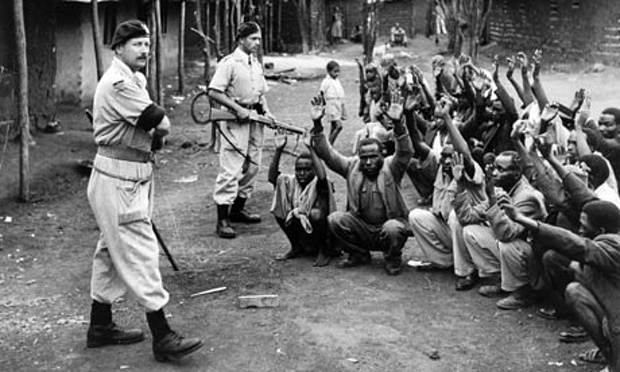
Mau-Mau

Researching Economy of Force, I certainly became aware of the general significance of these wars, including through Andrew J. Birtle’s and Laleh Khalili’s histories of counterinsurgency. However, Grove draws attention to something more relevant to Economy of Force than appreciated before: “one of the first federal bureaucracies with jurisdiction over the home and social issues”, he writes, “was created by and administered by the War Department”. Decades before the distinctly ‘social’ engineering during the Philippines campaign (1899-1902), the Bureau of Indian Affairs was administering indigenous populations on the mainland. In focusing on overseas imperial wars, Economy of Force surely neglects settler colonialism, its genocides, and how “warfare, pacification, and progressivism were an assemblage in the US context from the outset”. While the book was not centrally focussed on US state making, I’m grateful to Grove for insisting that settler colonialism is necessarily a form of counterinsurgency. To be sure, the Philippines campaign was examined not as the founding moment of American counterinsurgency, but because it was explicitly conceived by contemporaries as a form of overseas housekeeping; to problematize progressive social policy; and to challenge the effort to separate good (domestic) social engineering at home from bad social engineering (overseas). I would hesitate to wholly assimilate the Progressive Era (1890s-1920s) into earlier Indian Wars, though its ‘social reforms’ shaped indigenous administration. But these are quibbles. Grove is right that I have neglected something of significance in the ‘historical trajectory from Thanksgiving to Waziristan’. I hope to be able to rectify this in future work.

Continue reading

Critiquing the Social: Comments on Patricia Owens’ Economy of Force

The last commentary in our forum on Economy of Force, from Andrew Davenport. Andrew is Lecturer in International Politics at the University of Aberystwyth, where he works on International Theory, with particular emphasis on debates in Critical Theory, materialism and idealism, and modern social theory. He is the author most recently of ‘Marxism in IR: Condemned to a Realist Fate?’ in the European Journal of International Relations. Patricia’s rejoinder to the four commentaries (from Pablo, Jairus, Elke and Andrew) will follow tomorrow.


In the concluding section of Chapter Two of this book, Patricia Owens quotes Robert Nisbet to the effect that the essential concepts and perspectives of the sociological tradition “‘place it much closer to … philosophical conservatism’, than we might otherwise think.” A basic theme of the book is that it ought to be more clearly understood that prominent categories in the work of Durkheim, Weber and Marx – community, authority, alienation and status – are in fact just “conservative moral categories … but in scientific garb”.[1] The conservative character of sociology’s origins is in fact no secret. At much the same time as Nisbet was writing, Theodor Adorno also noted it: near the beginning of his introductory lectures on sociology, he emphasised that any assumption of an intrinsic connection between sociology and radical politics (that sociology = socialism) would be seriously mistaken: “if the concept of sociology is understood as it came into being, with the historical meaning it has, it can be said that the opposite is actually the case.” Sociology’s interest, from the start, was always the maintenance and preservation of the existing order, not its critique and change. What does the character of these origins mean for social theory? How should it affect or condition our understanding of social thinking and its basic concepts: precisely, ‘society’ and ‘the social’? Owens’ answer is unequivocal: it should lead to profound suspicion, if not outright rejection. Social thinking, from the start, contained a poison and its natural affinity to conservative thought, attitudes and practices is simply indicative of this noxious nature. Especially damaging in its consequences for IR theory, so the argument runs, has therefore been the unthinking naturalisation of ‘social’ terminology virtually across the spectrum, from statist Political Realism to Foucauldian biopolitics – as if society and the social were neutral terms that do not themselves colour or prejudice the discourse.

The language of ‘society’ is indeed widespread, and often perhaps unreflectively used, in IR, and so its critique is surely an important theoretical project. Not the least of the book’s merits is that it poses uncomfortable questions to critical theory about how far it is possible to adopt social thinking for purposes of critique. Owens directs some pointed remarks at Marxists, Foucauldians and other critical theorists for, in effect, supping with the devil, and in the chapters on counter-insurgency she marshals enough evidence of a ‘homology’ between social theory and imperial practices of counter-insurgency to give even the most committed sociologist pause. Further, in demonstrating that the emergence of distinctly social thinking was coeval with the development of capitalist society, there is at least the implication that those who would pursue critique of capital ought not to accept social categories at face value. Nevertheless, it seems to me that there are difficulties with the critique of the social elaborated in the book, both in how the argument is structured and with the categories employed, difficulties that lead to some of the work of critique remaining undone. As a result, the account of the social developed here, challenging and thought-provoking as it is, breaking new ground, nevertheless does not go as far as it might.

Continue reading

Economy of Force

We return from the holidays with gusto and a book symposium on Patricia Owens’ Economy of Force: Counterinsurgency and the Historical Rise of the Social (Cambridge, 2015). Patricia is Professor of International Relations at the University of Sussex, co-editor of European Journal of International Relations, and a former fellow of the Radcliffe Institute for Advanced Study at Harvard University and of Oriel College, Oxford. Patricia’s first book was Between War and Politics: International Relations and the thought of Hannah Arendt (Oxford, 2007). Economy of Force is in the Cambridge University Press series ‘Studies in International Relations’ and is out in paperback next summer (the introduction is available in full here). The book will also be the subject of a forthcoming special section of Security Dialogue.


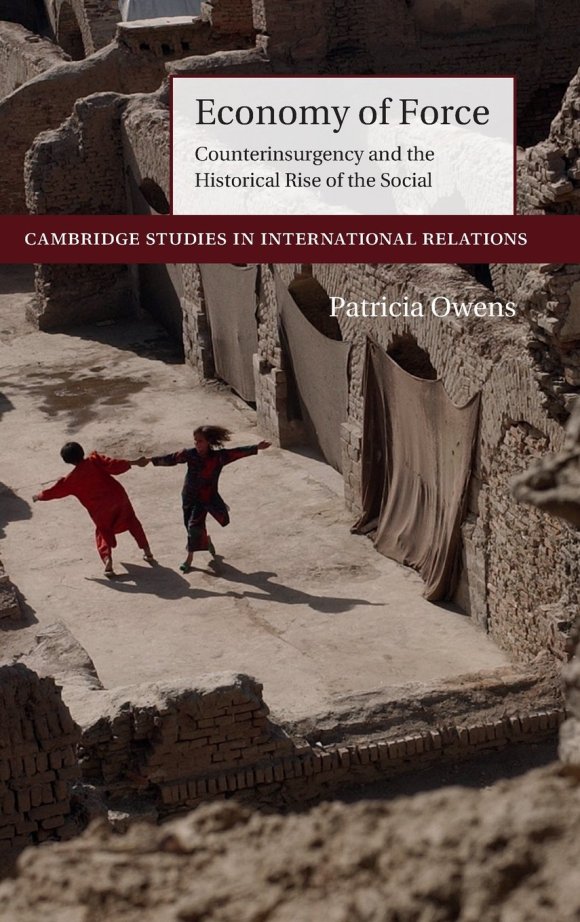
Economy of Force

Economy of Force seeks to rekindle interest in one of the oldest but neglected languages and techniques of government administration – household governance – that it uses to write a new history and theory of counterinsurgency with broad implications for social, political, and international thought. The book is a study of oikonomia in the use of force, from oikos, ancient Greek for household. But it also makes a larger claim, that household governance underlies the relatively recent rise of distinctly social forms of government and thought more broadly. Since the late eighteenth-century, modern, capitalist state and imperial administrators have drawn on and innovated different forms of household governance, scaling up and transforming the units of rule in which populations are domesticated. To really understand the significance of households-as-government we need to dispense with the relatively recent and bourgeois notion of households as houses, homes, or family-as-kin. Instead, households are best understood through the nature of the hierarchical relations between people in a particular spatial arrangement. Households are the persistent but historically variable spaces in which the life processes of members – real, vulnerable bodies needing food, water, shelter – are administered and the household itself is maintained.

There is a very long tradition of thinking of households-as-government in the history of political and economic thought and in anthropology, archeology and comparative studies of different household forms. There is also excellent and wide-ranging scholarship in literary and gender studies on practices and ideologies of domesticity (from domus, Latin for house). In drawing on and extending these and other literatures, Economy of Force suggests that there is a far deeper significance of households and forms of domesticity than captured in International Relations debates about the so-called ‘domestic analogy’. Household administration is highly portable and plays a remarkably significant role in imperial and international relations. These are grounds to make a stronger claim than one based on mere analogy. I argue that there is a domestic homology connecting different households, despite their historical and geographical variability, based on the genealogy of household governance in the history of social and political thought, but also the human experience of basic life necessities and the stubborn but contingent attempts to domesticate people through the administration and control of life needs.

Continue reading

There’s A Focus On The Boats Because The Sea Is Sexier Than The Land: A Reflection on the Centrality of the Boats in the Recent ‘Migration Crisis’

Pallister-Wilkins.Profile PictureA guest post from Polly Pallister-Wilkins, Assistant Professor in Political Science at the University of Amsterdam. Polly’s work broadly sits in the borderlands between International Relations, Critical Security Studies and Political Geography. More specifically she specialises in the intersection of humanitarian intervention and border control. Her current research is concerned with what she terms ‘humanitarian borderwork’ building on previous research into humanitarianism, border policing and the political sociologies of walls, fences and security barriers. Her regional areas of focus are the Mediterranean, specifically Greece, and the Middle East. She has been an assistant professor in the Department of Politics at the University of Amsterdam since 2012 after undertaking her doctoral research at SOAS, University of London. Recent work has appeared in International Political Sociology and Geopolitics. She is also the editor of a forthcoming forum in Mediterranean Politics on the ‘Migration Crisis’.
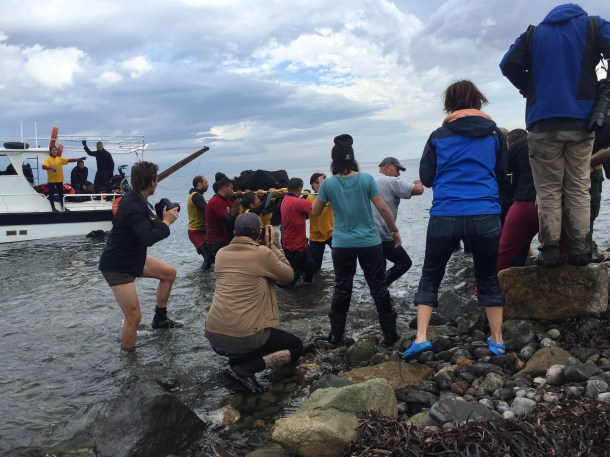

Lesvos boat landing, November 2015.Pallister-Wilkins

I grew up watching Baywatch. Saturday evenings were the highlight of my week. All that sun, sea, sand and heroics. This may account for my poor bastardisation—and for this I apologise—of Warsan Shire’s evocative verse. In addition I am not suggesting that all focus is on the boats that transport people and the sea they cross even as journeys and modes of travel become a central theme in border and mobility policing and the study thereof. I am labouring under artistic license here.

The appearance of search and rescue operations (SAR) in the Mediterranean and Aegean—beyond those undertaken continuously by commercial vessels and the daily routines of state coastguards—is, Cap Anamur aside, a relatively new phenomenon. The Migrant Offshore Aid Station (MOAS) was the first non-state actor to engage in humanitarian driven SAR in 2014, joined in 2015 by Médecins Sans Frontières (MSF) and later Seawatch in the southern Mediterranean. These actors are also present in the Aegean, a wholly different operating environment, with smaller SAR vessels, where they operate amongst a plethora of other groups and individuals focused on responding to the danger of the boat journeys of people on the move.

I have the utmost respect for those engaged in a range of practices that I call humanitarian borderwork. These humanitarian borderworkers, mostly volunteers, work tirelessly to alleviate the violence of a European border regime that makes safe and legal travel an impossibility for those seeking life. These people step in and step up to provide assistance for people on the move where Europe, its member states and its large-scale humanitarian organisations, so used to acting the sovereign and intervening elsewhere beyond the borders of Europe, have failed.

Continue reading

‘Once more unto the breach’ – On Hilary Benn and Fighting Wars with Words

IMG-20150308-WA0003 (3)A guest post from Nadya Ali. Nadya is a Teaching Fellow in Politics and IR at the University of Reading. Her thesis was written on the topic of UK counter-terrorism and it’s role in the governance of the domestic Muslim population. Her research interests include gendered understandings of political violence and postcolonial approaches in IR. She is also a convenor of the BISA Critical Studies on Terrorism Working Group.


Shadow Home Secretary Hilary Benn has emerged as the unlikely oratory hero through his speech to the House of Commons during the debate on whether to carry out airstrikes in Syria. It has been hailed as ‘extraordinary’ and as one “that will go down as one of the truly great speeches made in this House of Commons”. Benn has been described as ‘the mouse that roared’ and now even as a potential leadership candidate. The effusive coverage of the speech comes in the aftermath of the successful vote which enables the extension of British airstrikes targeting Islamic State (IS) from Iraq into Syria. Leaving aside the context of internal Labour party politics, Benn’s words have a resonance and political utility that extend far beyond the party. Despite the plaudits and unlike Shakespeare’s Henry V, Benn did not deliver a great speech but simply the right speech.

His dramatic moment in the House of Commons was the culmination of the successful move to, once more, mobilise British military capability as part of the ‘War on Terror’. According to one journalist the speech was written while the debate took place with Benn sitting on the front bench. This was no doubt intended as a compliment but it needn’t be: everything he said was could have been lifted out of the ‘War on Terror Handbook of Justifications to Fight Wars’, if indeed it existed. Since 9/11 Western leaders have deployed the same set of claims about particular actors, states and terrorist organisations to make the case for military interventions. Benn ticked all the relevant boxes; he talked suitably about the ‘fascist’ threat of IS, of ‘our values’ and the necessity to use further violence.

Continue reading