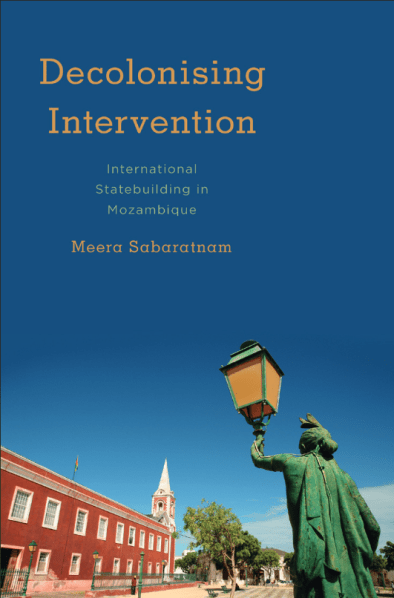
This guest post, from Marta Iñiguez de Heredia, is part of our symposium on Meera Sabaratnam’s Decolonising Intervention. Meera’s opening post is here. If tweeting, please use #DecolonisingIntervention! [Photo selection – LJ]
 Marta Iñiguez de Heredia is a Marie-Sklodowska Curie Fellow at the Institute Barcelonaof International Studies. She holds a PhD from the London School of Economics and Political Science (LSE). She has taught at the University of Cambridge, the LSE, Rouen Business School, Deakin University and La Trobe University. Her research concentrates on the historical sociology of peacebuilding processes, with a focus on the relationship between order, violence, state-making and resistance, and on Africa in particular. She draws on historical sociology, critical Africanist and practice literatures, as well as on extensive fieldwork. Current research is focused on EU’s peacebuilding policies, the militarisation of peacebuilding and political transitions through the emergence of African social movements.
In his opening chapter of The Invention of Africa, V.Y. Mudimbe states that a very basic question animating the book is “to what extent can one speak of an African knowledge, and in what sense?” (p.88) By unearthing what he calls African gnosis (“structured, common, and conventional knowledge”), Mudimbe seeks to explore the conditions of the possibility of knowing Africa otherwise; that is, outside the colonial library, that body of knowledge that keeps negating all that Africa is by constructing it as the ultimate other of Europe. What Mudimbe incisively captures is the politics of knowledge whereby, as Ngũgĩ wa Thiong’o puts it, “how we view ourselves, our environment even, is very much dependent on where we stand in relationship to imperialism in its colonial and neo-colonial stages.”
Decolonising Intervention theorises intervention from the perspective of relations of race and empire. Through the case of Mozambique, the global colonial structure of power is revealed not just in how interveners put in place programmes that debilitate state institutions, go to waste, or do not address actual material needs, but also in how the literature has theorised intervention so far. The “habit” of disregarding the historicity and politics of subjects and of thinking from the West is directly linked to how hierarchies of being and having are reproduced. Decolonising Intervention not only helps us looking at intervention in critical, decolonial ways, it also makes a crucial contribution to taking IR out of its colonial, Eurocentric origins and turning it into a critical tool for social change. This is all the more compelling due to the rich and nuanced theoretical framework it uses, by the detailed, impressive and thorough empirical research it draws upon, and by the refreshing writing style that makes the pages flow. Continue reading



 The Disorder Of Things