The Pay Strike And Its Discontents

Breaking Bad Pay Teachers More Money

The ballots are out, the wheels are in motion. Union members have until Thursday 10 October to vote on strike action over the latest derisory pay offer of 1% (if you haven’t received a ballot, go here). The justness of the cause seems clear enough. Since 2009, every pay award has been several percentage points below inflation, leading to a consistent real terms drop in pay. And some of those paltry increases were only attained after negotiations. Yet, despite the protests from above (and excepting a brief dip in student numbers), British higher education is in fine financial health. The overall wage bill is decreasing at the same time that surpluses are growing. And for “growing” read “more than doubling”, from £488 million in 2007/8 to £1.1 billion in 2011/2012. Managers are reaping their rewards accordingly, and a significant portion of Vice-Chancellors are seeing their pay go up by 10-20%. At Sussex, for example, Michael Farthing is now paid £280,000 (including pensions contributions), as compared to £178,000 in 2007 (that’ll be a 57% increase then).

And yet there is a foreboding. Fear is a factor, nondescript anxiety another. Perhaps an awkward sense that any level of action is somehow at odds with the academic code.

Articulated objections come in two stripes. First, the we-haven’t-got-it-so-bad defence. Beyond the usual ‘all in it together’ austerity ideology, there are pay increments (which most permanent academic staff get automatically). Real wages aren’t declining so hard if you move up a pay step each year. This is on its own a pretty restricted ambition, since it amounts to a kind of career “progression” that leaves you standing still. It is also, for all the talk of solidarity with lower-paid workers, a selfish analysis.

In the last 5 years, the pay for new lecturers and tutors has dropped 13% in real terms. Following the USS pension saga, they (we) have each had tens of thousands of pounds taken from them over the course of their careers, while staff that retained their old rights are paying more every month into a scheme that was, let us recall, nowhere near crisis. There are fewer scholarships and research grants than before, and an increase in teaching-heavy posts. Consumer-driven logics are set to make that worse. On the horizon, just over there, is a US-style expansion based on precarity, a prestige elite, and debt bubbles. Some at the top are already breaking from the national pay spine, inaugurating a two-tier system. Consider this trend alongside the state of university finances. What is it to look at this and say things aren’t so bad? I put it to you that such a position is detached, complacent, and irresponsible.

Second, there is the strikes-change-nothing complaint. This has better justification. Local actions over the last years have not reversed policies. Pensions were stripped down anyway. And there is something peculiar, isn’t there, about the idea of day-long walkouts and picket lines in a sector so based on relatively scattered student-teacher interactions. There is no machinery to fall silent, no buzzing shop floors to stand empty. Just a day of saved wages for management and probably a whole stack of reorganised lectures, academics not really being the types to withhold knowledge (or, rather, unwilling to see knowledge as labour). There is a sense that the old tactics are dead, and should be left in their graves.

On the one hand, this is an argument for more radical action. If employers can handle strike days, we need more. Or, alternatively, forms of action that do not fetishise the picket line. Something that will make VCs pay attention, like a marking boycott or withholding final grades. In a customer-orientated culture this is the pressure point, especially if action begins to alter the results of the National Student Survey, that Big Other of the academic scene (what do students really want?). The complaint goes up that the national union lacks the imagination to instigate these actions, and that we should therefore turn to more vibrant kinds of opposition. But new forms of resistance nevertheless confront established modes of punishment. When full pay is withheld day on day, when even partial performance leads to the forfeit of full wages, how quickly will we really buckle? We know something has to break the pattern, but we’re not sure we’re capable of it, or that the sacrifice is worth it. In other words, we find ourselves a little too close to text-book academic bitching: something more fundamental needs doing, but we’re not likely to be the ones to do it.

On the other hand, the fear and the paralysis can be found closer to home. Complaints about the union form do not produce their alternative ex nihilo. There are possible replacements, but no actually-existing ones. Nor does the appetite for creating one seem to exist. And for good reason. The paradoxical character of academic subjectivity is both to consider ourselves in a position of real epistemic and social privilege and to be so despondent about our influence on things as to merely absorb the changes thrust upon us (working conditions, impact agendas, research restrictions). The legal protections of strike action have no parallel, truncated as they are. Creative alternatives have raised energy, and served as political classrooms in their own right, but they haven’t actually stymied ‘reforms’ (whether on fees, outsourcing or investment portfolios). And, strange as it may sound, universities are probably happier taking draconian action against their workers than their students. A faculty occupation, if we could even imagine such a thing, would not end well.

None of that is to say that we (there’s that intangible collective again) should walk zombie-like to the picket. Fersure, let the rejuvenation of academic democracy proceed apace. In the meantime, we have to ask ourselves seriously what the consequence is of another pliant year. There are murmurings that a failure to win this ballot will endanger collective bargaining itself. If we cannot muster the resolve to deliver a strong yes on action short of a strike, and a strong yes on strike – if we cannot even deliver a serious turnout – that’s probably as much as we deserve.

(Dis)Embodied Methodology in International Political Economy

Nicki Smith

Following some previous discussion on similar themes, a guest post by Nicola Smith. Nicki is Senior Lecturer in Political Science at the University of Birmingham and has published on a diversity of issues surrounding globalisation and social justice. She is currently writing a monograph on Queer Sexual Economies for Palgrave and has published articles in Sexualities, Third World Quarterly and the British Journal of Politics and International Relations. Other related publications include Body/State and Queer Sex Work. The following piece has been developed as part of a book project on methods in critical International Political Economy, edited by Johnna Montgomerie, and a version of it was recently presented at the semi-plenary session on ‘The body in/and international relations’ at the 8th Pan-European Conference on International Relations in Warsaw.


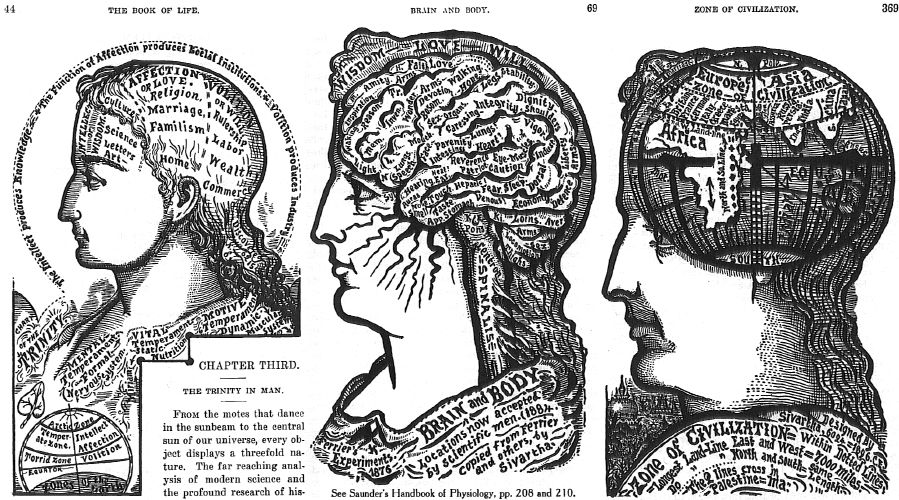
The Book of Life - Brain and Body - Zone of Civilization

There was a time when I understood International Political Economy (IPE) to mean ‘bodies of thought’ (realism, liberalism, Marxism, etc.) and so, not knowing which body to have, I tried each of them on for size. Realism didn’t fit (too tight); liberalism felt wrong (unethically-sourced materials); Marxism looked good (but I lacked the discipline to maintain it). Social constructivism suited my friends and felt pretty comfortable, so this was the body I decided to have. As a social constructivist, I did a lot of work on ideas (‘discourse’) and thought a lot about other bodies of thought. But what I didn’t do was to engage in thought about bodies. Bodies didn’t seem to happen in IPE; they appeared to exist somewhere else entirely, to be accessed only via metaphor (as in the above description) but always somewhere ‘over there’, never as the living, breathing stuff of the discipline. Bodies – or so I assumed – were off the cards.

In other contexts, though, I was thinking a lot about bodies: from the personal (‘will my body be able to produce another body, a child?’) to the professional (‘do I under-perform in job interviews because I gesticulate wildly when nervous?’) and the political, too (‘the government should de-criminalise the sale of sexual services’). Indeed, while I was writing a PhD and then monograph about states and markets – globalisation, economic development and social justice in the Irish Republic – it was bodies that I loved talking, reading, arguing about. I just didn’t see them as ‘IPE’.

In fact, bodies had been there all along; I hadn’t seen them because I hadn’t been looking.

Continue reading

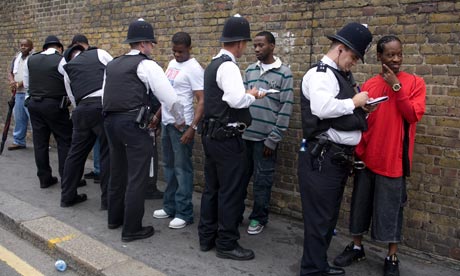
Stop and Search: Race and the Politics of Suspicion

banksy-searchStop and search at Notting Hill carnival

BETWEEN me and the other world there is ever an unasked question: unasked by some through feelings of delicacy; by others through the difficulty of rightly framing it. All, nevertheless, flutter round it. They approach me in a half-hesitant sort of way, eye me curiously or compassionately, and then, instead of saying directly, How does it feel to be a problem? they say, I know an excellent colored man in my town; or, I fought at Mechanicsville; or, Do not these Southern outrages make your blood boil? At these I smile, or am interested, or reduce the boiling to a simmer, as the occasion may require. To the real question, How does it feel to be a problem? I answer seldom a word.

– W. E. B. Du Bois, The Souls of Black Folk, (1905)

Video from excellent activist group Stop-Watch.

The political pause over Stop and Search

The riots of 2011, and the research that was conducted afterwards, have had multiple political effects. Of these, one of the most important has been a clearer public exposure of the deep animosities generated by police use of stop and search powers against young people and especially those of black and Asian backgrounds. Whilst the idea that stop and search causes animosity is not news to anyone interested in British race relations or human rights, it has unusually become the focus of increasing political attention. For many years the Independent Police Complaints Commission has warned that the use of stop and search powers may be being exercised in a discriminatory and unaccountable way, and the Equalities and Human Rights Commission have been investigating police forces on this front.  Yet it was only following the riots that the Metropolitan Police Commissioner Sir Bernard Hogan-Howe began a large overhaul of the use of the power in London in 2012. Following this, parliamentary briefings were issued which pointed to the broader ineffectiveness and abuse of the powers, and the Home Office has launched a consultation into the use of stop and search. In launching this consultation, equality-sceptic Home Secretary Theresa May acknowledged, in very measly terms, the discriminatory ways in which these powers had been exercised:

The official statistics show that, if someone is from a black or minority ethnic background, they are up to seven times more likely to be stopped and searched by the police than if they are white. Now we should not rush to conclusions about those statistics, but everybody involved in policing has a duty to make sure that nobody is ever stopped just on the basis of their skin colour or ethnicity. The law is clear that in normal circumstances, stop and search should only ever be used where there is a reasonable suspicion of criminality—and that is how it should be. I am sure we have all been told stories by constituents and members of the public about what it is like to be a young, law-abiding black man who has been stopped and searched by the police on more than one occasion. If anybody thinks it is sustainable to allow that to continue, with all its consequences for public confidence in the police, they need to think again.

House of Commons Debate, 2 July 2013 Continue reading

The Queer Art of Whistle Blowing

What should we make of the fact that Bradley Manning has become Chelsea, that Glenn Greenwald is gay, that David Miranda loves a man enough to submit to the harassment incurred by his partner’s work, that Greenwald’s detractors sought to tarnish him by association with—of all things—a porn company? Possibly nothing generalisable, except that gender is doing work here.

There has been no shortage of voices denying a straightforward connection between sexual orientation, gender identity, and patriotism. (Part of the reason I feel compelled to write about this is that there isn’t one.) San Francisco Pride Board notoriously repudiated Manning’s election as a Grand Marshall in the 2013 Pride in that city, declaring: ‘even the hint of support for actions which placed in harms [sic] way the lives of our men and women in uniform—and countless others, military and civilian alike—will not be tolerated by the leadership of San Francisco Pride.’ That statement has not been retracted, notwithstanding its now patent inaccuracy in light of the prosecution’s inability to cite any evidence that Manning’s leaks led to any deaths and the court’s decision finding her not guilty of the charge of ‘aiding the enemy’. Kristin (formerly Chris) Beck, ex-US Navy Seal who recently announced her gender transition, has been harsher in her condemnation of Manning: ‘For this person, whether male or female to use gender identity to act “BADLY” is a slap in the face to me and everyone who does not fit the “Binary Gender Norm.” It is not an excuse for anything illegal or unjust.’ Pablo K is right to point out the dangers of the temptation, for those who see a link between sex/gender and truth-telling, to make the reverse move—’to relegate Beck to a minority report, and so to re-inscribe the hierarchy of authenticity, this time with Manning as the actual face of resistance, and Beck the mere puppet of militarism’—while pointing out, also, that the gap between these contrasting appropriations is constitutive of the space of contemporary politics. So let’s talk politics.

Continue reading

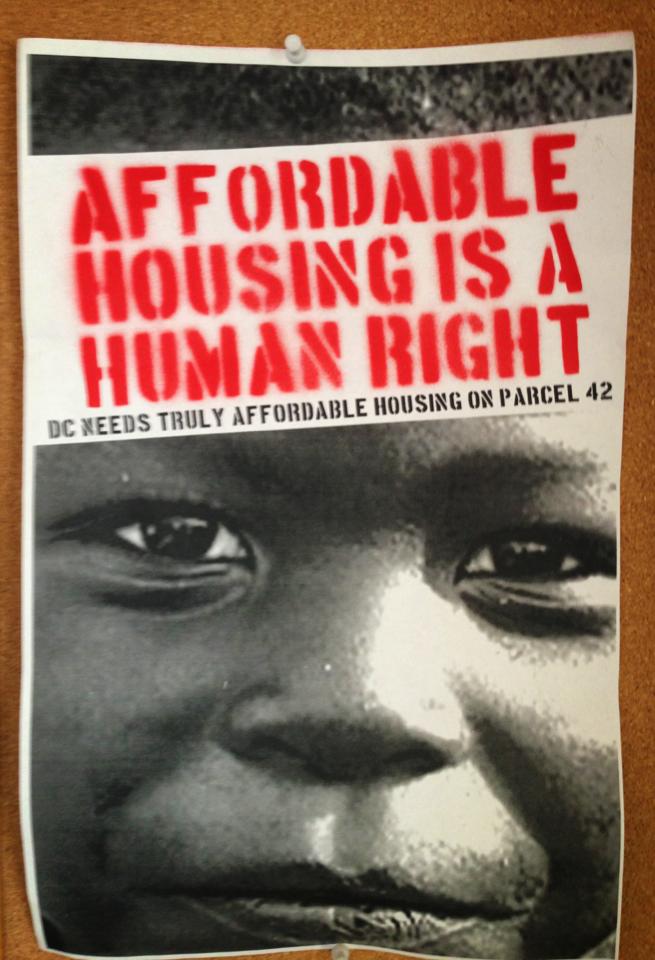
Washington, DC: a human rights city?

Below are some initial reflections on the work I’ve been doing in Washington DC on the human right to housing. They are not terribly substantive and serve as much as a tribute and thank you to those who hosted me as disquisition on the topic. But I wanted to post the piece for those who might be interested in my broader project, or what’s going on in Washington DC. Enjoy.

In December 2008 Washington DC was declared a human rights city. The DC City Council passed the resolution, pushed for by the American Friends Service Committee. While this is a lovely idea, it leaves one wondering what does it mean to be a human rights city. In particular, what does it mean in a city defined by inequality, where more than 15,000 citizens do not have homes, where 20% of the population lives in poverty, where housing is more unaffordable than anywhere in the United States, and where public and affordable housing is under constant threat. Perhaps the declaration of DC as a human rights city would seem less cynical if the DC City Council or the Federal Government had shown themselves committed to protecting the human rights of residents of the District, particularly the right to housing.

Housing is a Human Right

Human rights promise us many things. The right to housing, however, is perhaps the most fundamental. What do our rights mean if we do not have a place to call home? Article 25 of the Universal Declaration of Human Rights promises that

Everyone has the right to a standard of living adequate for the health and well-being of himself and of his family, including food, clothing, housing and medical care and necessary social services, and the right to security in the event of unemployment, sickness, disability, widowhood, old age or other lack of livelihood in circumstances beyond his control.

The right to housing is fundamental because it is in our homes that we find the space to rest, to pursue wellness, to find love, to raise families, and build communities, to collect our energy and thoughts so that we can participate in democratic politics, and it is where we find the safety, security and privacy that make a dignified life possible. Continue reading

Secrecy and Spectacle in the Overthrow of Mossadegh

Chris Emery LargeA guest post from Christian Emery, Lecturer in International Relations at the University of Plymouth. Chris completed his PhD at the University of Birmingham and has held teaching positions at the University of Warwick and the University of Nottingham. Between 2010 and 2013 he was a Fellow in the Department of International Relations at the London School of Economics. His research covers several areas but is primarily situated at the intersection of International Relations, Diplomatic History, and Foreign Policy Analysis. He is interested in all aspects of post-war US foreign policy, with specific expertise in US policy in Iran. His latest book is US Foreign Policy and the Iranian Revolution (Palgrave Macmillan, coming this October) and he is also the author of pieces in Cold War History, The Iran-Iraq War (Routledge, 2013) and commentary in The Guardian. His next journal article will appear in Diplomacy and Statecraft.


This week an organisation dedicated to expanding public access to US government information, and publishing its former secrets, released documents proving the CIA’s involvement in an illegal covert action. Sound familiar? In this case, however, the authors had no fear of landing themselves in solitary, a foreign embassy, or (worse still) a Russian airport. The organisation lifting the lid was the National Security Archive (I will not indulge in the ironic use of acronyms) which, despite the official sounding name, receives no government funding. The NSA (ok, just once) fights for greater transparency and accountability in US foreign policy within a legal framework. Its primary weapon in fighting for open government is the Freedom of Information Act, and its bluntness may be part of the reason why others have taken more drastic action. I will return to the prescient topic of government secrecy later on, but first a few words on the content of these documents.

The documents are significant for a number of reasons, but the headline news is this: ‘CIA Admits It Was Behind Iran’s Coup.’ The most significant line taken from these documents is from a CIA internal history from the mid-1970s: “the military coup that overthrew Mossadeq and his National Front cabinet was carried out under CIA direction as an act of US foreign policy, conceived and approved of at the highest levels of government.”

A legitimate response is:

Nicholas Cage You Don't Say

Quick historical recap. In August 1953 the CIA (working with MI6) orchestrated the overthrow of Iran’s democratically elected leader Mohammad Mossadegh and installed Muhammad Reza Shah Pahlavi in his place. The specific motivation for the coup (codenamed TPAJAX) was that Mossadegh was attempting to nationalise Iranian oil. The more pressing fear was that his government was unstable and Cold War thinking dictated that this made Iran vulnerable to Soviet influence. This anxiety was heightened by Iran’s huge oil resources, geographic proximity to the Soviet Union, and the existence of a large and well established Iranian communist party (the Tudeh). The plot to topple Mossadegh initially failed, spooking the Shah into premature exile, but a few days later US and UK agents managed through a variety of nefarious tactics to put a decisive number of pro-Shah supporters onto the streets. Mossadegh’s supporters were rounded up and the great man himself was sentenced to death (the sentence was never carried out – he died in Tehran in 1967). After the coup, Iran’s concession to Western oil companies was renegotiated and for the first time American petroleum companies were granted access to draw Iranian oil.

Continue reading

Un-Manning; Or, Queering Bradley

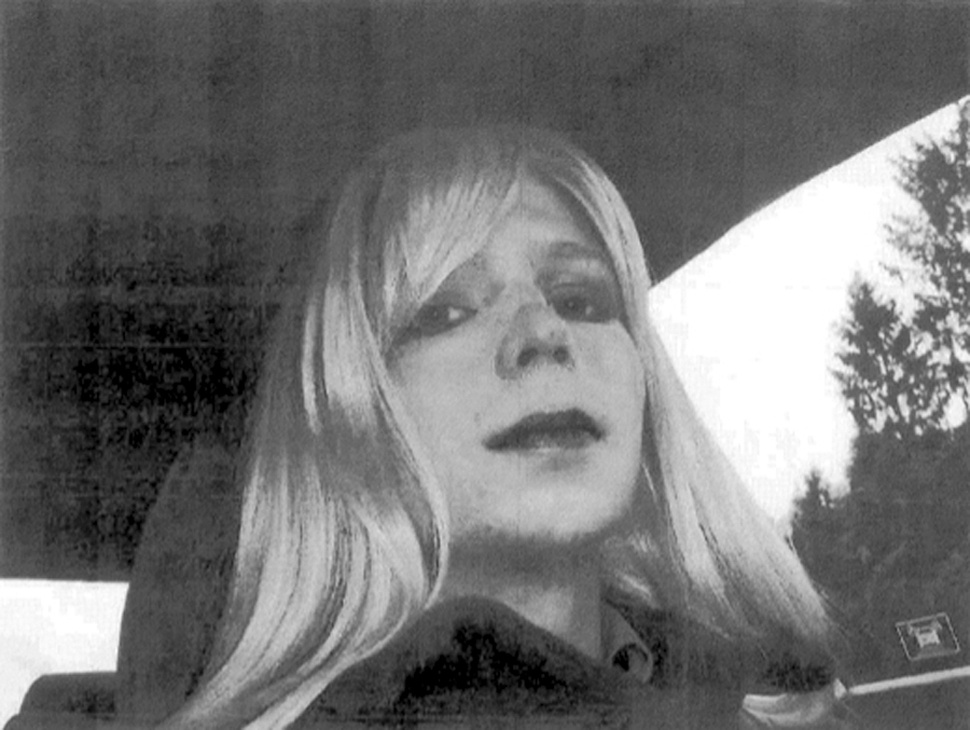
Bradley Manning Trans Wig

Private First Class Chelsea (formerly Bradley) E. Manning has serious gender issues. Or so goes the story of the moment. In the wake of her statement, the question of identity (and language) has somewhat displaced that of the conviction and sentence. Another dimension in the smearing of whistleblowers, perchance. A way to denigrate and emasculate her still further, and so to reinforce the patriarchal entitlement of that shining city on the hill. Except that Manning’s sexual personhood is more contested than that.[1]

Navy Captain and psychiatrist David Moulton, according to CBC, testified that Manning’s ‘gender disorder’, amongst other things, “caused him to conclude he could change the world by leaking classified information”. But Moulton was a defence witness. Captain Steven Lim, Manning’s brigade commander, also pointed towards gender trouble, and revealed the existence of the now much-seen photo of Manning in a wig to the Fort Meade court. Again, a defence witness. Manning’s lawyers were forbidden from seeing much of the (non-)evidence against him, thanks to techniques of classification, and this surely influenced their strategy. Since they could not openly contest claims of the most traitorous harm (claims that were in the end unsubstantiated), why not try and reduce the sentence with whatever biographical resources were available? Where gender identity sometimes served as justification for the leaks, at others it was made irrelevant (to wit: “It was never an excuse because that’s not what drove his actions. What drove his actions was a strong moral compass.”). Interviewed today, David Coombs (Manning’s lawyer) again juggled his client’s personhood somewhat unsuccessfully, maintaining both that “we weren’t offering it as an excuse” but also that Manning’s gender explorations were relevant because they “happened at the same time [as the leaks and therefore] that provides context”.

Paradoxically enough, it is at times Republicans who have had to point out the shamefulness of this strategy:

Now that he prepares to stand trial, he has shown himself to be willing to sacrifice honorable gay and lesbian servicemembers to avoid responsibility. Lawyers for Manning are claiming that his struggle with his sexual orientation contributed to emotional problems that should have precluded him from working in a classified environment. This shameful defense is an offense to the tens of thousands of gay servicemembers who served honorably under “don’t ask, don’t tell.” We all served under the same law, with the same challenges and struggles. We did not commit treason because of it.

Despite the appeal to homonationalism, there is here an actual defence of LGBTQ identity against perpetual fears of a deviance that cannot be trusted with full equality. Fairly obviously, framings of ‘disorder’ put trans* and genderqueer back in the realm of medical pathology from which they have only just begun to escape. And yet this is not a one-sided story of medical bio-politics. Continue reading

Why I’ll Miss Jean Bethke Elshtain

A short version of a tribute to Jean Bethke Elshtain, who died last Sunday, from Christine Sylvester, Professor of Political Science at the University of Connecticut.


Jean Bethke Elshtain

She was embraced by feminists for her books on Women and War and Public Man/Private Woman, and then ostracised by the sisterhood for her disapproval of gay marriage and approval of “just” wars in Afghanistan and Iraq. She would become anathema to peace researchers and sandpaper to scholars of critical IR. Those who liked her early writings in a secular vein would be disappointed when she began to argue from a base in religious philosophies. Jean Bethke Elshtain encapsulated the best hopes of feminists to effect change in core topics of “men’s studies” –International Relations and Religious Studies –and ended up instead on the wrong side of several issues. That’s clear. So let’s ignore her recent death, shall we? Possibly celebrate her end?

Not me. I met Jean at a series of feminist IR conferences held between 1989 and 1993 in the USA, and then shared many a panel with her at the International Studies Association for a few years. Without equivocation, had I not met Jean and found favour in her eyes, I wouldn’t have produced publishable work in my own voice. Jean pulled me aside at one conference, sat me down, and told me to maintain and further develop what she called my “maverick tendencies.” The good Coloradan that she was warned against following the herd as it raced along toward…possibly nothing. My graduate school mentors had been excellent and very encouraging, especially Karen Mingst. I learned much from them, but also resisted some of their good advice once I was out on my own, stubbornly insisting on writing about Zimbabwe and feminist IR –two very different specialisations, both approached in slightly off-centre ways. To Jean, that was the way to go. Permission granted. Years later, in 2001, when she was on an ISA panel discussing my work, along with Cynthia Enloe, Steve Smith, and Dipesh Chakrabarty, she gave me a hard time over what she called my “postmodern avoidances;” by then, Jean was a solid believer in truth. She gave an audience member an even harder time, though, for wilfully misrepresenting my arguments.

Jean the scholar I admired very much. Jean the person behind the scholar astounded me. Her story, of course, appears in an early chapter in Women and War (1987), a book that came out decades before IR recent “new” interest in auto-ethnography. Jean depicts herself as a smart-ass tomboy, a shoot-em-up leader of the cavalry of kids, clearly smarter than everyone around her. But she was decidedly in the pack of youngsters who contracted polio before the vaccine, and who had to suffer the neanderthal treatments available at the time (my cousin was similarly afflicted and spent months in a hideous Iron Lung.) Thereafter, Jean walked with a noticeable limp. I remember the two of us racing like maniacs down the streets of the University of Southern California to get to where we were to speak. That pronounced limp on a shortened leg could not be ignored: I suggested we go slower. She wouldn’t have it. “I can do this,” she said, “not happily or easily, but I can do it.”

Continue reading

HEFCE, the REF, Open Access and Journals in Politics, IR and Political Theory

UPDATE (8 September 2014): Lee originally wrote this as a guest post – providing some much needed concrete detail on journal open access policies – but is now with us for good.


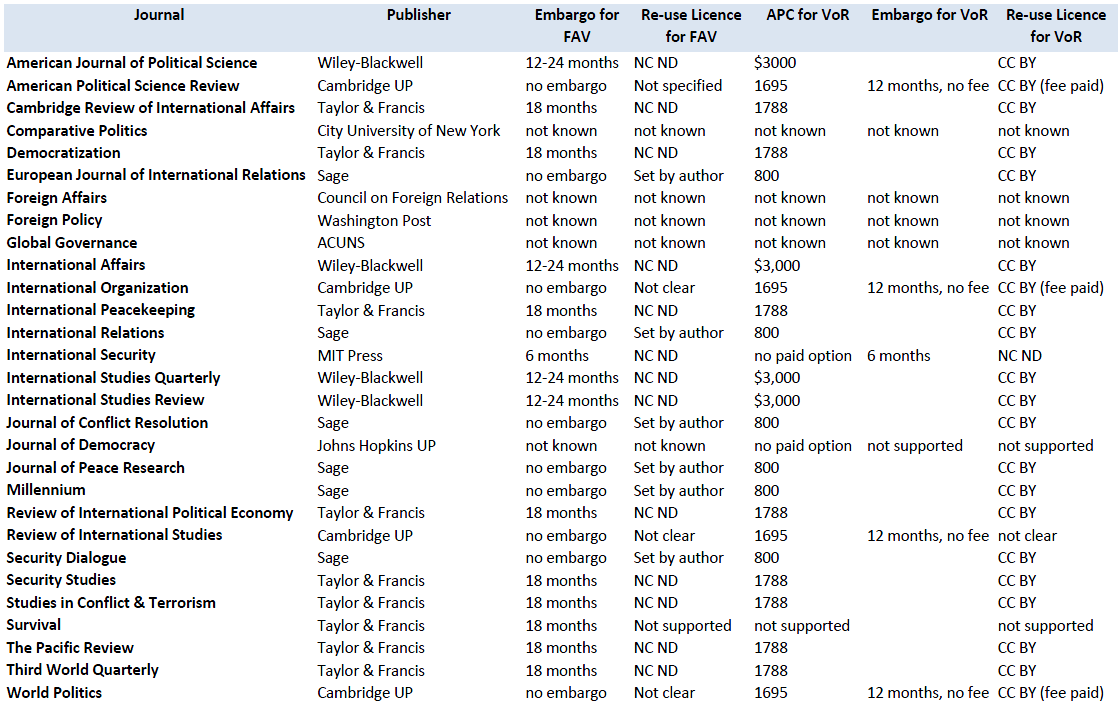
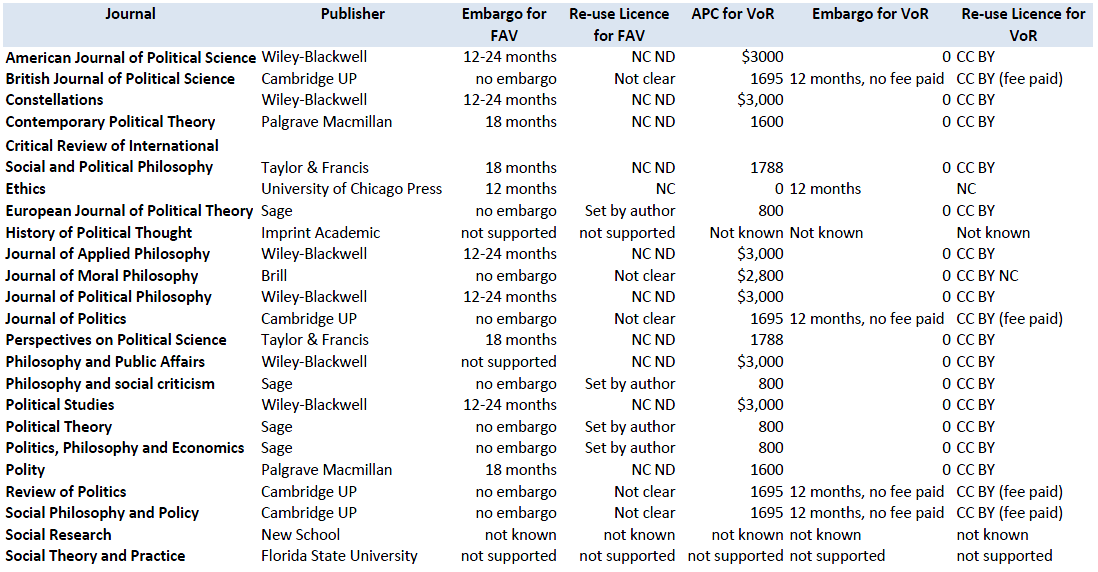
Following the launch of HEFCE’s consultation on Open Access for any post-2014 REF, and the generally positive reaction to it here, I examined the potential implications of HEFCE’s proposals for journal publishing in Politics, IR and Political Theory. I wanted to know whether the serious threat in HEFCE’s earlier proposals – notably the rush for ‘gold’ OA and associated Article Processing Charges (APCs) – had been eliminated by a downgrading of the proposals to permit ‘green’ OA, by depositing a ‘final accepted version’ (FAV, i.e. post-peer review, but pre-type setting) into an institutional repository. I also wanted to see what embargoes journals placed on FAVs (i.e. how long after the ‘Version of Record’ (VoR) is published in the journal the FAV can be made public); what re-use was permitted (what sort of licensing); and also to compare this route with the ‘gold’ access favoured by the Finch Report and the RCUK policy. I also wanted to gather information that could be used as part of a ‘soft boycott’ of OA-resistant outlets.

To do this I selected 57 journals that broadly represent the ‘top’ journals in the three subfields. I used composite rankings from Google Scholar, the ISI Citations Index, and surveys of scholars where available, and got feedback on an initial draft. The list isn’t intended to be definitive, just to give us a better sense of where the ‘big journals’ in which many scholars aspire to publish actually stand on OA.

It is not easy to get this information. Policies can vary by journal, not merely by publisher, and their websites are often opaque on the issue of self-archiving, particularly in terms of licensing. This may change if, as seems likely, HEFCE forges ahead on OA; but publishers also need to be pushed to display clearer information. The exaggerated nature of the Finch Report’s estimate of UK HE’s market power to change publishing models is underscored by the fact that US journals tend not to provide the information I was looking for (my thanks to Sarah Molloy for help with this).

The results are presented below for Politics, IR and Political Theory (click to enlarge each image). There are a lot of complexities with various journals which are shown in the full spreadsheet of results which you can see here; the spreadsheet also lets you reorder the information by different criteria.

OA - IR

Journal Open Access Policies for International Relations.

Journal Open Access Policies for Politics.

Journal Open Access Policies for Politics.

Journal Open Access Policies for Political Theory.

Journal Open Access Policies for Political Theory.

Several conclusions can be drawn.

(1) Most importantly, Pablo and Meera were basically right: the threat of HEFCE rushing to a ‘pay to say’ approach with hugely detrimental financial consequences for universities and the potential for internal rationing of APCs, has been defeated, for now (although RCUK’s policies remain intact). Some journals, particularly in the US, don’t seem to support green FAV self-archiving, or have gold APC routes – this is a problem because they would be non-compliant with HEFCE’s proposals; so we will need to push for exemptions on this score. However, by and large, where they allow FAV self-archiving, none of the journals appear to charge a fee; HEFCE’s current proposals now intend to compel more researchers to do what they are already entitled to do. So long as this does not change, HEFCE’s proposals should not involve ruinous costs or lead to APC rationing.

Continue reading

Rushed thoughts on political theory…

I am not sure I have proper post here, but I am pursuing some thoughts and it seems they might benefit from publicity. In the midst of “fieldwork” – a word I hate… Let’s scratch that – in the midst of a learning experience, in which I have been granted the opportunity to share in the struggle of some very brave people in Washington DC’s Shaw neighbourhood, I have stumbled over what seems a vital point about political theory. So vital in fact that it seems obvious now.

I spent yesterday in the Shaw neighbourhood of DC. Shaw is a historically black area, with a cultural and intellectual history that rivals Harlem or Bronzeville (in Chicago). It is also a neighbourhood in the midst of “gentrification”… wait, that’s the wrong word too. It is a neighbourhood in the midst of a campaign of displacement, moving long terms residents (mostly poor and Black – though also Latino and Asian) out of their homes and community. These people are being displaced to make way for “development” and “urban renewal” – which is a polite way of saying they are being moved for profit, because the investors and the city of Washington DC have found a way to make money off their homes and community.

Walking around the area you can see the transformation in process, as the old and new visions of the area meet like ocean currents. I sat in a park and while a young white woman jogged with her dog, a young and destitute black man watching from a nearby bench complained to himself that her dog needed to run free, not be stuck on a leash, and that the woman should have stayed in the suburbs rather than moving into his neighbourhood. And in Shaw, the writing is literally on the wall, as I walk past a former public housing complex that is now being advertised as a luxury apartment complex by a new owner keen to move out the current residence, renovate the building and move in new more profitable tenants.

I was fortunate to meet a group of local long time residents, mostly black women, who are trying to protect their homes and their place in the Shaw community. I won’t provide details here, but I will say that these people are incredibly brave and they face an absolutely monumental task. To oppose their own displacement requires them to fight against powerful adversaries using a system and a set of rules that is balanced against them. And this is where I started thinking about political theory… Continue reading