Dr Srnicek, I Presume?

Hot on Elke’s heels comes the news of the world’s latest doctor. Nick Srnicek, PhD. Awarded for his original thesis Representing Complexity: The Material Construction of World Politics, examined by Professors Iver Neumann and Alex Preda. A certain mastery thus attained.

Dr Nick

Living Knowledge Traditions and the Priestly Caste of the Western Academy

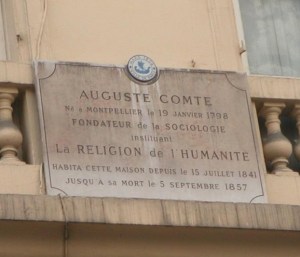
comte

The Western Academy, especially in its social science and humanities wings, incorporates as a priestly caste. Perhaps Kant is the first high priest of this caste when he argues for the Aufklärer to become a corporate entity equivalent to the hierocracy and nobility but exceptional in its duty to provide a truly public service of reasoning. The psalm of this priestly caste is “have the courage to use your own understanding”, its catechism: to singularly possess and hold aloft the flame of revelation, known as science, or, nowadays, the modern episteme. Even Marx holds the flame aloft when he takes Hegel’s Philosopher, who breathes world spirit, and makes him inhabit the skin of the Communist.

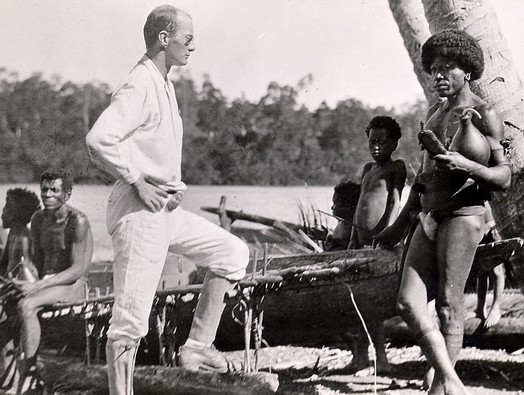
This priestly caste, as it founds the church of modernity, is instantly and integrally involved in founding a broader colonial division of labour.  These new priests conjure up the traditional/modern divide by the use of history –  differentiating old and new European Western societies – and by the use of anthropology (later, sociology too), by differentiating the colonized from the colonized. The living knowledge traditions of the colonized are pronounced dead on arrival in the present. And their cosmologies, philosophies, social practices – are entombed into opaque “cultures” the contents of which can only be clearly illuminated by the keepers of the flame. 

19_malinowski

Ultimately this mapping of difference works through race, gender and class coordinates so that even the “poor” living in the West, as well as un-mastered women and single mothers intersect with (post-)colonized subjects to become part of this opacity. The episteme of the Western Academy thus differentiates between the knowers and the known.

In this respect, the modern episteme is as seminal as gunboats to the maintenance of colonial difference. Key to this difference is not just the attribution of extra-ordinary exploitation, oppression and dispossession to colonized peoples but also their epistemic erasure, i.e., the outlawing of the possibility and desirability of intentional self-determining community amongst the colonized and their post-colonized descendents. It is in the colonial world and not Europe where Europeans develop the art of objectifying peoples into populations such that the basic competency of the colonized to self-define is deemed absent by the instruments and mores of European sanctioned international law. Postcolonial populations have only been able to become peoples under very specific conditionalities; and many who make the transition become the new police of colonial difference. Those who fall between or prefer a third way become the ungoverned, or ungovernable.

Continue reading

Dr Schwarz, I Presume?

And so, after some delay due to storm, and just a month after The Disorder Of Things turned three, our own Elke was closely quizzed by Professors Patrick Hayden and Chris Brown. The cause? The defence of her doctoral thesis: The Biopolitical Condition: Rethinking the Ethics of Political Violence in Life-Politics. Arendt, Foucault, and drones. Now passed, certified, set free. Without corrections. Henceforth, Dr Schwarz.

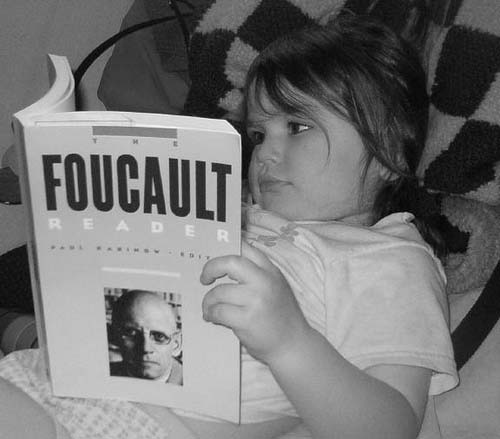
Elke Foucault

Not actually Elke.

Teach It, And They Will Come

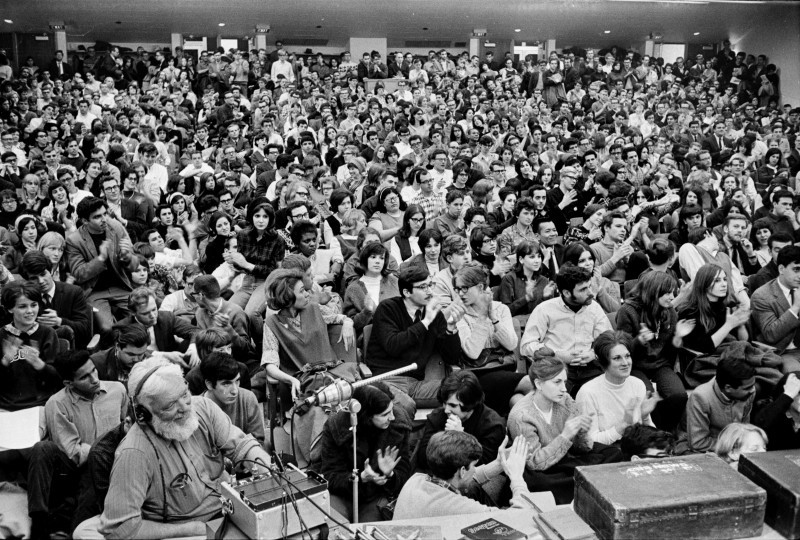
1960s Teach In

As another term approaches its zenith, we at The Disorder engage in a novel public service: making available a range of our module reading lists. Ready-made bibliographies, crib-sheets, self-help guides, or just objects of curiosity, to do with as you will. We have focused on our more specialised courses, on the assumption that there is a relative dearth of taught programmes on these issues, or taught from these perspectives. Most of the readings remain inaccessible online, although there are libraries still in existence where they may be found. You will also miss out on our great personal charms. Nevertheless, enjoy.

Just click on the titles for the full PDFs. May a thousand ideas bloom!


Joe (Lecturer in International Relations, City University)

Myths and Mysteries in World Politics (co-taught with Aggie Hirst and Amin Samman): This is a ten-week course that runs in the first term and is compulsory for all our undergraduate students. The idea behind it is that we wanted to provide an introduction to “theory” that not only avoided the numerous “isms” but which also harnessed the students’ interest in politics. So, the course is organised around key ideas in politics and we push students to think philosophically about what world politics is, as well as how they are already engaged in it. We hope to develop a critical sensibility by getting students to realise how much they already know, or think they know, about world politics and then encouraging them to look more deeply – hence the “Myths and Mysteries” title. The course is structured in three parts: there’s an initial week where we talk about what “politics” means and ask students to consider their own placement in the political world (this is also the topic of their first essay), then we cover “Power”, “Ethics”, “Violence” and “Law” as big conceptual ideas before turning to a section that looks at the institutions of world politics (broadly conceived), including “Empire”, “Capitalism”, “The State”, “Money” and “History”. In the end, the primary hope is to build intellectual skills – reading, writing, thinking – and introduce them to big ideas in politics rather than indoctrinate them in disciplinary debates.

Continue reading

Assessing Ernst Jünger: Prophet, Mystic, Accelerationist

Following on from the two previous posts (here and here), this final entry will conclude the story of Ernst Jünger’s intellectual trajectory from exalted warrior-poet to withdrawn mystic. I will then propose a brief assessment of Jünger’s legacy and contemporary relevance to our present concerns, notably to a putative political accelerationism. You can find here the full academic article on Ernst Jünger and the problem of nihilism that I published in 2016.

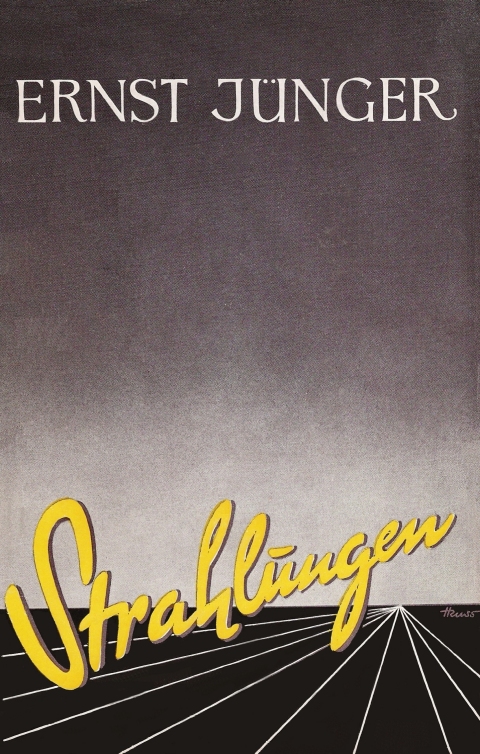
We pick up our story with the entry of Germany into the Second World War and Jünger’s new conscription into military service. Now aged 44, his experience of the war would however be quite different from the one that had so decisively shaped him as a young man. Following the successful French campaign, he would spend most of the war in an administrative posting in Paris where he assiduously frequented the literary and artistic circles, meeting collaborationist figures like Pierre Drieu La Rochelle and Louis-Ferdinand Céline but also Pablo Picasso and Jean Cocteau. As during the first war, Jünger kept a diary that would eventually be published in 1948 under the title of Strahlungen (“Radiations”). However we encounter within it a markedly different tone, reflective of the different circumstances in which he found himself but also indicative of a retreat from the ideas he had espoused up to the early 1930s. Devoid of much enthusiasm for the war, his writings appear at times almost indifferent to the wider drama playing itself out across Europe but become progressively more somber as the fate of Germany darkens, reports of atrocities in the East filter through, and his eldest son is killed in Italy.[1] Already looking ahead to the end of the conflict, Jünger also worked during the war on an essay called The Peace that proposed a vision of a united federal Europe and was circulated among the internal opposition to Hitler in the Wehrmacht. Several of these figures would be subsequently involved in the failed attempt on the Führer’s life in July 1944, a plot Jünger was seemingly aware of but took no direct part in.

ej1949am

The end of the war would nevertheless see Jünger being called to account for his inter-war writings. Having refused to submit to denazification, he would find himself barred from publishing for four years and he returned to live in the German countryside where he would reside until the end of his life. His remarkable longevity would grant him the opportunity for an abundant literary production, penning novels, essays and diaries ranging from science-fiction and magical realism to early ecological thinking and reflections on his multiple experiences with psychedelics. I will however restrict myself here to discussing Jünger’s immediate post-war writings since we find within them a clear statement of both the continuities and breaks with his prior thinking. Of particular importance is the text that he originally composed in 1950 on the occasion of the Festschrift for Martin Heidegger’s sixtieth birthday, Über die Linie (“Over the Line”).

Continue reading

Ernst Jünger on Total Mobilisation in the Age of the Worker

You can find here the full academic article on Ernst Jünger and the problem of nihilism that I published in 2016.

In this post, I will examine Ernst Jünger’s interwar writings, particularly as he moved from his recollections and reflections on the Great War (see earlier post) to a more ambitious analysis of the social and political turmoil that ensued. Sharpening his central problematique of nihilism and its overcoming, he would see in the commotions of his time the sign that the timorous bourgeois liberal societies of the nineteenth century were about to be swept away by a new technological age of total societal mobilisation and armed conflict. Anticipating and heralding the advent of the totalitarian regimes that were germinating as he wrote, the obvious points of convergence between these writings and fascist ideology have unsurprisingly made them Jünger’s most controversial. As objectionable as his political views were in their own right, Jünger was nonetheless never a National Socialist, spurning the advances made to him by the Party and having little truck with its “blood and soil” creed. He did however develop keen insights into the historical escalation of war and accompanying demands of total mobilisation alongside a withering critique of liberal societies’ preeminent concern with security and comfort.

7598547562(2)

Demobilised in 1923, Jünger spent the next three years studying zoology and developing a life-long passion for entomology (he reputedly amassed a collection of 40,000 beetles, even giving his name to a species he is credited with discovering). During those years, he also read philosophy, particularly the works of Nietzsche and Spengler. Departing from the university in 1926, Jünger then began a period of intense writing for nationalist publications and participation in the circles of the Conservative Revolutionary movement, becoming notably close to Ernst Niekisch, the central ideologist of National-Bolshevism. To enter into a detailed consideration of the ideological content of such seemingly paradoxical constellations would take us too far from our central object but it is nonetheless useful to remind ourselves of the ideological complexity and fluidity of Weimar Germany that are all too often repressed when we view the period from a post-WWII standpoint. Jünger’s independent streak also meant his associations ranged more widely than most, frequenting during this time left-wing writers such as Bertolt Brecht, Erich Mühsam, and Ernst Toller. It is within this eclectic milieu and the context of generalised crisis that his political thought was formed, leading to the publication of a series of essays in the first few years of the 1930s. Fascinated by the social and cultural effects of photography, Jünger also put together several collections of photobooks from which I have drawn the images that accompany this post.[1]

Continue reading

Ernst Jünger and the Search for Meaning on the Industrial Battlefield

This is the first in a series of posts on the German war veteran and author Ernst Jünger that draw on research I have presented at seminars at the University of CambridgeUniversity of East Anglia  and University of Sussex over the last year or so.  [Edit: The follow-up posts can now be found here and here]. You can find here the full academic article on Ernst Jünger and the problem of nihilism that I published in 2016.

A complex and controversial character, Ernst Jünger is mostly known today for the vivid autobiographical account of life in the trenches of the Great War he penned in Storm of Steel, one of the defining literary works produced by its veterans. Alongside its unapologetic celebration of war, it contains an unflinching, at times clinical, description of the unprecedented destruction wrought by the advent of modern industrial war. As we approach the centenary of the First World War, the text has lost none of its evocative power and is likely to remain a lasting document of the soldierly experience.

Ernst Jünger in 1919

Ernst Jünger in 1919

Jünger’s subsequent writings, published throughout a long life that ended in 1998 at the ripe old age of 102, are however far less well known in the English-speaking world and many of them remain untranslated to this day. And yet I want to argue that, as problematic a figure as he is, the trajectory of Jünger’s thought and work is worthy of our attention in that it crystallises in a particularly stark and vivid fashion some of the tensions and internecine struggles of the twentieth century. Jünger liked to refer to himself as a seismograph registering the underlying tectonic shifts that prefigured the tremors of his age and in the often exalted and rapturous form that took his writings they can indeed be read as a wilful exacerbation of contemporaneous trends, his failings as much his own as that of his times.

Jünger wrestled in particular with the problem of meaning and human agency in a world increasingly dominated by technology and instrumental rationality that appeared to reach their paroxysm in total war. Inheriting his philosophical outlook from Nietzsche, he understood the problem of the age to be that of nihilism, of the devaluation of all values and the increasing inability to posit any goals towards which life should tend after the ‘death of God.’ He came to view the domination of technique as central to the growth of nihilism, a proposition that appears in an inchoate but nonetheless suggestive form in Nietzsche’s own writings. This Nietzschean perspective would so come to dominate Jünger’s outlook and work that Martin Heidegger would not hesitate to dub him ‘the only genuine continuer of Nietzsche.’[1]

Continue reading

What Does It Mean To Become An Open Access Journal?

Following an earlier interview with Eva Erman on editing the open access journal Ethics & Global Politics, another set of enlightening responses on academic publishing. This time with Professor Brad Weiss of the College of William & Mary and President of the Society for Cultural Anthropology, which publishes Cultural Anthropology, the premier journal of the American Anthropological Association (AAA). It is a major journal by other metrics too (take your pick of GoogleScholar or Impact Factor). All of which is as preamble to the point: Cultural Anthropology will be a fully open access journal from 2014. Not just that. It has a web presence and offers a set of connected resources that are without compare (at least in my experience). Brad was kind enough to offer his time to answer some questions on taking a learned society journal of prestige open access.


Cultural Anthropology Cover Trimmed

1. How did the decision to make Cultural Anthropology open access come about? Who initiated it, and why?

There is a longish story here. For several years prior to this action, many members of the Society for Cultural Anthropology (SCA) Board, and our Editorial Board had been interested in pursuing an open access option. That really wasn’t up to us, as we are only one section of the AAA that maintains a contract with Wiley-Blackwell to publish more than 20 of its sections’ journals. However, the director of publications with the AAA, Oona Schmid, proposed the possibility, last August (2012) to all of the publishing sections that one of them could be permitted to go open access for the duration of the Wiley-Blackwell contract (which expires in 2017) given certain provisions. Our Board formed a task force, including some real experts on publishing and open access in particular, and this group determined that it was a good idea to pursue this option. As it happened, we were the only AAA section to elect to do so, so were authorized to make the transition, which will begin in February 2014.

2. How was the move to open access funded?

Again, a little complicated. For one thing, the SCA is the biggest section of the AAA, and our membership dues are important sources of revenue; but in and of themselves, they don’t cover the costs of publishing, as well as all of the other activities (workshops, board meetings, special sessions at the AAA meetings, a biennial conference, etc.) that the SCA undertakes. We have been able to build our fund balances over the last several years, when the Wiley-Blackwell contract brought us significant royalties. Between these two sources of funding, we are confident that we can make open access work – for now. In the long term, we are looking to develop an open access model that will incorporate many more sections of the AAA, so that whatever happens next in publishing (post-Wiley contract) allows sections to share editorial and distribution costs, which will substantially reduce the costs of publications for everyone. Our hope is that the costs of open access become so reduced through cost sharing, that each sections’ member dues will provide sufficient revenue to fund, not only their publications, but all of their other activities. This will probably mean that open access won’t be profitable, but will at least not be prohibitively expensive – and, crucially, that the professionals we hire to edit, publish and design the journal will get paid for their work.

3. It seems that your open access model, as paid for through membership dues, could be characterised as Article Processing Charges by another name. How would you respond to the objection that this is another drain on academic funds? 

We are seeking a middle ground. We cannot sustain open access for long on just membership dues; and we already have a broad membership, so we’re not asking for more money from members, we’re just using these funds for this purpose.  Moreover, we added the membership requirement primarily to reduce the number of unwarranted submissions that take literally hundreds of hours to process.  We are trying not to charge our members extra, but hoping that the fund balances we already have will keep our enterprise going until the AAA can generate a new publication model, which we hope will at least make open access more widely available, if not the standard model.

Continue reading

Where Have All The Black Professors Gone?

A new documentary, Absent From The Academy, on the status of black scholars in the UK. Alongside Paul Gilroy, Adam Elliott-Cooper, Denise Noble and others, it features our own Robbie Shilliam. The problem is simple enough: why are only 85 Professors in the UK – that’s 0.4% of the total – black? The official statistics show that only 1.4% of all academic staff are black or black British, whether African or Caribbean, compared to 4.5% of manual staff and around 3% of the general population (those, alongside assorted “mixed” and “other” are the categories available for contemporary biopolitics).

This accounting – while necessary – leaves some identities unreconstructed, not least when the inclusion of marginalised groups is read as synonymous with an intellectual identity politics. Gilroy channels C.L.R. James to warn of the reductionism, of making the status of whoever an issue of ‘X studies’, whilst privilege remains invisibly white. Or, as James argued in ‘Black Studies and the Contemporary Student’ (1969):

Now to talk to me about black studies as if it’s something that concerned black people is an utter denial. This is the history of Western Civilization. I can’t see it otherwise. This is the history that black people and white people and all serious students of modern history and the history of the world have to know. To say it’s some kind of ethnic problem is a lot of nonsense.

Struggling with Precarity: From More and Better Jobs to Less and Lesser Work

Once a French neologism, precarity is now a household name describing in equal measure the fate of low-wage, part-time holders of bullshit jobs, seasonal and migrant workers, creative entrepreneurs of the self, “graduates with no future,” foreclosed homeowners, debtors and increasingly even segments of the salaried bourgeoisie. At its most basic, a term for the economic uncertainty and existential angst associated with the dissolution of fixed employment, precarity also suggests the disintegration of stable societal bonds, occupational identities, social protections and a sense of entitlement and belonging characteristic of the old proletariat. In short, then, precarity is the experiential dimension of the crisis of the society of work dating back to the 70s and 80s.

Diego Rivera Detroit Industry Mural 1923

Increasingly advanced production methods, introduced since the 70s to tame shop-floor insubordination as well as reap the untapped potentials of global competition, have caused a decline in growth rates, which no amount of privatization, financialization and austerity measures has been able to make up for since. Andrew Kliman and others have argued that it is this real crisis in capitalist productivity that lies at the heart of the current slump, and not simply unrestrained financial gluttony, as the more short-termist analysis offer. As capitalist production develops, machines replace people and the rate of profitability, which is given by the human labor theory of value, drops, causing sluggish investment and slow growth. This is essentially Marx’s theory of economy crisis, aka the tendency of the profit rate to fall, but also a story we should know by now from Autonomist accounts about the transition from Fordism to post-Fordism (Hardt and Negri) or from profit extraction to rent-becoming-profit (Christian Marazzi), and from David Harvey’s accumulation by dispossession.

If we shift the scale of our focus from capital to labor, though, we see that the crisis of capitalist productivity is, in fact, a crisis of work or a crisis of a society built around work as the only legitimate point of access for income, status and citizenship rights. Again, Marx is instructive here: “Capital itself is the moving contradiction, [in] that it presses to reduce labour time to a minimum, while it posits labour time, on the other side, as sole measure and source of wealth.” Socially necessary labor is reduced to a minimum (through things like automation, outsourcing, and financialization) at the same time that human participation in paid work continues to remain our only measure and source of wealth. Work doesn’t disappear as a result. It becomes fragmented, devalued, and wasteful, ceasing to provide a social identity or a collective language of experience.

Image

Precarity is a word for our time. It describes the slow disintegration of the historic bond between capitalism, democracy and the welfare state. But it also entails a rallying cry to reverse this situation. Continue reading