Month: November 2010
Comprador Intellectuals in the Education Crisis

It certainly feels as if things are moving quickly in the fight over the thorough-going recomposition of UK higher education. The scale of occupation and student-led resistance has caught many by surprise. The interpretive battle over ‘violence’ may have performed familiar rituals, but the frequency and militancy of what is going on is new and invigorating. The number of occupations is now considerable, and the leadership of the NUS has been forced into support for tactics and strategy they had previously treated as marginalia. How different it looked in the immediate aftermath of the 10 November actions. The early denunciations of militant protest then seemed to foreshadow the enactment of a reformist middle ground. Aaron Porter gave at least one speech in which he appeared to accept that fees were going to be introduced as planned, and sought to move his energies into getting as much included in the £9,000 fee as possible. He mooted such bold objectives as an end to printing costs and a new universities watchdog to ensure value for money. As if to say, ‘we’ve made our point, now let’s go home’.
Last week’s much smaller protest, and its predictable, petty, kettle, seems to have made all the difference. More walk-outs are planned for today, and doubtless more occupations will follow. This has spooked Clegg to new levels of hysteria, warning that opposition to the cuts will themselves scare off the young, and the poor, and those without sufficient sense to make some back-of-the-envelope calculations as to their eventual debt burden. Obviously, this is true in a rather degraded sense of the word, since without sustained action directed at the proposals, many would not realise the scale of changes until they had already been passed. Verily, ignorance is bliss. Meanwhile, ermine-cloaked colleagues in the blue corner are reduced to crying traitor while the imperatives of civic order require ever more draconian shows of strength.
But where are the academics? Continue reading
Policing as protesting by other means?

In the discussions of the ‘evenements’ of November so far, many have rightly focused on the significance of the student protest for politics, on which there are excellent discussions here and here. But what are the police up to? And what might their participation in this spectacle tell us? Continue reading
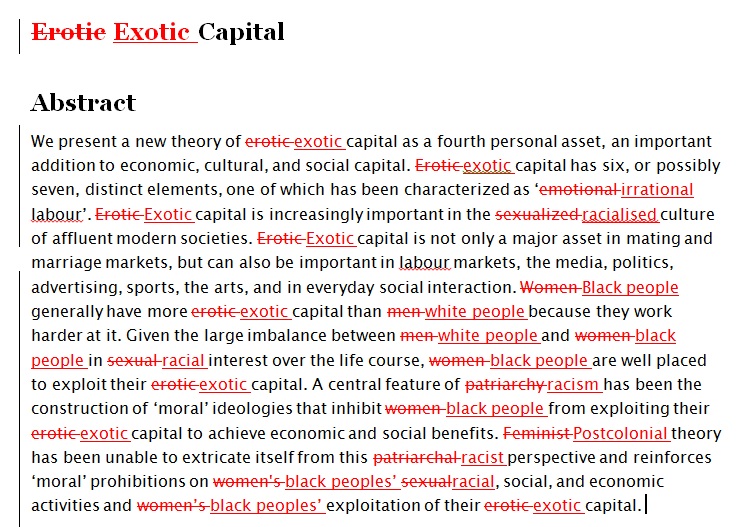
Have you got ‘Exotic Capital’?
The sequel.
Cosmopolitan Moralism and Human Rights
Sometimes I have the impression that all intellectuals have become cosmopolitans. But there is an increasing gap between what intellectuals think and preach and what the ordinary people feel. There is a growing divergence between the demos and the elites, especially concerning the perception and the treatment that should be reserved to the “diverse”: immigrants, minorities, gays and so on are more and more perceived as a threat. When xenophobia is rising, the intellectuals have a responsibility to help to distinguish between the real and apparent reasons, even at the price to become isolated from great parts of the population.
– Daniele Archibugi
In this post I want to both feature and expand upon an upcoming special issue (Volume 12, Issue 1) of Human Rights Review, which I guest edited with my colleague and friend Marta Iñiguez de Heredia. The special issue focuses on human rights as an ideal and practical politics, opening some initial space to consider why the interaction between moral ideals and practical politics is important, and provoking discussion of how the clear divide between them is unsustainable.
To set the stage, we find Daniele Archibugi and Seyla Benhabib discussing Cosmopolitanism at Open Democracy. For both authors the place of universal rights in cosmopolitan politics is central, but the moral principle expressed through universal human rights works in a very particular way. This approach to human rights prioritizes what, in the paper, we call the “philosopher’s” understanding of rights, which begins from rational moral principles already known before political action is taken.
The fallacious reasoning of Theresa May

Last week’s speech by Home Secretary Theresa May on the government’s intention to repeal some recent equality legislation was ironically and comprehensively overshadowed by the media frenzy about the impending lavish nuptials of the future King of the Realm to a Lowly Commoner. This may help to explain a little why the vacuous, fallacious and bizarre reasoning at the heart of it has been largely unremarked upon.
Overall, the speech sought to justify the repeal of the clause of the 2010 Equality Act which required public bodies to consider how they might address relevant socioeconomic disadvantages when making strategic decisions. My interest in this post is not to make the political case for this clause or not – rather it is to explore the reasoning offered by May in the speech that seeks to banish it into a category unrelated to inequalities of gender, race, religion, physical ability and so on.
The core tension emerges because throughout the speech May is desperate to present herself as a champion for gender-, age-, race- and sexual-orientation-based equality (ps nice U-turn, T), whilst trying to deny any place to socioeconomic aspects of equality. This is right at the heart of the New Conservative ideology that Cameron wants to promote – a socially enlightened politics of ‘fairness’ in a Big Society of ‘individuals’, that hugs hoodies whilst denying that socioeconomic disadvantage should be something that the government seeks to address. Continue reading
‘Immediate Commodifiability’; Or, A Virtual Teach-In on Austerity in Education

As a public service, some of the best of recent (and older) diagnosis and critique, largely an extension of work already done over at Infinite ThØught:
It is fascinating, and very revealing, to see how Browne’s unreal confidence in the rationality of subjective consumer choice is matched by his lack of belief in reasoned argument and judgment. The sentence that immediately follows the vacuous one about students’ ‘wants’ reads: ‘We have looked carefully at the scope to distribute funding by some objective metric of quality; but there is no robust way to do this and we doubt whether the choices of a central funding body should be put before those of students.’ It is, first of all, striking that the only alternative envisaged to the random play of subjective consumer choice is an ‘objective metric of quality’, i.e. some purely quantitative indicator. And second, it is no less striking that instead of allowing that an informed judgment might be based on reasons, arguments and evidence, there are simply the ‘choices’ made by two groups, treated as though they are just two equivalent expressions of subjective preference. We can have the money for a national system of higher education distributed either in accordance with the tastes of 18-year-olds or in accordance with the tastes of a group of older people in London: there’s no other way to do it.
Stefan Collini, Browne’s Gamble

György Lukács used to say that the objective unity of the capitalist order was never so apparent as in a phase of crisis. Then, the relative autonomy of expansionary times, which were so often asserted as the reality of social relations, would be abruptly suspended. The power of discretion would flow back to the centre, to the strategic politics of the state and to those prepared to launch a fundamental challenge to it.
What is objectionable is the ascendency of quantification, the emergence of quantifiability as a qualifying condition of relevance and admissibility. A species of transcendental reductionism. We need look no further than the familiar, degraded world of academic research. Scientific and scholarly projects, we all know, do well in these times to internalise the definitions, the priorities and the timescales of the REF as a main condition of finding institutional support. Reputation – the regard of one’s peers and serious audiences – is a frothy measure of achievement if it cannot be captured in scores and tables…League tables generally do not only reduce particular and distinct activity to a single numerical scale. As numerical procedures, they offer perverse compensation by generating distinctions where none can credibly be thought to exist in reality. 10 or 15 institutions differ within the space of 1%. But the visual code of the table – equal spacing in the plane of the vertical – renders such trivia grave and lapidary, carves them in stone…These processes of quantification and financialisation are effecting a progressive abstraction of university functions, in which exchange value is the homogeneous substance of working life. Now the labour of perfecting and defending these processes calls for an equally abstract organisational stratum of leader-managers, in a classic process of bureaucratisation.
Francis Mulhern, Humanities and University Corporatism
Wendy Brown, Why Privatisation Is About More Than Who Pays
Julian Assange and the Spectre of Rape

One step took him through the roaring waterfall
That closed like a bead-curtain, left him alone with the writhing
Of what he loved or hated.
His hands leapt out: they took vengeance for all
Denials and soft answers. There was one who said
Long since, ‘rough play will end in tears’.
Cecil Day Lewis, Sex Crime (in Joanna Bourke, Rape: A History from 1860 to Present)
And so the Julian Assange Rape Thing rambles on. For some of those keen to defend wikileaks from a legitimacy-crisis-by-proxy, the allegations have invalidated themselves in even being stated. The timing is more than suspicious, and public incompetence reveals machinations behind the scenes. It’s a classic Kompromat, a transparent stitch-up.
The standard ‘rule of law’ holding position – let due process take its course before condemnation – is strangely ineffective in this situation. The taint of sex crime is almost a performative speech act. The suggestion passes the sentence, and trimmings like ‘alleged’ only reinforce the effect, which thrives on ambiguity. All that said, there are two elements to the defences of Assange that deserve unpicking.
The first is the unforgivable recycling of rape myths. Smear is followed by counter-smear. After all, one of his accusers is a radical feminist! And we all know what that means. More than that, a lesbian! Or perhaps not. Like many a spectre of the inconstant feminine before her, she is not what she seems. Her identity, like her allegation itself, hints at a mercenary cunning.
The second, and related, problem is that of the pure non-sexuality implicitly attributed to Assange. Profiles brim with Matrix-y tropes, or paint him as the new King of the Hackerati, like Johnny Lee Miller with long hair. He moves mysteriously, a homeless pilgrim, and needs only a coffee and a laptop to wreak havoc on those stale old boys at the Pentagon. More than once he is identified as a monk, if one who self-flagellates at the altar of techno-modernity. Pristine public service. Political heroes don’t fuck, let alone rape. All those mucky fluids pull them down from their symbolic perch.
Why are these responses necessary? Clearly they are stand-ins for our feelings about wikileaks itself, and for visceral identifications with, and reactions against, the figure of the rebel. They are moves to person-alise the political. Assange is an embodiment, and the enterprise for all concerned stands and falls on the robustness or weakness of his flesh. But it is obvious that the stakes are wider than that, and that ‘the debate’ about information and truth in war can hardly be settled in the courtrooms of Sweden.
Instead of holding on to an agnostic distance from the allegations, could we not better serve both anti-rape politics and free knowledge by cutting the moral link altogether? In rushing to quash accusations and to lambaste accusers, matters on which we can’t possibly speak with authority, we only confirm their wider political power. Why should the outcome of the case affect our view on wikileaks at all? Can we really be saying that our politics is that reductionist? Or our moral sense so basic that the revelation of wrong-doing would bring the whole edifice tumbling down? Rape is quite bad enough on its own without it having to act as a keystone for just conduct in war or the rights of an informed citizenry.
UPDATE (30 Nov): The stakes in the game of embodiment have just been raised. An Interpol arrest warrant has just been issued for Assange, not on any charges of treason, breaches of secrecy, or hacking, but for ‘sex crimes’.
Pragmatist Notes, part I
It is no accident that American pragmatism once again rises to the surface of North Atlantic intellectual life at the present moment. For its major themes of evading epistemology-centered philosophy, accenting human powers, and transforming antiquated modes of social hierarchies in light of religious and/or ethical ideals make it relevant and attractive. The distinctive appeal of American pragmatism in our postmodern moment is its unashamedly moral emphasis and its unequivocally ameliorative impulse. In this world-weary period of pervasive cynicisms, nihilisms, terrorisms, and possible extermination, there is a longing for norms and values that can make a difference, a yearning for principled resistance and struggle that can change our desperate plight.
Prophetic pragmatism worships at no ideological altars. It condemns oppression anywhere and everywhere, be it the brutal butchery of thirdworld dictators, the regimentation and repression of peoples in the Soviet Union and Soviet-bloc countries, or the racism, patriarchy, homophobia, and economic injustice in the first-world capitalist nations. In this way, the precious ideals of individuality and democracy of prophetic pragmatism oppose all those power structures that lack public accountability, be they headed by military generals, bureaucratic party bosses, or corporate tycoons. Nor is prophetic pragmatism confined to any preordained historical agent, such as the working class, black people, or women. Rather, it invites all people of goodwill both here and abroad to fight for an Emersonian culture of creative democracy in which the plight of the wretched of the earth is alleviated.
– Cornel West, The American Evasion of Philosophy: A Genealogy of Pragmatism
International Relations versus Punk Rock
Today I was re-reading a piece by Kevin Dunn, “Never mind the bollocks: the punk rock politics of global communication,” and it lead me to wonder how far one’s route into the study of world politics affects how one perceives the “object” of inquiry. Dunn starts out by stating:
I am increasingly concerned about the ways that International Relations (IR) as a discipline seems unable to communicate to everyday citizens about issues of tremendous importance. I am repeatedly struck by our inability to speak to the people whose lives are affected daily by the issues we are supposed to be studying. More importantly, I am struck by how irrelevant we and our work can seem to the world’s population.
In 2003, I grappled quite openly and vocally with this alienation. The annual International Studies Association (ISA) Conference was being held in Portland, Oregon that year. Throughout the hallowed halls of the soul-numbing conference hotel, the discipline of IR was displaying its strengths and weaknesses. The US and its ‘ coalition of the willing’ were on the verge of invading Iraq. But within the ISA, there was little attempt to grapple with what this meant. My few attempts to stage some form of protest and intellectual outrage proved heart-warming but ineffectual. Then, at the end of the week, I went to a punk club a few blocks from the hotel to see a Joe Strummer tribute show. Joe Strummer, the frontman for the Clash, had died suddenly a few months before, and now over twenty bands from all over the region were coming together to play a benefit show. Each band performed two or three Clash songs; one band getting up after the other, sharing amps and a drum set. On stage, the bands were using the songs to make sense of the dangerous world we all found ourselves in. The in-between song banter reflected this – comments about President George W. Bush, remarks about American fascism, concerns about the impending war on Iraq, and pleas to register to vote. The kids in the club were using the Clash and punk rock, much as I did years before, to help them understand the world they were inheriting. While the discipline of IR pontificated down the street to itself about world affairs, I swirled in the mosh pit wondering: what relevance did I and the ISA have to these kids? Sadly, it seemed to me that we as a discipline were doing a poor job communicating with most of the people outside that conference hotel.
Leaving aside Dunn’s very interesting analysis of punk rock’s role as a form of counter-hegemonic global communication and subversive political message, the opening lines resonated in a profound way for me, as I share Dunn’s experience of punk music providing a frame for engaging with world politics. This leads me to the question: how does our route into the study of world politics affect our work? Continue reading
 The Disorder Of Things