Archive | Agonism RSS feed for this section

This Courage Called Utopia

9 Nov

(wild bells) A warm Disordered welcome to Wanda Vrasti, who previously guested on the topic of the neoliberal tourist-citizen imaginary, and now joins the collective permanently. And glad we are to have her. Her academic writings thus far include Volunteer Tourism in the Global South: Giving Back in Neoliberal Times (which came out with the Routledge Interventions series a few months ago), ‘The Strange Case of Ethnography in International Relations’ (which caused its own debate), ‘”Caring” Capitalism and the Duplicity of Critique’, and most recently ‘Universal But Not Truly “Global”: Governmentality, Economic Liberalism and the International’.


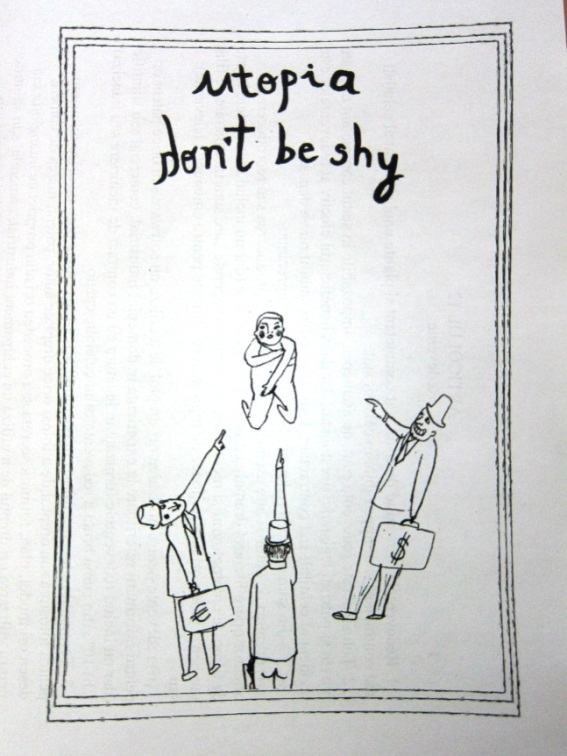
It’s often been said that this is not only a socio-economic crisis of systemic proportions, but also a crisis of the imagination. And how could this be otherwise? Decades of being told There Is No Alternative, that liberal capitalism is the only rational way of organizing society, has atrophied our ability to imagine social forms of life that defy the bottom line. Yet positive affirmations of another world do exist here and there, in neighbourhood assemblies, community organizations, art collectives and collective practices, the Occupy camps… It is only difficult to tell what exactly the notion of progress is that ties these disparate small-is-beautiful alternatives together: What type of utopias can we imagine today? And how do concrete representations or prefigurations of utopia incite transformative action?

Javier Lozano Jaén

First thing one has to notice about utopia is its paradoxical position: grave anxiety about having lost sight of utopia (see Jameson’s famous quote: “it has become easier to imagine the end of the world than the end of capitalism”) meets great scepticism about all efforts to represent utopia. The so-called “Jewish tradition of utopianism,” featuring Adorno, Bloch, and later on Jameson, for instance, welcomes utopianism as an immanent critique of the dominant order, but warns against the authoritarian tendencies inherent in concrete representations of utopia. Excessively detailed pictures of fulfilment or positive affirmations of radiance reek of “bourgeois comfort.” With one sweep, these luminaries rid utopianism of utopia, reducing it to a solipsistic exercise of wishing another world were possible without the faintest suggestion of what that world might look like.

But doing away with the positive dimension of utopia, treating utopia only as a negative impulse is to lose the specificity of utopia, namely, its distinctive affective value. The merit of concrete representations of utopia, no matter how imperfect or implausible, is to allow us to become emotionally and corporeally invested in the promise of a better future. As zones of sentience, utopias rouse the desire for another world that might seem ridiculous or illusory when set against the present, but which is indispensable for turning radical politics into something more than just a thought exercise. Even a classic like “Workers of the World Unite!” has an undeniable erotic (embodied) quality to it, which, if denied, banishes politics to the space of boredom and bureaucracy. It is one thing to tell people that another world is possible and another entirely to let them experience this, for however shortly.

Most concrete representations and prefigurations of utopia from the past half century or so have been of the anti-authoritarian sort. Continue reading 

Human Rights as Crisis Morality – a reply

29 Aug

If Anthony will forgive my presumptuousness, it seems that the crisis of human rights that worries him is that while critics have much to offer by highlighting the limitations, paradoxes, silences and aporias of human rights, they fail to offer a moral vision that can inspire or a practical politics that might make the world better. This concern goes beyond the practiced rejection of philosophising as an indulgence in the face of human misery. Anthony is concerned with the deeper problem faced by those critics who identify human rights with the global exertion of Western authority and a depoliticised vision of the individual and society under the conditions of contemporary neo-liberal capitalism. And that problem is that the process of critique itself risks overwhelming the possibility of political action for moral ends – to do good on behalf of, and in solidarity with, the “poor, downtrodden and despised”.

There’s a crude version of this critique that suggests human rights naysayers are obscurantist intellectuals, whose evasive politics demonstrate the bankrupt quietism of the contemporary left – or, as they would say back home, that they are “all hat and no cattle”. In his post Anthony is getting at something more substantive and, I think, very important, which is the difficulty of finding a critical ground for moral action in political life. If one admits the limitations and pernicious aspects of human rights as a broad set of political practices, what alternative justification can be offered for political action?

While supportive of human rights, Anthony is quite clear that the

difficulty here for human rights is that the very rhetoric of the movement, with its built in moralism and boosterism, makes it hard to consider that “human rights might be a bad thing”, or that they may not be the best – and certainly not the only – framework for considering serious problems and issues within the international system.

For this reason he respects the important role that critiques of human rights play in recognising the tendency for moral claims to be co-opted by political power, deconstructing the essentialised account of humanity, tracing the violence done to difference through universal claims and acknowledging the politics inherent in any account of justice. The key question, then, is what happens in the wake of our critical interrogation of human rights? Continue reading 

The Politics of Austerity: Emergency Economics and Debtocracy

17 Jul

austerity |ôˈsteritē| noun – sternness or severity of manner or attitude
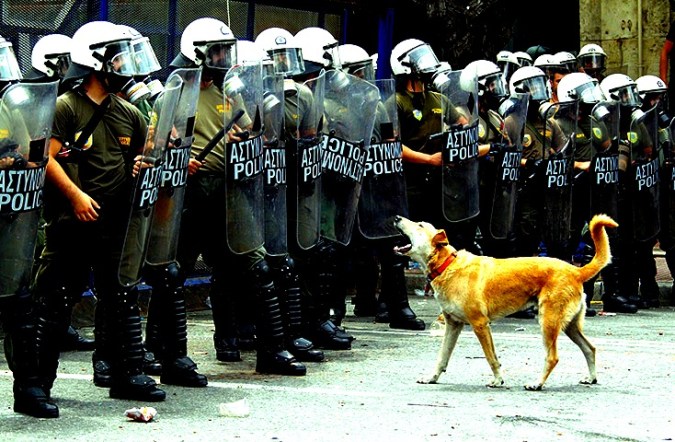
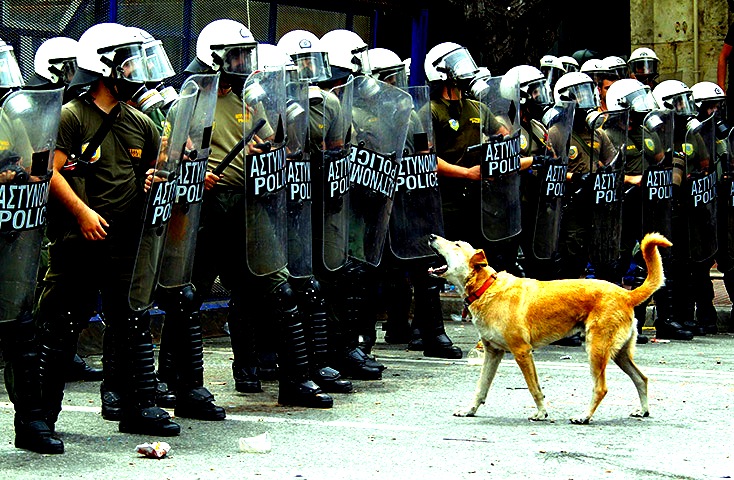
It was possible, therefore, to commit a sin without knowing that you committed it, without wanting to commit it, and without being able to avoid it. Sin was not necessarily something that you did: it might be something that happened to you.

– George Orwell, “Such, Such Were the Joys”

Why what have you thought of yourself?

Is it you then that thought yourself less?

Is it you that thought the President greater than you?

Or the rich better off than you? or the educated wiser than you?

 I do not affirm that what you see beyond is futile, I do not advise that you stop,

I do not say leadings you thought great are not great,

But I say that none lead to greater than these lead to.

– Walt Whitman, “A Song for Occupations,” Leaves of Grass

The Politics of Austerity – Part I

This is the first in a series of posts that look at the political implications of the ongoing global economic crisis. I begin by examining the way that crisis is being used to attack the very idea of democracy through an assertion of the political imperatives of “the market” and the violation, bending and re-writing of the law by capitalist elites. I conclude by laying out how understanding the economic crisis in political terms shapes our ability to respond to it.

In the second post I’ll look at the ethos of austerity, which justifies the pain inflicted on largely innocent people, while suggesting that an affirmative democratic response to the economic crisis must begin with its own ethos, which I suggest should be an ethos of care for the world – which can provide orientation and inspiration for political struggles seeking to address the deeper causes of our current crisis. In the third post, I turn to the structures of the economy and of politics that define the current crisis, looking at the banking crisis, the bailouts, the politics of recovery/austerity and also reflecting of the structural imperatives of capitalism that led us to crisis. This, then, leads to the question of how to respond to the politics of austerity, and of what alternative actions are available to us, which is where the fourth and final post will pick up – with an affirmation of a caring ethos that supports a radically democratic economic vision.

Emergency Economics

In a previous post I briefly highlighted Bonnie Honig’s work, Emergency Politics, to examine the way that the ethical case for austerity is made; most basically, the existence of a supreme emergency, in this case economic, justifies actions that would normally be considered unacceptable. Honig’s work looks at how the appeal to emergency is used to reassert the exceptional political power of the sovereign over and against the law, with a focus on the reassertion of sovereignty witnessed over the past ten years in response to the threat of terrorist attack in the US and Europe.

Rather than accepting the necessarily intractable conflict between the power of the sovereign and the power of the law, Honig attempts to deflate this paradox by turning her attention to the always ongoing contestation that defines democratic politics, a contest over both the content of the law and the institutional embodiment of sovereign power. She suggests, then, that attending to the ambiguities of the “people”, who are both the democratic sovereign and a diffuse multitude, as well as the political element in the law – as new laws come into being through political action – enables us to avoid thinking about emergencies as moments of exception in which the rule of law is lost to the play of political power, while also acknowledging the limits of established law in moments of profound crisis. By undermining the exceptional nature of crises and emergencies Honig alters the challenge we face when circumstances force us to make choices or carry out actions we know are harmful and wrong by asking what we (democratic publics and citizens) can do to survive an emergency with our integrity in tact.

What do we need to do to ensure our continuity as selves and/or our survival as a democracy with integrity? Our survival depends very much on how we handle ourselves in the aftermath of a wrong. We will not recover from some kinds of tragic conflict. But when faced with such situations, we must act and we must inhabit the aftermath of the situation in ways that promote our survival as a democracy.

I continue to find this a useful way to understand our current economic crisis. Appeals to austerity depend upon the exceptional state created by crisis in order to justify the pain inflicted upon masses of people and the priority given to private interests (the markets, investors and bankers) over democratic publics. So, as democratically enacted laws must bow before the sovereign power threatened by exceptional attacks, so economic justice and democratic equality must bow before the commands of market forces, of economic inevitability, in this time of crisis.

The economic version of this argument is stronger still. While the space of political contestation that remains open when we accept the framing of emergency politics is limited, it does exist in the clashing of opposing sovereigns. The prospect of a substantive alternative to neoliberal economic ideology is dim, a light flickering weakly on antiquated appeals for a return to Keynesianism or watered down triangulations of the moderate-middle that sell off dreams of a just economy bit by bit – capitalist realism in action.
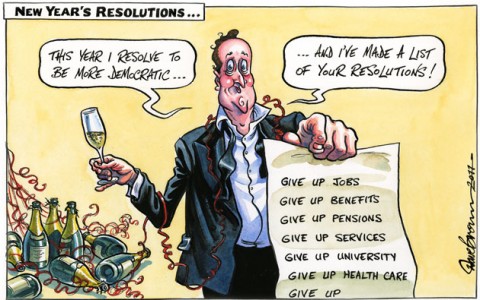
Honig awakens us to an important aspects of our current crisis: that “the market” is not in fact supremely sovereign, and the move to re-establish and further neoliberal policies and push through austerity measures requires an engagement in democratic politics – albeit one that undermines the notion of the public itself and seeks to use the power of the law to subvert democracy. Recognising the current crisis in these terms not only challenges us to consider how to survive our current troubles without giving up democratic virtues, it also reinvigorates and clarifies the political challenge we face. Emergency economics – with its assertion of debtocracy over democracy – is not an inevitable response to the crisis, it is a political one that we can, and should, fight against.

Continue reading 

On Objecting to the New College of the Humanities; Or, Who Would Pay £18,000 a Year to Listen to this Outdated Victorian Rationalism When They Could Buy Themselves a Second-Hand Copy of John Stuart Mill?

8 Jun

Yes, this is more comment on the New College, a.k.a. Grayling Hall, a.k.a. Grayling’s Folly, a.k.a. North Oxford in Bedford Square (NOBS), a.k.a. The Ultimate Scab University.

It won’t have escaped your notice that there has been a flurry of disgust, disbelief, protest and rage at the announcement of the New College of the Humanities (an aside: ‘of the’ Humanities? Why not ‘for the’ Humanities?). There have also been a number of responses that pretty much add up to ‘meh’: to wit, there are some bad things, but also some good things about Grayling’s Folly. And then there has been some welcoming of this project, and its ‘chutzpah’. Since we are in a downward vortex of vanishing funding and academic status, why not expand where we can? And why damn the entrepreneurial? As Brian Leiter puts it:

NCH is just the natural continuation of the elimination of 75% of government funding for higher education and 800% increases in tuition in the space of a few years. If the Brits can’t even keep the Tories out of office, and if their party of the Left is now in bed with the Neoliberals, it’s really hard to see why one should think “petitioning” the government for more government funding for higher ed will produce any results. The battle to be won is at the polls, and NCH is just a symptom of the battle already lost.

All this makes me think it’s worth clarifying the case against, and the potential mitigating factors. Continue reading 

What We (Should Have) Talked About at ISA: The Politics of Humanity and The Ambiguous History of Human Rights – Part III

28 May

This is the final post in a series laying out a set of interrelated arguments I presented at this year’s ISA conference. The first post looked at the nature of human rights claims, while the second considered how rethinking human rights in terms of contestation over the ambiguous meaning of humanity as a political identity affects our understanding of the history of human rights. In the final post I suggest a positive ethos, enabled by attending to human rights in terms of agonism and pluralism.

Human Rights as a Democratising Ethos

In part 1, I analysed human rights as an attempt to offer a universal moral justification of political authority. This is a perennial political question, but one which is reconfigured by talk of “human rights”, as the political identity of humanity opens up question over who is included in political community, as well as the boundaries that define such communities. The stakes of the question of human rights – offering a universal account of who is included as a rights bearing member of the political community, and the legitimate order of that community – lead to a profound anxiety over justifications. The moral reasons we have to uphold human rights should be weighty, powerful and certain – or so the logic dictates.

What emerges from this logic is an essentially legislative understanding of human rights, in which moral principles give justification for the necessary and minimal law to grant legitimacy to the universal vision of both individual and community. If this moral law is to be more than an imposition of power, a merely effective positive law, it must involve a universal moral appeal that cannot be denied in order to secure human rights as the necessary law of legitimate authority. In this regard Habermas’ defense of moral universality and human rights are indicative and sophisticated examples. (Habermas 1992, 1998)

Continue reading 

What We (Should Have) Talked About at ISA: The Politics of Humanity and The Ambiguous History of Human Rights – Part II

28 Apr

In part I of this series I outlined an alternative analysis of human rights – one that focuses on rights as the institutionalisation of particular values and relationships, specifically as responses to the question of what obligations and privileges grant political authority legitimacy. This leads to a focus on the act of claiming rights as a way of reconstructing the social order. To clarify and develop this analysis of rights I look at the drafting of the Universal Declaration of Human Rights (UDHR), which is taken by supporters and critics alike as the foundational text of the international human rights regime. This historical inquiry is intended to achieve two ends: first, to clarify how an account of rights that takes contestation and ambiguity as inherent and productive aspects of the idea of human rights alters our understanding of the development of human rights; and second, to use two key conceptual debates that dominated the drafting of the UDHR to further develop my agonistic analysis of rights by illustrating the way that claiming human rights  generates contestation over the moral significance of humanity as a political identity and the reconstruction needed to produce a legitimate international/world politics.

Narratives of Consensus and Imposition

The fundamental debate over human rights has been, and continues to be, over whether human rights are universal or not. There are clearly identifiable camps on both sides of the issue – those convinced of the universality of human rights and anxious to move past such basic questions on one side, and on the other those who think human rights are a compromised project born of an assimilative Western universalism that is best overcome or abandoned – and these opposing views of human rights strongly affect how we understand their historical development. History does not speak for itself, this much we know, but the history of human rights in particular suffers from a lack of awareness – an awareness of how our understanding of what rights are and how they are justified affects our understanding of historical events.

In the paper presented at ISA I trace out these contrasting narratives more carefully, but the broad strokes can be made in terms of consensus and imposition. In the consensus narrative, the UDHR, and the post-WWII period more broadly, represent a moment of consensus in which a fundamental moral truth was discovered (or constructed), which affirmed a comprehensive list of rights possessed by all members of the human family and which served (and continues to serve) as an ideal we should strive to implement through reform of international politics. The counter narrative of imposition re-frames the consensus achieved in the UN General Assembly vote in 1948 as a moment of Western liberal imposition, suggesting that the victors of WWII declared the universality of liberal values and politics by fiat,i mposing them upon the rest of humanity. Continue reading 

What We (Should Have) Talked About at ISA: The Politics of Humanity and The Ambiguous History of Human Rights – Part I

21 Apr

Men cannot live without seeking to describe and explain the universe to themselves. The models they use in doing this must deeply affect their lives, not least when they are unconscious; much of the misery and frustration of men is due to the mechanical or unconscious, as well as deliberate, application of models where they do not work… The goal of philosophy is always the same, to assist men to understand themselves and thus operate in the open, and not wildly, in the dark.

-Isaiah Berlin, The Purpose of Philosophy

Last month I presented two papers on human rights at the ISA conference in Montreal (both are available in draft form from the ISA website, here and here, please do not cite, but comments are welcome). Attempting to offer a summary of those papers, however, has made clear to me that they are importantly connected and perhaps incomplete as separate papers – hence the “should” in the title. Together, the papers offer a pluralistic and agonistic reconstruction of human rights as a political concept and an ethical ideal. I’ll try to offer a shorter version of the argument that connects these two papers here, though broken into three (relatively) short posts. My reconstruction begins (Part 1) with a theoretical analysis of human rights, which forms the basis for an argument (Part 2) about how we should understand the history of human rights and, finally, (Part 3) leads to a defence of a democratising reconstruction of human rights.

The Nature of Human Rights Claims

Human rights, I argue, are of central importance for contemporary political theory because they respond to the basic question of legitimate authority, which is most simply the question of what justifies the coercive power of political authority. Traditionally, the question of legitimate authority addressed to the modern state and it is from this line of thinking that we inherent the rights discourse – in which authority is rendered legitimate by protecting the rights of individual members of the political community, which is a group importantly distinct from those actually subject to the coercive power of the state.

The details of this can be filled-in in many ways, but the  logic of rights is central to modern political thought. These political rights, and the institutions of governance they support, in turn, are justified by an appeal to moral rights. The moral appeal is central to the rights tradition as it is the absolute and certain quality of moral principles that justify the limitations imposed upon political authority and the powers granted to political authority to exclude, harm and constrain. Human rights emerge from this modern rights tradition, but the conditions and consequence of their emergence are complex. Continue reading 

Follow

Get every new post delivered to your Inbox.

Join 736 other followers

%d bloggers like this: